
Bowmans · Inspiration · Design
Freestanding stone baths: pros, cons and three materials compared
By Jonathon Barclay · · 18 min read
If you’ve been looking at freestanding baths, you’ll have seen some described as “stone”, “stone resin” or “solid surface”, usually sitting above the acrylic ones in the price list. A brochure rarely explains what the word means, or whether it gets you a better bath.
Our view is that a stone freestanding bath is worth it if you’ll actually use the bath and you want the solid feel and a matt or coloured finish. It isn’t an upgrade on every count. The stone baths we compare below weigh 78kg to 120kg empty, against 38kg for a 1680mm acrylic bath, so acrylic is far easier to carry into the house and it usually costs less. Once each bath is filled to the capacity its maker states, the difference on the floor is much smaller than those empty weights suggest, because the acrylic bath holds more water. Between the stone and acrylic baths from BC Designs that we compare below, the most it comes to is about 17kg, and two of the three stone baths come out lighter than the acrylic one. The floor needs checking whichever you choose.
The other thing to know is that “stone” isn’t one material. Crosswater, BC Designs and Victoria + Albert each make their own, with headline guarantees of 10 and 25 years, and what they’ve published doesn’t agree on something as basic as whether the bath can sit on a heated floor. Crosswater says no. BC Designs’ March 2025 brochure said yes, and its July 2026 brochure doesn’t repeat it. So read the installation instructions for the exact model before the floor build-up is fixed. Everything here is our opinion based on the makers’ published figures. We haven’t tested these baths against each other.
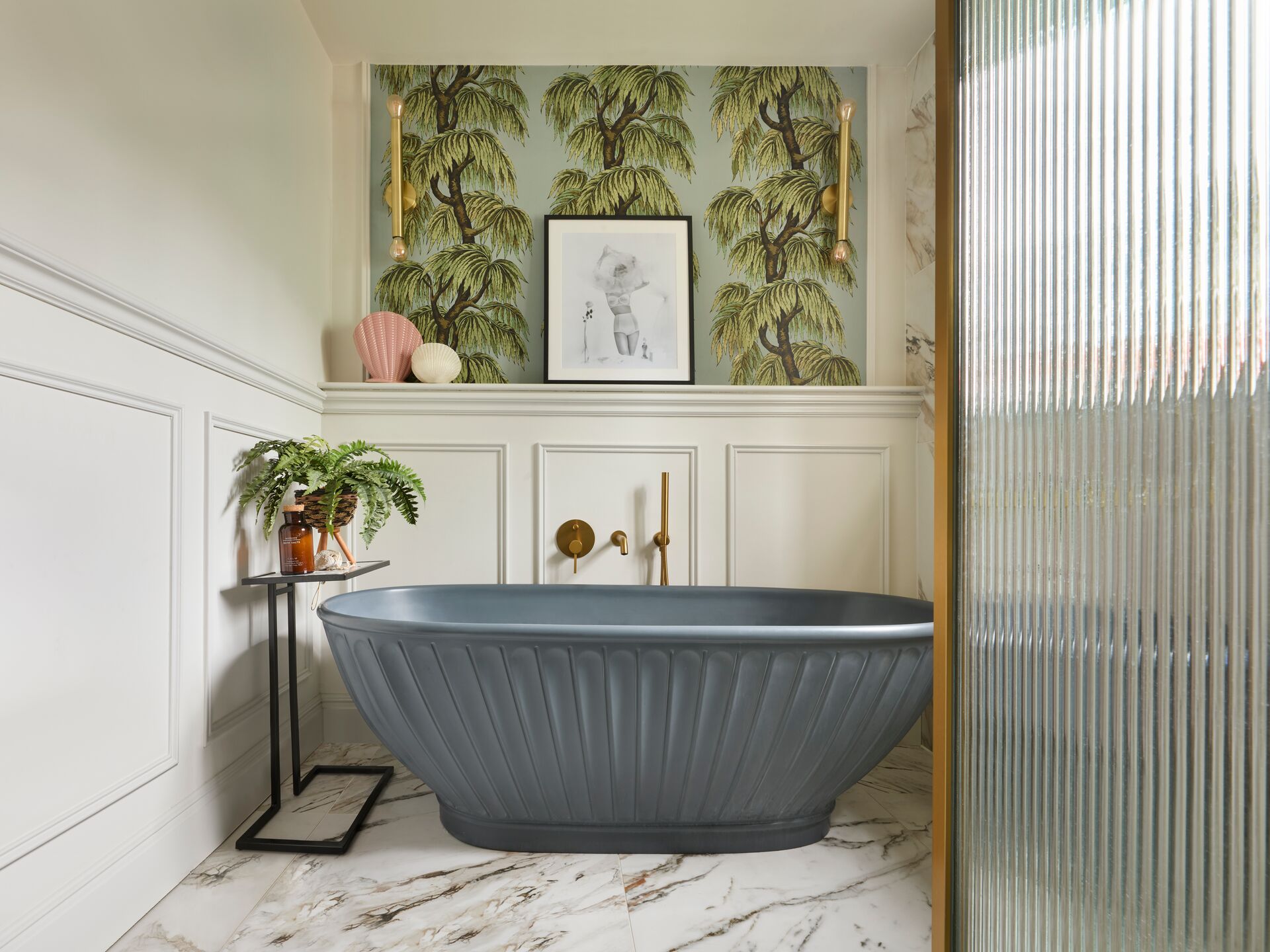
What is a stone bath? In a bathroom showroom, a stone bath is almost never carved from a block of stone. It’s a bath cast as one solid piece from the maker’s own composite, usually described as ground stone or minerals bound with resin, so the wall of the bath is solid material and not a thin shell. Each maker has its own named material: Crosswater calls its version Clearstone, BC Designs calls its material Cian solid surface, and Victoria + Albert calls its material QUARRYCAST. Retailers often lump them together as “stone resin”, so if you’ve been asking what a stone resin bath is, it’s the same family of products under a looser name.
Quick Navigation
What is a stone bath actually made of?
Three makers, three different materials, and they don’t tell you the same amount about what’s in them. That’s worth knowing because the word “stone” on a brochure tells you nothing about how a particular bath has to be installed or looked after. These are the three we compare in this article.
Crosswater MPRO bath: Clearstone
Crosswater says the MPRO bath is “made from a stone construction” and lists the material as Clearstone. It doesn’t publish what Clearstone is made of on the product page, so we won’t guess. The bath comes in Gloss White or Matt White and in two sizes: 1690 x 800 x 570mm at 91kg, and a smaller one of about 1.5m at 78kg. There are no tap holes, and Crosswater says to “pair with a freestanding bath tap”, which is how the Bradwell bathroom further down was designed. The guarantee is 10 years if you register the bath online within 60 days of purchase. Crosswater’s terms give 2 years otherwise.
BC Designs: Cian solid surface
BC Designs calls Cian a solid surface material and says it is “highly durable, stain resistant, non-porous, scratch resistant and retains heat”. Its FAQ page describes Cian as “an advanced blend of acrylic modified polyester resin and mineral fillers”. There’s no gel coat. The surface you touch is the material itself, hand polished, with a Silk Matt option on some models. BC Designs baths in Cian are made in the company’s own factory in Cape Town. You can have white, polished or silk matt depending on the model, or one of eight ColourKast colours, which include Light Fawn, Industrial Grey and Minty Green. Not every colour is offered on every model. The guarantee is 10 years.
Victoria + Albert: QUARRYCAST
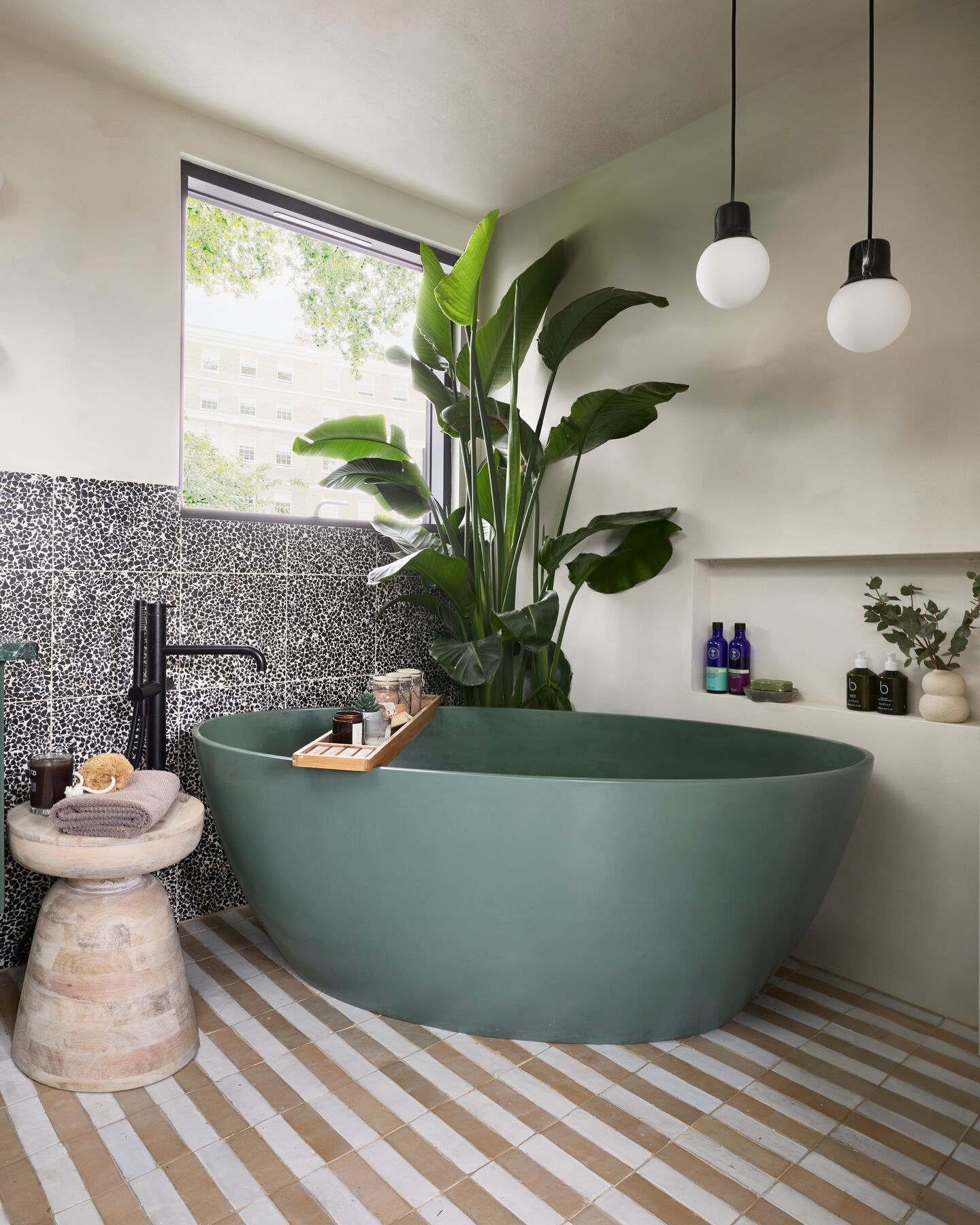
Victoria + Albert names its ingredients. It says QUARRYCAST is “a unique blend of Volcanic Limestone and high-performance resins”, “solid all the way through” and “more than twice as hard as acrylic with no creaking or flexing”. If you’re weighing up QUARRYCAST vs acrylic, that’s the maker’s case: a harder, solid wall that doesn’t flex. Gloss is standard, there’s a matt that is “made in the cast, not by coatings or glaze”, and the outside can be finished in over 200 RAL colours. The maker says the average weight of its baths is 72kg and offers “a 25 year guarantee on all our baths and basins”. That’s the longest headline figure of the three, so read the terms to see what it covers.
Swipe across to compare all columns.
| Maker | What they call it | Finishes | Guarantee | On a heated floor? |
|---|---|---|---|---|
| Crosswater (MPRO bath) | Clearstone | Gloss White, Matt White | 10 years if registered online within 60 days, 2 years if not | No. Instructions say the bath should not sit on a heated floor |
| BC Designs | Cian solid surface | Polished, Silk Matt, 8 ColourKast colours (varies by model) | 10 years | March 2025 brochure said yes. The July 2026 brochure doesn’t say, so confirm with the maker |
| Victoria + Albert | QUARRYCAST | Gloss, matt, 200+ exterior colours | 25 years | Check the model’s instructions |
The last column is the one people don’t expect, and we come back to it further down.
Do stone baths keep the water warm for longer?
All three makers say their stone baths retain heat, and none of them publishes a number. Crosswater claims “excellent heat retention”. BC Designs says Cian “retains heat for the perfect long soak”. Victoria + Albert describes QUARRYCAST as “warm to the touch with high insulating properties, keeping your bath water warmer for longer”. It’s a plausible claim, because the wall of a stone bath is a thick solid casting and not a thin shell.
Acrylic gets the same claim, though. BC Designs also lists “Heat retaining” as a reason to choose its double-skinned Acrymite acrylic baths, which it says “retain the heat of the room for a comfortable bathing experience”. So the same maker claims heat retention for both materials and publishes a figure for neither. We wouldn’t pay extra for stone on heat alone.
Ignore the “ten times better than acrylic” figure. It appears on seller blogs, and we could not find a published test behind it. None of the three makers here publishes a cooling test, and we have not run one. Treat heat retention as a plausible but unmeasured advantage, and choose on feel, finish and practicalities.
Stone bath vs acrylic: what actually differs?
Feel, finish, carrying weight, water capacity and price all differ. The load on the floor differs far less than the empty weights suggest.
The fairest comparison is a like-for-like pair from one maker. BC Designs makes both materials, so take two of its baths at 1680mm long. The figures are from BC Designs’ July 2026 brochure. The Casini in Cian weighs 90kg dry and holds 180 litres. The Viado in Acrymite acrylic weighs 38kg dry and holds 245 litres. Both carry a ten year guarantee. Acrylic usually costs less.
So are stone baths better than acrylic? If you want the solid feel and a matt or coloured finish, yes. They’re much heavier to carry upstairs and usually cost more, and in BC Designs’ range a stone bath often holds less water than an acrylic one of the same length. The first list below is where we’d still give it to acrylic, and the second has the benefits of stone.
Stone bath cons: where acrylic is better
- Less than half the weight to get up the stairs: 38kg against 90kg in the pair above
- Usually costs less
- Often more water for the same length. BC Designs’ Viado and Ovali acrylic baths of 1580mm to 1690mm hold 225 to 245 litres, and its Cian baths of 1665mm to 1680mm hold 180 to 190 litres
Stone bath pros: where stone is better
- Solid all the way through. Victoria + Albert claims “no creaking or flexing” for QUARRYCAST
- Matt finishes and maker-supplied colours on modern shapes. BC Designs’ July 2026 brochure lists its contemporary acrylic baths in Gloss White. If you want colour on one, it’s the maker’s painting service, which paints a bath to order
- A published method for sanding and re-polishing fine scratches, from Crosswater (see the FAQs)
- A longer headline guarantee from one maker: Victoria + Albert’s 25 years, subject to its terms
We haven’t listed “can be repaired” as something only stone offers, because BC Designs says of its acrylic too that “minor damages can be polished or repaired”. What Crosswater adds is a published sanding method. And if you like a generous fill, compare the litres as well as the length, because in this maker’s range many of the acrylic baths hold noticeably more, though not all of them.
How heavy is a stone bath, and will the floor take it?
The stone baths here weigh 78kg to 120kg empty, against 38kg for the acrylic one. So yes, stone resin baths are heavy to move. But water adds about 1kg per litre and a person adds more, so the filled figure is the one that matters to the floor, and on that measure the gap shrinks a lot.
Swipe across to compare all columns.
| Bath | Material | Length | Dry weight | Capacity | Up to about, filled (before you get in) |
|---|---|---|---|---|---|
| Crosswater MPRO | Clearstone | 1690mm | 91kg | not published | ask Crosswater |
| Crosswater MPRO, smaller size | Clearstone | about 1.5m | 78kg | not published | ask Crosswater |
| BC Designs Crea | Cian | 1665mm | 85kg | 190 litres | 275kg |
| BC Designs Casini | Cian | 1680mm | 90kg | 180 litres | 270kg |
| BC Designs Magnus | Cian | 1680mm | 120kg | 180 litres | 300kg |
| BC Designs Viado 1680 | Acrymite acrylic | 1680mm | 38kg | 245 litres | 283kg |
Dry weights and capacities are the makers’ figures, with BC Designs’ taken from its July 2026 brochure, and the last column is our own sum of the two. BC Designs doesn’t say whether capacity is measured to the brim or to the overflow, and it notes that its dimensions are approximate. Nobody fills a bath to the brim with someone in it either, so read the last column as an upper figure. Victoria + Albert gives only an average across its range, 72kg, so ask for the weight and capacity of the model you’re considering.
Filled to the maker’s stated capacity, the Casini in stone comes to about 270kg and the Viado in acrylic to about 283kg. So on BC Designs’ figures the filled acrylic bath is the heavier of the two, by about 13kg, but that’s only because it holds 65 litres more water. Put the same amount of water in each and the stone bath is 52kg heavier, which is simply the difference between 90kg and 38kg. The heaviest stone bath in the table, the Magnus at about 300kg, is 17kg above the acrylic one.
Either way, once someone gets in you’re asking the floor to carry roughly 350kg to 375kg. If we assume a 75kg bather, and that is only an assumption, the three Cian baths come to about 345kg to 375kg and the acrylic Viado to about 358kg. So the floor question belongs to every freestanding bath, stone or acrylic.
Where stone really is harder is delivery day. A single casting of roughly 80kg to 120kg has to go up the stairs and into position without being chipped, so work out the route and how many people you’ll need before it arrives.
Get the floor checked by the right person. Add the bath’s dry weight, its capacity in litres and the people who will use it, then ask a structural engineer or a competent builder whether the floor will carry it, especially upstairs on older timber joists. In England the guidance sits in Approved Document A (Structure). We supply the maker’s weights; we don’t assess floors.
We haven’t gone into joists here because our guide on how to check the floor for a freestanding bath already does. Its weight ranges assume 180 to 220 litres in either material and a 75kg bather, so the Cian baths above fall inside its stone range and the 245 litre Viado lands a little above its acrylic one.
What catches people out with stone baths
Mostly it’s the installation instructions, which differ from one maker to the next even though the brochures use the same word. Each of these applies to the maker and model named, so check the instructions for your own bath before anything is ordered.
1. Underfloor heating under the wrong bath
Crosswater’s instructions for its stone baths say not to put heating pipes or mats under the bath area: “The bath should not sit on a heated floor.” BC Designs has said the opposite for Cian. Its March 2025 baths brochure said the material meets a thermal shock standard and “can be placed on heated floors.” The July 2026 brochure doesn’t repeat that line, so ask BC Designs to confirm it in writing for your model. Either way, the heating layout has to be drawn after the bath is chosen. Our bathroom underfloor heating guide explains how the heated zones are planned.
2. No way to reach the waste
Crosswater says “Under floor access required for plumbing of bath waste”. The waste pipe goes through the floor only, and the side of the bath must not be drilled for it. BC Designs notes that the Crea has enough void underneath for a low-level trap, and asks you to contact them first if the waste pipe has to run above the floor. Its Casini is the opposite: a fitted trap “will protrude below the floor level”, so “a small floor recess will have to be made under the bath”. This isn’t only a stone problem, because BC Designs prints the same floor-recess note for the acrylic Viado. Settle the waste position with your fitter before the floor goes down.
Four smaller points, three from BC Designs and one from Crosswater:
- ColourKast colours are made to order. BC Designs’ July 2026 brochure gives a 15 week lead time for them, so check the current lead time before you book a fitter.
- BC Designs warns that darker colours are more likely to show marks.
- On the Crea it isn’t possible to fit an overflow filler, so the choice is a floor-standing or wall-mounted filler.
- Crosswater says bath mats and suction pads can damage the surface of its stone baths over time and must be avoided, which matters if anyone in the house relies on a non-slip mat.
Stone baths in two Bowmans projects
Two of our published projects have stone baths in them, and they show two different ways of choosing one.
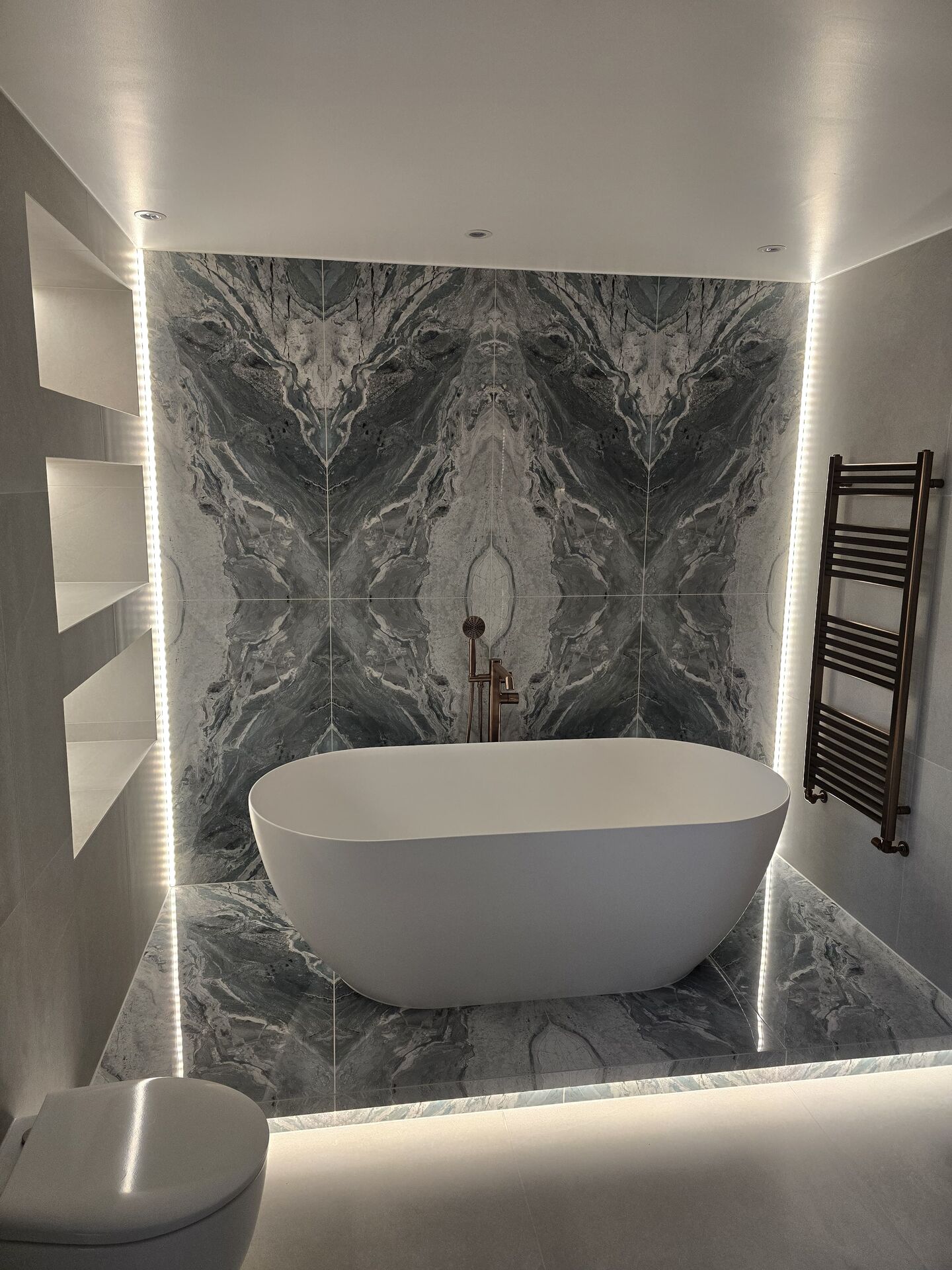
In a family bathroom in Bradwell, CM77, the bath is a Crosswater MPRO stone bath on a raised tiled platform with mitred tile edges and LED light underneath. It stands in front of bookmatched Ca’ Pietra Ocean Magnifique slabs and is filled by a JTP Evo freestanding bath filler in brushed bronze, with a separate walk-in shower. The wall is the bold part of that room, so a plain white bath in front of it makes sense.
In a master ensuite in West Mersea, CO5, the bath is a BC Designs Crea in Light Fawn, one of the ColourKast colours, against dark bookmatched Ca’ Pietra Nero Magnifique walls, with a wall-mounted JTP Evo filler in brushed bronze. The walls there are dark, and a warm colour sits against them more gently than bright white would.
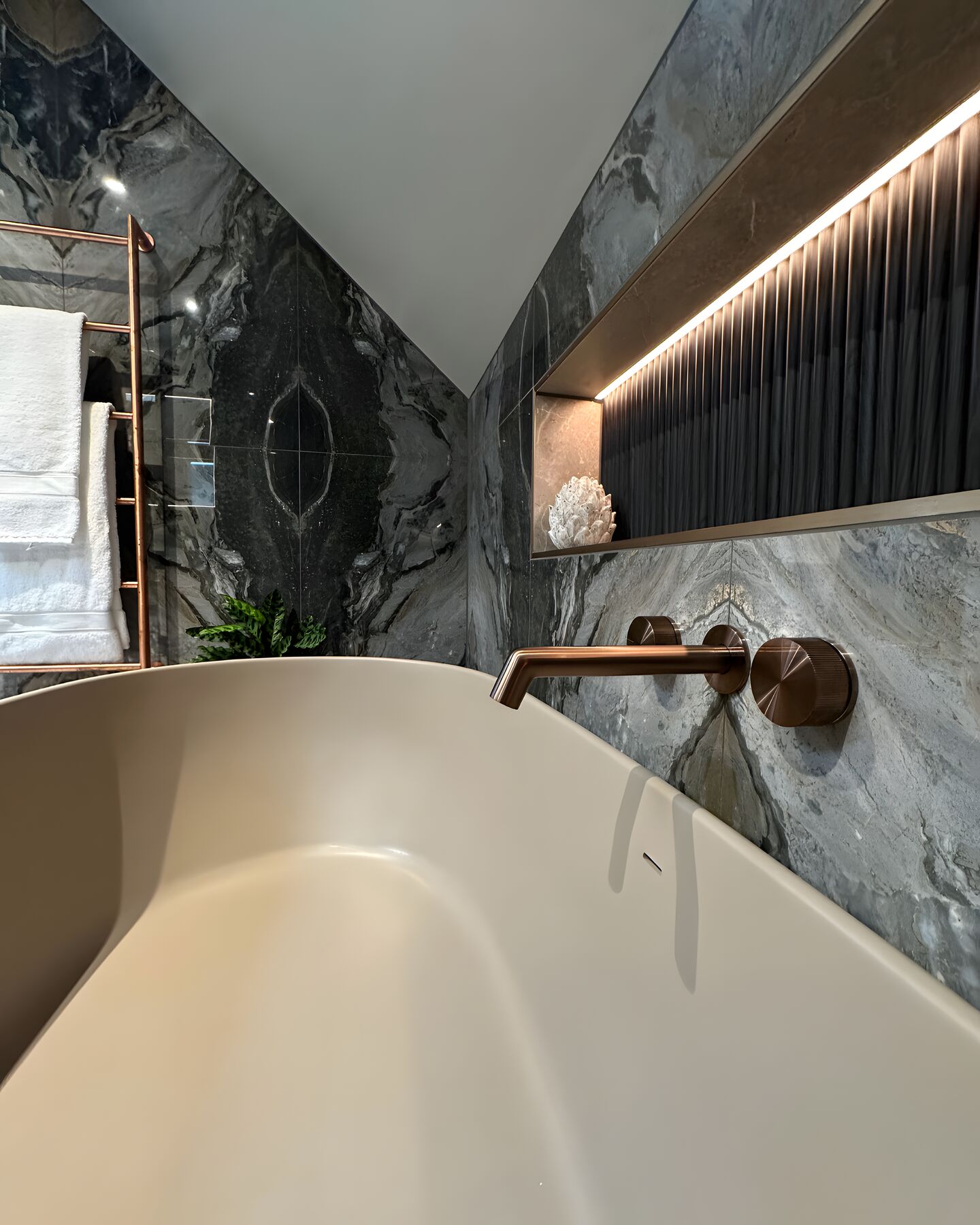
In both rooms the filler was decided along with the bath. The MPRO has no tap holes and the Crea can’t take an overflow filler, so one room has a freestanding filler and the other a wall-mounted one. The platform in Bradwell is in the 3D design renders too, so it was planned with the bath.
How we handle it. The bath, the filler, the waste position and any floor heating get drawn together in the design, which is included when you choose your products with us. If you’re buying the bath for your own fitter, we give you the maker’s published weight, capacity and installation guide for the exact model so they can plan the floor and the waste.
Is a stone bath worth it?
Yes, if you’ll use the bath and you want what stone gives you, which is the solid feel and a matt or coloured finish. What we wouldn’t do is choose between a stone resin or acrylic bath on heat retention or floor loading alone, because neither is a strong reason. The makers don’t publish a figure for the first, and the second is much closer than the empty weights make it look.
If you’ve settled on stone, the three makers suit different rooms. The Crosswater MPRO is white only, in gloss or matt, and at 78kg or 91kg, depending on size, it’s close in weight to the Crea and the Casini and well under the Magnus. But Crosswater says it shouldn’t sit on a heated floor. We’d look at BC Designs’ Cian if you want a colour. It’s also the one to ask about if the bath is going on a heated floor. BC Designs’ March 2025 brochure said Cian can be placed on one, but the July 2026 brochure doesn’t repeat that, so get it confirmed in writing for your model before the heating layout is fixed. Allow for the made-to-order lead time on the colours. Victoria + Albert has the longest headline guarantee and over 200 exterior colours, but get the weight, the capacity and the heated-floor instruction for the exact model before you compare it with the other two.
Verdict: worth it if you’ll use it and you want the finish
Choose stone if the bath is the centre of the room, you want matt or colour, and you like a bath that feels solid. Choose a good acrylic if the bath is occasional, the budget is better spent on the shower or brassware, or access to the room is awkward. Whichever you pick, match the exact model to the floor heating plan and the waste route before anything is fixed.
Frequently Asked Questions
Choosing your bath
Finish and feel are things you judge by hand, so book a showroom visit at Braintree or Leigh-on-Sea, and ask when you book which stone baths are on display. Bring the room dimensions, which floor the bathroom is on, and whether underfloor heating is planned. If you’re using your own fitter, that’s fine, and we’ll give them the maker’s information for the bath you choose.