
Bowmans · Inspiration · Design
Bathroom underfloor heating: wet vs electric, cost vs benefit
No underfloor heating is the most-cited regret on UK home improvement forums after a bathroom refurb, ahead of "wrong-colour grout" and well ahead of "wrong tap finish". Most cost guides answer the question in two paragraphs and a confusing table. We can do better than that. Wet vs electric isn’t the fight people think it is. The right answer turns on three things, and by the end of this you’ll know which system suits your project, what it should cost in 2026, and which regulations apply to it.
01 · The two systems
How does bathroom underfloor heating actually work?
Bathroom underfloor heating is two physically different systems wearing one label. Electric underfloor heating is a resistance-heating mat or loose wire that turns electricity straight into heat inside the floor build-up. Wet underfloor heating (also called hydronic) is a network of small-bore pipes carrying warm water from a manifold, fed by a boiler or heat pump. The two behave so differently in cost, install and daily use that sharing a name is half the reason buyers get this decision wrong.
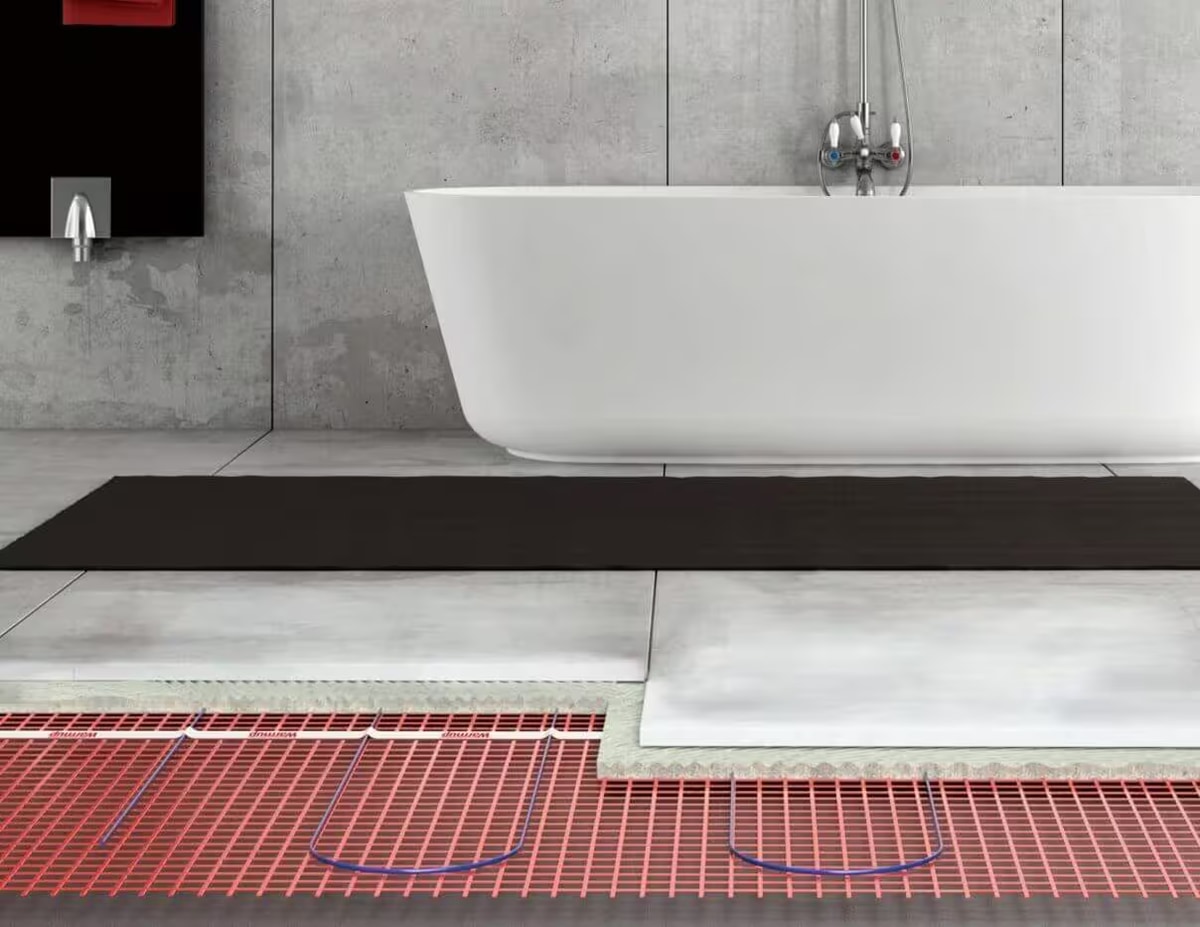
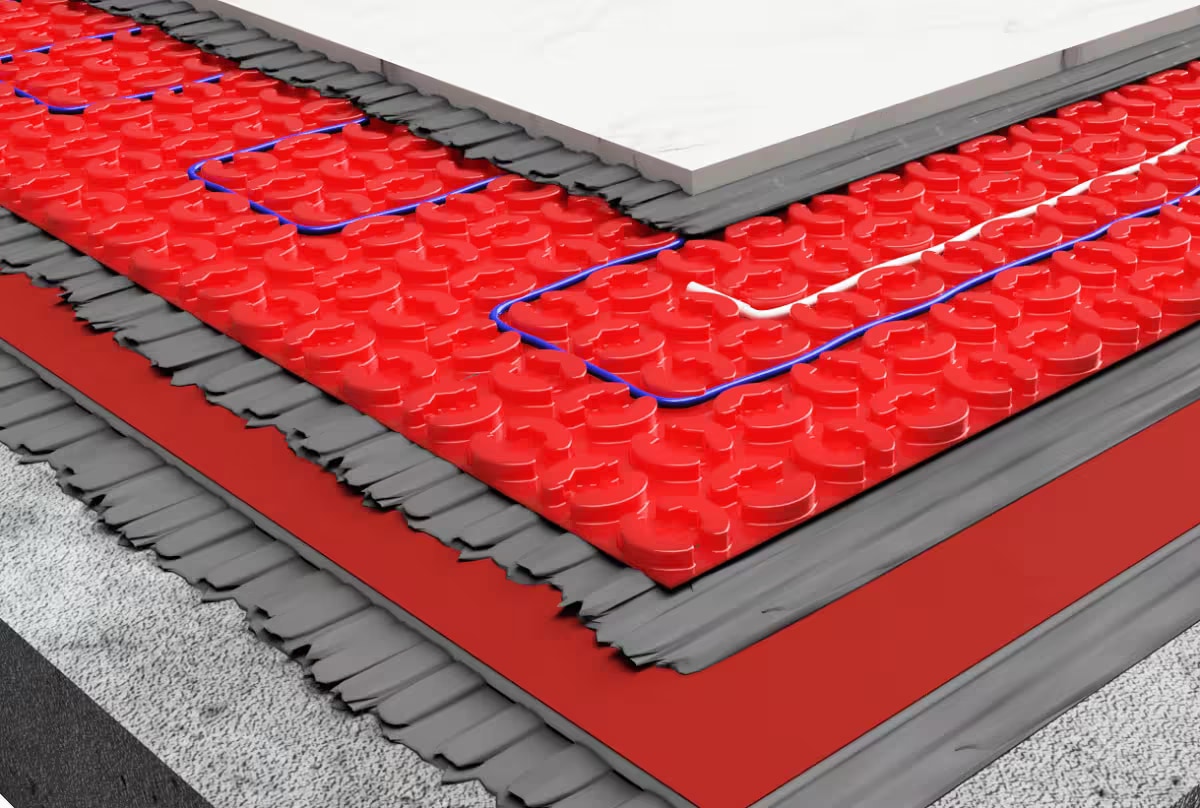
An electric system in a bathroom is usually a self-adhesive heating mat sized to fit the open floor area, putting out somewhere around 100–200W per square metre. It sits on insulation board (6mm tile-backer is standard), goes under the tile adhesive, and connects to a thermostat with an embedded floor sensor. The whole stack adds 5–15mm to the floor build-up, depending on which insulation board you use. Think of the element as a long, very thin resistance heater: switch it on, the wire warms up, the floor warms up, the room warms up. There’s no inertia, no return loop, no manifold. Warmup dominates the UK market for this category, and they supply the systems we specify on most Bowman projects.
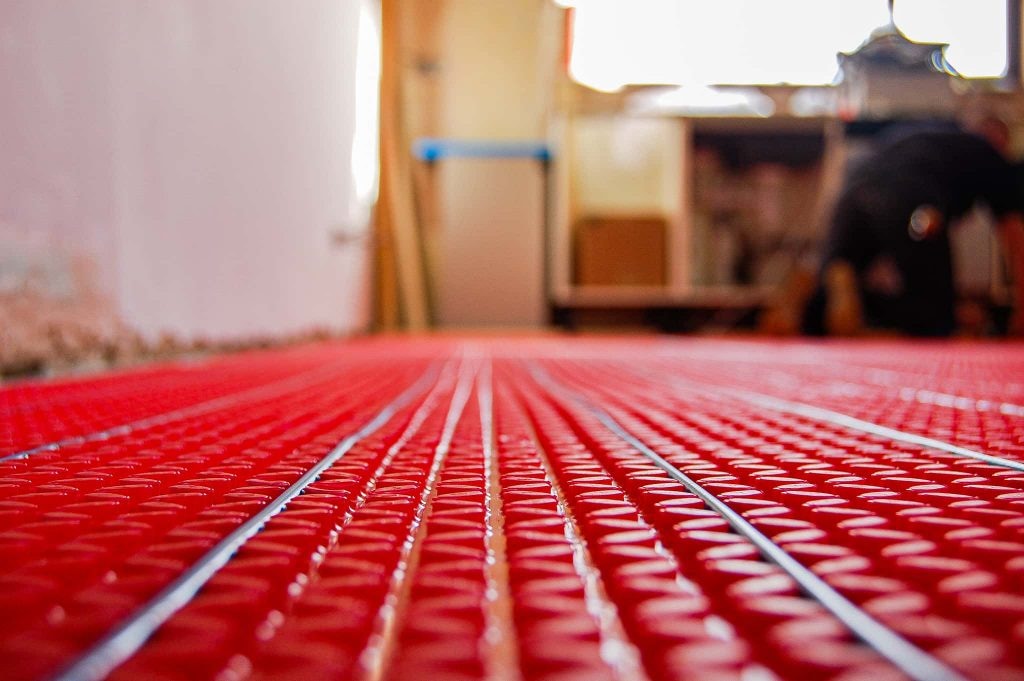
A wet system carries 35–50°C water from a manifold through PEX or PERT pipework laid in loops across the floor. That pipework can be cast into a 50–75mm sand-and-cement screed, clipped to insulation panels and finished with a flow screed, or laid in an 18mm low-profile overlay on top of an existing floor. Each loop is balanced at the manifold, and each room (or zone) gets its own actuator and thermostat. Whatever heats the rest of the house heats the water: a condensing gas boiler, an air-source heat pump, sometimes a ground-source heat pump or thermal store. A wet system is really a horizontal radiator, far more surface area at a far lower water temperature.
Temperature behaviour gives you the first practical difference. Electric mats reach floor surface temperature in 20–40 minutes from cold. Wet systems take 1–2 hours to get there, and they respond slowly afterwards, because the screed mass is doing most of the work and thermal mass never hurries. If you use the bathroom morning and night, electric gives you heat when you want it. A wet system would rather sit on a steady schedule and let the heat source modulate it, instead of being switched on demand. That difference drives more of the buying decision than install cost does.
Both systems share one thing: surface temperature is regulated. BS EN 1264, the European underfloor heating design standard, sets a maximum floor surface temperature of 29°C in habitable areas and 33°C in peripheral zones (bathroom edges included). Go above that and you get foot discomfort and damage to the floor finish. Decent thermostats default to a 27°C floor limit; the sensor reads the screed or substrate temperature, and the system cuts out when it hits the ceiling. That’s all academic until you specify a wood or vinyl finish, because then the floor manufacturer’s own lower limit (typically 27°C surface) takes over. We’ll come back to it in the floor-finish section.
"Wet vs electric isn’t really a fight. It’s a question of how many rooms you’re heating, and what’s heating them."
02 · Install cost
How much does bathroom underfloor heating cost to install in 2026?
For a typical UK bathroom of 4–6 square metres usable floor area, electric underfloor heating costs roughly £750–£1,600 supplied and installed. Call it £400–£900 for the heating mat, insulation board, thermostat and accessories, then £350–£700 for installation labour by a Part-P registered electrician. That labour line isn’t optional: the install is notifiable electrical work under Approved Document P, and a competent person has to sign it off. On most Bowman projects the cost lands mid-range, a Warmup DCM-Pro mat with a 6iE smart thermostat over insulation board, fitted as part of the broader bathroom install.
Wet underfloor heating into a single retrofit bathroom runs £900–£2,000+, and that assumes the manifold and a flow-and-return path back to the heat source already exist. Running new pipework all the way back to a boiler or heat pump? Add the plumbing labour for that route. The cheap end of the wet-retrofit range uses a low-profile overlay system (16–18mm build-up, no screed) and goes in inside a day. The expensive end means lifting the floor, laying insulation panels and pipework, then pouring 50–75mm of screed that has to cure for 21–28 days before you can tile. So on a like-for-like basis, wet retrofit costs about twice what electric does in one bathroom. The economics flip on a whole-house project, where the bathroom is folded into a multi-room install and the manifold, heat source and labour spread across every floor.
Here’s the cost line designers add up and homeowners often miss: floor build-up consequences. Put 12mm of insulation board under a 6mm electric mat and you’ve added 18mm to the bathroom floor, which is sometimes enough to need door undercutting (£30–£60 per door) and threshold strips (£40–£80). A wet system in screed adds 50–75mm, and that almost always means lifting and re-fixing skirtings, undercutting doors, and reworking the floor at the bathroom threshold. Low-profile wet overlay systems sit in the middle: 16–18mm of build-up, with much the same door-and-threshold knock-on as a thicker electric stack.
Two things matter when you’re comparing quotes. First, ask whether the price includes the thermostat, because plenty of cheap quotes leave it out. Second, ask whether the electrical work is being notified to building control by a Part-P electrician, or quietly assumed to be your problem. Notification is part of the regulatory cost rather than a paperwork fiddle, and we come back to it under regulations below. For a fuller picture of where bathroom money goes by spec tier, our luxury bathroom cost guide for UK 2026 sets UFH inside the wider £15k–£40k+ project bands.
03 · Running cost
How much does bathroom underfloor heating cost to run?
Running cost is the conversation that gets the most heat and the least light on UK home improvement forums. So here’s our version, with every assumption on the table.
An electric heating mat in a 5 square metre bathroom typically draws 150W per square metre, so 750W with everything on. It doesn’t run flat out for long, though. The thermostat cycles the mat to hold floor temperature, and a well-insulated bathroom floor settles at roughly a 30–50% duty cycle once it’s up to heat. Run the mat 2 hours a day, average 40% duty across that window plus warm-up, and you’re using roughly 1–1.5 kWh a day. At a 2026 typical electricity unit rate of about 26–28p per kWh (Ofgem energy price cap basis), that’s £15–£40 a year for the bathroom alone. Set the mat to come on for 30 minutes morning and evening only, and the figure halves. What moves that number is insulation board thickness, screed depth, room target temperature and how long you leave it on, rather than which system you chose.
What a wet system costs to run depends entirely on what’s heating the water. On a modern condensing gas boiler at typical 2026 rates, a useful kWh of heat from wet UFH costs around 30–40% less than the same heat from electric resistance. The boiler is roughly 90% efficient, and gas is cheaper per kWh than electricity. Put the same system on an air-source heat pump with a coefficient of performance (COP) of 3.5–4.5 and a useful kWh of heat costs 50–65% less than electric. Every electric kWh into the pump comes back as 3.5–4.5 kWh of usable heat. That’s why the Future Homes Standard (expected 2025–26 under the Approved Document L pathway) pushes new-build heating toward heat pumps with low-temperature distribution, and UFH is the natural way to distribute it.
There’s a catch, though. Those savings only matter if the bathroom uses enough kWh a year for the difference to compound, and a 5 square metre bathroom run sensibly on electric never gets there. Run the maths the other way round: the bathroom alone might save you £10–£25 a year on heat-pump wet against electric. The extra install spend (somewhere between £200 and £1,500 depending on how you cost the wet system) takes 8–60 years to pay back at that rate. Wet only makes economic sense once it’s amortised across a multi-room install. In one bathroom on its own, the running-cost difference is real but small in absolute terms.
One operating tip beats most of what you’ll read elsewhere: insulation board under the mat or pipework matters more than system choice. A 6mm tile-backer board under an electric mat cuts downward heat loss into the floor structure by 30–50% against a bare screed, and a 10mm or 12mm board is better still in suspended-floor bathrooms over an unheated room below. The same goes for wet UFH on insulation panels. We always specify proper insulation under the heating layer, because it trims warm-up time and running cost for very little extra material spend.
04 · The decision
Wet vs electric underfloor heating: a decision framework
Use this table on most UK bathroom projects. Three variables settle it: how many rooms you’re heating, what heat source the rest of the property runs on, and how much floor build-up you can live with.
| Your situation | Right system | Why |
|---|---|---|
| Single bathroom retrofit, gas-boiler house | Electric | Lower install, shorter time, no screed cure, fits under tile finishes with minimal build-up. |
| Single bathroom retrofit, heat-pump house | Wet (if manifold reaches) | Heat pump COP makes wet much cheaper to run; one room is still close to break-even but the comfort gain is significant. |
| Whole-house renovation, all floors going wet UFH | Wet | Bathroom folded into a project-wide install; manifold and heat-source costs amortised; running-cost case obvious. |
| Period property, suspended timber floor, cannot lose ceiling height | Electric | 5-15mm build-up easy to absorb; wet retrofit either needs floor lifting (Victorian terrace) or low-profile overlay (still 16-18mm). |
| New-build extension, slab being poured anyway | Wet | Pipework laid before screed pour; marginal labour cost; full-screed thermal mass works in your favour. |
| Cloakroom or WC under 2m² | Electric or skip | Output too low to justify wet manifold leg; small electric mat sometimes worth the comfort, often not. |
| Wetroom with continuous tiled floor | Electric | Mat sits over tanking; no penetrations needed; works around the drain. See our wetroom tanking guide for the full waterproofing stack. |
| Bathroom over an unheated garage or void | Electric, with thicker insulation | Downward heat loss is the killer; 12mm tile-backer board minimum, sometimes 20mm. Worth specifying once the cost is factored in. |
The single most useful test: are you heating one bathroom, or are you heating the whole house? One bathroom — electric. Whole house, especially on a heat pump, means wet throughout, bathrooms included, no exceptions. The decisions that go wrong are nearly always someone who specified wet for a single bathroom because it sounded more sophisticated, then watched the install cost climb as the manifold pipework crept across the property.
05 · The pushback
When bathroom underfloor heating is not worth it
Most UFH articles assume the answer is yes. Sometimes it isn’t. Here are three situations where we’d talk a client out of it.
Carpeted bathrooms or rooms with retained timber floorboards. UFH only works well into a high-conductivity finish: tile, stone or porcelain ideally, engineered wood or LVT acceptably. If the brief is to keep an existing carpeted floor, or to retain wide-board original timber with a wax finish, the heat gets soaked up by the floor covering instead of reaching the surface. The system technically works. The comfort gain is small, though, and the running cost looks poor against the result.
Holiday flats and rarely-used second homes. The case for UFH rests on comfort during regular morning use. A bathroom used three weekends a year won’t earn that install cost back, in comfort or in running-cost terms. A high-output heated towel rail at the right wattage gives you most of the comfort win for a fraction of the spend.
If a towel radiator is part of the plan, our bathroom radiator materials guide explains how to compare the body material, finish and rated output alongside your heating system.
Tenant lets where the tenant pays the heating bill but the landlord pays the install. The economics rarely line up. Electric UFH adds £750–£1,600 to a landlord’s refurb without directly lifting rent or yield. Wet UFH only makes sense if the whole property is getting it. This comes up on properties going to tenancy after renovation, and the honest call is usually to stop at a heated towel rail, unless the property is pitching at the top of its local rental band.
Flip all that around and you get the case where UFH is non-negotiable: a primary bathroom or principal en-suite in an owner-occupied home, used daily, finished in tile or stone, with a designer involved. At the £18–£35k standard-luxury tier it stops being a question and becomes part of the brief. If you’ve already engaged a designer, specifying it is one of the easier conversations you’ll have. And using a designer at all is usually what catches the build-up and zoning issues that decide whether a UFH install succeeds or quietly disappoints.
06 · The regs
Building Regs and electrical zoning for bathroom underfloor heating
Three regulatory documents apply to bathroom UFH in England. Most articles skip them, and getting any one of them wrong is what triggers expensive snagging or, at worst, a failed building-control sign-off.
Approved Document P (Electrical safety - dwellings), 2013 edition, current. Bathroom electrical work is notifiable. So an electric UFH install has to be carried out by a Part-P registered competent person, or inspected and signed off by one afterwards. That person notifies the work to building control under their scheme (NICEIC, NAPIT, Stroma). The scheme then issues an electrical installation certificate that you keep with the property documents. (Source: gov.uk, Approved Document P.) Skipping it is the single most common UFH install error on UK home improvement forums, and it usually only bites when the property sells and the survey flags missing certification.
BS 7671:2018+A4:2026 (the IET Wiring Regulations, 18th Edition). Amendment 4 has applied since it was published on 15 April 2026. Amendment 3 stays valid until it’s withdrawn on 15 October 2026, giving a six-month transition in which installers may work to either. Three rules from BS 7671 Section 701 land directly on bathroom UFH:
- 30 mA RCD protection mandatory on every bathroom circuit, including the UFH supply.
- Bathroom electrical zones dictate ingress protection: Zone 0 (inside bath / shower tray) requires IPX7 rated equipment and SELV 12V max; Zone 1 (above to 2.25m) requires IPX4 minimum; Zone 2 (0.6m horizontal beyond Zone 1) requires IPX4 minimum. Zone 3 has been removed from the standard, so older diagrams showing a four-zone scheme are out of date. (Source: IET BS 7671 18th Edition.)
- The UFH thermostat itself sits outside the zoned area, or in Zone 2 with an appropriate IP rating, and the floor sensor lead is buried in the screed. Both are standard practice for any reputable installer. Still worth checking on a quote that lists "thermostat in bathroom" without saying where.
Approved Document L (Conservation of fuel and power, Volume 1 Dwellings), 2021 edition with 2023 amendments. The Future Homes Standard pathway (expected in force 2025–26) tightens primary-energy and fabric-energy targets sharply, and UFH is one of the distribution methods that lets a heat pump hit them. Wet UFH counts toward primary-energy calculations on a SAP assessment, while electric UFH counts as a direct-electric heating load. On a like-for-like refurb of one bathroom, ADL rarely bites. On an extension or a major renovation it shapes the heating system you can specify. (Source: gov.uk, Approved Document L.)
One thing the regulations don’t require, but every decent designer specifies anyway: a bathroom extract fan running 15 L/s intermittent or 8 L/s continuous (per Approved Document F). UFH doesn’t replace ventilation. A warm floor in a humid bathroom with no extract is a mould problem waiting to happen. Treat the two as a pair. Both sit on a designer’s planning checklist at the ventilation and electrical-zoning steps, specified together rather than bolted on at the end.
07 · The finish
Which floor finishes work with bathroom underfloor heating?
Floor finish drives more of the UFH spec than most buyers expect. The heating system has a maximum surface temperature target (typically 27°C for comfort, 33°C as the absolute peripheral limit per BS EN 1264). The floor finish has its own limit, set by whoever made it. Whichever number is lower wins, and that ceiling decides how much heat you can pull out of the system.
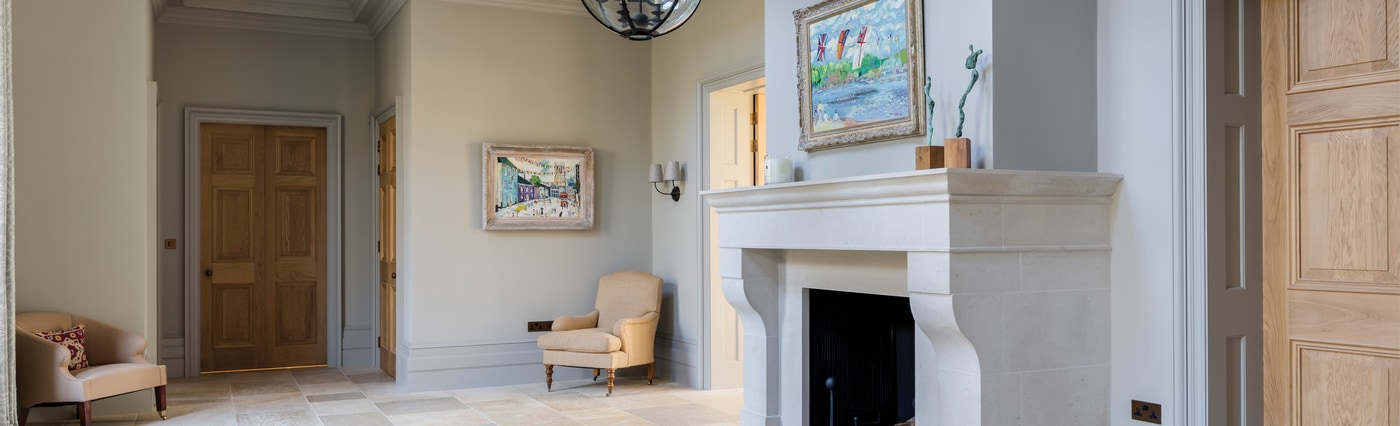
Porcelain and ceramic tile. The natural fit. High thermal conductivity, high thermal mass, and no upper temperature worry in normal residential use. It’s what we specify on most luxury bathroom projects. Ca Pietra porcelain, natural-stone-effect tile, large formats and full-bodied porcelains all work without compromise. Output runs at the system design figure with no derating.
Natural stone. Limestone, marble, slate and travertine all work well over UFH provided the bedding is right. We usually specify a flexible cement-based adhesive rated for movement, because a rigid brittle one cracks under thermal cycling. The surface temperature limit is usually 27–29°C, set by the stone manufacturer, and marble in particular likes a gentle warm-up cycle to avoid thermal shock. Stone is the finish where a careful installer matters most.
Luxury vinyl tile (LVT) and click-LVT. Most premium LVT systems are rated for use over electric UFH up to a 27°C surface temperature. Always check the manufacturer’s UFH compatibility statement, because some click systems are rated for hydronic only, some for both and some for neither. Output derates by 20–30% against tile, thanks to that temperature ceiling.
Engineered wood. Workable, but only with a thinner, lower-output mat (100W/m² rather than 150–200W/m²) and a 27°C surface temperature limit, and only if the plank construction is UFH-rated by its manufacturer. Plenty of engineered wood isn’t. Solid hardwood we’d steer you away from altogether, because of moisture-driven movement.
Microcement and resin floors. Both wet and electric UFH suit these, provided the substrate is prepared properly and the resin or microcement is rated for thermal cycling. Microcement keeps turning up at the £25k+ tier, and it works particularly well with wet UFH on a screed substrate.
The pattern across all of these is simple enough. For tile and stone, UFH is straightforward and outputs at design. For wood and vinyl, the floor finish caps the system and outputs drop, which is fine for comfort in a 4–6m² bathroom but worth knowing if you want UFH as the main heat source in a bigger room. For more on tile selection at the spec stage, our best tiles for small bathrooms guide covers material choice in compact spaces, and the tile layout ideas guide handles pattern.
08 · The control layer
Smart thermostats and how a designer specifies UFH
The cheapest part of a UFH system to upgrade later is also the part that moves the running-cost number most: the thermostat. A £30 dial thermostat will hold an electric mat at the same surface temperature as a £200 learning thermostat. The difference shows up in duty cycle and warm-up scheduling.
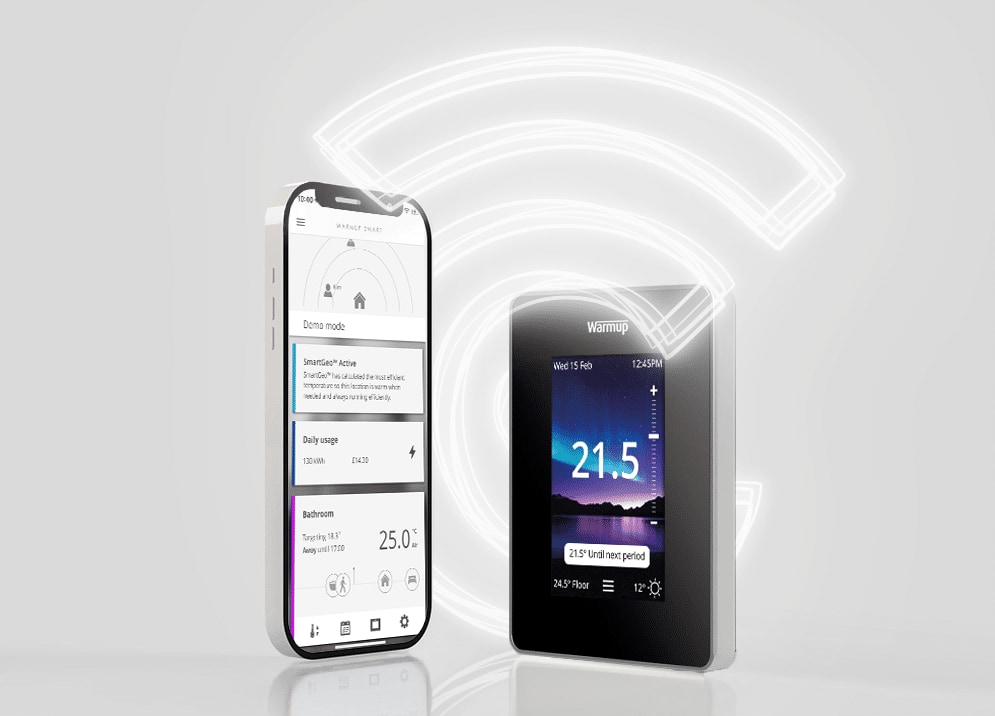
A learning thermostat (Warmup 6iE, Warmup Element, or similar) tracks how long the floor takes to warm up, then back-calculates when to switch on so the floor hits target temperature exactly when you want it. If you use the bathroom 7am to 8am, it learns to fire at 6:30am instead of holding temperature all night. Energy use typically drops 15–25% against a fixed-schedule thermostat doing the same job. App control is the nice-to-have: you can switch the floor on remotely on the way home from a weekend away.
Voice control through Alexa or Google Assistant exists on most current learning thermostats. Whether you use it comes down to taste. The energy saving comes from the smart scheduling underneath, not from the voice control on top.
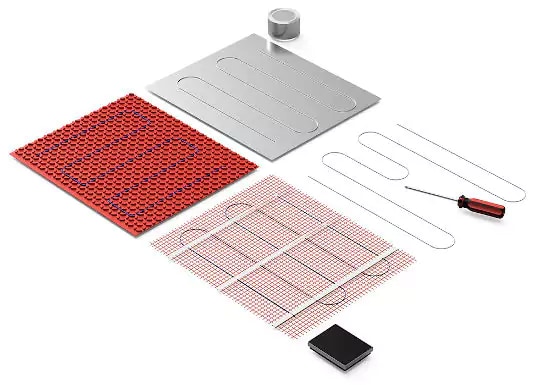
Here’s how the spec actually gets made. At the showroom appointment we walk the floor and mark the heated zone, leaving out the footprint of the bath, the vanity unit and any built-in furniture. The mat can’t run under fixed cabinetry, because heat builds up. Output comes next: typically 150W/m² for a regularly-used family bathroom, 200W/m² for an ensuite that gets shorter, more intense use, 100W/m² under wood or LVT. Insulation board thickness follows the floor below, so 6mm minimum on solid concrete, 10–12mm over a heated or unheated room, 20mm where the bathroom sits over an unheated garage. Then the thermostat, which comes down to how much the client cares about smart scheduling. Mat, insulation, thermostat and Part-P labour all go on the spec sheet alongside the brassware, sanitaryware and tile.
Without a designer, the same faults keep repeating. The heating output is wrong, too low under stone or too high under wood. The insulation board is missing or too thin. The thermostat is whatever cheap model came in the kit. And the install gets done by a fitter rather than a Part-P electrician, so building control never sees a certificate. Each of those is cheap to fix up front and expensive to fix afterwards. If you’re weighing up whether to involve a designer at all, our honest guide on whether a bathroom designer is worth it walks through the four trigger conditions where the answer is yes.
Frequently asked questions
Everything UK homeowners ask about bathroom underfloor heating in 2026.
What is next
Ready to specify underfloor heating in your bathroom?
We design and specify Warmup underfloor heating as part of the standard luxury bathroom brief at our Braintree and Leigh-on-Sea showrooms. The UFH spec folds into the wider design appointment alongside brassware, sanitaryware, tile and vanity selection. We walk the floor, work out the heated zone, pick output and insulation, and put a Part-P registered electrician on the install team. There’s no separate design fee, and we benchmark our product pricing against the major UK online retailers on every brand we sell.
Our Braintree showroom is on Springwood Industrial Estate, CM7 2YN, and it covers Braintree, Chelmsford, Colchester and Maldon. Leigh, Southend, Brentwood, Billericay and Rayleigh are looked after by the Leigh-on-Sea showroom. Bring measurements, a few photos, or even just ideas, and we’ll work the underfloor heating into the spec alongside everything else.
See Warmup underfloor heating in a finished install: our Chelmsford CM2 family bathroom runs it beneath a fully tiled wet-room floor.
Companion guides: luxury bathroom cost UK 2026 · is a bathroom designer worth it?