Bowmans · Inspiration · Design

Freestanding bath vs built-in: which works for your luxury bathroom?

By Jonathon Barclay, Founder 18 min read

Most freestanding-vs-built-in articles answer the wrong question. They line up the two options like trim-levels and ask which is “more luxurious”. The honest answer is that the two baths solve different rooms. A freestanding bath is a sculptural object you walk around; it earns its place when the room is large enough to give it air, the floor structure can take the weight, and the way you actually bathe matches the geometry of slipper, double-ended or boat. A built-in bath is the room-efficient choice that frees space for shower, vanity and storage, and it can read every bit as luxurious in the right hands. This guide weighs both options on the seven decisions that matter, with real numbers from the brands we sell, including BC Designs who make most of the freestanding baths fitted in UK luxury bathrooms in 2026.

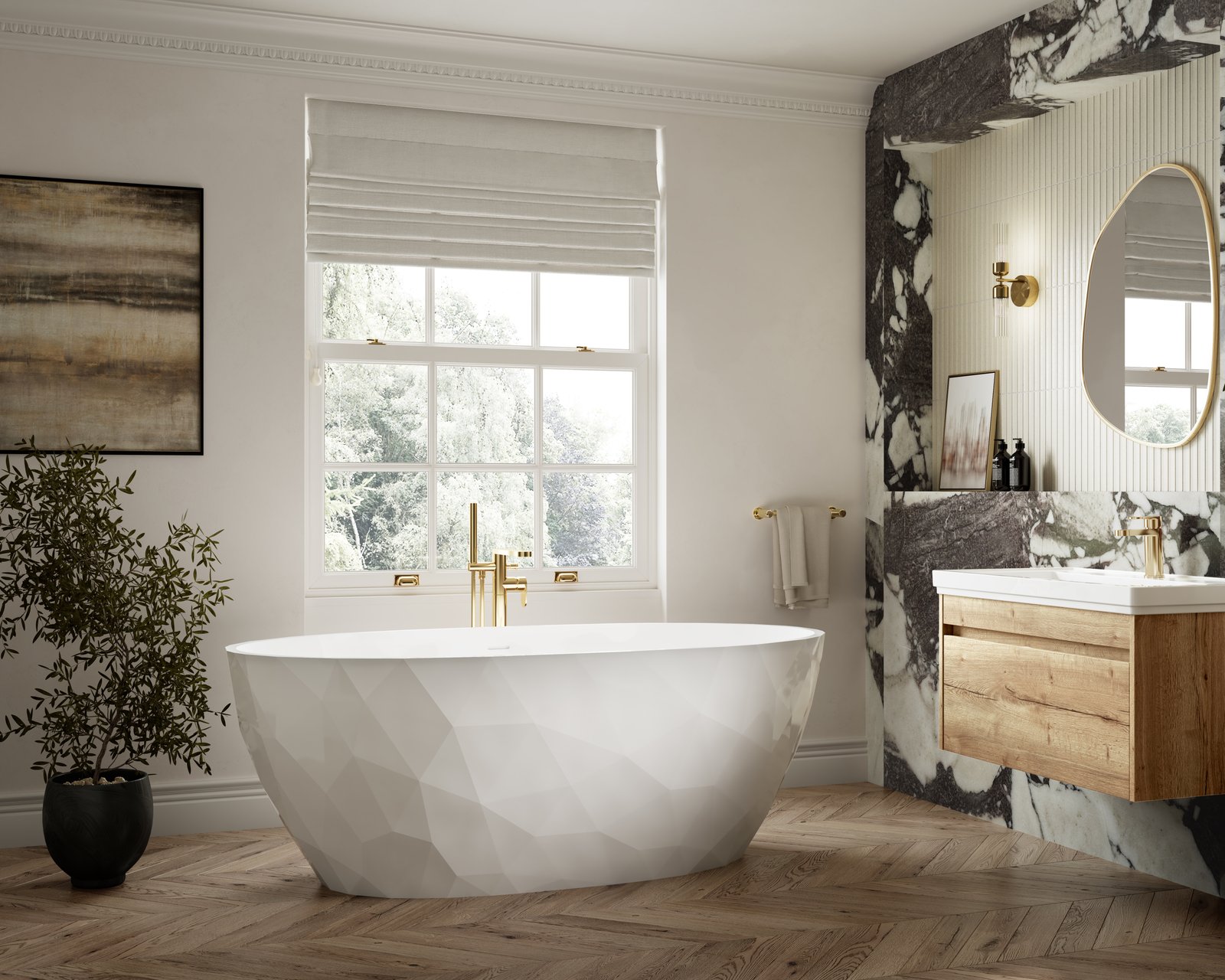
BC Designs BAA001 Aurelius cast-stone freestanding slipper bath as the hero piece in a UK luxury bathroom - the bath sits clear of the walls with around 1100mm of floor on the foot end, with veined marble walls and floor-mounted brushed brassware behind
BC Designs Aurelius (BAA001) cast-stone slipper bath as a hero piece. The freestanding case rests on three things: floor space, floor structure, and how you actually bathe.

01 · The real distinction

What is the actual difference between a freestanding and a built-in bath?

A freestanding bath is a finished sculptural object on four feet or a plinth, designed to be seen from every side. The plumbing exits through the floor or the back of the body, the taps are wall-mounted or floor-mounted on a freestanding pillar, and the bath sits clear of the walls so the eye reads it as furniture, not as building fabric. A built-in bath is a steel, acrylic or composite trough dropped into a tiled or panelled surround, with the plumbing fed from the side or end through the framing of the alcove. From the room you see the alcove face, the rim, and three sides of tile or panel; you do not see the bath itself.

The decision between the two is rarely a pure aesthetic preference. A freestanding bath asks the room for floor space (clearance for walking around it), the floor for structural capacity (weight when full plus a person), the plumbing for a specific entry route (usually through the floor), and the user for a bathing pattern that matches one of three shapes. A built-in bath asks the room for an alcove of the right length, then takes orders — shower over, fixed screen, panelled, tiled, in a niche or an island. Most of the “which is more luxurious” debate online ignores the structural and plumbing reality entirely, which is why most online advice is bad advice.

In a 2026 UK luxury bathroom in the £15,000–£35,000 spec band, the freestanding-or-built-in choice usually moves about £1,000–£3,000 either direction on product cost and another £400–£900 on install (joist reinforcement, floor-mounted plumbing). It is not a small line. Designer-led showrooms model both options against the actual room before committing — an exercise our bathroom design service goes through on every project where a freestanding bath is on the brief. For the cost band context, see our companion guide on luxury bathroom cost in the UK.

Freestanding vs built-in: the practical comparison

Decision Freestanding Built-in
Visual role Sculptural hero piece Quiet alcove, frame is the brassware and surround
Min sensible room size ~7 sqm with at least 1100mm foot clearance ~4–5 sqm
Weight when full + bather 230–600kg (acrylic to cast iron) 220–320kg (acrylic / steel)
Plumbing entry Through floor, or through a feature wall behind Side or end of alcove (easier in joist runs)
Cleaning Perimeter dust trap, six accessible surfaces Single silicone seam to maintain
Shower compatibility Usually no — fit a separate walk-in shower Yes — fixed screen and overhead head
Indicative price (product only) £1,500–£8,000+ £400–£2,500

Indicative ranges based on Bowman 2026 supplier pricing for BC Designs, Catalano and Crosswater. Cast-iron and copper freestanding baths sit at the top of the freestanding range; mainstream acrylic baths at the bottom.

1100mm

Foot-end clearance for hero-piece freestanding

600kg

Cast-iron bath full + bather, on four feet

58%

UK homeowners enlarged primary shower in renovation

Houzz UK 2025 Bathroom Trends Study · BC Designs 2026 product specifications

02 · The structural reality

How heavy is a freestanding bath, and will my floor take it?

The single most expensive freestanding-bath mistake we see is skipping the joist check. Most homeowners ask about price first and weight last; the right order is the other way round, because if the floor will not take the bath, no amount of price comparison helps.

A typical 1700mm acrylic freestanding bath weighs 30–45kg dry. Add 180–220 litres of water (1kg per litre) and a 75kg adult and you are at 290–340kg of point load on four feet. A cast-stone or composite freestanding bath in the same length weighs 80–120kg dry, so the same scenario lands at 340–420kg full with bather. A traditional cast-iron freestanding bath weighs 200–300kg dry; full with bather, you are looking at 500–600kg of total load distributed unevenly across four feet. A copper bath in the same shape is similar in weight to cast iron.

For comparison, a built-in acrylic bath in the same length weighs 18–25kg dry and full with bather lands at 220–260kg, but the load is spread along the bath body and the alcove framing rather than concentrated on four small footprints. Steel built-in baths run heavier (40–55kg dry) but distribute the same way. The single-foot point load — and how it interacts with joist size, span and centres — is the question for any cast-iron or copper freestanding spec.

Bath weight by material (1700mm typical)

Material Bath dry Full with bather Joist check?
Acrylic freestanding 30–45kg ~290–340kg Usually no on modern builds; yes on Victorian / 1930s
Cast-stone / composite freestanding 80–120kg ~340–420kg Yes, especially on first floor of older properties
Cast-iron freestanding 200–300kg ~500–600kg Always
Copper freestanding 160–220kg ~440–520kg Always
Built-in acrylic 18–25kg ~220–260kg Rarely — load distributed by alcove framing

Source: BC Designs 2026 product specifications (BAA001 Aurelius cast-stone, BAC010 copper, BAB070 double-ended acrylic), industry weight averages for cast-iron baths from UK heritage suppliers. Bather weight assumed at 75kg.

The frustrating part is that joist condition is invisible until the floor comes up. We have specified cast-stone freestanding baths for projects where the joists were perfect Victorian originals at 50×175mm centres — no reinforcement needed. We have specified acrylic freestanding baths for 1930s semis where the original joists had been over-notched for 1980s pipework and needed sistering throughout. The point is that joist load is checked once the floor is up, not assumed from the property age. Designer-led showrooms model both freestanding and built-in options precisely because the structural verdict can change the answer. Skipping the joist check is in our top five bathroom layout mistakes that cost thousands to fix.

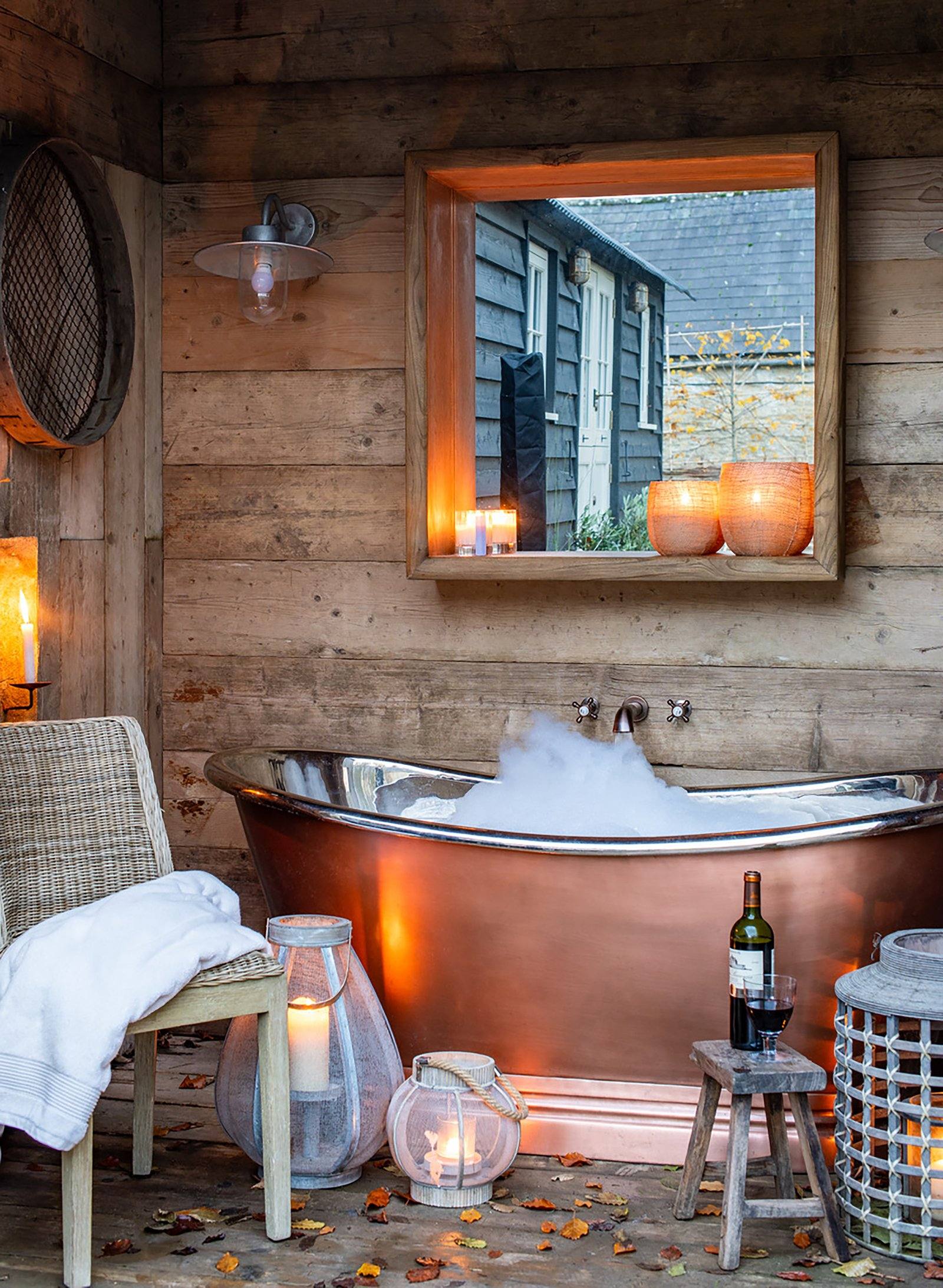
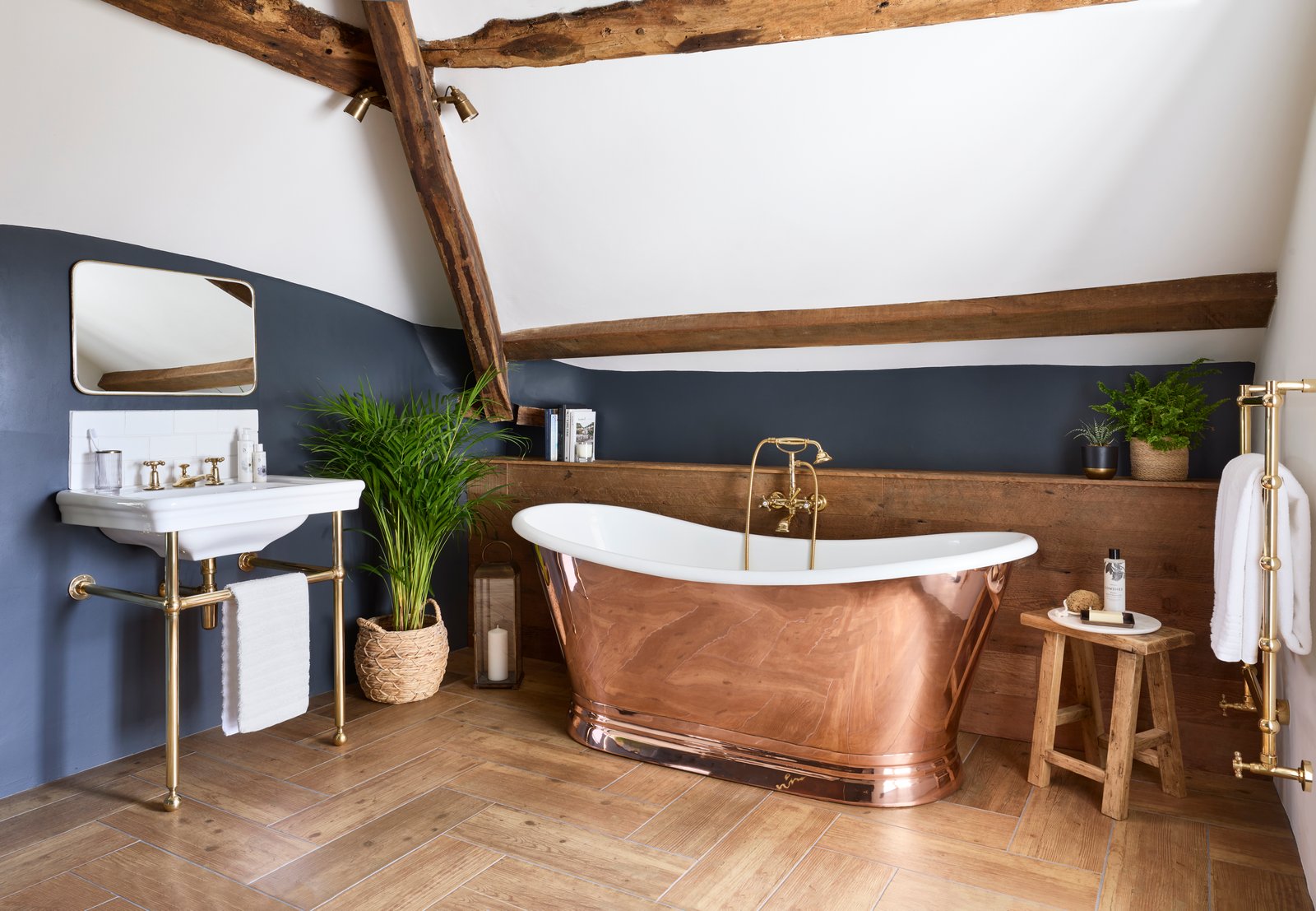
BC Designs BAC010 copper freestanding bath in a rustic barn bathroom - copper baths weigh 160-220kg dry and over 500kg full with bather, putting them firmly in the joist-reinforcement-always category for upstairs UK installations
BC Designs BAC010 copper freestanding bath. Heaviest end of the freestanding spectrum — over 500kg full with bather, distributed over four small feet. Joist reinforcement is mandatory for upstairs installation.

03 · The plumbing question

How does plumbing differ between freestanding and built-in baths?

A built-in bath is plumbed from the side or the end through the alcove framing — the pipework runs in a stud wall or under the floor next to the bath, the trap is accessible behind a removable bath panel, and any future leak or service issue is reached without lifting tile. The freestanding equivalent is fundamentally different: the hot, cold and waste runs come up through the floor inside the bath footprint, or through the back wall just behind it for a back-to-wall freestanding model. There is no panel to remove. Service access is through the floorboards.

That difference matters in three practical ways. First, the freestanding plumbing has to be exactly right at first install — centred on the bath waste, square to the body, accurate to the millimetre. A built-in bath tolerates 10mm of slop because the panel hides it; a freestanding bath does not. Second, the wall finish behind a freestanding bath has to be installed before the bath sits down, because you cannot tile around the bath once it is in place — whereas a built-in bath ships with a removable panel that lets the bath be lowered after the alcove is finished. Third, future service access on a freestanding bath means lifting the bath off its feet, which on a cast-iron model is a four-person job and risks chipping the nickel-plated outer finish.

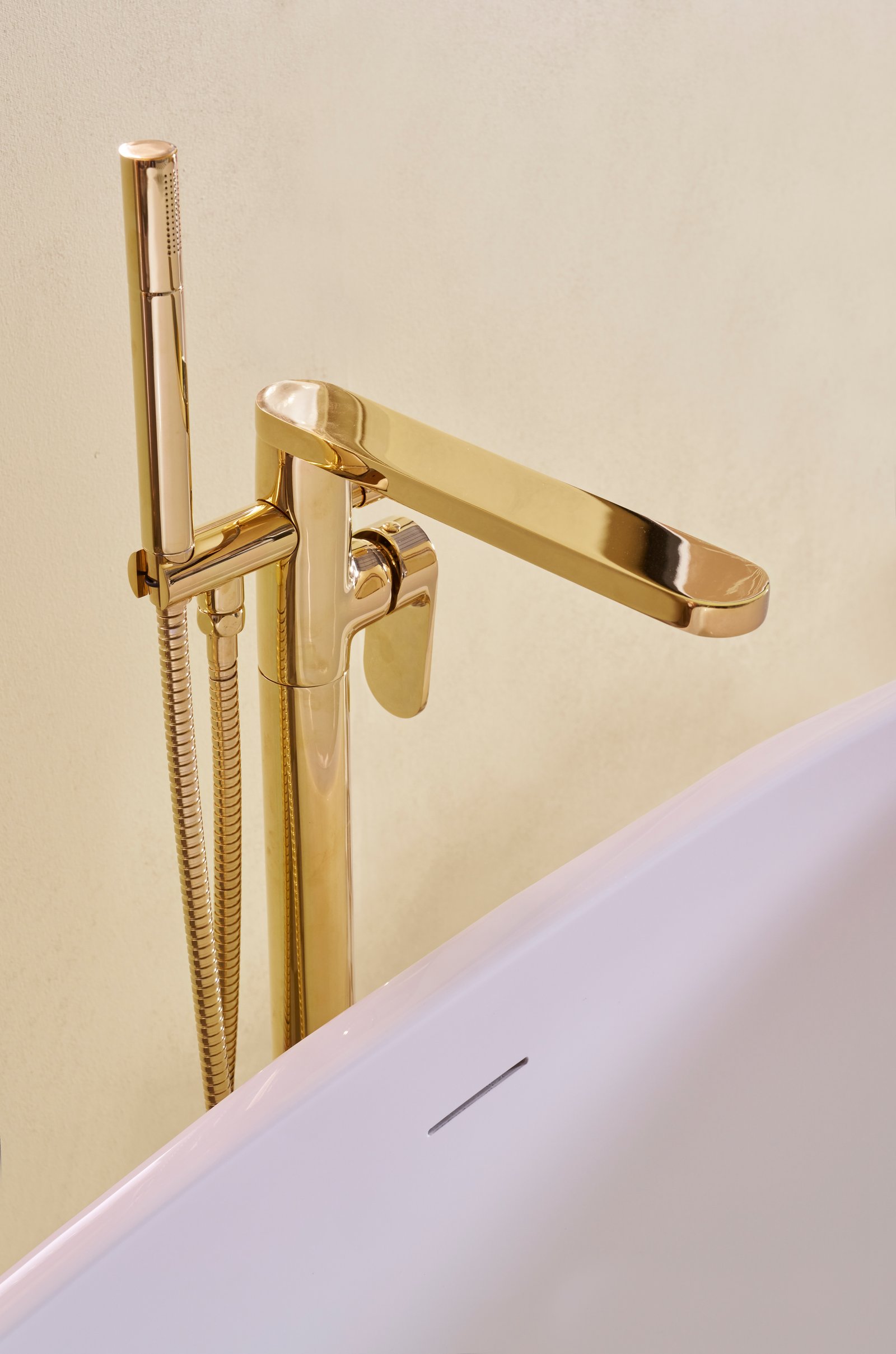
Modern freestanding installations use floor-mounted bath shower mixers (the BC Designs CHE321G in brushed brass, for example, or the Crosswater Union floor-mounted bath shower mixer) where the brassware is its own pillar rising from the floor next to the bath. The tap is decorative and serviceable from the front. Wall-mounted variants exit a feature wall behind the bath and look cleaner but require absolute alignment between bath position and wall pipe-out at first fix — if the bath needs to move 50mm at second fix, the feature wall has to come apart. Designers spec position to the millimetre on freestanding plumbing for exactly this reason.

Freestanding plumbing

Through the floor

Hot, cold and 40mm waste rise through the joists at the exact bath waste position. Floor-mounted pillar tap or wall-mounted bath shower mixer. Service access via floorboards beneath. Add 1–2 hours to first-fix plumbing for the floor-exit work and pre-bath final-finish.

Built-in plumbing

Side or end feed

Pipework runs in the alcove stud wall or under floor beside the bath. Wall-mounted or deck-mounted brassware. Service access via removable bath panel — usually 5 minutes with a screwdriver. Standard plumbing labour, no special floor work.

If the existing bathroom has a built-in bath and the homeowner wants to switch to freestanding, the plumbing rework is non-trivial. New floor exit points, capping off the side feeds, possibly relocating the soil pipe access if the WC moves to make room. Add £500–£1,200 to the plumbing line for a freestanding bath swap-in, plus the joist-check work above. None of this argues against freestanding — it argues for budgeting for it honestly at the design stage rather than discovering it as a surprise at the install stage.

BC Designs CHE321G floor-mounted bath shower mixer in brushed brass - the freestanding solution for hot, cold and shower handset feed, plumbed through the floor inside the bath footprint and serviced from the front
BC Designs CHE321G floor-mounted bath shower mixer in brushed brass. The freestanding plumbing standard — hot, cold and shower handset rising through the floor as a serviceable pillar.
“A built-in bath tolerates ten millimetres of slop because the panel hides it. A freestanding bath does not. Position is set at first fix or it is set wrong.”

04 · The clearance rule

How much space does a freestanding bath actually need?

A freestanding bath used as the visual hero of a room needs roughly 1100mm (1.1 metres) of clear floor at the foot end, at least 600mm on each long side, and full visual clearance at the head end (whether that is against a wall or a feature panel). The 1100mm at the foot end is the figure that turns the bath from a fitted product into a sculptural object — below that, the eye still reads the bath as boxed-in, and the freestanding visual benefit is largely lost.

This translates to a usable bathroom footprint of roughly 2.4×3.0 metres (around 7 square metres) as the practical floor where a 1700mm freestanding bath earns its place as a hero piece, with a separate walk-in shower, vanity and WC fitting around it. Smaller than that and the bath dominates the floor at the cost of everything else — the room reads as “a bath with a vanity squeezed in” rather than a coordinated luxury bathroom.

A back-to-wall freestanding bath compresses the requirement — the bath sits flush to one wall and you save 200–400mm of behind-the-bath space, but you give up a quarter of the visual statement. It is a sensible compromise for rooms in the 5–7 square metre range where a true island freestanding is too tight, but if the room can take a true island you should probably have one.

Clearance for a 1700mm freestanding bath

Side Minimum Why
Foot end 1100mm Walk-around clearance + visual breathing room. Below this, the bath reads as boxed-in.
Long sides 600mm each Clean access for cleaning, towel-keeping, helping a child in or out.
Head end 200mm if against feature wall, otherwise 600mm Clearance for tap connections + visual gap from the wall.
Above (ceiling) 2300mm to ceiling Bath fill height plus bather seated — rarely an issue but worth checking on loft conversions.

Bowman 2026 design-service guidelines for freestanding bath placement. Minimums; comfortable hero-piece placement uses 1300mm at the foot end and 700–800mm on the long sides.

A built-in bath fits comfortably in alcoves of 1700×750mm (the standard 1700mm bath length), often less — the bath uses the alcove walls as its frame rather than asking for clearance around itself. This is why a built-in bath delivers a credible luxury bathroom in rooms as small as 4–5 square metres, where a freestanding bath would dominate the floor and leave nothing for shower or vanity.

The clearance question also runs the other way. In rooms over about 12 square metres, a freestanding bath used without enough negative space around it can read as undersized rather than sculptural — a 1700mm bath in a 4-metre-long room can look lost. Larger rooms benefit from longer freestanding baths (the 1800mm BC Designs Boat Bath (BAC070) is a good fit for principal suites with floor space to give).

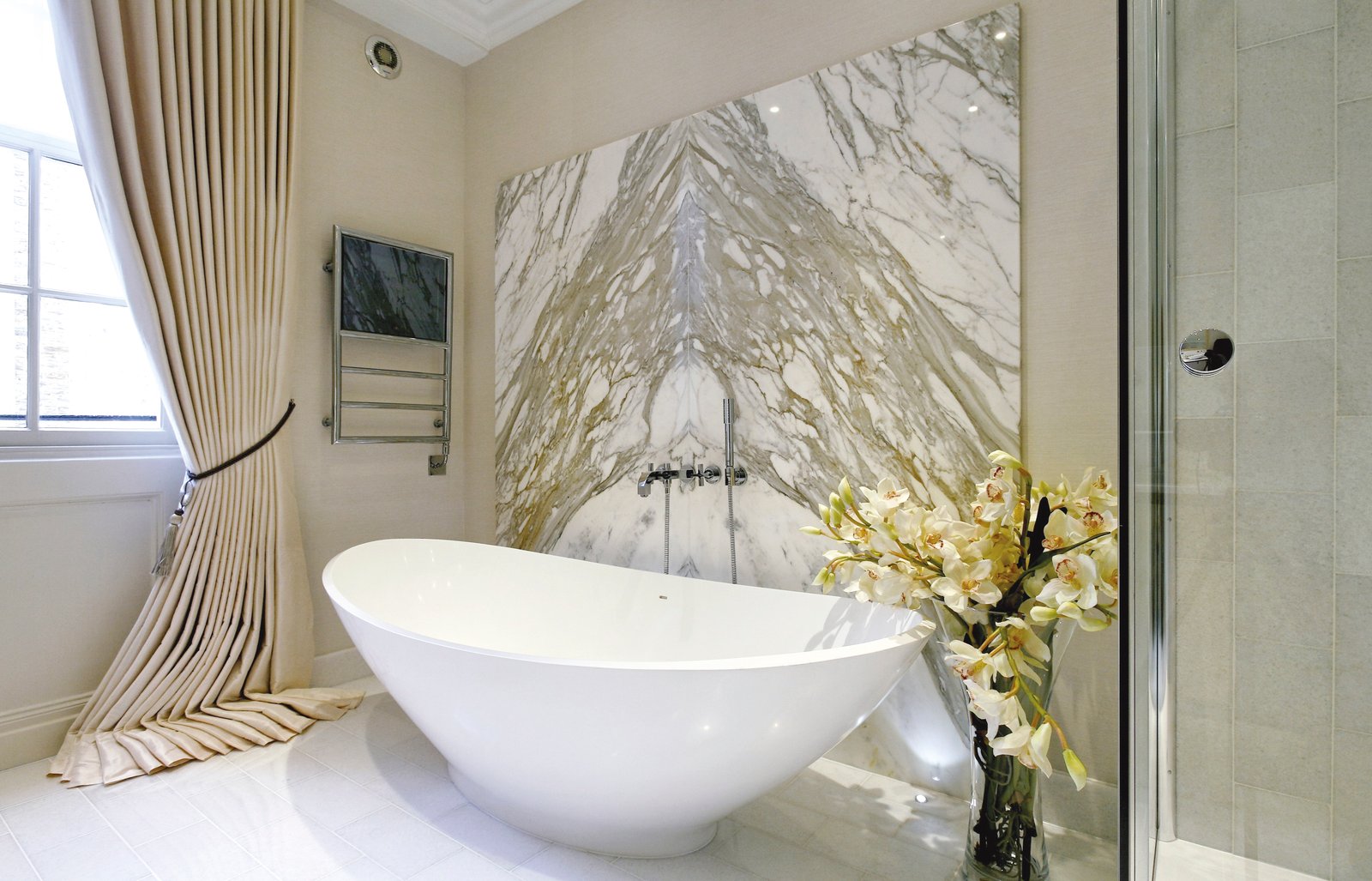
BC Designs BAB005 freestanding bath in a modern UK luxury bathroom - the bath has roughly 1100mm of foot-end clearance and full long-side access on both flanks, the minimum geometry that makes the freestanding piece read as sculptural rather than boxed-in
BC Designs BAB005 in a modern alcove placement. Roughly 1100mm at the foot end, full clearance on both long sides — the geometry that turns a bath into a sculptural piece.

05 · The maintenance trade-off

Is a freestanding bath harder to clean than a built-in?

Yes, but not in the way most online debates suggest. The cleaning difference between freestanding and built-in is not really about wiping the bath itself — both wipe down in a few minutes. The difference is the perimeter around the bath, and the maintenance assumptions are honestly inverted from what most homeowners expect.

A freestanding bath has six surfaces you can reach: the bath body inside and out, the four feet, the floor under the bath, and the wall surfaces behind and around it. The catch is the floor under the bath. Dust, hair, the occasional bottle that rolls under there — all of it accumulates in a space that looks dramatic in photos but is awkward to vacuum or mop. Most freestanding-bath owners on Mumsnet describe a quarterly “move the bath outwards on its feet, sweep underneath, mop, push back” routine. With a cast-iron bath at 200kg+ dry, “move outwards” is not trivial.

A built-in bath has a single silicone seam where the bath rim meets the surround tile or stone. That seam is the maintenance unit. It needs to be cut out and replaced every 5–7 years to prevent mould penetration; modern silicone holds up better than 1990s-era product but it still ages. There is no underneath to sweep, no behind to dust, no feet to wipe limescale off. Limescale shows on visible chrome or brushed-finish brassware regardless of which bath you have, but the bath body of a built-in is hidden by the surround — only the rim and tap area need attention.

Freestanding cleaning reality

Six accessible surfaces

  • Bath body inside and out (visible)
  • Four feet, including limescale at the floor join
  • Floor under the bath (dust, hair, bottle traps)
  • Wall behind and around (splash zones)
  • No silicone seam to fail
  • Quarterly “move and clean underneath” routine

Built-in cleaning reality

One silicone seam

  • Bath body inside (visible)
  • Rim and tap area (visible)
  • Surround tile / stone (visible)
  • Silicone seam between bath and surround — replace every 5–7 years
  • No underneath to access
  • Routine wipe-down only

Two practical mitigations on the freestanding side. First, specify the bath at least 600mm clear of all walls so cleaning access is real, not theoretical. Second, choose a bath where the underside is glazed or finished rather than left raw — BC Designs cast-stone baths come with a fully finished underside, where some imported acrylic baths have a textured raw underside that catches dust and stays grubby looking. Third, accept that the quarterly cleaning routine is the cost of admission for the visual benefit. None of this argues against freestanding; it argues for choosing it eyes-open.

BC Designs BAS070 painted boat freestanding bath in a dark luxury UK bathroom - the perimeter floor between bath feet and walls is the maintenance reality of every freestanding bath, where dust accumulates and access for cleaning is the trade-off for the sculptural form
BC Designs BAS070 painted boat bath. The perimeter floor and the area under the bath is the maintenance reality — the trade-off for the sculptural form.

06 · The shapes, honestly

Slipper, double-ended, boat: which shape suits how you actually bathe?

Freestanding baths come in three classic shapes plus regional variants. The shapes are not interchangeable — they were each developed for a specific way of bathing, and choosing the one that does not match how you actually use a bath is the second-most-common freestanding regret on UK home renovation forums (after skipping the joist check).

Shape one

Slipper bath

One raised end, one lower end. You sit at the raised end with your back fully supported by the high curve, legs stretched along the body, head and shoulders well clear of the water. Best for: single deep soaks, long reading-in-the-bath sessions, taller bathers who want neck support. Less suited to: two bathers, washing children, anyone who likes to lie flatter. Typical length 1500–1700mm. Reference model: BC Designs BAA001 Aurelius.

Shape two

Double-ended bath

Symmetrical, with the taps in the centre of one long side and two equal sloping ends. Either bather can lean back; two adults can sit facing each other; a single adult can lie flat with feet at one end and head at the other. Best for: couples who actually bathe together, families where both adults bathe, lower-back bathers who prefer to lie flat. Less suited to: tall bathers wanting deep recline support. Typical length 1700–1800mm. Reference model: BC Designs BAB070.

Shape three

Boat bath

Two raised ends with the taps in the centre of one long side. The most sculptural shape and historically the longest — a true boat bath delivers 1700–1800mm of clear length plus the visual weight of two raised curves. Best for: hero-piece principal suites with floor space to give, single or paired bathers who want full back support at either end, and the highest visual impact freestanding option. Less suited to: compact rooms, anyone who wants a quiet bath instead of a sculptural one. Higher water capacity than slipper or double-ended (240–280 litres at comfortable depth). Reference model: BC Designs BAC070 Boat Bath.

Beyond these three classics, BC Designs offers regional variants and capsule shapes — the BAB025 with overhead shower (designed for combined shower-and-bath use), the BAB035 which is a shorter modern variant good for compact rooms, the BAB005 modern reduced-profile shape, and painted-finish or coloured options across most of the range. The shapes mostly cluster around the three classics; if you know which classic suits your bathing pattern, you can navigate the variant catalogue without confusion.

The honest test for which shape suits you: think about the last 10 baths you took. Were you alone or with a partner? Did you sit upright reading or lie flat soaking? Did your back ache from neck strain or did your knees stick up? The right shape comes out of the answers, not from the showroom photo. We talk this through at the design stage of every freestanding bath project — it is the conversation that prevents the sculptural-but-uncomfortable result that most freestanding-bath regrets describe.

BC Designs BAB070 double-ended freestanding bath in a minimal white UK luxury bathroom - the symmetrical geometry suits paired bathers and bathers who prefer to lie flat with neither end raised
BC Designs BAB070 double-ended bath. Symmetrical geometry, taps centred on the long side — the shape for bathers who lie flat or share with a partner.
BC Designs BAC070 Boat Bath in a country-style UK luxury bathroom - the sculptural double-raised-end shape that asks for the most floor space and delivers the highest visual weight of the freestanding range
BC Designs BAC070 Boat Bath. Two raised ends, taps centred — the most sculptural freestanding form, asking the most floor space, delivering the most visual weight.

07 · The running cost

Does a freestanding bath cost more to run than a built-in?

Slightly. The honest numbers are smaller than most online articles imply, but the difference is real and worth knowing. Freestanding baths typically hold more water at a comfortable bathing depth than built-in baths of the same length, because the body of a freestanding bath is deeper and the under-tap area larger. A 1700mm freestanding double-ended bath typically holds 240–280 litres at the standard fill line; a 1700mm built-in bath holds 180–220 litres at the same comfortable depth. That is an extra 50–60 litres per bath.

Heating that extra water costs energy. From cold mains (around 12°C in UK winter) to bath temperature (around 40°C), heating 60 litres takes roughly 1.0–1.2 kWh of energy. On 2026 UK domestic gas rates that is around 6–9 pence per bath; on electric immersion or instant-water heat at 2026 electric rates, around 25–35 pence per bath. Across a year of regular bathing (say two baths a week) you are looking at £6–£36 of additional energy, depending on heat source.

Water cost is the bigger variable if you are metered. UK average metered water-and-waste-water charges in 2026 sit at around 0.30–0.36 pence per litre combined, reading from Water UK data on regional supplier tariffs. 60 extra litres at that rate is around 18–22 pence per bath. Across two baths a week for a year that is roughly £19–£23 of additional water. If you are on rateable-value water (still common in older properties), the marginal cost of an extra bath fill is zero — you are paying a fixed annual figure regardless.

Combined, a freestanding bath costs roughly £25–£60 more per year to run than an equivalent built-in bath in regular family use. A large boat bath at the top of the freestanding range can push that to £80–£100 because it holds another 30–40 litres again. Set against the bath product cost (£1,500–£8,000) and the joist-and-plumbing setup cost, the run-cost difference is real but small.

“Pick a freestanding bath for the geometry, not the photograph. The shape that suits how you actually bathe is the shape you will still love five years in.”

08 · Property value

Does a freestanding bath add to UK property resale value?

Indirectly more than directly. UK estate agents at the upper end of the market — Hamptons, Knight Frank, Savills — consistently flag well-specified freestanding baths as a saleability lift in principal en-suites and family bathrooms in homes valued £500,000 and above, particularly in period properties where the bath complements the architecture. The lift shows up as shorter time on market and narrower negotiation discounts rather than a directly attributable price uplift.

Below the £500,000 mark, the picture is mixed. A freestanding bath in a starter or family home where it has come at the cost of storage, vanity space or a usable shower can read as form-over-function and slow a sale — particularly to buyers with young children who prioritise practicality. The Houzz UK 2025 Bathroom Trends Study reports that 58% of UK homeowners enlarged their primary shower during renovation and 25% by more than 50%; the market signal is that buyers want a working shower more than they want a sculptural bath. A freestanding bath in a room that fails the working-shower test is a net negative, not a net positive.

The pattern that consistently adds value is a freestanding bath plus a separate walk-in shower in a coordinated luxury bathroom. That ensemble — well-coordinated brassware, considered tile, joist properly reinforced, working underfloor heating — is what UK luxury buyers in 2026 expect to see. The freestanding bath alone, without the walk-in shower or with a poorly-specified surround, does not read as luxury — it reads as a single expensive object in a compromised room.

The honest framing for resale: if you are staying in the home five or more years, you will get the lifestyle value of the bath; the resale lift is a bonus on a slightly faster sale at slightly less negotiation. If you are staying under three years, the spend recovery is uncertain — do the freestanding bath because you want it now, not as a financial play.

09 · The other side

When does a built-in bath beat a freestanding bath?

Four scenarios where the built-in is the better answer. None of them mean “less luxury” — they mean the room or the use case asks for something a freestanding bath cannot deliver.

Scenario one

Compact bathrooms (under 6–7 sqm)

A freestanding bath in a small bathroom dominates the floor and starves the shower or vanity of the space they need to feel like a luxury bathroom. A built-in bath in a coordinated stone or large-format porcelain alcove returns the floor and lets the rest of the room work. The built-in alcove can be every bit as luxurious — it just earns the look through coordination, not sculpture.

Scenario two

Family bathrooms with small children

A built-in bath tile-edge surround makes bath-side perching, towel-keeping, toy-management and the practical reality of bathing children much easier than a freestanding bath sculptural sides. Cleaning is easier too; the perimeter dust trap of a freestanding bath plus active small children is a frustrating combination. Save the freestanding for the principal en-suite.

Scenario three

Shower-over-bath as the realistic shower solution

If the room is too small for a separate walk-in shower, the realistic solution is a built-in bath with a fixed glass shower screen and an overhead rainfall shower head. This works on a built-in. On a freestanding bath, the screen-over compromise is visually awkward and creates splash-and-grout-line problems — you sacrifice the freestanding visual benefit and gain the worst of the shower-over experience.

Scenario four

Borderline joist load with no reinforcement budget

If the structural surveyor verdict on a Victorian or 1930s first-floor bathroom is “reinforcement needed for cast-iron freestanding, marginal for cast-stone” and the £400–£900 reinforcement cost would push the project over budget, a built-in bath sidesteps the question entirely. The load distribution of a built-in alcove is gentle on existing joists in a way a four-foot freestanding never is.

The fifth scenario, which is harder to put on a list: when the homeowner genuinely does not bathe enough to justify the floor space a hero freestanding piece needs. A £6,000 BC Designs Aurelius used twice a year is an expensive sculpture. The kbbreview Bathroom Designer of the Year award shortlists are full of bathrooms where the freestanding bath is the photograph and the walk-in shower is the daily-use object — that division of labour works only if the room is large enough to do both well. In smaller rooms, ask honestly which one you will use, then specify the answer.

The bath choice does not sit alone — it is coordinated alongside the joist plan, the plumbing route, the brassware finish, the tile spec and the lighting design as a single set, which is why our companion guide on whether a bathroom designer is worth it covers the four trigger conditions where designer-led specification pays for itself in avoided rework. Bath choice is one of those triggers.

UK luxury bathroom with built-in bath ensemble - Catalano premium ceramic basin and WC, brushed brassware, large-format stone tile, coordinated lighting - the built-in scheme that reads as luxurious through coordination rather than sculpture, the answer for compact rooms or shower-over scenarios
A built-in bath ensemble with Catalano sanitaryware. Reads as luxurious through coordinated finishes — the right answer for compact rooms, family bathrooms and shower-over scenarios.

Frequently asked questions

Everything UK homeowners ask about freestanding vs built-in baths.

It depends on the material. An acrylic freestanding bath weighs 30-45kg dry and around 230-260kg full of water. A cast-stone or composite bath weighs 80-120kg dry and 280-340kg full. A traditional cast-iron freestanding bath weighs 200-300kg dry and 400-500kg full of water - and once a person climbs in, point loads on the four feet can exceed 600kg total. Most modern UK family homes can take an acrylic or cast-stone bath without intervention, but cast-iron and copper baths usually need a joist check and often joist reinforcement, especially in Victorian, Edwardian and 1930s properties where original timbers may have settled or notched plumbing runs.
For an acrylic freestanding bath in a typical 1990s-or-newer build, usually no - the joists were sized for modern bathroom loads. For a cast-iron, copper or stone freestanding bath, almost always yes, particularly in older properties. The check is straightforward: a structural surveyor or experienced installer looks at joist size, span, centres and condition, then either signs off or specifies sister-joists, additional noggins, or a localised plywood load-spreader plate. The work itself adds around £400-£900 to a luxury bathroom project. Skipping the check is the single most expensive bath-related mistake we see.
A freestanding bath used as a hero piece needs around 1100mm (1.1 metres) of clear space at the foot end and at least 600mm at each side, with full visual clearance from any wall - the whole point of freestanding is that you walk around it. If you push it within 200-300mm of a wall, you keep the freestanding tap and waste arrangement but lose the visual statement that justifies the price. Below 1100mm of foot clearance, a built-in or back-to-wall freestanding bath usually delivers a better-feeling room. Bowman's design service measures and 3D-models bath clearance before any product is ordered.
A slipper bath has one raised end and one lower end - you sit and recline at the raised end with your back supported, which suits a single bather and a deep soak. A double-ended bath has the taps in the middle of the long side and two equal sloping ends - it suits two bathers facing each other or a single bather lying flatter. A boat bath has two raised ends with the taps centred - the most sculptural shape, longest typical lengths (1700-1800mm), best for a hero-piece room but uses more water. BC Designs makes all three forms in cast stone (BAA001 Aurelius slipper, BAB070 double-ended, BAC070 Boat Bath).
Slightly. A 1700mm double-ended freestanding bath holds around 240-280 litres at a comfortable bathing depth; a 1700mm built-in bath usually holds 180-220 litres because the body is shallower and the under-tap area smaller. Heating an extra 50-60 litres from cold mains to bath temperature takes around 0.8-1.2 kWh of energy - on a 2026 UK gas tariff that's roughly 6-9 pence per bath, on electric immersion 25-35p. Across a year of regular bathing the difference is real but small. The bigger run-cost variable is water rate if you're metered: 60 extra litres per bath at 2026 average UK metered rates is around 18-22p in water and waste-water charges combined.
Indirectly more than directly. UK estate agents (Hamptons, Knight Frank, Savills) consistently flag freestanding baths as a saleability lift in principal en-suites and family bathrooms in homes valued £500,000+, particularly in period properties where the bath complements the architecture. The lift is in time-on-market and negotiation room, not a directly attributable price uplift. In smaller or starter homes, a freestanding bath that sacrifices storage or shower space can read as form-over-function and slow a sale. The honest answer: a well-specified freestanding bath in the right room helps; a freestanding bath squeezed into a room that needed a built-in helps less.
Technically yes, practically usually no. A few BC Designs models (the BAB025 with overhead shower) are designed for combined shower-and-bath use and accept a wall-mounted shower screen and rail. For most freestanding baths the shower-over compromise loses the visual benefit (you bolt a screen to your sculptural bath) and creates splash and grout-line problems. The standard luxury solution is a freestanding bath as a hero piece plus a separate walk-in shower. If the room is too small to accommodate both, a built-in bath with a fixed shower screen and overhead shower head is usually the better answer than a freestanding bath with a hung-on screen.
Four scenarios. (1) Compact rooms under about 6 square metres where a freestanding bath would dominate the floor and starve the shower or vanity of space. (2) Family bathrooms used by small children, where a built-in's tile-edge surround makes bath-side perching, towel-keeping and toy-management easier than a freestanding bath's sculptural sides. (3) Rooms where shower-over-bath is the realistic shower solution. (4) Properties where joist load is borderline and the £400-£900 reinforcement cost would push the project over budget. A built-in bath in a coordinated stone or large-format porcelain alcove with quality brassware can read as luxurious as a freestanding piece - it just looks different.
BC Designs BAB035R freestanding bath placed in a bay window of a UK luxury bathroom - the well-considered placement that earns the freestanding case, with floor space, joist plan and plumbing route resolved before any product was ordered
BC Designs BAB035R in a bay window placement. Freestanding earns its place when the room, the floor and the user all line up.

What is next

Specifying a bath for your bathroom?

We sell the full BC Designs range — Aurelius slipper, Boat Bath, the BAB070 double-ended, copper, painted finishes, the lot — alongside a curated set of built-in baths from suppliers we know well. Where Bowman is different is the pricing model: we benchmark our product pricing against the major UK online retailers (Drench, Victorian Plumbing, the supplier-direct sites) on every brand we sell, and the design service comes alongside the product price rather than on top of it. That includes the floor-loading check, the plumbing route plan, the clearance modelling and the bath-shape conversation.

We run our design service from showrooms in Braintree (Springwood Industrial Estate, CM7 2YN) and Leigh-on-Sea. The first appointment is free, and we will happily talk through both freestanding and built-in options against the actual room you have. If you would rather get a feel for the numbers first, our interactive product price guide covers bath spec and the surrounding kit. No data capture, no sales call, no email required.

Companion guides: how much does a luxury bathroom cost in the UK? · is a bathroom designer worth it?

Visit Our Showrooms Free brochures Price estimator