
Bowmans / Original research
Wet-room floors or shower trays: three years of customer selections
If you're deciding between a tiled wet-room floor and a finished shower tray, our records show trays appearing more often than identifiable wet-floor systems. Some tiled shower floors may not have a recognisable system in our order records.
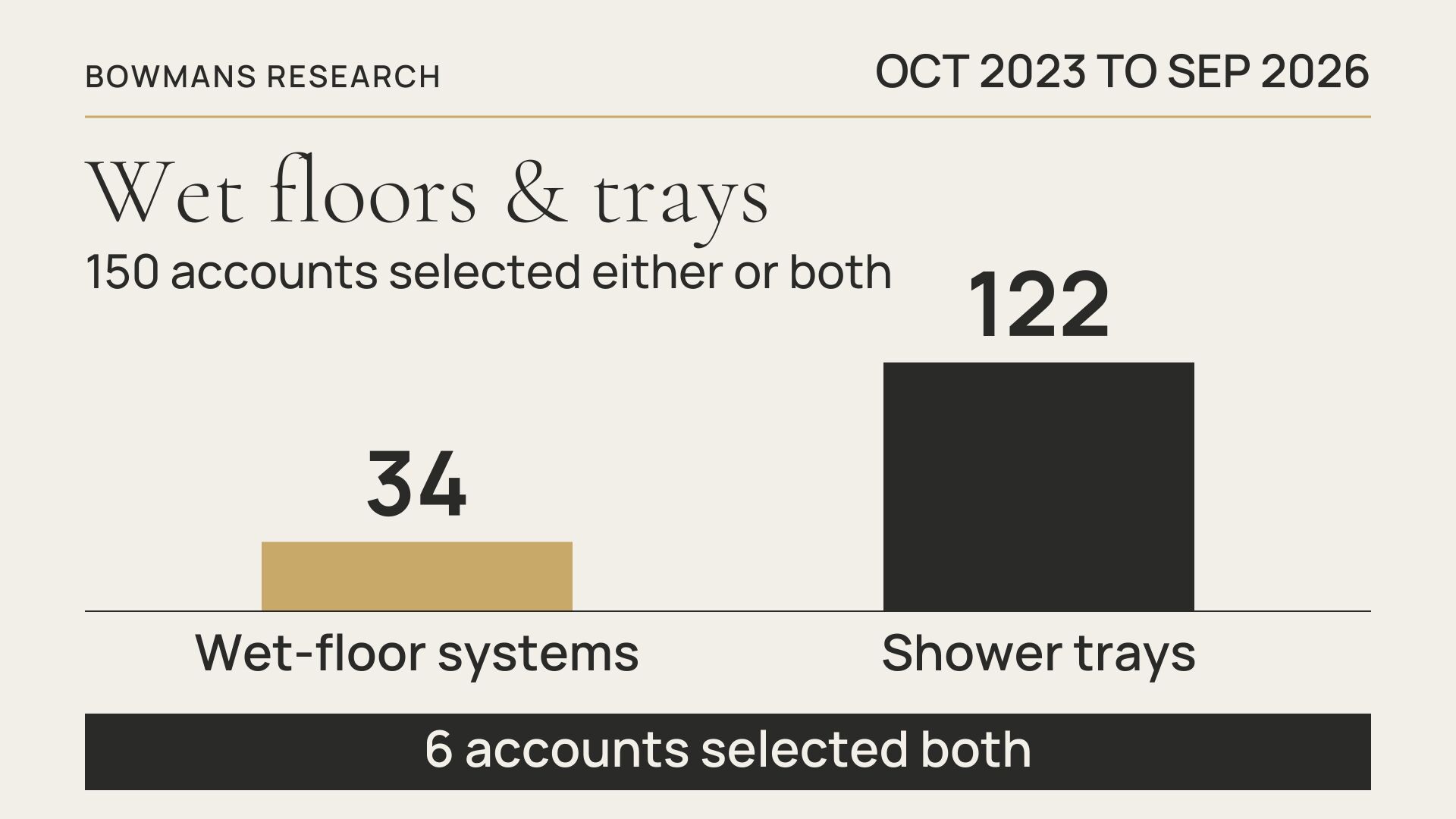
Across 227 customer accounts, we identified 150 that included at least one shower tray or wet-floor system. Of those, 116 selected a tray without an identifiable wet-floor system, while 28 selected a wet-floor system without a tray. Six accounts selected both. An account can cover different orders, rooms or projects; the records don't establish the finished layouts.
That doesn't mean a tray is right for every bathroom. It does show that identifiable wet-floor systems were the less common selection in the orders we could see. The practical decision still comes down to the floor construction, drainage, waterproofing and the type of shower entrance you want.
Quick Navigation
What the customer records show
The figures below cover customer accounts with an identifiable wet-floor system, shower tray or both between 1 October 2023 and 30 September 2026.
A customer account is the unit we counted. One account can include several rooms, projects or orders, so these aren't numbers of completed bathrooms or individual products sold.
| Selection recorded | Customer accounts | Share of accounts with either selection |
|---|---|---|
| Wet-floor system only | 28 | 18.7% |
| Shower tray only | 116 | 77.3% |
| Both | 6 | 4.0% |
| Total with either selection | 150 | 100% |
Across the full sample, 34 accounts included an identifiable wet-floor system and 122 included a shower tray. Those totals include the six accounts with both.
A further 77 of the 227 accounts had neither category identified. That could mean the order didn't involve a shower, the relevant product came from elsewhere or the available description wasn't clear enough to classify. We haven't treated an absence from our records as evidence that no shower base was installed.
You can see the figures alongside the other findings in the Bowmans Bathroom Choices Report 2026.
The 34 wet-floor-system accounts shouldn't be read as 34 completed wet rooms. We counted an account only where the records included an identifiable tiled-floor former or screed-forming system. Site-formed floors and products supplied directly by a fitter may not appear in Bowmans order data.
What we counted as a wet-floor system or shower tray
A shower tray is a finished base supplied as a visible product. A wet-floor system forms the fall beneath a tiled shower floor, using a floor former or a screed-forming system that directs water towards the waste.
The distinction matters because the finished rooms can look similar in photographs. A low-profile tray with a simple glass screen can have the open appearance people often associate with a wet room. A tiled floor, meanwhile, still needs a properly formed fall, drainage and waterproofing beneath the visible surface.
Our wet-floor category required an identifiable system supporting a tiled shower floor. That included floor formers and products such as an Aqua-Grade screed-forming system. Impey's installation information shows the difference between a floor former fitted into a floor structure and its modular Aqua-Grade sections used to form the shower fall in a new concrete floor.
We didn't assume that every order described as a walk-in shower was a wet-floor installation. And we didn't classify an ambiguous product as a tray or former simply because it appeared beside shower glass.
This is why the figures are useful as a record of identifiable product selections, but not as a count of every wet room fitted for a Bowmans customer.
The receipt-evidenced check
We also checked the result against a narrower group of 175 customer accounts linked to orders with positive receipt evidence.
Within that group, 117 accounts had either selection:
| Selection recorded | Customer accounts | Share of accounts with either selection |
|---|---|---|
| Wet-floor system only | 23 | 19.7% |
| Shower tray only | 89 | 76.1% |
| Both | 5 | 4.3% |
| Total with either selection | 117 | 100.1% due to rounding |
In total, 28 receipt-evidenced accounts included a wet-floor system and 94 included a shower tray, with five appearing in both totals.
The tray-only share was 76.1%, compared with 77.3% in the broader sample. That close result gives us a useful check, but it doesn't turn the records into a survey or establish what was eventually installed. Receipt evidence also doesn't necessarily mean an order was fully paid or that the bathroom was completed.
These remain selection snapshots from the records available to us.
The floor and the glass are separate decisions
An open shower entrance doesn't automatically require a tiled wet floor. You can use a walk-in glass screen with a shower tray, just as a wet-floor system can be combined with glass to control where the water goes.
That distinction is easy to miss if you begin with an image of the finished shower rather than the construction beneath it.
The base deals with the floor, fall, waste and waterproofing arrangement. The glass deals with the enclosure and where the water is likely to travel while the shower is being used. They need to work together, but they aren't the same choice.
Our walk-in shower research looks at the enclosure side separately. For a fuller comparison of the two base constructions, see wet-room former vs shower tray.
What to check before choosing
We'd start with the floor construction rather than deciding from appearance alone.
Ask your fitter what can be accommodated within the existing floor build-up and where the waste can run. A tiled wet floor needs a suitable fall towards the drain, but how that is formed depends on the structure beneath it. A shower tray has its own fitting requirements, so it shouldn't be treated as a product you can choose without checking the room either.
The main points to settle are:
- whether the floor can accept the proposed former, screed system or tray
- where the waste will sit and how the drainage route will work
- how the shower area and surrounding floor will be waterproofed
- which products are covered by the fitter's waterproofing and installation guarantee
- whether the glass arrangement will contain water in the available space
- who is supplying each part of the system
The bit people often miss is responsibility. If the former, drain, waterproofing and glass come from different places, establish who is checking that they work together before anything is ordered. The same applies if you're buying products from Bowmans for installation by your own fitter.
Our guide to bathroom tanking explains the waterproofing side in more detail.
For most projects, we'd choose the shower base only after checking the floor build-up, waste position and proposed glass. The records show that trays were the more common selection, but they don't tell us which construction is right for your room.
If you bring your room dimensions, floor information and fitter's requirements to Braintree or Leigh-on-Sea, we can help you specify compatible products through our bathroom design and supply service. We also welcome supply-only projects where you already have a fitter.
Methods and sources
This research covers 1 October 2023 to 30 September 2026 and was retrieved on 2 October 2026. We assessed 8,914 item lines across 455 qualifying order records linked to 227 customer accounts. The work began with 560 candidate TruBlue records and 113 current CRM sales orders. Where 115 detailed TruBlue records were explicitly linked to 88 CRM orders, they were folded into the current CRM order lines once to avoid double counting.
Order dates came from the first dated positive receipt where available, followed by live acceptance, historical acceptance or a positive non-credit invoice date. We didn't substitute creation or import dates. The receipt-evidenced check covers 315 orders across 175 accounts.
Current item descriptions retrieved in 2026 were attached to historic order dates, so the study isn't a reconstruction of every order exactly as it stood at the time. Late amendments may be present. Voided, removed, swapped, optional and by-others items were excluded, as was an explicitly returned tray where a replacement was recorded. The replacement remained eligible. Ambiguous items remained unknown.
This is an available-record study, not an audited exhaustive ledger, national market survey or survey of customer preferences. The records include different buying arrangements and some trade accounts. They can't establish purchase motives, installed layouts, daily use or products retained or bought elsewhere.
The primary sources are the Bowmans Bathroom Choices Report 2026 and its aggregate research tables.