
Bowmans / Original research
Walk-in shower screen or door: what our order research shows
If you’re choosing a shower tray, our records don’t point to one obvious answer on the glazing.
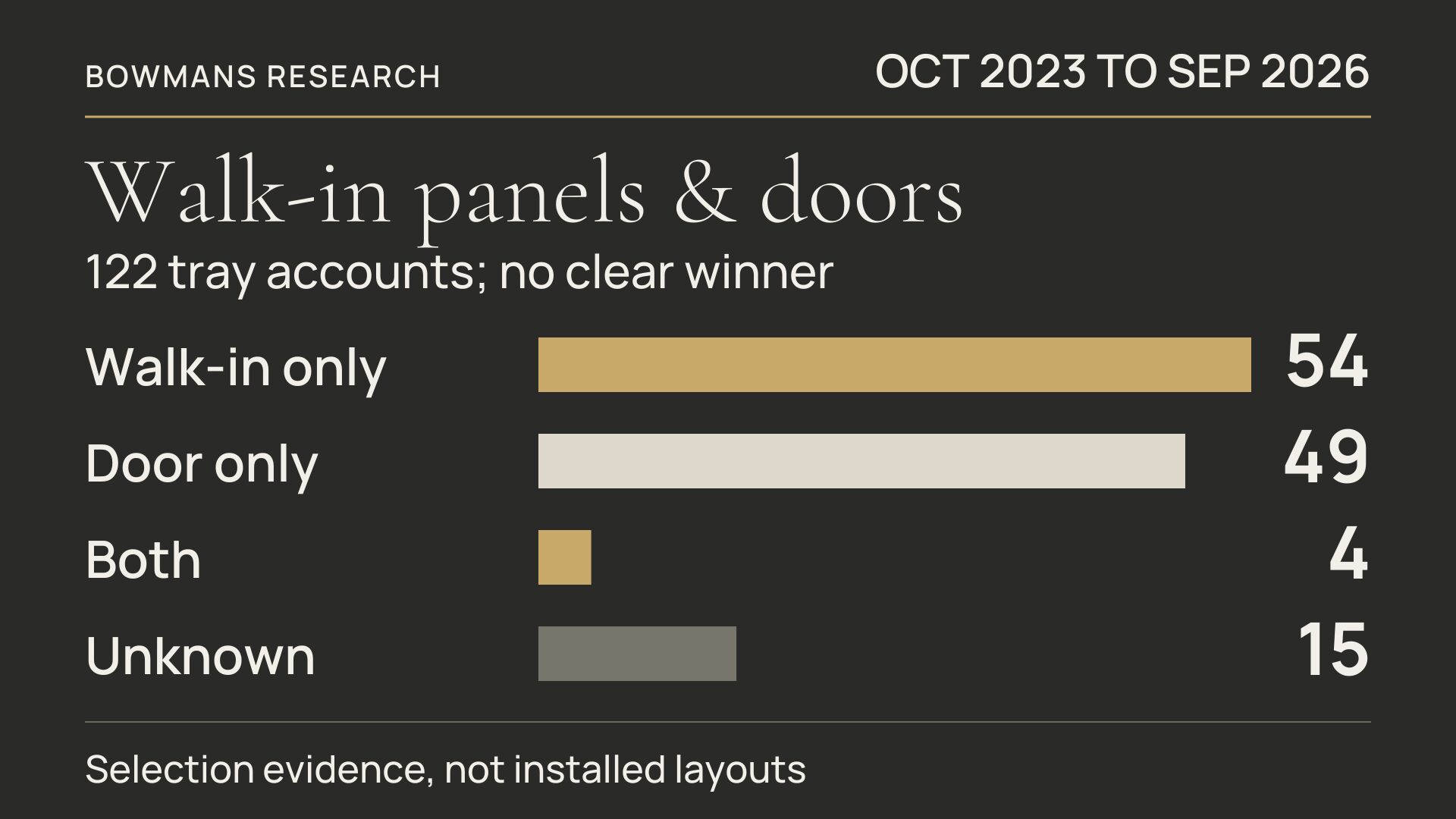
Across the research period, 1 October 2023 to 30 September 2026, among 122 customer accounts with an identifiable tray, 54 had walk-in evidence only and 49 had door evidence only. Four had evidence of both, while 15 couldn’t be classified from the surviving order descriptions.
That makes the recorded split close enough that we wouldn’t treat either option as the default. The right choice still depends on the room, the entrance into the shower and how the fittings will be arranged.
Quick Navigation
The recorded enclosure choices
| Recorded evidence | Customer accounts | Share of tray accounts |
|---|---|---|
| Walk-in evidence only | 54 | 44.3% |
| Door evidence only | 49 | 40.2% |
| Both evidence types | 4 | 3.3% |
| Unclassified only | 15 | 12.3% |
| Total | 122 | 100.1% due to rounding |
These figures cover customer accounts rather than individual shower screens or doors. One account can include more than one room, project or order, so the counts shouldn’t be read as units sold or completed bathrooms.
They also describe what we could identify in the order records. “Walk-in evidence only” doesn’t prove that the finished shower had no door bought elsewhere or added later. In the same way, “door evidence only” describes the evidence we found rather than every piece of glass in the completed room.
The figures come from the Bowmans Bathroom Choices Report 2026.
In this research, walk-in evidence means an identifiable tray with a main fixed screen and no complete shower door recorded. Door evidence means the order contained an identifiable shower door or enclosure with a door.
The distinction matters because a fixed screen and a door affect the room differently. A screen leaves an open entrance. A hinged or sliding door creates a more defined enclosure and changes how you approach the shower.
This isn’t a full comparison of wet rooms and trays. If you’re still deciding between those two starting points, read our guide to wet rooms and walk-in showers first.
What counts as walk-in evidence
We only classified an order as walk-in evidence when there was one identifiable tray, a main fixed screen and no complete door recorded.
A small return panel on its own wasn’t enough. Nor did we classify orders where multiple or mixed shower bases made it unclear which glazing belonged with which tray.
There were 18 tray accounts with some uncertainty in their orders. Three also had a known enclosure choice elsewhere in their records, leaving 15 accounts where the evidence was unclassified throughout.
A main panel with no door on the order is evidence of a walk-in selection, but it isn’t proof that the completed shower was doorless. The customer may have retained an existing item, changed the order later or bought something elsewhere.
This is why the categories use the word “evidence”. The records can show what Bowmans supplied or recorded, but they can’t establish every finished layout or why a customer made a particular choice.
Why the result is close
The small lead changes when we look only at orders with dated receipt evidence.
Scroll the table sideways to see all columns.
| Recorded evidence | All qualifying tray accounts | Share | Receipt-evidenced tray accounts | Share |
|---|---|---|---|---|
| Walk-in evidence only | 54 | 44.3% | 38 | 40.4% |
| Door evidence only | 49 | 40.2% | 41 | 43.6% |
| Both evidence types | 4 | 3.3% | 2 | 2.1% |
| Unclassified only | 15 | 12.3% | 13 | 13.8% |
| Total | 122 | 100.1% due to rounding | 94 | 99.9% due to rounding |
Across the full qualifying sample, walk-in evidence only is ahead by five accounts. In the receipt-evidenced subset, door evidence only is ahead by three.
That reversal is more useful than trying to name a winner. It shows how easily a small ranking can change when the evidence filter changes.
The receipt-evidenced subset contains 94 tray accounts from orders with a dated positive receipt. It gives us a firmer date trail, but it isn’t necessarily a record of fully paid or completed projects. The broader sample includes valid commitments without surviving receipt evidence, so neither view should be treated as the single correct measure of popularity.
Our practical reading is that both arrangements are established choices with trays. The figures don’t give you a reason to choose one over the other without first looking at the bathroom plan.
Choosing the opening
Start by marking the entrance and every fitting on the plan. A screen or door can look perfectly sensible in isolation and still be awkward once the basin, toilet, towel rail and shower controls are in place.
We’d check:
- where you’ll stand as you enter the shower
- whether a hinged door has room to move without meeting another fitting
- whether a sliding door gives more useful access in the available space
- whether you can reach the controls without stepping directly under the shower
- the manufacturer’s stated opening and adjustment for the exact product
- the likely direction of splash, discussed with your fitter before the glazing is ordered
Don’t choose from a photograph and assume the opening will work the same way in your room. The tray size, panel position, shower outlet and nearby fittings all affect the decision.
It’s also worth choosing the tray before finalising the glazing. Our guide to shower tray sizes explains what to settle before you move on to the screen or door.
A tray can be designed for use with walk-in glazing. Lakes, for example, sells a named tray-and-walk-in system. That shows the combination exists as a coordinated product, but it doesn’t mean every screen will suit every tray. Check the stated compatibility and adjustment for the products you’re actually buying.
If the plan allows either arrangement, we’d make the decision on access, splash control and how you want to use the shower. The order research tells us that both are normal choices. It can’t tell us which one will work better in your room.
Methods and sources
This available-record study covers 1 October 2023 to 30 September 2026, using Europe/London dates. The data was retrieved on 2 October 2026.
We examined 560 candidate TruBlue records and 113 current CRM sales orders. Explicit links were used to reconcile them, and 115 detailed TruBlue records represented in 88 CRM orders were folded into the current CRM order lines once. After exclusions and reconciliation, the broad research sample contained 455 qualifying order records across 227 customer accounts, with 8,914 item lines assessed.
Order dates came from the first dated positive receipt where available, followed by live acceptance, historical acceptance or a positive non-credit invoice date used as a proxy. We didn’t substitute creation or import dates. The receipt-evidenced subset used here contains 315 orders across 175 accounts; 94 of those accounts had identifiable tray records.
Current item descriptions retrieved in 2026 were attached to historic dates, so this isn’t a reconstruction of each order exactly as it first stood. Late amendments are possible. Voided, removed, swapped, optional and by-others items were excluded, as was an explicitly returned tray where a replacement was recorded. The replacement remained eligible. Ambiguous records remained unclassified.
This isn’t an audited exhaustive ledger, a national market survey or a preference survey. The records include some trade accounts and different buying arrangements. They don’t establish purchase motives, installed layouts, daily habits or products retained or bought elsewhere.
The primary sources are the Bowmans Bathroom Choices Report 2026 and its aggregate research tables.
If you’re planning the room now, bring the dimensions and proposed layout to Braintree or Leigh-on-Sea. We can help with bathroom design and supply, or specify the tray and glazing for your existing fitter.