
Bowmans / Original research
Baths and shower trays: what three years of Bowmans orders show
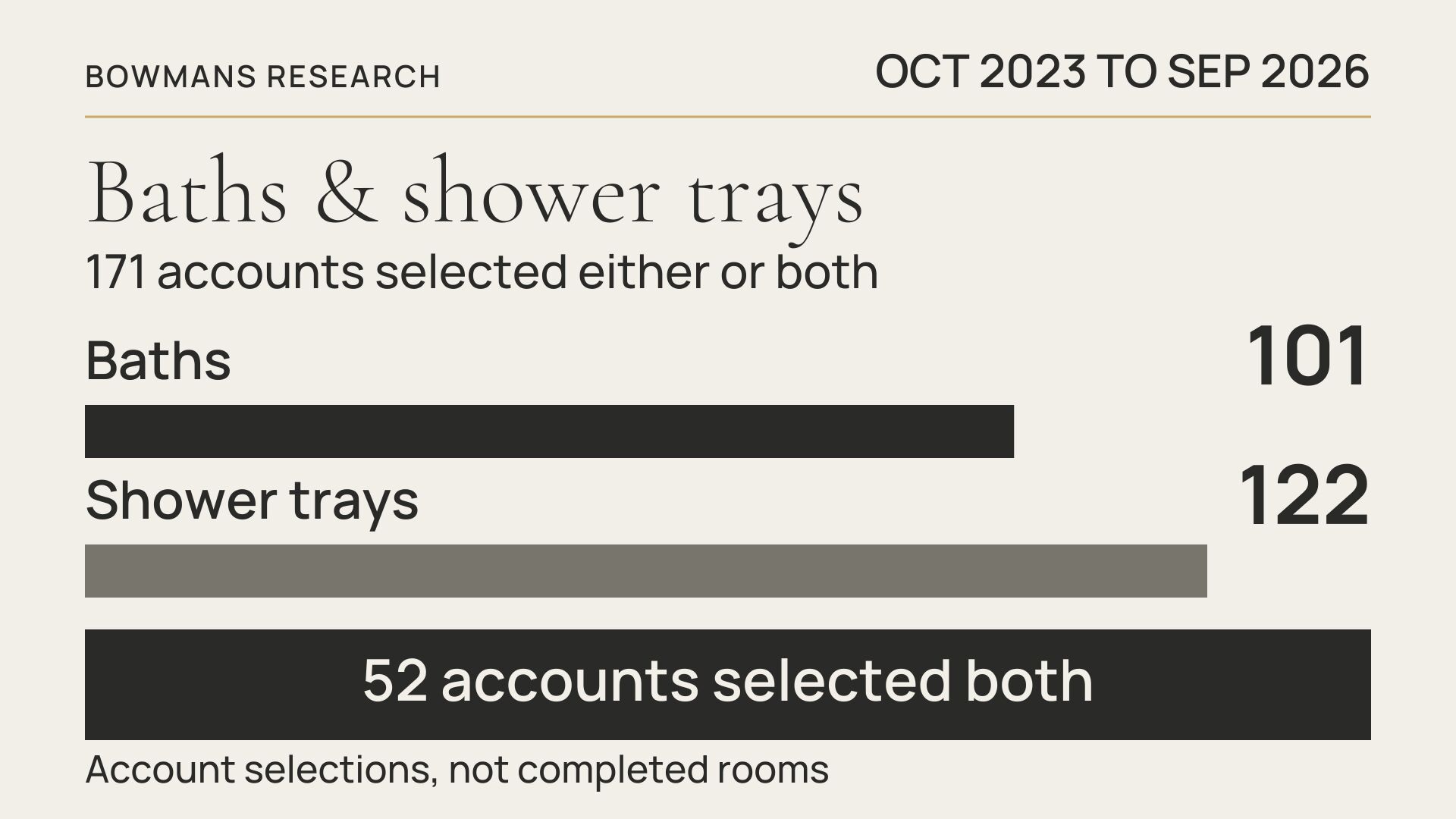
Between 1 October 2023 and 30 September 2026, 101 of the 227 customer accounts in our qualifying order records included a bath. A shower tray appeared in 122.
That doesn't mean shower trays replaced baths. Fifty-two accounts included both, so this isn't a straightforward choice between one and the other.
In this research, a shower tray means the tray forming the base of a shower enclosure or walk-in shower. The figure doesn't include showers fitted over baths or showers with another type of finished floor, so it isn't a count of every shower supplied.
Quick Navigation
What the orders show
Of the 171 accounts that included either a bath or a shower tray, 70 selected a tray without a bath and 49 selected a bath without a tray. The remaining 52 included both.
| Recorded selection | Customer accounts | Share of accounts with either |
|---|---|---|
| Bath only | 49 | 28.7% |
| Shower tray only | 70 | 40.9% |
| Both | 52 | 30.4% |
You can see the figures and their wider context in the Bowmans Bathroom Choices Report 2026.
The tray-only group was the largest. These order selections don't establish whether a bath was replaced or removed, and nearly a third of the accounts with either category included both.
There were also 56 accounts with neither recorded. That doesn't establish that these customers had no bath or shower. They may have been buying for a cloakroom, purchasing only part of a bathroom from Bowmans or keeping something already installed. The records don't tell us what was retained or bought elsewhere.
Why the accounts with both matter
The 52 accounts containing both a bath and a shower tray show why these products shouldn't always be treated as direct alternatives.
A customer account can cover more than one room, project or order. Someone might be buying a bath for one room and a tray for another. The records don't show the installed layouts, so we can't say that all 52 accounts resulted in a bath and separate shower in the same bathroom.
Even with that limitation, the overlap is useful. It shows that choosing a shower tray doesn't necessarily settle the question of whether a home should also have a bath.
That matters when you're planning several rooms. The main bathroom, an en suite and a guest bathroom don't all need to do the same job. It can be more useful to decide what each room needs to provide than to ask whether baths or showers are generally more popular.
Checking the result against orders with receipt evidence
We also checked the pattern using the smaller group of orders with dated receipt evidence. This covered 315 orders across 175 customer accounts.
Within that subset, 81 accounts included a bath and 94 included a shower tray. Forty included both. Of the 135 accounts with either category, the split was:
| Recorded selection | Customer accounts | Share of accounts with either |
|---|---|---|
| Bath only | 41 | 30.4% |
| Shower tray only | 54 | 40.0% |
| Both | 40 | 29.6% |
The proportions are close to those in the broader sample. That gives us a useful check on the main finding: tray-only selections were the largest group, but a substantial number of accounts contained both categories.
The receipt evidence doesn't prove that an order was fully paid, installed or completed. It simply gives us a firmer dated subset to compare with the wider records.
What this means when planning your bathroom
Don't remove or keep a bath simply because another customer's order included one. These figures describe recorded selections, not which layout will work in your home.
Start with how the room needs to be used and what the rest of the property already provides.
- If this is the only bathroom, decide whether anyone using the home needs or strongly prefers a bath.
- If another room already has a suitable bath, the room you're planning may be able to concentrate on providing a better shower.
- If you're working across several bathrooms, decide which room should handle each job rather than repeating the same arrangement everywhere.
- If you want a bath and separate shower in one room, check that both can fit without leaving either cramped or making movement around the room awkward.
The figures don't support claims about resale value, water use or mobility. They also don't tell us why an account contained a particular product. Those questions need to be considered separately rather than inferred from an order description.
Once you've decided that a bath belongs in the plan, the next question is which type suits the room. Our guide to freestanding and built-in baths explains the practical differences.
If you're planning a shower, choosing the tray is only part of it. Its size has to work with the available floor area and the enclosure you intend to use. The shower floor and enclosure remain separate choices, even when they're planned together. Our guide to shower tray sizes covers that decision in more detail.
A tray-only count shouldn't be read as a count of all showers. It excludes showers over baths and any shower using another type of floor.
We'd use this research as context, not as a rule for your layout. The useful decision is which facilities your home needs, which room should contain them and how much space each one requires.
Methods and sources
This is an available-record study of Bowmans orders, not a national market survey or a survey of customer preferences.
We examined 560 candidate TruBlue records and 113 current CRM sales orders. Records explicitly linked across the two systems were reconciled so that 115 detailed TruBlue records represented in 88 CRM orders were folded into the current CRM order lines once.
The resulting broad sample contained 455 qualifying order records across 227 customer accounts, with 8,914 item lines assessed. The customer account was used as the unit for selections because one account can cover several orders, rooms or projects and can include more than one fixture category.
Order dates came from the first dated receipt with positive net receipts for 315 orders, live acceptance for 49, historical acceptance for 27 and positive non-credit invoice dates as proxies for 64. Creation and import dates weren't substituted. The broader sample therefore includes commitments without surviving receipt evidence.
Current item descriptions retrieved in 2026 were attached to historic dates, rather than reconstructing each order exactly as it appeared at the time. Late amendments may be present. Voided, removed, swapped, optional and by-others items were excluded, as was an explicitly returned shower tray where a replacement was recorded. Ambiguous items remained unknown. Eleven groups had partial credit evidence and were also checked through a sensitivity excluding them.
The records include some trade accounts and different buying arrangements. They don't establish purchase motives, completed room layouts, daily habits or products retained or bought elsewhere. Counts refer to accounts containing a selection, not units sold, unique households or completed bathrooms.
The research window was 1 October 2023 to 30 September 2026 in Europe/London, and the data was retrieved on 2 October 2026. The primary sources are the Bowmans Bathroom Choices Report 2026 and its aggregate research tables.
If you're deciding what belongs in your own layout, Bowmans can help with bathroom design and supply from our Braintree and Leigh-on-Sea showrooms. We also welcome supply-only projects where you already have a fitter and need help choosing and specifying the products.