Bowmans · Inspiration · Design

Wet room vs walk-in shower: which is right for your bathroom?

By Jonathon Barclay, Founder 17 min read

Most UK retailers use the terms wet room and walk-in shower interchangeably, which is where the confusion starts. They are not the same thing — not in cost, not in install, not in regulation, and not in how they live with you for the next twenty years. One is a fully tanked, gradient-floored, single-zone bathroom. The other is a defined showering area inside a normal bathroom. The right answer for your project depends on your property, your floor, your spend, and what you actually want the room to feel like. Here is the honest comparison.

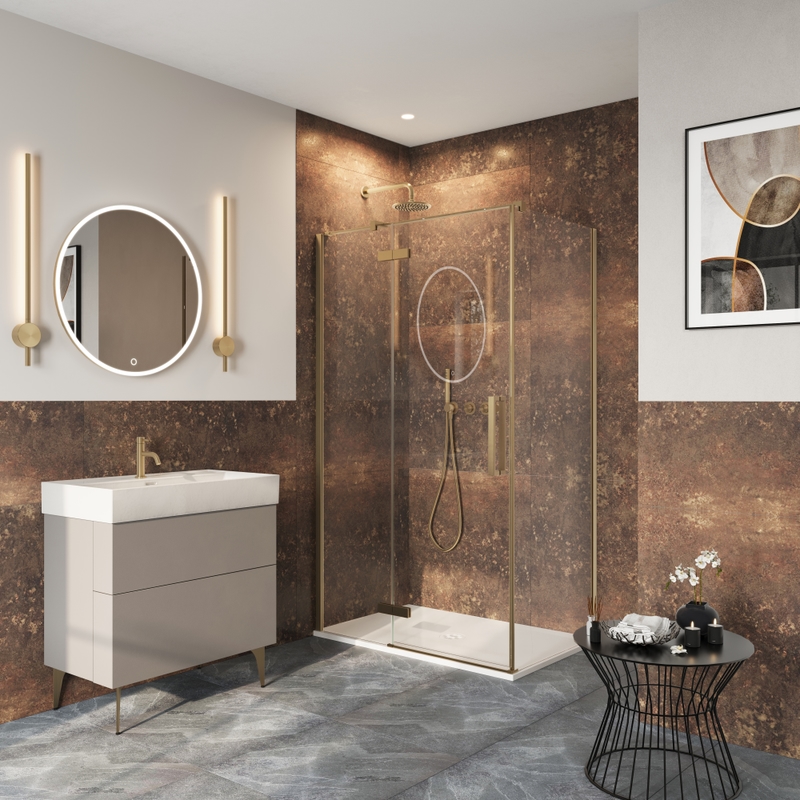
Walk-in shower vs wet room - Lakes Cannes frameless walk-in enclosure with low-profile tray, brushed brass thermostatic shower set, large-format porcelain tile, sage green wall panelling - the walk-in shower configuration as a defined showering zone inside a dry bathroom
The walk-in shower configuration — defined enclosure, low-profile tray, frameless glass, dry bathroom around it. The lower-cost, faster-install side of the comparison.

01 · The definitions

What is the actual difference between a wet room and a walk-in shower?

A wet room is a fully tanked bathroom where the entire floor is the drainage zone. There is no shower tray. There is often no glass screen at all, or just a single splash-panel. The whole floor has a gradient fall built into the screed or a pre-formed substrate, and water runs across that gradient to a linear or central drain. The walls are tanked from skirting to ceiling height in the wet zones. The room is, in effect, a single waterproof envelope.

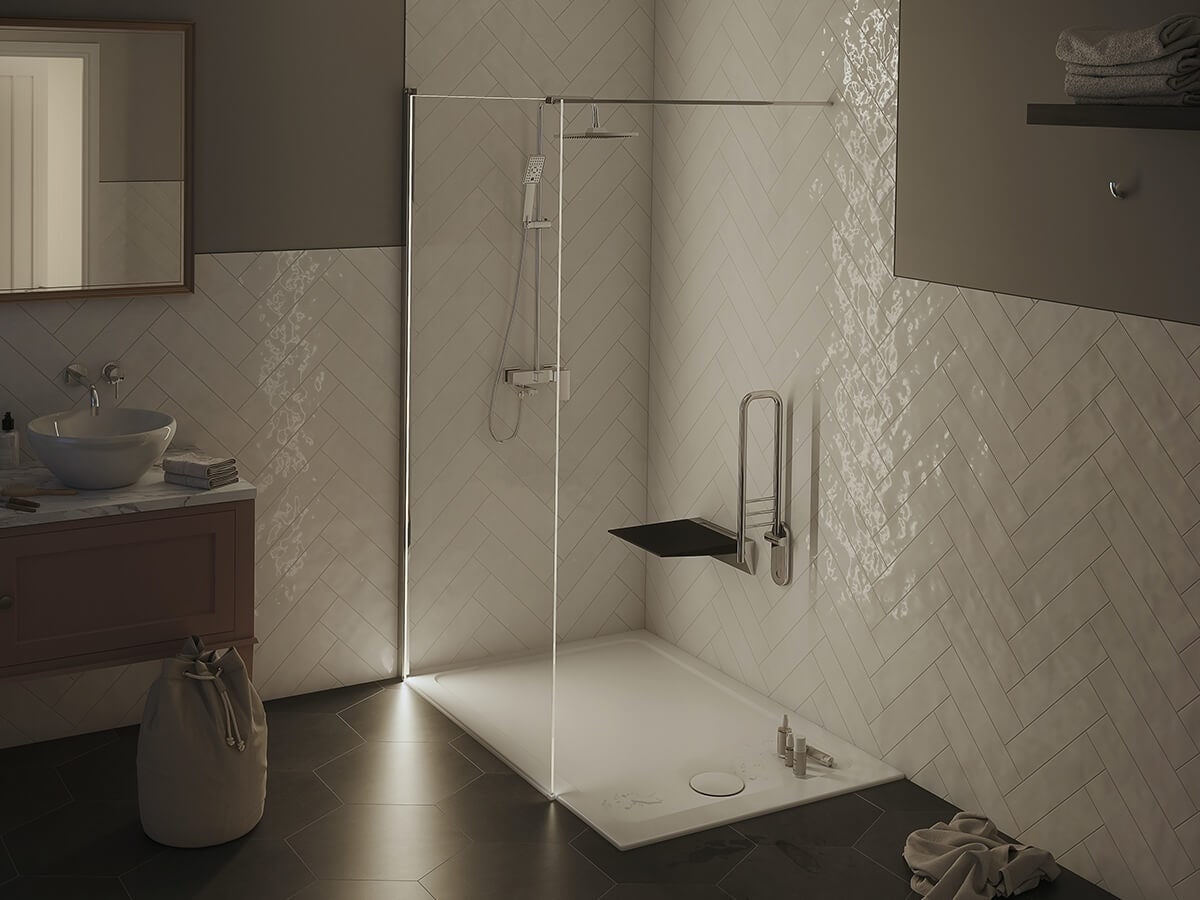
A walk-in shower is a defined showering area inside an otherwise normal bathroom. There is a tray — either a low-profile (40–70 mm) acrylic or stone-resin one sitting on the floor with a step, or a flush-fitted tray let into the substrate so the top surface sits level with the surrounding floor. There is a frameless glass screen or panel defining the showering zone. The rest of the bathroom — the WC area, the basin and vanity, the bath if there is one — stays dry. Waterproofing is required inside the shower zone only.

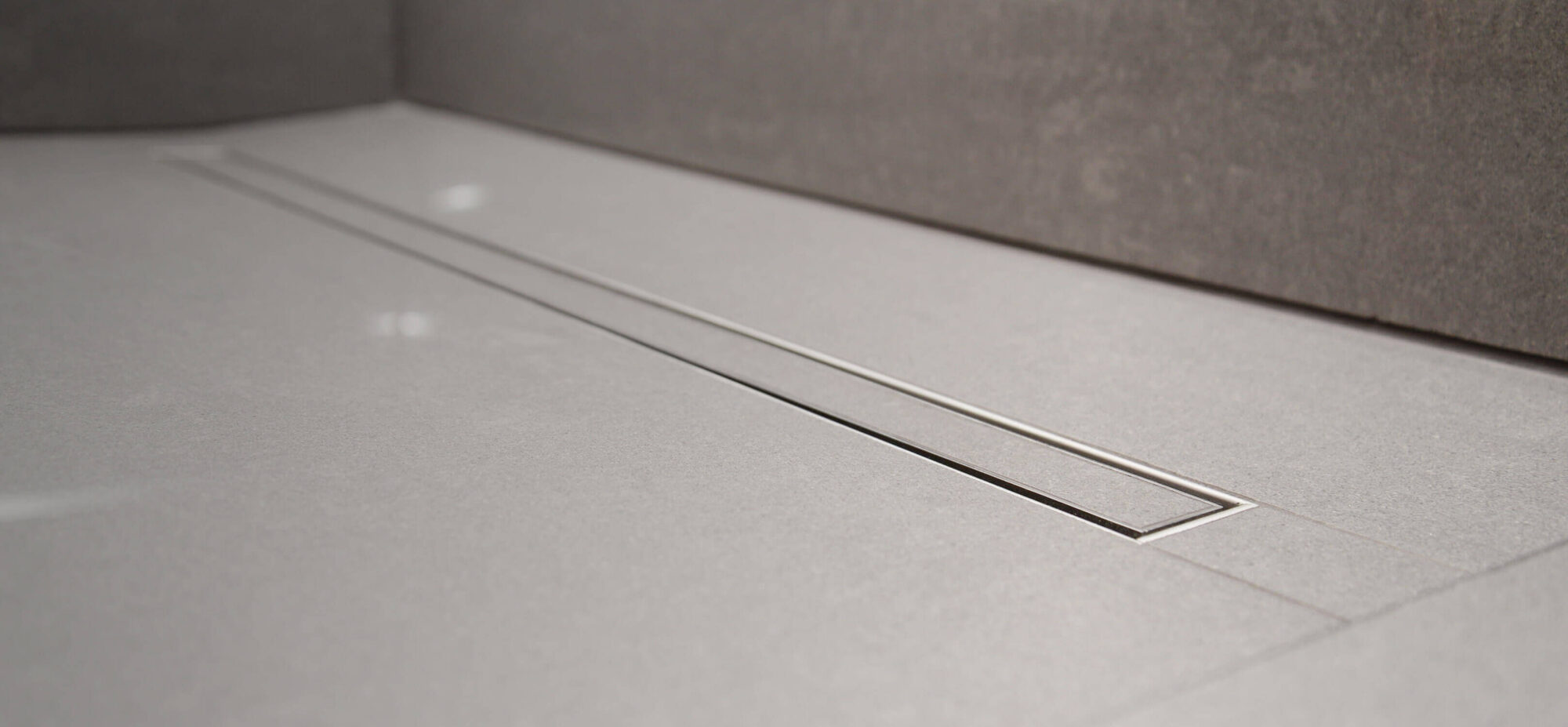
That is the structural difference. The retail confusion comes from the fact that a flush-fitted walk-in shower with a single splash-screen and large-format tile carrying through the rest of the floor looks like a wet room from a Pinterest distance. It is not. The build-up underneath is a tray-and-tank arrangement, not a fully gradient-screeded waterproofed floor. The visible difference is mostly the drain — a wet room has a single linear or gully drain set into the gradient floor; a walk-in shower has a drain inside the tray.

Why this matters for buyers: the cost, the install timeline, the Building Regulations responsibilities, the suitability for upstairs floors, and the failure-mode consequences of the two are genuinely different. Treating them as interchangeable is how you end up paying wet-room money for a walk-in shower, or worse, expecting walk-in-shower install simplicity from a wet-room build.

02 · The wet room

Wet room: what it is, and when it is the right answer

A wet room solves three real problems. It makes a small bathroom feel larger because the visual continuity of a single tiled floor reads as more space than a tray-and-screen arrangement that breaks the room up. It is the only bathroom configuration that complies with Approved Document M4(3) (wheelchair-user dwellings) without modification — a level-access shower of at least 1200 mm × 1200 mm with a 1500 mm turning circle is exactly what a properly-built wet room provides. And it allows for the floor materials — large-format porcelain, cast micro-cement, natural stone — to run continuously across the room, which is the visual move most luxury wet rooms are actually buying.

The structural build-up of a UK wet room follows a defined order. Substrate preparation first — on a timber floor, that means deflection-rated tile-backer board or a manufacturer-rated former such as On The Level, Wedi or Schluter Kerdi-Line. The former carries the gradient fall built in, typically 1:50 to 1:80 depending on the tile size and drain position, with the BS EN 12056-2 minimum dictating the pipe-diameter-and-length calculation rather than a single fixed figure. Tanking system applied next — a paint-on liquid membrane or sheet-membrane system bonded to substrate, lapped at perimeters, sealed at every pipe penetration. Tile bedding on top of the cured tanking with a flexible polymer-modified adhesive. Grout flexibility-rated for wet zones. Brassware and drain set last.

Get any one of those layers wrong and the wet room fails invisibly during install and expensively in year three. Tanking-failure rectification is the single most expensive bathroom rework on UK trade forums — ceiling damage to the room below, wet plasterboard, mould remediation, and a full tile-up and start-again on the original installer’s bill (or yours, if the installer disappeared). This is why wet rooms reward a specialist installer rather than a generalist plumber.

UK wet room build-up - On The Level pre-formed wet-room substrate former with built-in gradient fall to a linear drain, full-floor tanking and large-format porcelain tile carrying continuously across the floor without a tray or kerb
A wet-room substrate former with the gradient fall pre-built in — the structural foundation that distinguishes a true wet room from a flush walk-in shower. On The Level system shown.

When a wet room is the right answer

Four scenarios where the wet room earns its premium consistently:

  • Small ensuites under 5 sq m. The floor continuity makes the room feel larger; the lack of a tray-and-screen footprint reclaims usable square metres.
  • Accessibility-adapted bathrooms. Approved Document M4(3) compliance is structurally inseparable from the wet-room build — level access, 1200 × 1200 mm minimum showering area, no kerb to step over.
  • Visually-led principal suites where the floor material is the architecture. A book-matched Ca’ Pietra stone slab or a continuous micro-cement floor only reads correctly without a tray interrupting it.
  • Loft conversions where ceiling height is short. A flush-fitted wet-room floor avoids the 70–120 mm tray sitting proud of the joists, which matters when the headroom is already marginal.

Outside those four cases, the cost-and-install premium of a wet room is buying you visual preference rather than functional advantage. That is a perfectly good reason to choose one — just go in knowing that is what you are paying for.

03 · The walk-in shower

Walk-in shower: what it is, and when it is the right answer

A walk-in shower is the configuration most UK family bathrooms quietly default to in 2026, and for good reasons. It gives you the visual openness of a wet room across the showering zone — large-format tile, frameless glass, no shower-curtain or hinged-door choreography — without the structural complexity of full-floor tanking. The Houzz UK 2025 Bathroom Trends Study reports 58% of respondents enlarged their primary shower during their renovation, and 25% by more than 50%. That space mostly went into walk-in shower zones, not wet rooms.

The build-up is straightforward. A flat substrate, primed and waterproofed inside the shower zone (the tanking lap stops 200 mm beyond the screen line, not at the room perimeter). A tray dropped in — either a low-profile Lakes or Roper Rhodes stone-resin tray sitting on the floor with a 40–60 mm step, or a flush-fitted tray let into the substrate. Frameless glass screen fixed to the wall and floor. Tile run up to and around the screen channel. Thermostatic valve and shower set installed last.

What you get out of that build-up: simpler labour, faster install (typically 2–3 days less than a wet room of the same footprint), more forgiving tolerances, and a defined drainage zone where any leak shows up immediately rather than tracking under the rest of the floor. What you give up: the floor-material continuity, the M4(3) compliance, and (on cramped ensuites) the few square metres a tray-and-screen footprint costs you.

When a walk-in shower is the right answer

Five scenarios where it wins on practical grounds:

  • Family bathrooms with an existing bath you want to keep. A walk-in shower alongside a freestanding bath is the standard luxury family-bathroom configuration in 2026. A wet room with a bath is a structural awkwardness most clients regret.
  • Tighter project budgets. The £1,500–£3,500 saving versus a wet room funds a meaningful spec uplift elsewhere — better brassware, larger-format tile, a freestanding bath upgrade.
  • Faster project timelines. 2–3 days less on site is consequential when you are bathing the whole family at the in-laws for the duration.
  • First-time renovation buyers without a specialist wet-room installer in the local trade pool. Walk-in showers are within the competence of any good general bathroom installer; wet rooms reward a specialist.
  • Conventional family-home configurations where the bathroom looks — and is sold — as a bathroom. Buyers searching for family homes mostly want a bath plus a shower somewhere, not a single tanked wet room.

04 · The comparison

Wet room vs walk-in shower: the eight-point comparison

The honest side-by-side. Eight points where the two options genuinely differ in 2026, with the trade-off named on each side rather than a winner declared.

Point Wet room Walk-in shower
Install cost +£1,500–£3,500 over walk-in for same footprint Baseline for a like-for-like luxury bathroom
Install time +2–3 days for substrate falls and tanking cure Faster — tray and screen drop in cleanly
Tanking Full-floor and full-height in wet zones Inside the shower enclosure only
Drainage Linear or central, set into the gradient floor; pipe fall calculated per BS EN 12056-2 In-tray drain — standard plumbed waste
Glass Often none, or a single splash panel Frameless screen, sometimes a hinged door
Resale signal Modern, aspirational, accessibility-friendly — valued at par with quality walk-in Conventional, family-friendly — valued at par with quality wet room
Accessibility Approved Document M4(3) compliant by build — level access, 1200 × 1200 mm minimum Tray creates a 40–70 mm step unless flush-fitted
Repair Tanking failure is expensive and disruptive — whole floor up Tray or screen failures are localised and quicker to fix

Cost and timing differentials reflect Bowman 2026 supplier pricing for a 5–6 sqm UK family bathroom; site conditions and substrate type can shift figures.

05 · The cost reality

What does each actually cost in the UK in 2026?

The honest answer: the product cost is broadly similar between the two configurations. The brassware is the same valve, the same shower set, the same handset; the glass is broadly comparable in price; the tile quantity is in the same range. Where the wet-room premium lives is in the floor build-up — the substrate former or screeded gradient fall, the full-room tanking system, the linear drain, and the additional labour days.

For a 5–6 sq m UK family bathroom in 2026, the indicative differential breaks down like this:

Wet-room premium over walk-in shower — line by line

Item Walk-in shower Wet room Differential
Substrate & falls Standard backerboard, flat Pre-formed substrate (Wedi / On The Level) or screeded fall +£400–£900
Tanking system Shower zone only (~3 sq m) Full floor plus full-height wet zones (~12 sq m+) +£300–£700
Drainage In-tray drain, standard waste run Linear drain, gradient-fall waste run +£200–£500
Tile cuts & labour Flat floor — standard cuts Mitred cuts to gradient and drain edges +£400–£900
Tray Stone-resin or acrylic tray, £300–£800 None — replaced by substrate former cost above −£300–£800 (saved)
Net wet-room premium +£1,500–£3,500

Indicative ranges based on Bowman 2026 supplier pricing. Net premium scales with room size and substrate complexity; loft-conversion and concrete-slab installs sit at opposite ends of the band.

The wet-room premium of £1,500–£3,500 sits inside the standard luxury band rather than dictating it. On a £25,000 luxury bathroom build the option lands the project at £26,500–£28,500 — meaningful, but not the figure that decides the project. The harder cost question is the one most quotes do not break out clearly: how does the showroom price its products?

Most UK designer-led showrooms price products a touch above the major online retailers (Drench, Victorian Plumbing, the supplier-direct sites). The spread funds the ‘free’ design service. Bowman benchmarks against the major online retailers on every brand we sell; the design service is added value the business absorbs, not a margin uplift folded into your basket. The honest test for any showroom you are talking to: ask how their pricing on the same brassware, sanitaryware and tile compares to Drench or Victorian Plumbing line by line. If the answer is vague, the design is not really free. We covered the full pricing model in our luxury bathroom cost UK guide.

06 · The buyer’s-guide regulatory aside

UK Building Regulations: the bits both options must clear

Both wet rooms and walk-in showers are bathroom installs and are governed by the same Approved Documents. The differences are in how the rules are applied to a single-zone tanked floor versus a defined showering enclosure. Five regulatory beats matter for buyers in 2026, and asking about them is one of the strongest signals you can give a showroom or installer that you know what you are looking at.

BS 7671 Amendment 3:2024 — bathroom electrical zones

The current edition of the IET Wiring Regulations is BS 7671:2018 incorporating Amendment 3:2024, published 31 July 2024 and in force until Amendment 4 (the 19th Edition) is expected on 15 October 2026. The bathroom-zone framework matters for both wet rooms and walk-in showers because the zones are defined by water exposure, not by enclosure type:

  • Zone 0 — inside the bath or the shower zone itself. IPX7 minimum protection rating; SELV (separated extra-low voltage) limited to 12 V.
  • Zone 1 — from the floor of the shower up to a height of 2.25 m above floor level. IPX4 minimum.
  • Zone 2 — 0.6 m horizontally beyond Zone 1. IPX4 minimum.
  • Zone 3 has been removed in current editions. Older guidance referencing it is out of date.
  • 30 mA RCD protection is mandatory on every bathroom circuit — lighting, shaver socket, extract fan, underfloor heating (almost universal in wet rooms because the floor is tiled stone or porcelain), the lot.

Wet rooms shift Zone 1 outward because there is no enclosure boundary — the shower zone is the floor area within the gradient catchment, which often extends further than a tray-and-screen footprint. Light fittings, shaver sockets, mirror demisters and extract fans need to be plotted against the zones after the wet-room layout is finalised, not before. Walk-in showers have a simpler zone calculation because the screen line defines the boundary.

Bathroom electrical work is notifiable under Approved Document P, meaning it must be carried out by a Part-P registered competent-person electrician or notified to Building Control before work starts. Source: gov.uk Approved Document P and IET BS 7671.

Approved Document G — water and sanitation

Approved Document G (sanitation, hot water safety, water efficiency) is the 2015 edition incorporating the 2024 amendments, in force from 1 October 2024. Two beats matter for wet rooms and walk-in showers:

  • Bath-fill thermostatic mixing must limit maximum outlet temperature to 48°C — this applies regardless of whether the bathroom has a wet room, a walk-in shower, both, or just a bath.
  • Water efficiency target is 125 L per person per day for new dwellings (110 L/p/d optional tighter standard). High-flow rainfall shower heads in wet rooms can put pressure on this calculation if the rest of the spec is not flow-restricted.

Source: gov.uk Approved Document G.

Drainage falls — BS EN 12056-2

The minimum gradient fall for shower waste is governed by BS EN 12056-2 (gravity drainage systems inside buildings). Critically, there is no single fixed minimum figure — the required fall depends on pipe diameter, run length and discharge unit calculation. For UK domestic shower wastes, common practice is:

  • 1:50 to 1:80 across the wet-room floor zone, set into the substrate former or screed gradient.
  • 40 mm minimum trap seal on shower wastes per BS EN 12056-2; 50 mm recommended for wet rooms with longer waste runs.
  • 1:40 minimum fall on the connected branch waste pipe to the soil stack (this is the figure most domestic plumbers default to).

Cited as practice and standard, not as bespoke regulation; the fitter or designer should produce the gradient and trap calculation specific to your floor build-up and soil-stack position.

Approved Document M — accessibility (where relevant)

Approved Document M Volume 1 (access to and use of dwellings) covers accessibility tiers M4(1), M4(2) and M4(3). For new-build and accessibility-adapted bathrooms:

  • M4(2) — walls capable of supporting future grab rails at 1.5 kN/m².
  • M4(3) — level-access shower minimum 1200 mm × 1200 mm; 1500 mm turning circle; 750 mm clear in front of the WC; basins 770–850 mm above finished floor level with knee space.

Wet rooms hit M4(3) by build. Flush-fitted walk-in showers can hit it with the right tray spec; standard-tray walk-in showers do not. Source: gov.uk Approved Document M.

Extract ventilation — Approved Document F & L

Bathroom extract is governed by Approved Document F (ventilation) cross-referenced with the energy targets in Approved Document L. The figure that matters: 15 L/s intermittent extract or 8 L/s continuous. Wet rooms typically need an upgraded extract because the larger water-exposure area produces more steam load; an inline extract fan ducted to a soffit vent is the standard upgrade. Standard family-bathroom intermittent extract fans rarely keep up with a wet-room steam volume on a long shower.

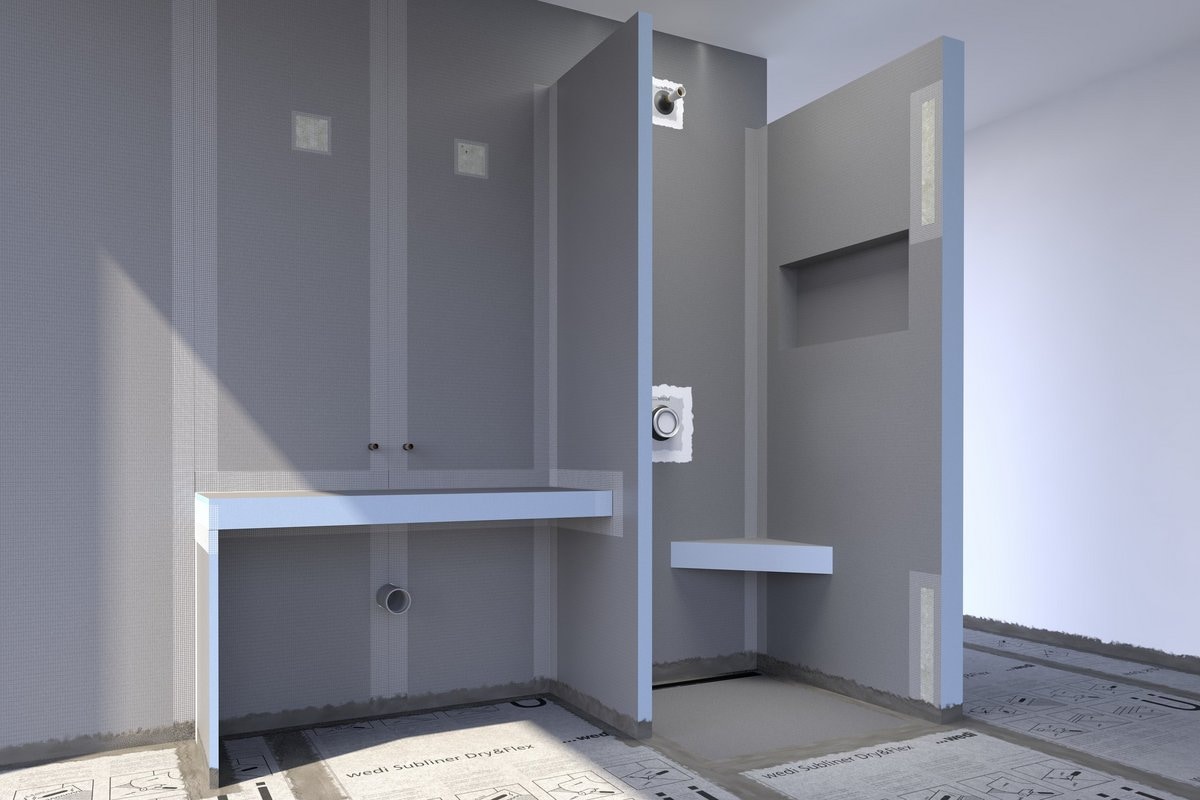
Wet room tanking system - Wedi waterproofing building boards lapped at perimeter junctions and sealed at pipe penetrations, the substrate layer that distinguishes a UK Building Regulations compliant wet room from a flush walk-in shower
Wedi waterproofing building boards — the tanking layer beneath the tile that does the regulatory work. Get this layer wrong and the bathroom fails in year three.

07 · The small-room question

Which works better in a small UK bathroom?

For a small UK family bathroom — broadly the 2.4 m × 1.8 m floor plate that defines most Victorian terrace upstairs bathrooms and 1990s ensuites — the wet room often feels larger because the floor reads as continuous. There is no tray edge, no screen footprint, no visual interruption between the shower zone and the rest of the room. The eye travels further; the room feels bigger than its plan.

The trade-off is splashback. Without a screen, water travels further than expected — particularly onto adjacent vanities, joinery and (most commonly on UK forum write-ups) the toilet roll. The standard compromise is a half-height glass splash-screen fixed to the wall and floor at the wet-room threshold, defining the shower zone visually and physically without breaking the floor continuity. This adds £300–£600 to the build, and it is the configuration we put on most small wet rooms now.

Walk-in showers in small bathrooms work better when the room is narrow but long enough to give the showering zone a 900 mm or 1000 mm width with a frameless screen and a defined enclosure footprint. Below that, the shower zone feels cramped and the screen feels in the way. For ensuites under 4 sq m the wet-room with a half-height splash-screen wins almost without exception.

Below 2.0 m × 1.6 m, neither option is ideal. A 760 × 760 mm tray-and-sliding-door shower enclosure is the practical answer at that footprint — both wet room and walk-in shower start to lose their visual advantages and begin to feel like compromises. Some renovation projects are simply better served by a different configuration, or by reorganising the floor plan to claim back another half-square-metre.

If your project is specifically tiles-led, our guide to the best tiles for small UK bathrooms covers the tile-size and grout-strategy decisions that interact directly with this question.

08 · The resale question

Do wet rooms add value? What UK estate agents actually say

The honest answer from the UK estate-agent community is that wet rooms are valued at par with quality walk-in showers in most family-home configurations. The value lift comes from the bathroom looking modern and well-built, not from the wet-room status itself. Nobody is paying a premium for a wet room over an equivalent walk-in shower in the same house.

Where wet rooms do measurably add value: accessibility-adapted homes. An Approved Document M4(3) compliant level-access shower broadens the buyer pool to include downsizers, mobility-affected buyers, and buyers planning ahead for a parent moving in. In areas with an older demographic profile (the Essex coast, the home-counties retirement belt) this can be a meaningful resale advantage that a standard walk-in shower does not provide. Outside those buyer segments, the wet room reads as a stylistic choice, not a value-add.

Where wet rooms can cost resale value: family homes where the wet room replaces the only bath in the house. UK property listings consistently show that buyers searching for family homes filter for at least one bath somewhere on the property. Removing the bath entirely from a single-bathroom home is the single most cited resale regret on Mumsnet and Houzz UK forum threads. If your only bathroom is going wet-room, find space for a freestanding bath inside the wet zone, or keep a bath in another room.

Walk-in showers are the safer resale choice for conventional family homes — they read as conventional, family-friendly, and they preserve the bath option. Wet rooms are the right resale choice when you are designing for a specific buyer segment (downsizer, mobility-adapted, design-led principal-suite) where their advantages are a feature rather than a curiosity.

09 · The design layer

When does a wet room need a designer?

Almost always, in our experience. Wet rooms are the bathroom configuration with the most ways to go wrong, and most of the failure modes are decisions made before tile sets — gradient falls calculated for the wrong drain position, tanking specifications that miss a perimeter junction, BS 7671 zones miscalculated under the new amendment, soil-pipe relocations that quietly break Part G compliance, drainage falls flatter than the substrate can carry water across.

Walk-in showers are forgiving by comparison. A competent general bathroom installer can drop a low-profile tray, tank inside the screen line, install a frameless glass and a thermostatic valve, and produce a result that works for twenty years. Wet rooms reward a specialist installer and a designer who has signed off the floor build-up before the trades start.

This is not a generic argument for designers; it is a specific argument about wet rooms. Whether using a designer is the right call for your specific project depends on the four trigger conditions covered in our is a bathroom designer worth it guide — layout problem, £15,000+ budget, period property, or a 3D-visual requirement. Wet rooms typically tick at least two of those, often three. Walk-in showers in standard rectangular bathrooms often tick none.

The single-point-of-accountability model — one team owning the design, the spec, the supply and the install — is the most reliable way to prevent the wet-room failure modes. The designer signs off the floor build-up, the substrate former, the gradient calculation and the drain position before anything is ordered. The same team owns the install, so when the tiler hits a question on site, the designer answers it rather than the homeowner googling at 7pm. That coordination is what wet rooms genuinely need, and what informal supply-and-install splits often fail to provide.

10 · The honest moves

Five mistakes we see most often on both builds

Patterns we see repeatedly on UK projects coming through our showrooms or being quoted against ours. None of these are exotic; they are the standard ways either configuration goes wrong, and they are all preventable with the right design layer up front.

Mistake one

Calling a flush walk-in shower a wet room

A flush-fitted tray with a single splash-screen and continuous tile is a walk-in shower, not a wet room. Marketing copy often blurs the two; quotes occasionally do too. Ask the showroom to show you the floor build-up drawing — substrate former, tanking system, drain location. If there is a tray, it is a walk-in.

Mistake two

No half-height splash-screen on a small wet room

In a wet room under 5 sq m, water carries further than the homeowner expects. Onto the vanity, onto the toilet roll, onto a parquet feature wall a metre from the shower head. The half-height glass splash-screen is the standard fix; we put one on most small wet rooms now. £300–£600 well spent.

Mistake three

BS 7671 Amendment 3:2024 zones plotted from the wrong baseline

In a wet room, Zone 1 extends across the gradient floor — not just over a tray footprint. Light fittings, mirror demisters and shaver sockets that were Zone 2-compliant on a tray-shower spec can fall into Zone 1 once the floor is wet-room. Re-plot the zones once the layout is final, not before.

Mistake four

Removing the only bath from a single-bathroom home

The most-cited resale regret on UK forums for a reason. Family-home buyers filter for properties with a bath. If your house has one bathroom and you are wet-rooming it, build a freestanding bath into the wet zone. If you are walk-in-showering it, keep the bath alongside.

Mistake five

Standard intermittent extract on a wet room

A 15 L/s intermittent extract fan, fine on a tray-shower bathroom, struggles with the steam load of a wet room over a long shower. The result: persistent condensation on mirrors, slow tile-grout drying, mould risk on perimeter sealants. The upgrade is an inline 8 L/s continuous extract ducted to a soffit vent, often paired with a humidity-sensing trigger. £200–£400 on the install; saves tile-grout failure costs in year three.

Two of those five mistakes (calling things by the wrong name, plotting electrical zones from the wrong baseline) are catchable in the design phase before any work starts. Two more (no splash-screen, removing the only bath) are catchable in the spatial-planning phase. Only the extract-fan upgrade is a genuinely operational decision the installer makes during the build. That ratio — four out of five preventable upstream — is the strongest functional argument for the design layer existing at all.

Frequently asked questions

Everything UK homeowners ask about wet rooms versus walk-in showers in 2026.

A wet room is a fully tanked bathroom where the entire floor is the drainage zone — no tray, no kerb, often no glass screen at all, with a gradient fall built into the substrate so water runs to a linear or central drain. A walk-in shower is a defined showering area inside a normal bathroom — typically a low-profile or flush tray with a frameless glass screen, with the rest of the bathroom kept dry. Wet rooms require full-room waterproofing per the manufacturer's tanking system; walk-in showers only need waterproofing inside the shower zone. The terms are often used interchangeably in retail copy, which is where most of the buyer confusion comes from.
Yes, typically £1,500–£3,500 more on the install for a like-for-like room size in 2026. The cost difference is almost entirely structural — full-floor tanking (Wedi, Schluter or equivalent system), a screeded gradient fall built across the whole floor, a linear drain or central gully, and significantly more tile cuts. The product cost (brassware, glass, fixtures) is broadly similar between the two — the gap is in the floor build-up and the labour to do it correctly. On a £25,000 luxury bathroom, the wet-room option lands the project at £26,500–£28,500 versus the walk-in shower equivalent.
No, in almost all cases. Internal bathroom works to an existing dwelling are permitted development and do not need planning permission. Building Regulations approval is a different matter — wet rooms must comply with Approved Document G (water and sanitation, 2024 amendment in force from October 2024), Approved Document P (electrical safety) and BS 7671 Amendment 3:2024 (bathroom zones and RCD protection). Listed buildings and properties in conservation areas may need additional consent for any external changes (extract fans through facades, soil-pipe routing). Ask your local Building Control before you start; the £200–£400 application fee is cheaper than rectifying a non-compliant install.
Yes, but the floor build-up changes. Timber-joist floors need a sheet-tanked or tray-system former (On The Level, Wedi, Schluter Kerdi-Line) to create the gradient fall without compromising the joist depth, and the joists may need additional noggins or sister-joists to take the screed weight. Solid concrete floors are easier — the screed bonds directly to the slab once primed and tanked. The single biggest upstairs failure mode is inadequate substrate preparation: water finding any unsealed perimeter or pipe-penetration eventually shows up on the ceiling below. This is the strongest case for using an experienced wet-room installer — not a generalist plumber.
For a small UK family bathroom (around 2.4m × 1.8m) a wet room often feels larger because the visual continuity of one tiled floor reads as more space than a tray-and-screen arrangement breaking the room up. The trade-off is that without a screen, water can travel further than expected — splashback onto basins, vanities, joinery and (most commonly) the toilet roll. A half-height glass splash-screen solves this and is the most common compromise. Walk-in showers work better when the room is narrow but long enough to give the showering zone its own enclosure footprint. Below 2.0m × 1.6m, neither option is ideal and a tray with a sliding door usually wins on practicality.
Mixed picture. UK estate agents typically value a wet room at par with a quality walk-in shower in family-home configurations — the value lift comes from the bathroom looking modern and well-built, not from the wet-room status itself. Where wet rooms add measurable value is in accessibility-adapted homes (Approved Document M4(3) compliant level-access shower, 1200mm × 1200mm minimum), which broaden the buyer pool to downsizers and mobility-affected buyers. The most common resale-regret on UK forums is removing the family bath entirely from a single-bathroom home — buyers with young children rule those out at the property-search stage. If you only have one bathroom, keep a bath somewhere in the house.
Almost always, yes. Wet rooms are the bathroom type with the most ways to go wrong: gradient falls calculated for the wrong drain position, tanking failures at perimeter junctions, electrical zones miscalculated under BS 7671 Amendment 3:2024, soil-pipe relocation that breaks Part G compliance, drainage falls flatter than the substrate can carry water across. Walk-in showers are forgiving by comparison — most fitters can install a level-access tray with a frameless screen successfully. Wet rooms genuinely need the design layer to coordinate the structural, drainage and electrical decisions before tile sets. Whether the designer route makes sense for your specific project depends on the four trigger conditions covered in our companion guide on whether a bathroom designer is worth it.
Wet room and walk-in shower brassware - Crosswater thermostatic valve and shower set in matt black, the spec layer that sits on top of either configuration once the floor build-up is decided
Crosswater thermostatic shower set — the brassware-and-control layer is broadly the same on either configuration. The differential is in the floor build-up below.

What is next

Working out which configuration is right for your bathroom?

We design wet rooms and walk-in showers to the same standard, in the same showrooms, with the same designers. The first appointment is free, takes about an hour, and works out which configuration suits your room, your spend, and your property. We benchmark our product pricing against the major UK online retailers (Drench, Victorian Plumbing, the supplier-direct sites) on every brand we sell — so the £1,500–£3,500 wet-room premium is a structural cost, not a margin uplift.

We run our design service from showrooms in Braintree (Springwood Industrial Estate, CM7 2YN) and Leigh-on-Sea. There is no design fee, no margin uplift on products to fund design, and no obligation to buy. Your fitter or ours; we work either way.

Companion guides: is a bathroom designer worth it? · how much does a luxury bathroom cost in the UK in 2026? · what is bathroom tanking?

Visit Our Showrooms Free brochures Price estimator