
Bowmans · Inspiration · Design
Stainless steel towel rails vs chrome: which will rust?
By Jonathon Barclay · · 22 min read
Yes, a chrome towel rail can rust. The chrome is only a plated finish, and the rail underneath is usually mild steel, which Vogue UK calls the more common material for these products. Mild steel rusts when water and oxygen get to it, so a plated steel rail depends on its plating on the outside and on corrosion inhibitor in the heating water on the inside. Stainless steel and brass resist corrosion through the metal itself.
The guarantees differ as well. Vogue UK puts a 30-year guarantee on the brass and stainless steel rails that carry its 30-year symbol and 15 years on its mild steel ones, and JIS Europe puts 25 years on the body of its all-stainless rails. The circuit matters too. If the rail is going on the direct hot water circuit, where the water carries on to your taps, Vogue UK won’t allow a rail with any steel parts, which rules out chrome-plated mild steel and leaves stainless steel or brass.
That doesn’t make chrome a bad buy. On a sealed central heating circuit with inhibitor in it, a well-made chrome rail is a reasonable choice. So the useful question is which circuit the rail is going on and which room it’s going in.
A “chrome” towel rail is normally chrome-plated mild steel. Mild steel rusts when water and oxygen reach it, so it relies on plating outside and corrosion inhibitor inside. Stainless steel and brass don’t rely on a coating. Vogue UK’s guarantee symbols run to 30 years on brass and stainless steel rails and 15 on mild steel, model by model, and it won’t allow steel parts on a direct hot water circuit.
Quick Navigation
Why a chrome towel rail can rust
A chrome towel rail can rust because the chrome is a thin plated layer and the tube underneath is usually mild steel. It can start in two places: on the outside, if water gets past the plating, and on the inside, if the water in the heating system isn’t treated.
We say “can” on purpose. It doesn’t mean every chrome rail will rust, and some chrome rails are plated brass rather than plated steel, which we come to further down. But if you’re wondering why the towel rail you’ve got now is rusting, these are the two ways it happens.
From the outside
Chrome is a finish, not the metal the rail is made from. The British Stainless Steel Association contrasts stainless steel with other steels, which suffer “general” corrosion, where large areas of the surface are affected. Ordinary steel rusts when water and oxygen reach it, and that’s the behaviour stainless steel is made to avoid.
So on the outside, a plated steel rail is only as good as its plating, and it lives in the dampest room in the house with wet towels hung over it most days. If water finds a way past the plating, there’s ordinary steel underneath. We can’t put a timescale on that and it isn’t inevitable, but it’s the mechanism behind a chrome rail that has started to rust.
It’s also why we’d look after the finish. Zehnder tells owners not to use abrasive or spray cleaners on any radiator, because they can have “a very damaging effect on the finish”. Zehnder is talking about radiator finishes in general there rather than chrome in particular. We’d take it more seriously on a plated steel rail, though, because the finish is also the rail’s protection.
This isn’t a new complaint. JIS Europe, which makes the all-stainless Sussex Range, says it was founded in 1997 “in response to the frustration of their chrome bathroom products rusting”.
From the inside
The inside of the rail is full of system water, the same water that goes round your boiler and radiators. If that water isn’t treated it can corrode steel from the inside, where you can’t see it.
Vogue UK says a sealed system should contain a BS 7593 corrosion inhibitor to maintain both the system and the towel warmer, and that going without “could result in corrosion or even failure”. Zehnder adds a practical consequence: “Failure to add an inhibitor can invalidate radiator warranties”. It also says the inhibitor should be topped up whenever the system has been drained down.
Building Regulations guidance in England asks for the same treatment when a new heating appliance goes in. Paragraph 8.8 of Approved Document L Volume 1 (2021 edition incorporating 2023 amendments) has the circuits cleaned and flushed, inhibitor added and the system commissioned to BS 7593. That paragraph applies to a new heating appliance rather than to changing a towel rail, but it’s the same standard the manufacturers are pointing to.
Adding or moving a rail on the heating circuit usually means draining it. When the system is drained, the inhibitor goes with the water. Ask your fitter to re-dose it when they refill, which is what Zehnder’s top-up advice is asking for. If it isn’t replaced, the steel inside the rail and the rest of the system is left unprotected, and that’s the failure Vogue UK warns about.
Chrome-plated mild steel
Protected by a coating outside and inhibitor inside.
- 1. Chrome plating. A finish on the outside, not the metal the rail is made from.
- 2. Mild steel wall. Ordinary steel corrodes when water and oxygen reach it, so it relies on the plating outside and inhibitor inside.
- 3. System water. On a sealed circuit it should contain BS 7593 corrosion inhibitor (Vogue UK).
- 4. Damaged plating. A scratch or chip through the chrome exposes the steel underneath.
Stainless steel
The same metal all the way through, with no coating to rely on.
- 1. Surface film. A chromium-rich oxide film forms naturally on the surface. It is invisible in real life.
- 2. Stainless steel wall. One alloy right through, containing at least 10.5% chromium.
- 3. System water. A sealed circuit still needs water treated to BS 7593, whatever the rail is made of.
- 4. Scratch. A scratch exposes more stainless steel, and the film “will normally self repair” given oxygen (BSSA).
Why stainless steel and brass don’t rely on a coating
Stainless steel and brass resist corrosion because of what the metal is, so there isn’t a plated layer standing between the bathroom and something that rusts.
Stainless steel is steel alloyed with at least 10.5% chromium. The BSSA explains that the chromium forms a very thin oxide film on the surface, and that “if the film is damaged it will normally self repair” as long as there’s oxygen around. Put simply, a deep scratch in the chrome on a plated steel rail exposes steel. A scratch in stainless steel exposes more stainless steel, and the film forms again.
JIS Europe builds its whole Sussex Range this way. Its technical page says every rail is “100% stainless steel including the brackets”, made from 304 grade stainless steel with 316 grade welds. JIS says the rails “will not rust, flake or corrode”, and qualifies that with “under normal operating conditions”. That’s JIS’s claim about its own product, and the condition is part of it.
What 304 and 316 mean
They’re grades of stainless steel, and the difference is what else goes into the alloy. 304 contains nickel, which helps the protective film re-form. 316 adds molybdenum, which the BSSA says makes chloride ions less able to break the film down in small patches. “Marine grade” is JIS’s label for 316, and it’s what JIS uses for the welds.
The grades matter because stainless steel is corrosion resistant, not indestructible. The BSSA notes that localised attack can still happen and is “often associated with chloride ions”, so we wouldn’t describe any stainless rail as immune. JIS’s own care advice is simply a soft cotton or microfibre cloth and water.
JIS publishes its grades. Zehnder’s datasheet for its all-stainless Stellar Spa doesn’t give one, so we won’t guess at it.
Brass
Brass is the other body material that doesn’t depend on a coating. Vogue UK makes its brass rails from dezincification-resistant (DZR) brass, which it describes as corrosion resistant and a better base for a plated finish. Its FAQ puts brass alongside stainless steel as a material with very high resistance to corrosion, and calls both a very good material for heat emitters, over the more common mild steel. That’s Vogue’s view of its own materials rather than an independent test.
This is also where the word “chrome” stops being much help. A chrome finish can sit on brass as well as on steel, so the finish name alone doesn’t tell you what you’re buying. The Vogue UK Ieri (TM014-BR), for example, has a brass body. We’ve explained how material and finish differ on a radiator in a separate guide.
Which circuit is your towel rail on?
Check the circuit before you think about which metal you prefer. A towel rail can be plumbed into one of two circuits, and on one of them Vogue UK won’t accept a rail with any steel parts, so the decision is made for you.
Vogue UK describes the two like this. An indirect or closed circuit is the sealed central heating loop, with the same water going round the boiler and radiators. Vogue says any towel warmer can go on it regardless of material, provided the system contains inhibitor. A direct or open circuit is different, because the domestic hot water that goes on to your taps and shower runs through the rail first. On that circuit, Vogue says, “only towel warmers manufactured totally from brass or stainless steel can be installed. Any model made from or consisting of ferrous metal (steel) components cannot be installed on a Direct/Open circuit.”
The reason is that the water is fresh mains water on its way to your taps, so nobody can dose it with inhibitor, and a mild steel rail would have new, untreated water running through it every day. So what decides which circuit you’re on is where the water ends up. If it comes out of a tap or shower, the rail is on the direct circuit, whatever your heating system is called.
JIS Europe says all of its models are 100% stainless steel and so suit “any plumbing system including open/hot water systems”. Zehnder describes its all-stainless Stellar Spa as “suitable for use with open heating systems”, but it doesn’t define that phrase as the tap-water circuit. If you want a Zehnder model on one, we’d have Zehnder or your fitter approve the exact circuit before ordering.
A common reason for choosing the hot water circuit is a warm rail in summer, when the heating is off. A dual fuel rail gets you that from the heating circuit instead. It has an electric element for the months when the central heating isn’t running, so the choice of material stays open. There’s more on it in the FAQs below.
Your fitter is the one who confirms which circuit you have. Vogue is clear about it: “Product compatibility is the responsibility of the installer.” If you’re replacing an existing rail or radiator, note which circuit it’s on while you’re working through your bathroom planning checklist, because the question needs answering before the order goes in.
Direct hot water circuit
- The water goes on to your taps and showers
- No inhibitor possible
- All-stainless or all-brass rails only (Vogue UK’s rule; JIS Europe approves its all-stainless rails)
- Nothing with mild steel parts
Sealed central heating circuit
- Any material the maker approves
- Must contain BS 7593 inhibitor, topped up after any drain-down
- Mild steel, stainless steel or brass are all possible
- The rail only heats when the heating runs, unless it’s dual fuel
Water softener plus brass on a hot water circuit is a no. Vogue UK says its brass-tube rails “should not be installed on an open circuit if a water softener is present”, because softened water can attack the zinc in brass, which is called dezincification, until the tube leaks. Vogue uses dezincification-resistant brass but says “resistant” doesn’t rule it out, and suggests checking with your local water authority. In that situation stainless steel is the safer choice. This is only about direct hot water circuits. It doesn’t affect brass on sealed heating.
Direct hot water circuit
The water in the rail is the same hot water that comes out of your taps.
- The hot water heading for your taps and shower runs through the rail first, so it can’t be dosed with inhibitor.
- Vogue UK allows only rails made entirely of brass or stainless steel here: nothing with steel (ferrous) parts. JIS Europe approves its all-stainless rails for “open/hot water systems”.
- If there’s a water softener, Vogue UK rules out brass as well.
Sealed central heating circuit
The same treated water goes round and round.
- Heated water flows out (red), returns to the boiler (blue) and goes round again, so it should contain BS 7593 corrosion inhibitor.
- Mild steel, stainless steel or brass are all possible, as long as the maker approves the model for it.
- The inhibitor leaves with the water whenever the system is drained, so it needs topping up afterwards (Zehnder).
Stainless steel, brass and mild steel guarantees compared
Vogue UK makes towel rails in all three metals. Its guarantee symbols run to 30 years on brass and stainless steel and 15 on mild steel. JIS Europe, which only makes stainless steel rails, puts 25 years on the rail body.
Swipe across to compare all columns.
| Manufacturer | Body material | Maker’s guarantee | Circuits the maker allows |
|---|---|---|---|
| Vogue UK | Brass (DZR) | 30 years | All heating and hot water systems (not a hot water circuit with a water softener) |
| Vogue UK | Stainless steel | 30 years | All heating and hot water systems |
| Vogue UK | Mild steel | 15 years | Closed (indirect) heating systems only, meaning the central heating loop |
| JIS Europe, Sussex Range | Stainless steel (304, 316 welds) | 25 years on the rail body, against manufacturing defects | Any plumbing system, “including open/hot water systems” |
The periods come from Vogue UK’s technical page and JIS Europe’s technical page.
It’s worth being clear about what these guarantees are. JIS’s covers manufacturing defects in the rail body. Vogue’s page names the periods but doesn’t publish the terms, and each period applies to products carrying Vogue’s guarantee symbol, so check the exact model and ask for the terms. Not every model carries the full period. Vogue’s page also has a 2-year guarantee symbol for some products. These guarantees aren’t a promise that the rail will last that long, and they aren’t Bowmans guarantees either. They belong to the manufacturer.
The small print matters as well. JIS needs proof of purchase and doesn’t cover fitting or delivery costs. Its valves carry 5 years, its electric elements 1 year and its Black Edition finish 5 years. Vogue UK says its products must be installed to the British Standards it lists, including BS 7593 for water treatment, “to avoid invalidation of the guarantee”. So the inhibitor we talked about earlier is a guarantee condition as well as good practice.
The thing we’d take from that table is in the Vogue rows. It’s the same maker and the same guarantee scheme, and the cover on mild steel is half as long. Vogue doesn’t say why. We read that as a sign of what Vogue expects from each material over the long run, but that’s our reading and not something Vogue states.
It’s also Vogue’s comparison alone. It isn’t a rule that every manufacturer backs stainless steel and brass for longer, so check the maker’s terms for whichever rail you’re considering.
What you give up with stainless steel or brass
What you give up is mostly money. Stainless steel and brass rails generally cost more than mild steel ones. How much more depends on the model, size and finish, so we’d price the actual rails you’re comparing rather than work from a rule of thumb.
On heat, the finish and the design decide more than the metal does. Vogue UK’s own figures give a useful illustration. At near-identical sizes, all at ΔT50 (the temperature difference the outputs are rated at), the mild steel Focus (MD001, 800 x 505mm) is listed at 252W in chrome and 420W in white. The stainless steel Kerve (MD036, 800 x 500mm) is listed at 243W, though Vogue doesn’t name the finish that figure is for. So the chrome mild steel rail and the stainless one are within a few watts of each other, and on the Focus the big jump comes from paint. Vogue explains that chrome plating reflects heat back into the rail, so a powder-coated version gives out more.
The same thing happens within a single stainless steel model. Zehnder’s Stellar Spa datasheet lists the 572 x 450mm size at 161W polished and 219W painted at ΔT50.
This isn’t a controlled test. The Focus has 14 bars and D-section uprights and the Kerve has 12 round bars, so don’t read it as one metal heating better than another. The practical point is that a shiny rail of any metal is a towel dryer first. If the rail has to heat the room, a painted finish or a larger rail matters more than what it’s made of.
For sizing, declared outputs and what ΔT50 means, see how to compare a bathroom radiator’s heat output. If the rail won’t heat the room on its own, underfloor heating is the usual partner.
Check the ΔT before comparing outputs between brands. JIS Europe publishes its outputs at ΔT60, while Vogue UK and Zehnder headline ΔT50. A ΔT60 figure is always the bigger number for the same rail, so make sure you’re comparing like with like.
What we’d choose, circuit by circuit
We start with the circuit and the room, then choose the metal. Stainless steel or brass is what we’d pick wherever corrosion resistance decides the matter. That means a rail on the direct hot water circuit, a rail that’s going to get splashed, a heating system whose water treatment you can’t vouch for, or a bathroom you want to fit once and leave for decades. On a sealed, properly inhibited central heating circuit, chrome-plated or painted mild steel is a legitimate choice.
So if you’re asking whether stainless steel towel radiators are better than chrome ones, our answer is that they’re better at resisting corrosion, and that only settles it in some bathrooms. The model names below are examples from the makers’ published ranges.
Stainless steel
We’d choose it for a hot water circuit, for wetrooms and rails close to the shower, and for a room you want to fit once. From the brands we supply, the JIS Europe Sussex Range is all stainless with a 25-year body guarantee, Vogue UK makes the Kerve, and Zehnder describes the Stellar Spa as “All stainless steel construction”. JIS’s finishes are polished or satin, and it also offers black and a brushed brass colour as powder coats over the stainless. A stainless steel rail still isn’t one you can forget about. On a heating circuit the system needs its inhibitor whatever the rail is made of.
Brass
We’d choose brass for traditional designs and plated finishes where you want the corrosion resistance as well. The Vogue UK Ieri is a brass rail that carries Vogue’s 30-year guarantee symbol and its symbol for all heating and hot water systems. The drawback is the softener rule. If you have a water softener, Vogue UK advises against brass on a direct hot water circuit, and we’d move to stainless steel.
Chrome-plated or painted mild steel
We’d choose it on a sealed, inhibited central heating circuit when the design or colour you want is made in mild steel. Vogue UK’s Focus, for example, comes in RAL colours and special finishes with a 15-year guarantee. We’d lean towards a painted finish if the rail has real heating to do. The conditions are a closed circuit only, inhibitor kept topped up, and no abrasive cleaners on the finish.
If you haven’t yet settled between a wet room or walk-in shower, decide that first, because an open shower area puts more water near the rail.
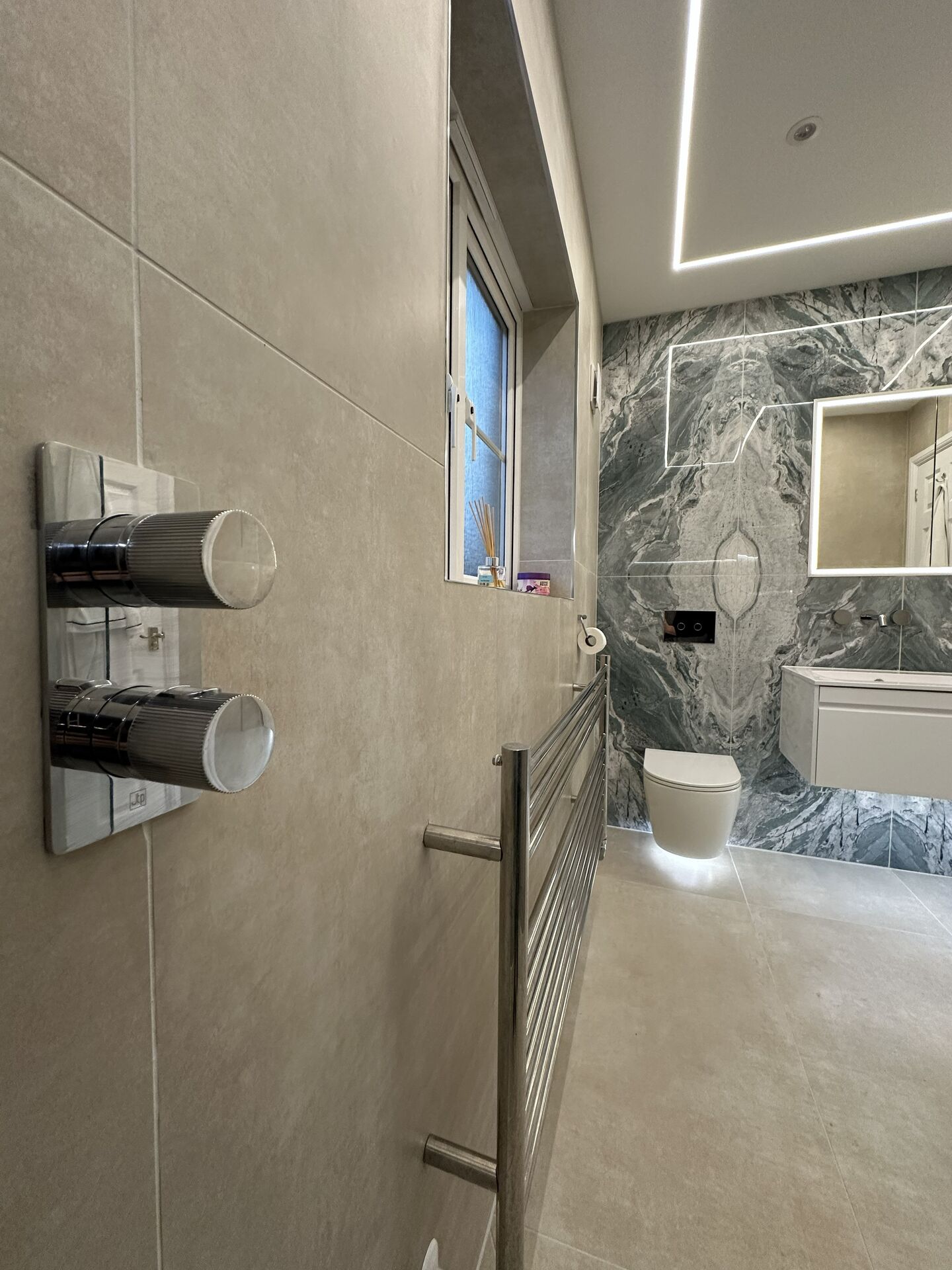
You can see a stainless steel rail in that position in one of our projects. In our Braintree CM7 ensuite wetroom, completed in 2025, the towel radiator sits under the window, on the wall beside the open shower zone. It’s a JIS Europe Newick, which JIS makes from 100% stainless steel.
Verdict: decide the circuit, then the metal
On a hot water circuit Vogue UK rules out mild steel, so it’s stainless steel or brass. On sealed heating we’d still lean towards stainless steel or brass for a bathroom you want to fit once. Vogue UK’s guarantee symbols run twice as long on brass and stainless steel as on mild steel, and JIS Europe puts 25 years on an all-stainless body. That’s a durability call, not a ranking of quality or warmth. A mild steel rail on a well-kept system is a sound choice when the design, colour or output you need comes that way.
What we ask before we order a towel rail
Which circuit is the rail going on, and is there a water softener in the house? How much wall space is there, and how far can the rail project into the room? Which brassware finish does it need to match? Is it heating-only or dual fuel? If your own fitter is installing, get their answer on the circuit before the order goes in.
We design and supply. Installation is by your own fitter or an approved fitter we can introduce. With a full-room project the design is included and you pay for the products you choose.
Frequently Asked Questions
Bring your answers to the showroom
The right size depends on your wall, and the finish has to sit with your brassware, so this is an easier decision to talk through with our team than to make from a product page. Bring your answers to the questions we ask before we order a towel rail, along with the wall width and height, to our Braintree or Leigh-on-Sea showroom. You can book a showroom visit, or find both on our Essex showrooms page.
Related Guides and Inspiration
Does your bathroom radiator’s material matter?
Heat output, ΔT50 and finish
JIS Europe stainless steel towel rails
The Sussex Range at Bowmans
Vogue UK towel rails and radiators
Brass, stainless and mild steel designs
Bathroom underfloor heating: wet vs electric
When the rail won’t heat the room alone