
Bowmans · Inspiration · Design
Does your bathroom radiator’s material matter?
By Jonathon Barclay · · 10 min read
Yes, but not in the simple sense that one metal is always better than another.
The material affects how a radiator can be made, which finishes are available and whether the manufacturer approves it for your heating system. But it doesn’t tell you whether the radiator will heat your bathroom properly, hold towels comfortably or suit the available wall.
We’d choose the exact model, size and configuration from a declared heat requirement. We’d then look at the material and finish, rather than starting with a blanket rule that brass is better than stainless steel or mild steel.
Quick Navigation
Material and finish aren’t the same thing
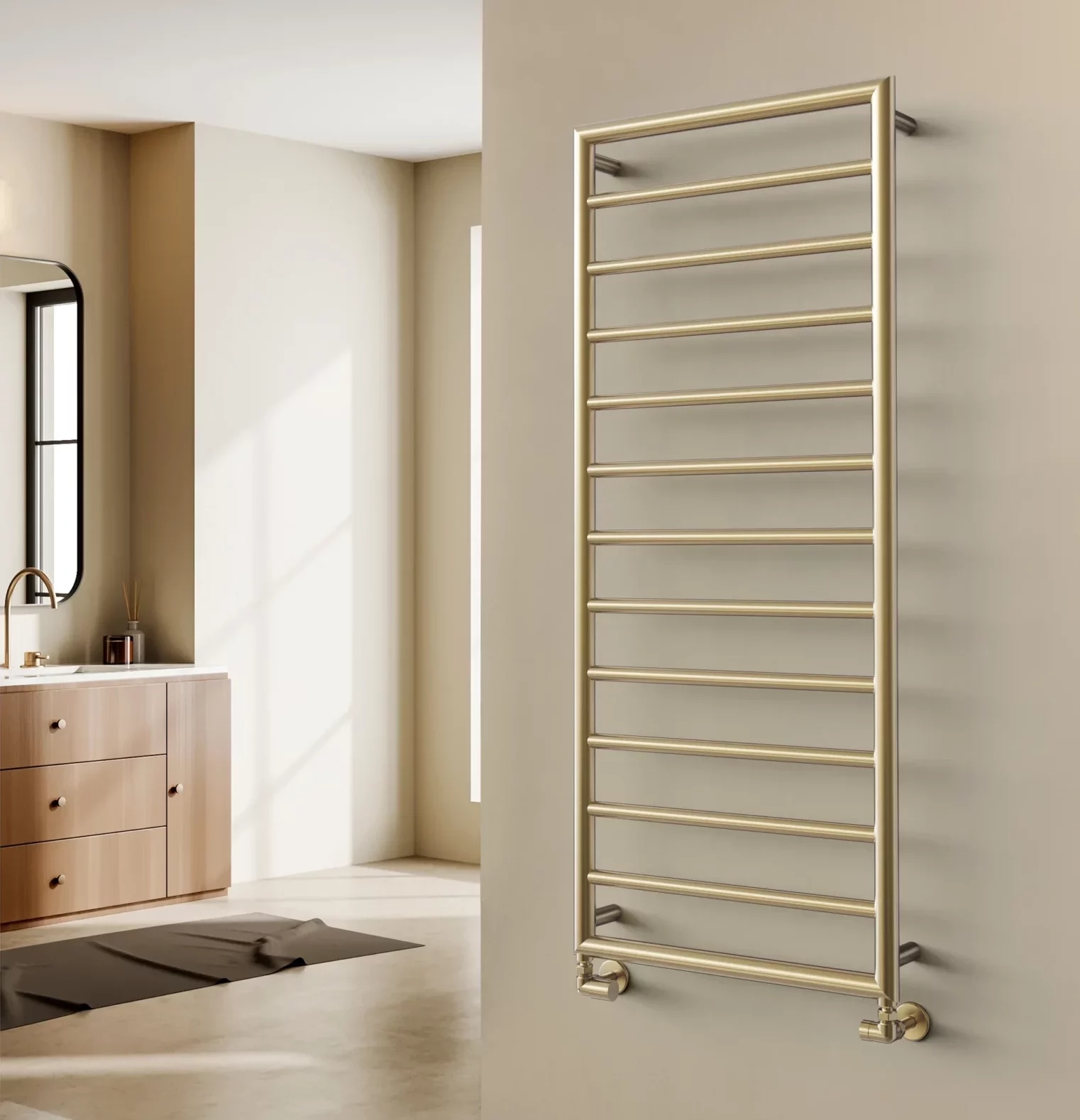
A brushed brass finish doesn’t necessarily mean the radiator itself is made from brass.
Some radiators use brass construction. Others combine different metals, or apply a decorative finish over the underlying material. This matters because the finish you see in the room doesn’t tell you the radiator’s construction, heat output or suitability for a particular system.
The Vogue UK Ieri is listed with brass construction and includes a towel shelf. By comparison, the Vogue UK Baroque combines a white mild-steel column with a chrome-plated brass frame. Calling both of them “brass radiators” would miss an important difference.
So if you want a brass-coloured towel rail, choose the visible finish you like and then check what the actual product is made from. If material matters because of your heating circuit, that needs to be confirmed from the technical information for the precise model.
You can view further radiator options from Vogue UK and Zehnder, but make comparisons using model references and technical sheets rather than finish names alone.
Which material should you choose?
There isn’t a universal hierarchy. Brass, stainless steel and mild steel can all be legitimate choices when the manufacturer approves the radiator for the intended system.
Brass
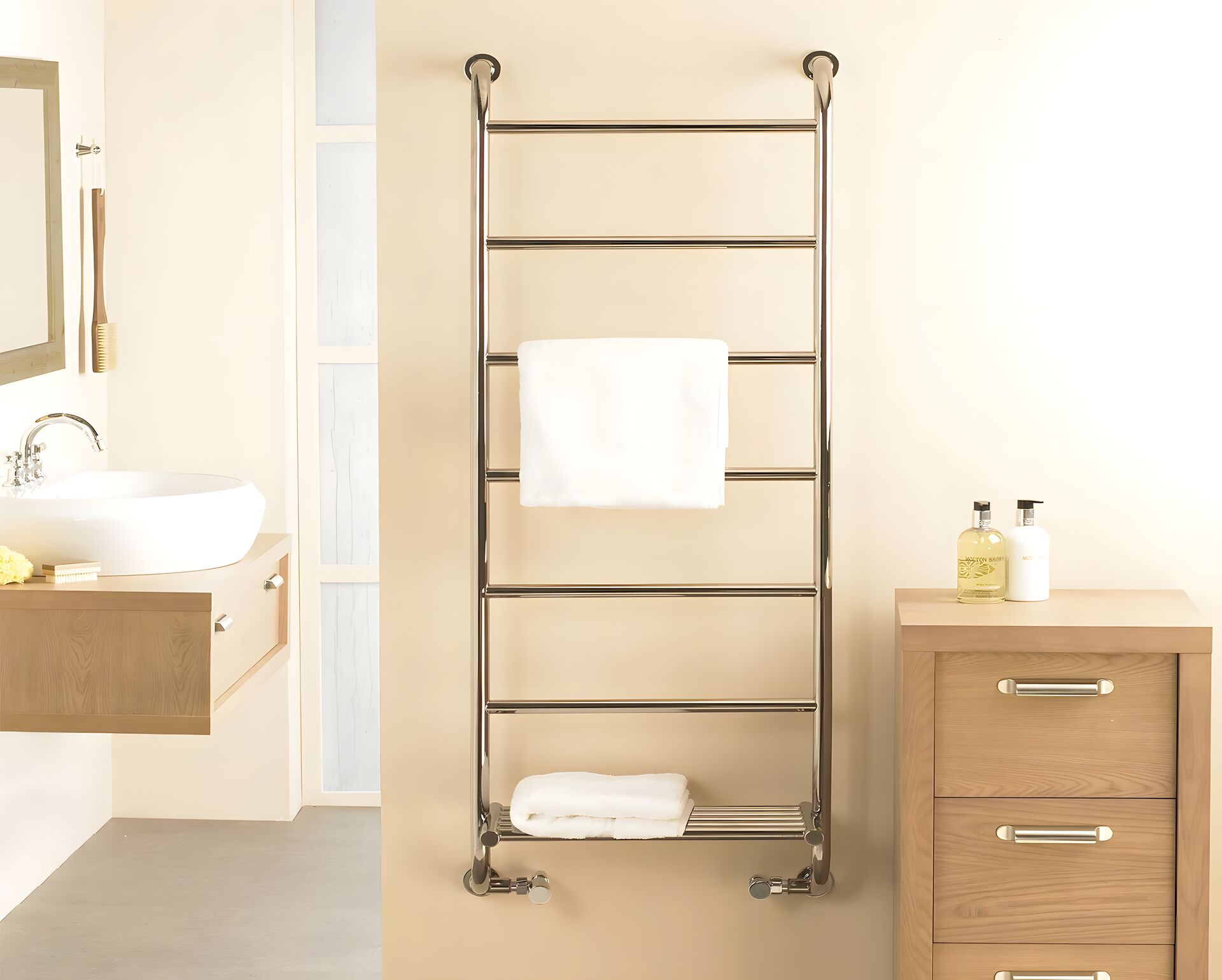
Brass can be the actual construction material, as it is with the Vogue UK Ieri, but a brass appearance alone doesn’t prove that.
We’d consider a model such as the Ieri when its shape and towel shelf work with the room, and when the selected size produces the heat output required. We wouldn’t specify it merely because brass sounds like the more expensive or desirable material.
You also need to order the correct heating configuration. The Ieri product information shows heating and hot-water, heating with electric, and electric-only options. That doesn’t mean every version arrives ready for dual-fuel use. The full model and configuration need to be confirmed when it’s ordered.
Stainless steel
Stainless steel may be useful where the manufacturer has approved a particular model for the intended heating system.
The Zehnder Stellar Spa is made entirely from stainless steel. Zehnder also describes it as suitable for open heating systems, but that shouldn’t be taken as permission to connect it to any circuit that happens to contain water. Open heating and potable hot-water circuits aren’t interchangeable descriptions, so the exact circuit should be approved by the manufacturer or your fitter.
Some central-heating versions can be fitted with a supplementary heater for dual-energy use. That still needs to be specified properly. The electric element rating is separate from the radiator’s water-heated output, and dual energy shouldn’t be treated as a plug-and-play assumption.
Mild steel
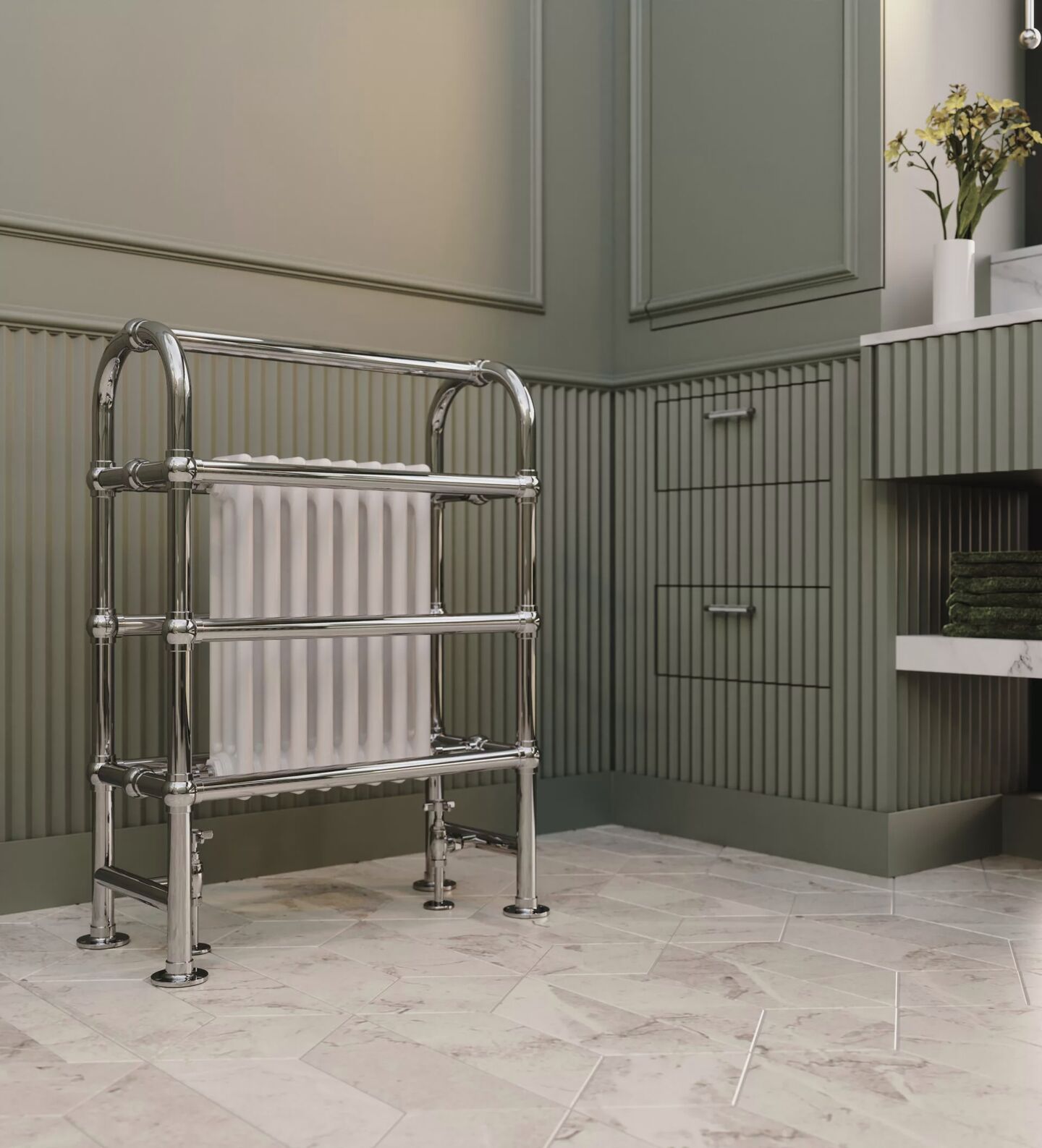
Mild steel isn’t automatically the budget or inferior choice. It’s used in established radiator designs, including the heating column within the Vogue UK Baroque.
The useful questions are whether the manufacturer approves the selected model for your system, whether it gives the required output at your operating temperature and whether its dimensions work in the room. The name of the metal won’t answer any of those on its own.
Material alone doesn’t determine heat output
These published figures show why it’s unhelpful to rank radiator materials using isolated product outputs.
Swipe across to compare all columns.
| Model | Construction | Example size | Declared output at ΔT50 |
|---|---|---|---|
| Vogue UK Ieri TM014-BR | Brass | 750 × 500 × 265mm | 219W / 747 BTU |
| Vogue UK Baroque LG014-BR | Mild-steel column with chrome-plated brass frame | 900 × 675 × 325mm | 871W / 2,972 BTU |
| Zehnder Stellar Spa STGI-060-045, polished | Stainless steel | 572 × 450mm | 161W |
These figures are not a material ranking. This isn’t a controlled material test. The radiators have different sizes, depths and forms, so the figures can’t tell us that one metal heats a bathroom better than another.
The Baroque illustrates the point particularly well. Its much higher figure belongs to a larger, deeper design with a substantial column. It doesn’t prove that its combination of mild steel and brass is inherently better at heating than the other materials.
The right comparison is between complete products that fit your available wall and can meet the room’s calculated heat requirement.
The finish can change the declared output
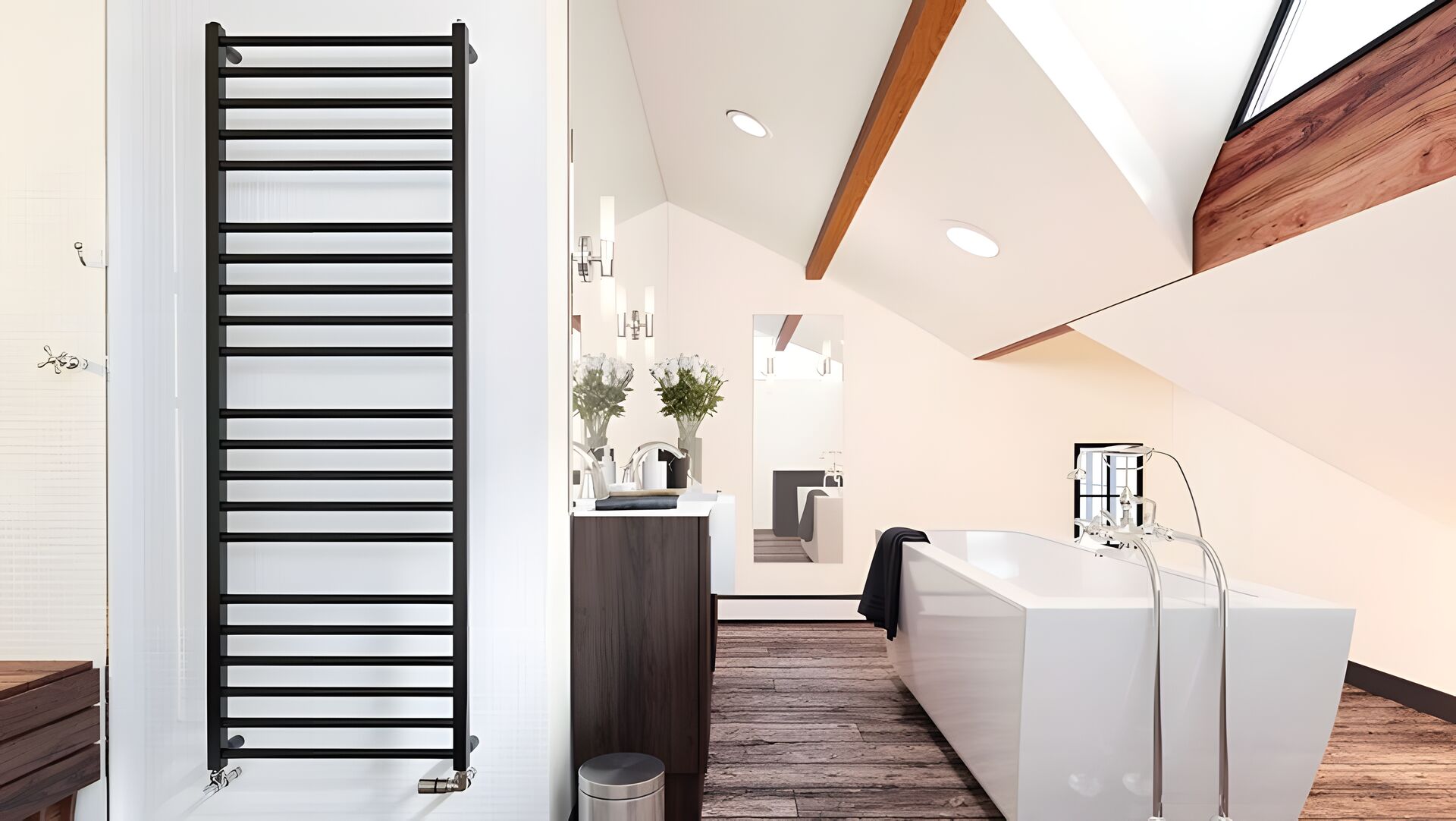
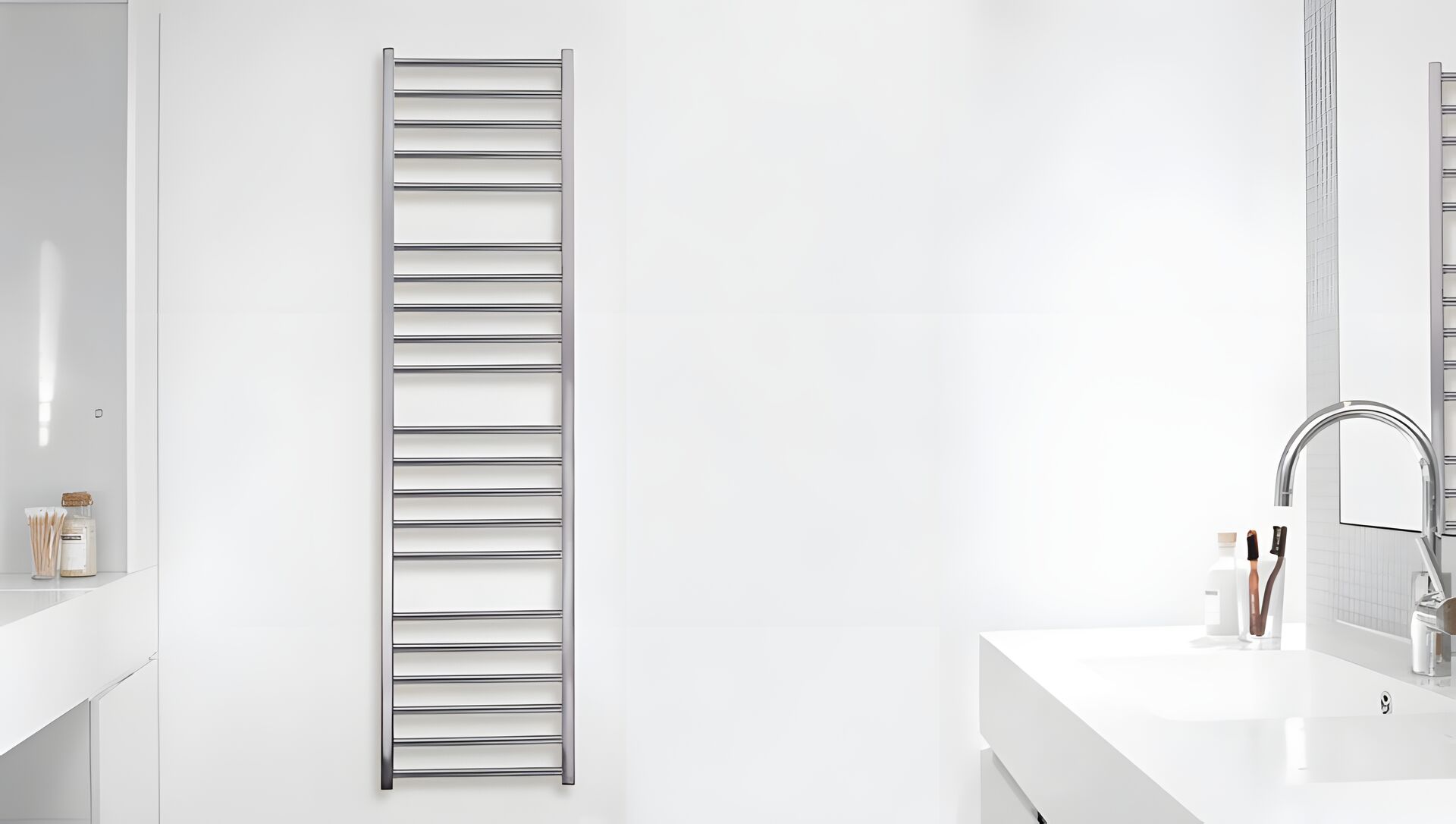
Finish isn’t always a cosmetic decision.
For the same 572 × 450mm Zehnder Stellar Spa size, the official technical datasheet publishes 161W at ΔT50 for the polished version and 219W at ΔT50 for the painted version.
That doesn’t give us a general rule for every polished or painted radiator. It tells us to check the declared output for the exact finish and model being ordered.
This is easy to miss if you choose the colour from a sample and assume the technical figure from another version still applies. We’d want the finish, dimensions, model reference and output to agree on the final specification.
What does ΔT50 mean?
ΔT50 describes a temperature difference. It means the average water temperature inside the radiator is 50°C higher than the room temperature used for the calculation.
It doesn’t mean the radiator surface sits at 50°C.
Published output at ΔT50 is useful for comparing correctly specified products, but your heating system may operate at a different temperature. The same polished Stellar Spa listed at 161W at ΔT50 is rated at 84W at ΔT30 in its technical datasheet.
That drop matters, particularly with lower-temperature heating systems. Your heating designer or fitter needs to calculate the room’s heat loss and confirm the output required at the system’s actual operating temperature.
Will a towel radiator heat the whole bathroom?
Not necessarily.
A towel warmer can be the right size for drying towels but still fall short of the room’s heating requirement. Towels also cover part of the radiator while it’s in use, so it’s worth treating towel capacity and room heating as related but separate questions.
If the model you like can’t provide the required output, the sensible answer may be a larger version, another heat source or a different radiator design. Choosing a supposedly superior material won’t make an undersized product adequate.
Look at the usable towel space
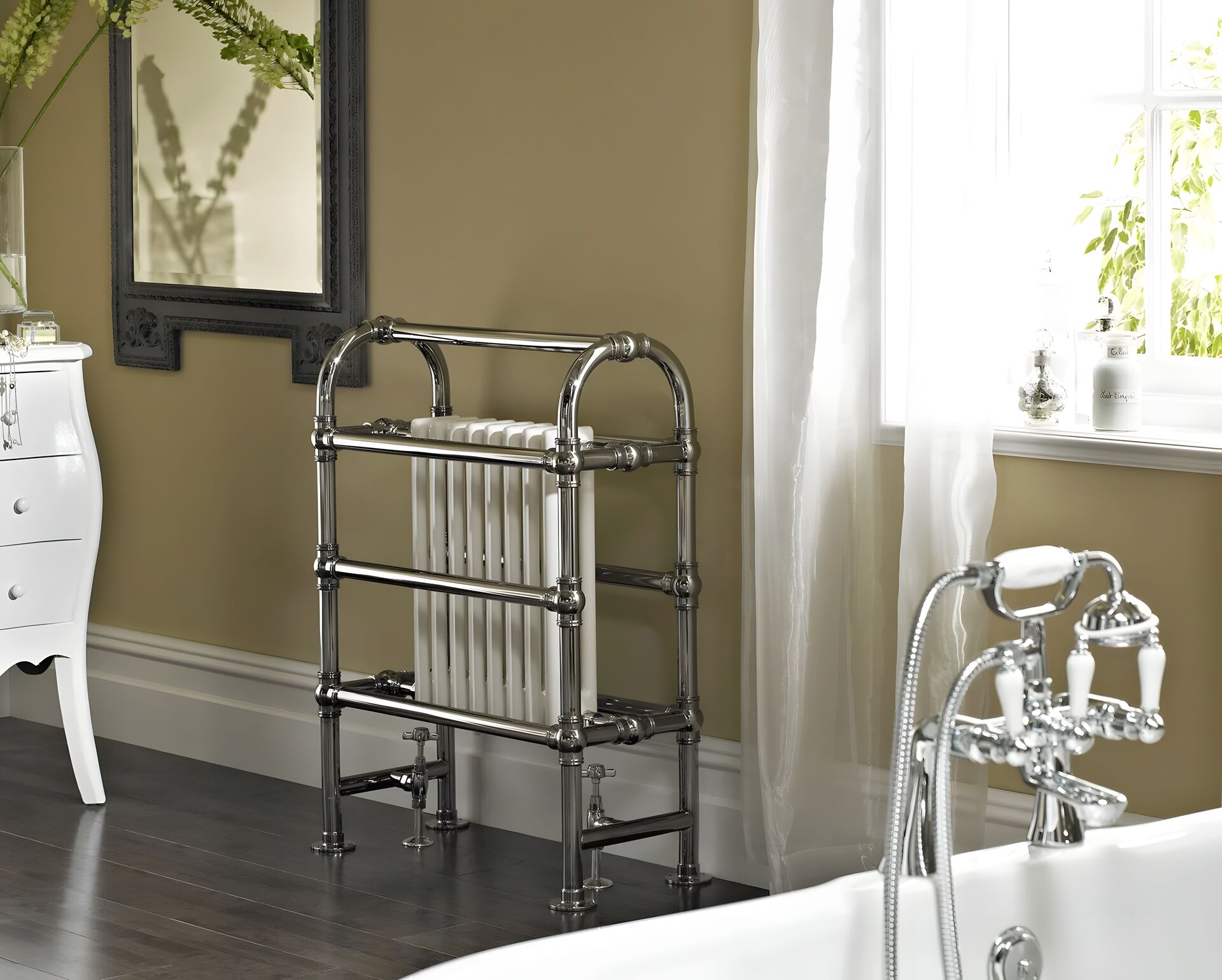
A radiator can have generous overall dimensions and still be awkward to use.
We’d look at the distance between rails, the number of useful openings and whether you can put a towel on without folding it into a narrow gap. Shelves and projecting rails can help, but they also increase the radiator’s depth into the room.
For example, the 750mm Ieri listed above projects 265mm and includes a towel shelf. The Baroque LG014-BR is 325mm deep, while the OG016-BR version with the same published output is 350mm deep. Those extra millimetres may be perfectly acceptable on an open wall, but less so beside a bath, basin or doorway.
This is why a front elevation isn’t enough. Check the depth as well as the height and width, then allow space for towels to hang without obstructing how you move around the room.
Decide how the radiator will be heated
The product must be ordered for the way you intend to use it.
A bathroom radiator may be offered for central heating, electric-only use or a configuration that allows an electric heater alongside the water-fed system. Those choices aren’t interchangeable after the radiator arrives.
Agree the heating configuration
Your fitter will need to confirm the circuit, controls and connection arrangement. If you’re buying through Bowmans for an installation by your own fitter, bring their requirements into the conversation before the order is placed. It’s much easier to confirm the correct version at that stage than to adapt the wrong one on site.
Check care requirements before choosing the finish
Obtain the manufacturer’s care guide for the exact finish before committing to it.
Polished, plated and painted surfaces may have different cleaning instructions. The bathroom cleaner you already use may not be suitable for every finish, and the product’s own guidance should decide what can safely be applied.
This is particularly worth checking for a prominent finish that you’re repeating across taps, shower fittings and accessories. A finish can look right on the showroom sample but still be the wrong choice for you if its care requirements don’t suit how the room will be used.
What should you compare before ordering?
Start with the room and the heating system, not a preferred metal.
We’d want to know:
- The bathroom’s heat-loss calculation.
- The heating system and its actual operating temperature.
- Whether the radiator will be water-fed, electric or correctly specified for dual-energy use.
- The available wall width, height and depth.
- How many towels you need to hang.
- The exact model, size and finish.
- The declared output for that precise specification.
- Whether the manufacturer approves it for the intended circuit.
- The care instructions for the selected finish.
The material is one part of the choice
Once those points are clear, material becomes a useful part of the decision rather than a shortcut for judging quality.
Find the right radiator for your bathroom
If you’re choosing a radiator for a new bathroom, bring the room dimensions, details of the heating system, the available wall and your preferred finish to our Braintree or Leigh-on-Sea showroom. We can help you discuss your radiator specification, whether Bowmans is designing the whole bathroom or supplying products for your own fitter.
Related Guides and Inspiration
Vogue UK radiators
Explore towel rails and radiator designs at Bowmans.
Zehnder radiators
Compare models, finishes and bathroom heating options.
Bathroom underfloor heating
Consider how floor heating fits the wider heating plan.
Bathroom planning checklist
Coordinate product choices with your fitter’s requirements.