
Bowmans · Inspiration · Design
How to plan a luxury bathroom: a designer’s 14-step checklist
Most luxury bathroom projects fail at planning, not at install. The fitter takes the blame for products that won’t fit, taps that dribble, soil pipes in the wrong place, joists that flex under a freestanding bath, tiles that don’t work in the room’s real light. Every one of those is a planning mistake. So this is the checklist we run on every project: 14 ordered steps, what to do at each, and the mistake we see most often. Print it, take it to whichever showroom you’re talking to, and use it to test the conversation.
01 · The brief
Define the brief in writing before you look at any product
The brief is a written document that captures how the bathroom needs to work for the people using it. Not what it looks like: that comes later. A written brief changes the conversation in every showroom you walk into, because a designer holding a real brief works differently from one who’s selling out of a brochure.
What to do. Write it down in one sitting. Who uses the bathroom, with heights, ages, mobility and whether anyone bathes children in there. How many people use it morning and evening. Whether it needs a bath at all: Houzz UK’s 2025 Bathroom Trends Study reports 58% of UK homeowners enlarged the primary shower in renovation, 25% of them by more than 50%. Your storage reality, meaning how many towels, what cleaning products, hairdryer and straighteners. The room’s role, whether that’s family bathroom, ensuite, principal-suite spa or guest. Your budget range. And your timeline, including any hard dates such as a baby due, a remortgage or a sale.
The common mistake. Starting with a Pinterest moodboard. Pinterest tells the designer what you find pretty. It tells them nothing about how the room has to perform on a wet Monday morning with the whole family awake. A good designer turns the brief into product choices that come out pretty and functional. Reverse the order and you’ll get a beautiful room that doesn’t work for the way you live.
That brief is the only document the designer should be working from when they propose a layout. If they start drawing without one, slow them down.
02 · The survey
Measure the room properly — floor, ceiling, openings, services
A bathroom is a 3D problem before it’s a floor plan. Products that fit on paper but not in the actual room are the single most expensive surprise on a luxury install. Nearly always it traces back to one of three measurements nobody took.
What to do. Measure floor plan width and length wall-to-wall. Measure ceiling height at the lowest point, because sloping ceilings dictate which rainfall shower heads will fit: a head with a 30cm projection on a 2.0m ceiling reaches a 1.95m user. Note window cill height and door swing direction. Photograph where the soil-stack waste pipe currently exits the WC wall, since relocating it costs £1,500–£3,000 in plumbing rework. Note the existing radiator’s plumbing run, off the bathroom feed or off the central-heating loop. Then measure the depth of any wall the basin or wall-hung WC will fix to, because concealed cisterns need around 200mm of wall depth and plenty of UK stud walls give you 100mm.
The common mistake. Trusting the original architect’s floor plan. Walls are rarely square, ceilings are rarely flat, and 1930s and earlier properties drift several centimetres across a 3-metre wall. Bring a laser measure (a Bosch GLM at £60 is fine), measure the diagonals as well, and note the deviation. A designer working from your real numbers can plan to the millimetre; one working from the architect’s drawing plans to a room that doesn’t exist. See who designs the bathroom after the architect’s plans are done for how that handover should work.
03 · The water system
Survey the water system and the actual pressure at the bathroom
This is the survey that prevents the most expensive single mistake in luxury bathrooms. The pressure at the existing bath tap dictates which taps, valves and shower heads will work in the room you’re about to build. Get it wrong and you’ll find out post-install, when the new monobloc dribbles or the rainfall head trickles.
What to do. Identify the system: gravity-fed (loft tank, low pressure, typical of older properties), unvented mains-pressure (no tank, mains pressure, typical post-2000s), or a megaflow / accumulator system. Get a pressure reading at the existing bath tap with a £20 plumbers’ merchant pressure gauge. Anything above 2 bar is comfortable for almost any modern fitting, and 1–2 bar limits some monoblocs and rainfall heads. Below 1 bar you’re looking at a dribble unless you fit a shower pump, and that’s around £400–£800 plus install, with its own noise, warranty and energy implications. Check the hot-water cylinder type: unvented hot-water systems above 15 litres require a registered competent person to install or alter, per Approved Document G3.
The common mistake. Choosing a tap before checking the system. Mumsnet renovation threads are full of people who fitted a beautiful Italian monobloc to a 1930s gravity loft and got 0.4 bar. The fix is either a pump or a return-and-reorder cycle, and both cost £400–£1,500 and weeks of delay. Hansgrohe publishes minimum pressure ratings on every product spec sheet; so does Crosswater. Read them both.
04 · The structure
Check joist direction and floor load before you fall in love with a freestanding bath
A 1700×750mm cast-iron freestanding bath weighs around 100kg empty and 350–400kg filled with a person in it. UK timber upper floors built to current standards are designed for a residential imposed load of 1.5 kN/m² per BS EN 1991-1-1, and a freestanding bath concentrates that load over roughly 1.3m². For most modern properties the floor takes it without any trouble. Older or compromised floors are the ones that don’t.
What to do. Lift a floorboard or look from below. Note joist direction, meaning parallel to or perpendicular to the bath’s long axis. Note joist size: minimum 47×195mm in modern construction, or 47×145mm and smaller in 1930s and earlier properties. Then note the span between supporting walls and any notch damage from previous plumbing runs, because notches in the bottom third of a joist seriously reduce its capacity. Joists running parallel to the bath with no double-up underneath are the worst combination, since the load transfers through one joist instead of three or four. If anything is borderline, a structural engineer’s sign-off is £200–£500 and protects against a flex-and-crack outcome.
The common mistake. Buying the bath on Instagram aesthetics, then building blocking under the floor as an afterthought when the bath turns up. Acrylic and stone-resin freestanding baths weigh a fraction of cast iron (30–60kg empty, 250–300kg filled), so the cheapest fix when the floor is light is to switch material. Decide the structure first, then the product.
05 · The bath decision
Decide bath type first — it locks half the layout
Bath choice is the structural decision the rest of the room arranges itself around. Built-in or freestanding, single-ended or double-ended, material, fill method — each of those constrains where the basin, WC and shower can sit. So make it first and let the other product choices follow.
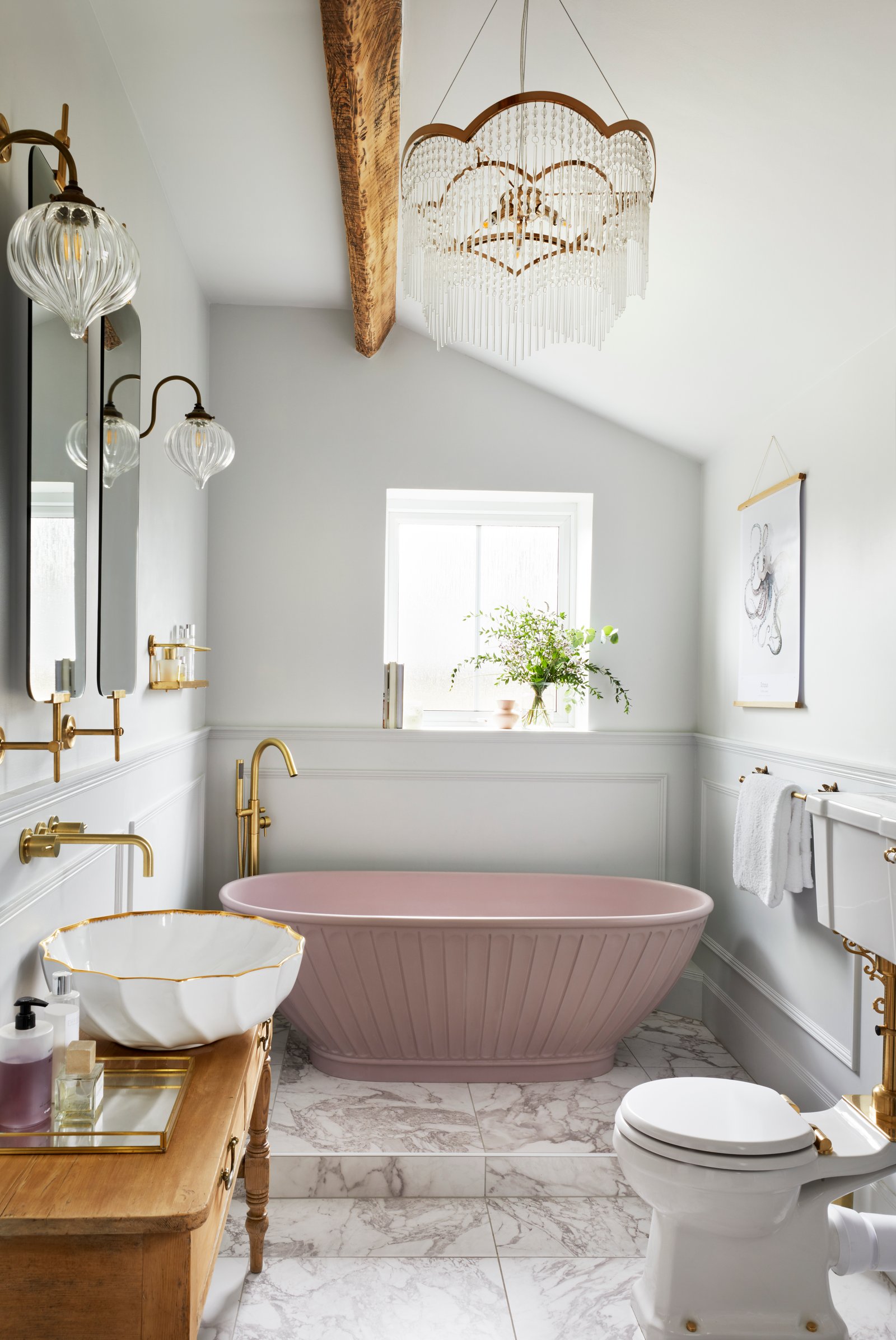
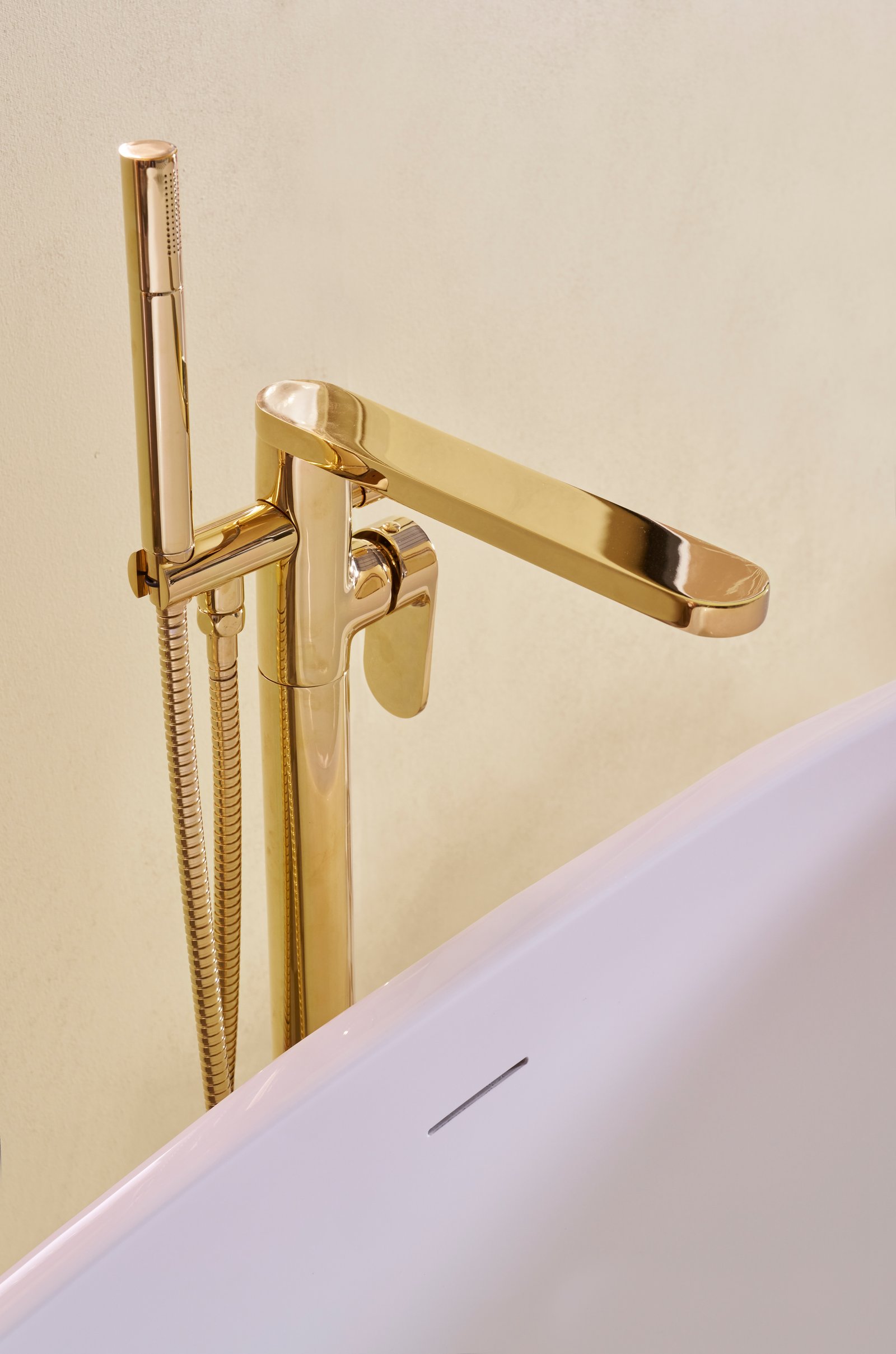
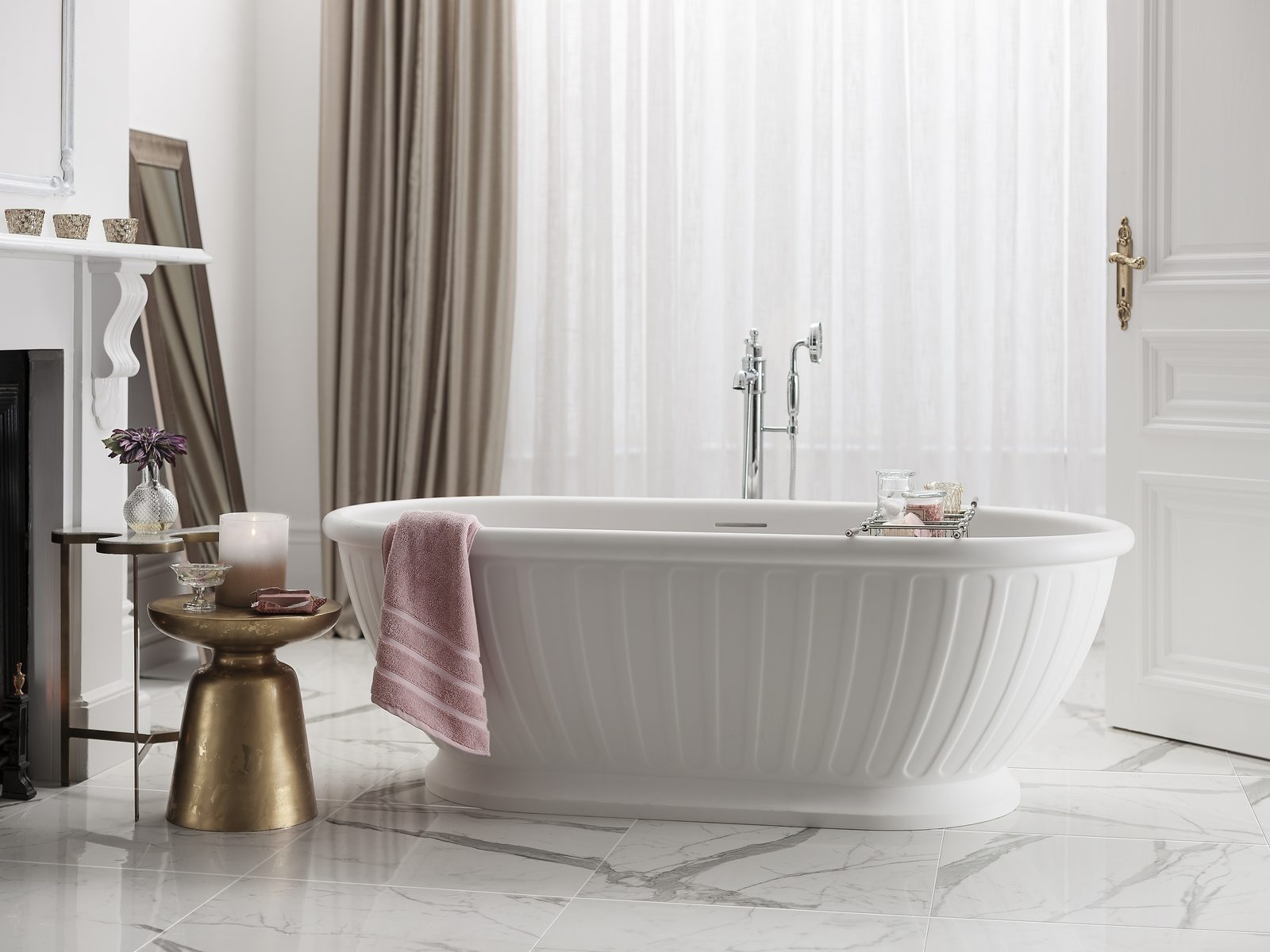
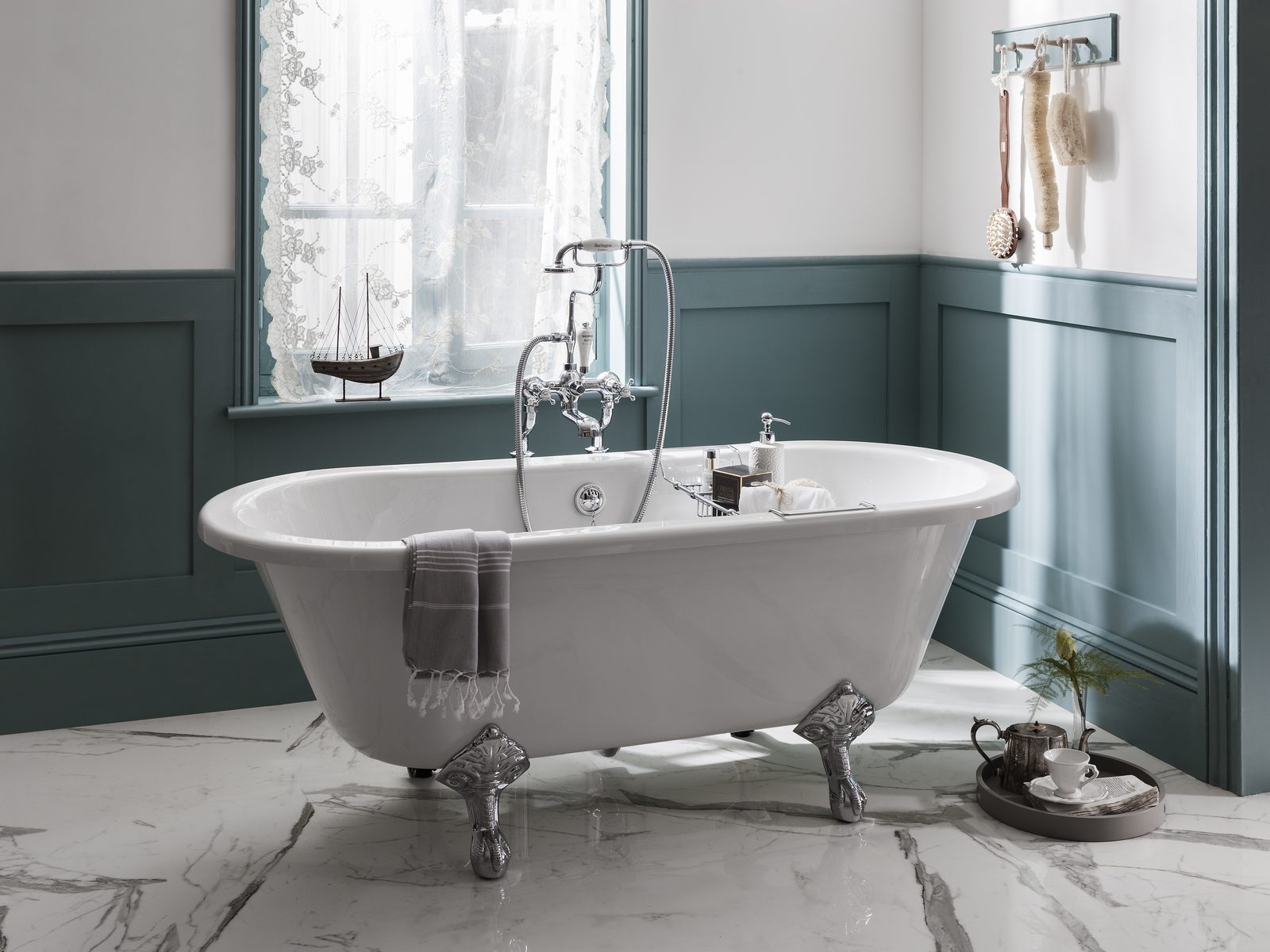
What to do. Pick a category before a product. Built-in baths give you a tile shelf, more storage and lower install cost; they read traditional or transitional. Freestanding baths read luxury immediately, but they eat 40–60cm of floor space on each side for cleaning and bathing comfort. Their fill route comes either from the floor, with concealed plumbing under the floorboards, or from the wall, where a floor-mounted bath-shower mixer like the BC Designs Cheviot adds another statement piece. Double-ended freestanding baths read most luxurious; single-ended are usually cheaper and fit better against a wall. Material affects weight (covered above), heat retention (cast iron and stone resin hold heat longer than acrylic) and cost.
The common mistake. Trying to fit a freestanding bath into a room that doesn’t have the floor space for it. The bath looks beautiful in the brochure photo at full distance; in a 4m² ensuite with the freestanding bath crammed against a wall, the room reads cluttered and the bath is impossible to clean around. Below 5m², a built-in bath almost always looks better, and a walk-in shower with no bath is often the right answer in an ensuite.
06 · The tile decision
Choose tile in the actual room light, not under showroom spotlights
Tile choice is the second-most-expensive thing to get wrong, after the bath. Showroom lighting is bright, neutral and even; your bathroom probably isn’t. A pale grey tile that reads ivory under showroom LEDs turns green under north-facing daylight and blue under warm evening LEDs at home.
What to do. Get full sample tiles rather than the postcard chips. Bring them home. Look at them at 9am, 3pm and 9pm in the actual room, against a swatch of the wall colour and the vanity finish. Photograph each one. Note any colour shift. Slip rating matters too: floors in wet zones should be R10 minimum (BS EN 14411 / EN 13036-4 classification), and shower trays and walk-in shower floors are happier at R11. Black grout looks good for six months, then shows white limescale residue worse than the original tile after that, and it’s the most-regretted choice on Mumsnet renovation threads. Light-grey or pale-cream floor grout stains visibly within a year if the bathroom sees children. Mid-grey grout in a sealed-fast formula is the durable middle ground.
The common mistake. Choosing a textured wall tile in a hard-water area. Fine-textured zellige and crackle-glaze surfaces pick up limescale that no glass cleaner will shift. Smooth glazed porcelain and large-format polished stone are the easier finishes to live with in Essex and the East of England, where water hardness sits in the 250–350 mg/l calcium carbonate range.
07 · The brassware decision
Spec brassware to match the water system, finish family and lead time
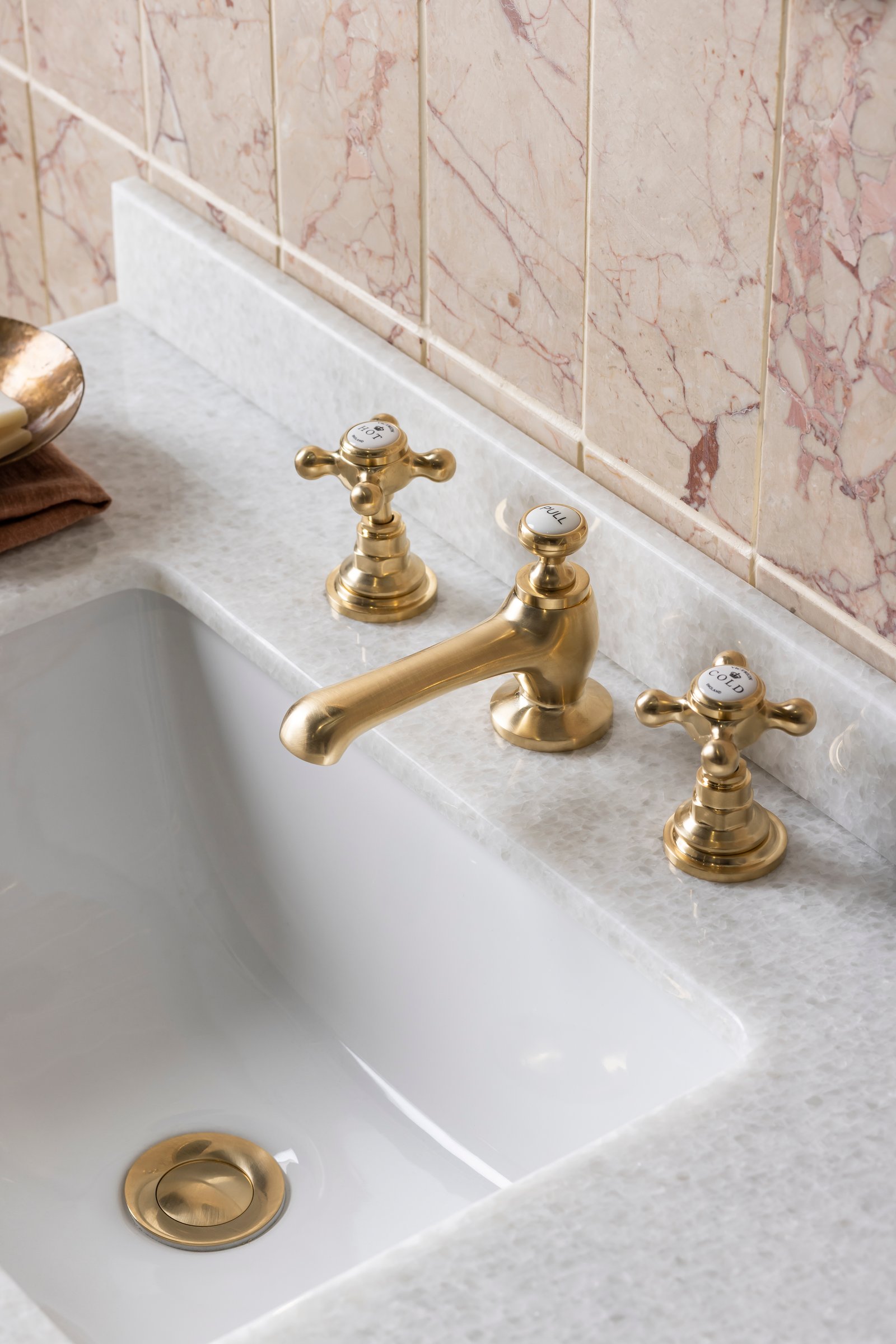
Brassware is where finish coordination begins. Every visible metal in the room belongs to one family or fights the others: tap, shower head, towel rail, mirror frame, vanity handle, light fittings. Settle that at planning stage and the room holds together for ten years. Leave it to chance and the eye trips on every cold-warm jump.
What to do. Pick a finish family first: chrome, matt black, brushed nickel, brushed brass, or aged bronze. Then check three things on every brassware product spec sheet. (1) Minimum operating pressure: covered in step 3, but worth re-confirming on each piece. (2) Lead time: chrome and matt black usually ship within a fortnight, while brushed nickel, PVD bronze and aged brass can take 8–14 weeks and add 15–25% to list price. (3) Outlet flow rate, particularly on basin taps: some European spec basin mixers run at 5 l/min flow restriction (good for water efficiency under Approved Document G2’s 125 L/person/day target), others at 8–9 l/min (faster fill, slightly higher water bill). UK 2026 trend data from kbbfocus has BC Designs design manager Keeley Sutcliffe noting that “brushed nickel gives you the neutrality of chrome without the coldness”. Brushed nickel and brushed brass have both been rising through 2025 and 2026.
The common mistake. Mixing finish families to “save money on the bits no one sees”. The towel rail in chrome when everything else is brushed brass; the WC flush plate in white when every other metal is bronze. Coherence costs nothing extra at planning, because you just buy the rail in the right finish. It’s close to impossible to fix once the products are on site.
08 · The lighting plan
Build a layered lighting plan before the electrician drills
A single line of cool-white LED downlights is the default in builder-spec bathrooms. It produces the worst possible light for both functional tasks (shaving, makeup, reading shampoo bottles) and atmosphere, because a 7am bath shouldn’t feel like an operating theatre. Layered lighting is what separates a luxury bathroom from a hotel chain.
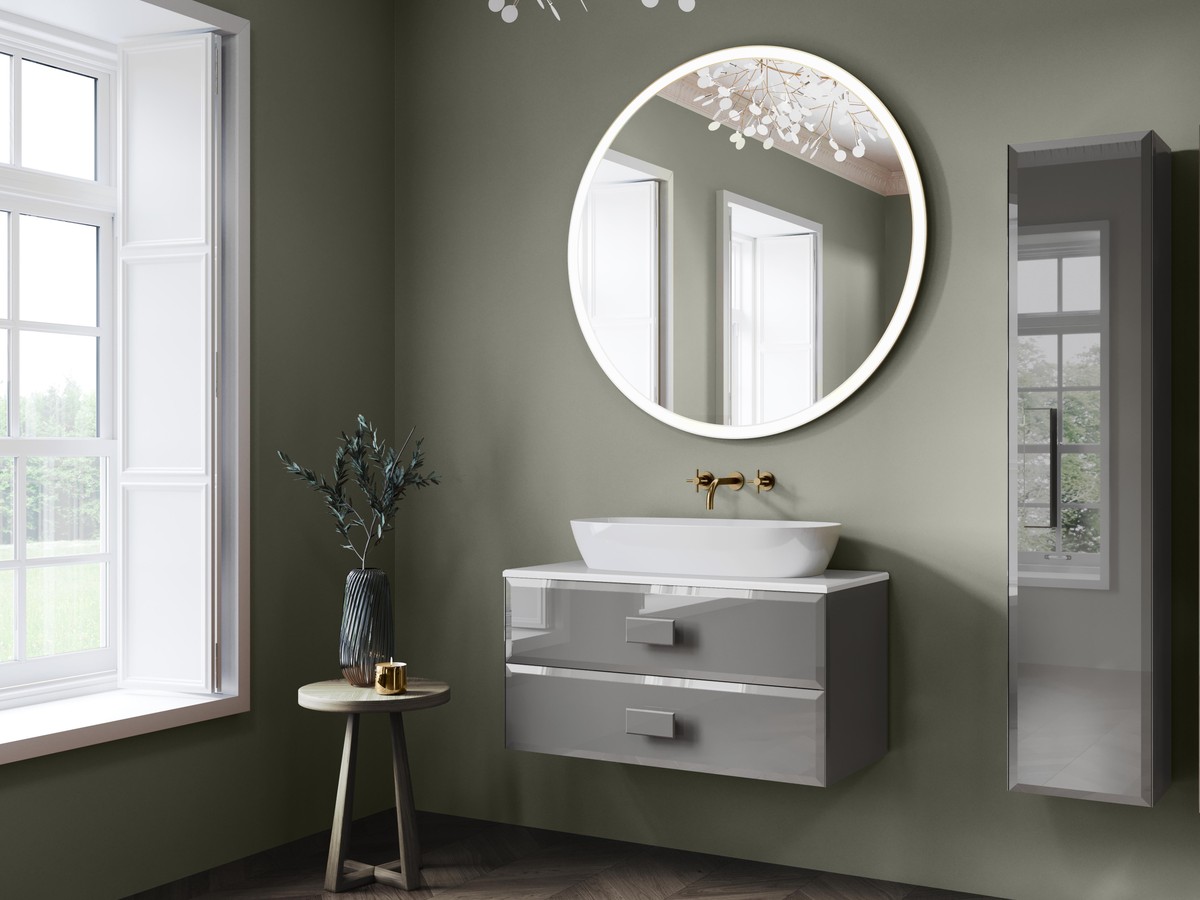
What to do. Plan four layers. (1) Ambient: a few warm-white (2700–3000K) downlights for general fill, dimmable. (2) Task: mirror lighting at face height (vertical LED strips on either side of the mirror, or a backlit mirror); ceiling downlights are the wrong source for shaving because they cast a shadow under the brow. (3) Accent: under-vanity LED strip, a niche-light in the shower, a wall sconce next to a bath. (4) Mood: a separate dimmer circuit on the lowest layer, or a colour-tunable fixture for evening soaks. All bathroom fittings must be IPX-rated to the zone they sit in (covered in step 10) and on a 30 mA RCD-protected circuit per BS 7671:2018+A4:2026.
The common mistake. Treating lighting as an electrician’s afterthought instead of a designer’s spec line. The fitter knocks holes for downlights on day three of the install based on what looks even from below, and you’ll live with that pattern for the next decade. Plan the lighting on paper, with circuits, dimmer groupings and IPX ratings, before the electrician arrives.
09 · The ventilation
Specify ventilation to Approved Document F, and treat it as mandatory
Bathroom ventilation is the unglamorous specification line that protects every other product in the room from premature failure. Damp from inadequate extract corrodes brassware, lifts paint, swells timber vanities, blooms grout and feeds black mould into the worst silicone joints. Approved Document F (Ventilation) sets the minimum.
What to do. Specify either intermittent extract at 15 litres per second or continuous extract at 8 litres per second, per Approved Document F. The fan has to duct to outside. A loft, a soffit or a stud-wall void doesn’t count, whatever anyone tells you on site. In bathrooms with no openable window, run-on time of at least 15 minutes after the light goes off is required. For higher-end specifications, a humidity-tracking fan such as the Vent-Axia models that raise extract rate as humidity rises handles a long shower better than a fixed-rate extract on a timer. Quiet-rated fans (sound output below 25 dB(A) at 3m) are worth the £50–£150 premium, because cheap fans get switched off and never replaced.
The common mistake. Reusing the existing fan because “it’s only six years old”. That fan was specced for a smaller bathroom in worse use. Recheck it against the 15 L/s rule using the new room volume rather than the old one. Wetrooms and walk-in showers in particular need extract sized for the moisture they generate, and floor area on plan tells you very little about that.
10 · The electrics
Get electrical zoning right — BS 7671:2018+A4:2026
Bathroom electrics are the most regulated part of any luxury bathroom, and the area where a non-Part-P installer’s shortcut puts you on the wrong side of the law and the wrong side of your home insurance. The current rules are BS 7671:2018+A4:2026 (the IET Wiring Regulations, 18th Edition), referenced by Approved Document P. Amendment 4 has applied since 15 April 2026; Amendment 3 stays valid until it’s withdrawn on 15 October 2026.
What to do. Map the zones on plan before you specify any fitting. Zone 0 is the inside of the bath or shower: IPX7 minimum, SELV 12V max only. Zone 1 is the area above the bath or shower up to 2.25m from the floor, at IPX4 minimum. Zone 2 is 0.6m horizontally beyond Zone 1, again at IPX4 minimum. (Zone 3 was removed from the regulations, and old guidance still circulating online is out of date.) Every bathroom circuit must be on 30 mA RCD protection. Notifiable bathroom electrical work has to use a Part-P registered competent person or be notified to building control. Plan socket positions, mirror-light zones, towel-rail switching and the underfloor-heating thermostat outside Zone 2 wherever possible.
The common mistake. Letting a fitter run cables and decide IPX ratings on site. The product you wanted may not be IPX-rated for the zone the fitter has just cut a hole in. Then it’s either a different fitting, which means a spec change and a fresh lead time, or a different position, which means a different look. Plan the electrics with the bathroom designer at the table. It isn’t a site decision.
11 · The finish coordination
Coordinate every finish across every product — the moodboard test
Finish coordination is what separates a luxury bathroom from a high-spec one. A high-spec bathroom is the right products bought independently; a luxury bathroom is the right products bought as a coherent palette. The difference is the moodboard: the physical sample tray of every finish in the room, viewed together before order.
What to do. Build a physical moodboard rather than a Pinterest one. Pull the real tile sample, the real brassware finish swatch, the real paint card, the real vanity finish chip, the real stone or quartz worktop sample, the real grout colour and the real silicone colour. Lay them on a tray. Photograph them in the bathroom’s own light at 9am and 9pm, then live with them for a week. Coloured suites are the trend that exposes weak coordination fastest: Catalano Carolina green or sabbia, BagnoDesign Studio 316’s eight colours, Roca Ohtake. They look glorious in the brochure photo, where every other surface has been lit to flatter them. In your room they’re unforgiving.
The common mistake. Coordinating from photographs alone, because photographs lie about colour. The same matt-black tap photographed against three different walls comes out as three different shades of grey. Physical samples in physical room light are the only test that holds up. Designers do this as standard; fitters and DIY routes skip it.
12 · The specification
Lock the full specification sheet — product codes, quantities, lead times
The specification sheet is what turns a moodboard into a buildable project. Every product, every finish, every quantity, every supplier, every lead time, every delivery address, every install note. A standard luxury bathroom sits at 60–90 line items on the spec sheet; a bespoke principal-suite ensuite can run to 150.
What to do. Get a complete spec sheet in writing before you sign anything. Each line should carry: manufacturer name, product name and code, finish, dimensions, quantity, unit price, line price, lead time, supplier and a note flag for any pressure rating, IPX zone or compatibility constraint. The grout colour and silicone colour are line items in their own right. The tile waste percentage (usually 10–15% on rectangular layouts, 20%+ on herringbone or chevron) is a quantity adjustment rather than an optional extra. Check the line for “additional fixings, brackets and accessories”, since concealed cisterns, basin trap kits and waste plates are the things that get forgotten.
The common mistake. Accepting a quote that summarises rather than specifies. “Brassware: Crosswater package £3,200” is a summary, and it isn’t a spec. Ask for line-by-line. Any showroom that resists giving you the line detail before order is a flag, because the detail is exactly what you’re paying for. The cost reality across the £15k, £25k and £40k tiers is broken down further in our luxury bathroom cost UK guide.
13 · The render review
Review the 3D render properly, with the styling turned off
A 3D render is a verification tool. Treat it as marketing and it stops doing its job. What you’re catching at this stage is everything that looks fine on plan but reads wrong in three dimensions. A door swinging into a vanity. A towel rail that blocks the window when it’s open, a mirror that stares straight into the WC, a pendant hung exactly where someone drying their hair will hit it.
What to do. Walk through the render in three modes. (1) Functional: trace your morning routine (WC, basin, shower, towel, mirror, exit) and see whether anything gets in the way. (2) Sightline: what do you see when the door opens? What does a guest see? Is the WC the first thing in view from the landing? (3) Lighting and reflection: where does daylight fall at 9am? Does the mirror throw glare into the bath, and where does the towel rail cast shadow? Ask the designer to render the room at 9am, 3pm and 9pm light if the software supports it.
The common mistake. Treating the render as a brochure. The first render is usually styled to look beautiful — warm lights on, towels folded, dramatic angle. That’s the version that sells the design. It won’t catch problems. Ask for the unstyled render with overhead light only, a plan-view drop-down to verify the layout, and a clean section view to see the heights. Three or four revision rounds at this stage is normal, and it prevents change orders during install.
14 · Sign-off and order
Sign off in writing, then order, then strip
The last step is the simplest, and it prevents the most expensive failure of all: starting strip-out before the products are on site. A stripped bathroom with nothing to put in it is a money meter. It runs at £30–£60 per pallet per week in storage, plus accommodation, plus the family-of-four-bathing-elsewhere logistics, plus the reorder cycle if anything turns up wrong.
What to do. Sign off the spec sheet in writing — literally a signed PDF with the full line-by-line attached. Place all orders. Wait for delivery: 6–10 weeks for European vanities and stone slabs, 8–14 weeks for special-finish brassware. When the products arrive on site and have been QA-checked against the spec sheet for damage and correctness, then brief the installer to strip and start. A good fitter won’t work on faith that “the bath should be here next week”. The bath is in the room before the floor comes up. Site management visits during install (typically £60–£100 per visit) catch small spec deviations before they turn into big ones, so ask whether they’re included or charged separately.
The common mistake. Letting an enthusiastic installer start strip-out “to keep momentum” while products are still 4 weeks out. So the bathroom sits stripped for those 4 weeks, the family bathes at the in-laws or under a temporary shower in the kitchen, and if one product turns up wrong the wait extends to 6–10 weeks. The cost of that slip dwarfs anything you saved by starting early. Order, deliver, then strip. Every time.
Whether your project warrants a designer-led process, or whether you can run the checklist with a fitter, is covered in our is a bathroom designer worth it guide. Look at the four trigger conditions there: £15k+ budget, awkward layout, period property, 3D render requirement. Ticking two of the four is usually the threshold. Below that, the checklist still applies, but a competent fitter and a tight Pinterest board can stand in for the formal designer step.
Frequently asked questions
Everything UK homeowners ask about planning a luxury bathroom in 2026.
What’s next
Run the checklist with a designer
We run this checklist on every project. The first showroom appointment is included, with no obligation to buy. We benchmark our product pricing against the major UK online retailers (Drench, Victorian Plumbing, the supplier-direct sites) on every brand we sell, so the design service sits alongside the product price rather than inside it. If you’d rather get a feel for the numbers yourself first, our interactive price guide walks through the spec in your own time. Here’s the test for any showroom you’re considering: ask how their pricing compares to the major online retailers. A vague answer means you’re paying for the design somewhere in the basket.
We design from showrooms in Braintree (Springwood Industrial Estate, CM7 2YN) and Leigh-on-Sea. There’s no design fee, no margin uplift on products and no obligation. We ask clients to be seriously planning a project before we book designer time, since we don’t recover the cost through your basket.
Companion guides: is a bathroom designer worth it? · luxury bathroom cost UK 2026