
Bowmans · Inspiration · Design
TECEsquare Flush Plate Finishes: Which One Suits Your Bathroom?
By Jonathon Barclay · · 8 min read
The flush plate is often chosen after the taps, tiles and furniture, even though it sits in clear view above the toilet. By then, you may have spent a considerable amount on a carefully coordinated room only to discover that the obvious plate finish doesn't quite match anything else.
With the TECEsquare collection, we'd choose the plate alongside the brassware and main wall finish. Compatibility still comes first, but once that's confirmed, the plate should look like a deliberate part of the bathroom rather than something added because the installer needed an answer.
TECEsquare is a geometric flush plate with two buttons for dual flushing. In 2026, TECE announced four additional brushed surfaces for the metal version: cool nickel, bronze, brass and black stainless steel. UK availability should be confirmed before the bathroom is specified or products are ordered.
Quick Navigation
What are the four TECEsquare flush plate finishes?
TECE announced cool nickel, bronze, brass and black stainless steel as four new brushed surfaces in 2026. The company also states that these versions have an anti-fingerprint coating and can be coordinated with finishes available for TECEdrainway and TECEdrainprofile. You can see the manufacturer's announcement of the four surfaces and the TECEsquare metal product information.
The TECE 2026 product brochure gave planned availability from mid-February 2026. That isn't confirmation that every finish is currently stocked or available to order in the UK. Check the exact finish, product reference and likely supply date before building the room around it.
| Finish | What it tends to work with | What to check before choosing it |
|---|---|---|
| Cool nickel | Cooler metal finishes and restrained grey, white or stone palettes | Whether it sits comfortably beside your taps, shower controls and accessories, rather than appearing noticeably warmer or darker |
| Bronze | Warm stone, timber and deeper wall colours | Whether the bronze is close enough to the other metal finishes in the room, especially where they appear on the same wall |
| Brass | Warm neutrals and schemes where the brassware is intended to be visible | Whether the shade and brushed texture work with the chosen taps, shower and handles |
| Black stainless steel | Dark details, black brassware and rooms where a strong contrast is wanted | Whether another dark rectangle above the WC makes the wall feel too busy, particularly against pale tiles |
This is a design comparison, not a promise of an exact colour match with products from another manufacturer. The physical samples need to be judged together.
Don't rely on finish names to produce an exact match
“Brass”, “bronze” and “nickel” aren't universal colours. Two manufacturers can use the same name for finishes that differ in warmth, depth, texture and sheen.
That difference becomes more noticeable when the products are close together. A brass flush plate may look perfectly suitable on its own but slightly green, pale or polished beside a warmer brushed-brass tap. Bronze can vary even more, from a fairly light brown metal to something much darker.
We'd compare the plate with the actual brassware sample in the same light. Showroom lighting, daylight and warm bathroom lighting can each change how a metallic surface looks. Photographs on separate websites aren't reliable enough for a close match.
If an exact match isn't possible, we'd usually make the difference look intentional. That may mean choosing a quieter nickel finish rather than adding a second version of brass, or using black stainless steel as a clear contrast. A near match can look more accidental than two finishes that are obviously different.
Our guide to choosing bathroom brassware finishes explains how to coordinate taps, shower controls and smaller details across the rest of the room.
Decide whether the flush plate should stand out
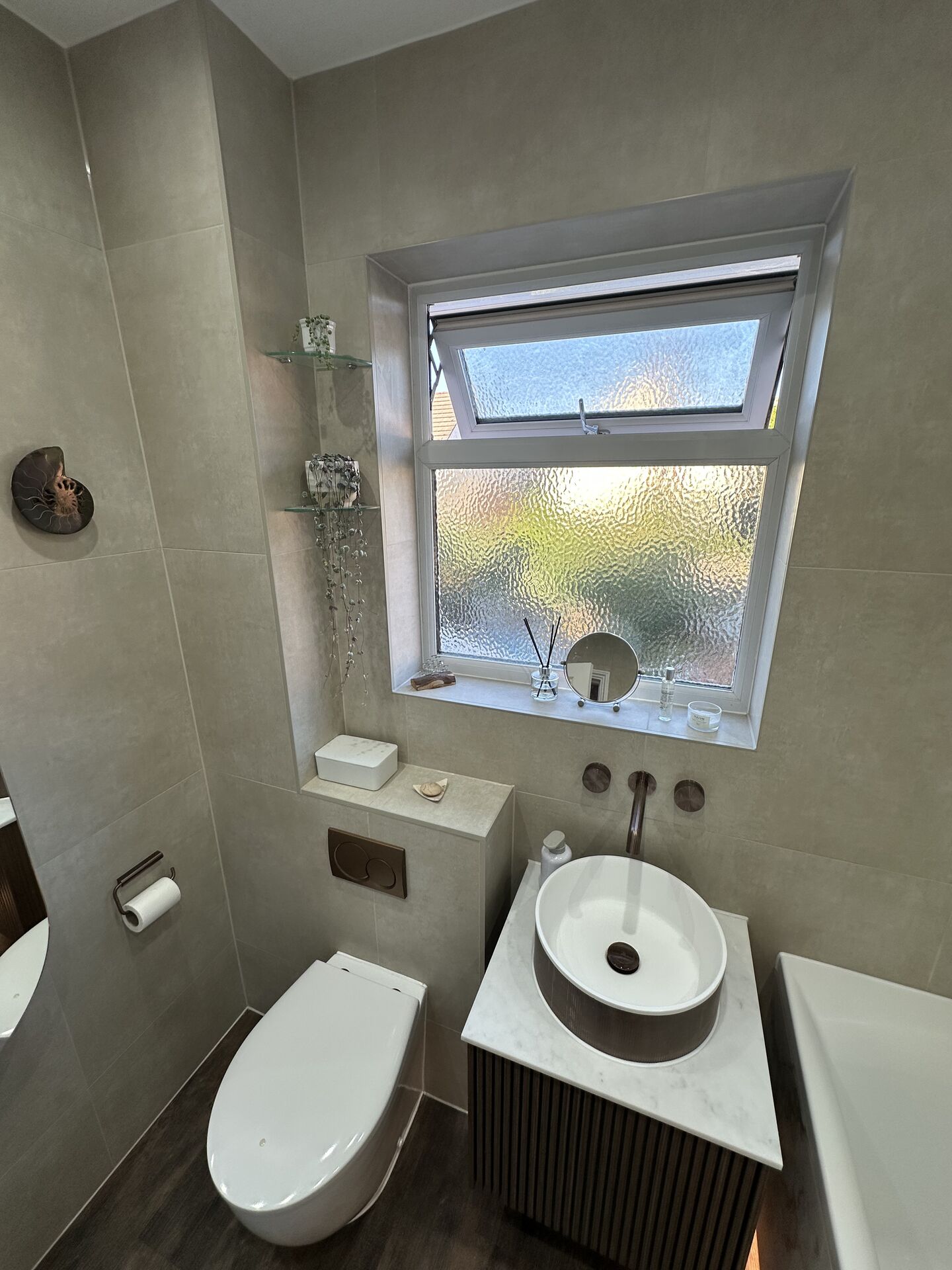
A metallic TECEsquare plate makes sense when you want the WC wall to carry one of the room's main finishes. Its geometric shape and two-button arrangement give it a definite presence, particularly against a plain tile.
That isn't always what the wall needs. If the tiles already have strong veining, pattern or texture, another contrasting fitting can make the area feel unnecessarily busy. The same applies if the WC sits beside prominent furniture, a heated towel rail or several brassware details.
In that situation, we'd also consider a plate that sits more quietly against the wall, provided it is approved for the chosen cistern and actuation system. The aim isn't to hide the flush control completely. It is to stop it competing with the parts of the bathroom you actually want people to notice.
A darker plate against a dark tile can do this, as can a pale plate against a light wall. But judge the buttons as well as the outer face. A plate may look restrained from a distance while its button outlines remain quite prominent.
Check cistern compatibility before choosing a finish
The most important question isn't which TECEsquare finish looks best. It is whether the exact plate is approved for the concealed cistern and actuation system being installed.
A flush plate isn't a universal cover that can be fitted to any concealed cistern. The mechanism behind it has to connect correctly with the system inside the wall. You shouldn't assume that every TECE plate works with every TECE installation, and a plate from another cistern manufacturer shouldn't be treated as interchangeable.
Before ordering, identify:
- The exact concealed cistern and actuation system.
- The full product reference for the TECEsquare plate.
- The manufacturer's approved compatibility between those two products.
- Any installation requirements shown in the current product documents.
- Whether the chosen finish is available in the UK within the project programme.
If you're buying the products for your own fitter, give them the product references and technical documents before anything is installed. A photograph of the plate or a finish name isn't enough.
Changing the plate later may sound simple because it remains visible. But if the preferred model isn't compatible with the concealed system already inside the wall, the choice can become much more restricted.
Plan the plate position with the tile layout
The flush plate needs to be easy to reach, but its position also affects how the tiled wall looks. This should be resolved before the tiles are set out.
On a plain wall, a small change in position may not be especially noticeable. With large-format tiles, book-matched patterns or strong grout lines, it matters much more. A plate that sits slightly off a tile centreline or cuts awkwardly across a prominent vein can look wrong even though it works perfectly well.
We'd assess it as part of the whole WC elevation. That means looking at the toilet, plate, tile joints, any nearby niche and the edges of the furniture together. The installer then needs the final setting-out information before tiling begins.
Reach matters as well. The plate shouldn't be placed purely to suit a grout joint if that makes it awkward to operate. The finished position has to work both visually and practically.
An anti-fingerprint coating doesn't make the plate maintenance-free
TECE describes the four brushed surfaces as having an anti-fingerprint coating. That should be treated as help with visible handling marks, not a promise that the plate will never show fingerprints or need cleaning.
The buttons are touched every day. Dust, cleaning residue and marks can still collect around their edges and across the face. Darker finishes may also show pale residue more clearly, while warmer metals can reveal streaks if the wrong cleaning product is used.
Follow the current manufacturer care guidance for the exact plate. Avoid assuming that a cleaner suitable for the toilet or surrounding tile is also suitable for a coated metal surface.
The practical question is whether you're comfortable maintaining a visible metallic plate. If you know that every mark on black or brass fittings will bother you, a quieter finish may be the better choice even if the stronger option looks better on a sample board.
What to confirm before ordering
Confirm compatibility first, then choose the finish alongside the rest of the scheme.
- Confirm the concealed system. Record the exact cistern and actuation details rather than relying on the brand name alone.
- Check the plate reference. Make sure the selected TECEsquare version is approved for that system.
- Confirm UK availability. Ask about the exact finish and expected supply date before agreeing the installation programme.
- Compare physical samples. Place the plate beside the taps, shower finish, furniture hardware and main tile under the same light.
- Choose contrast or coordination deliberately. Don't accept a close metallic match without seeing whether the difference is distracting.
- Set out the WC wall. Agree the plate position in relation to tile joints, patterns and nearby fittings before tiling starts.
- Give the documents to the fitter. Product references and current installation information should be checked before the cistern is enclosed.
If you're considering a TECEsquare plate as part of a whole-room specification, bring the tile and brassware choices to a showroom planning appointment. The team at Braintree or Leigh-on-Sea can help you assess how a flush plate would fit the room scheme. Ask which samples can be arranged and whether the selected product is available before committing to it.