
Bowmans · Inspiration · Design
Bathroom brassware finishes 2026: brushed brass, chrome, matt black and PVD
Brassware is the part of a luxury bathroom you spend the longest looking at, touch the most often, and regret the spec of three years in. Finish choice is where most of that regret lives. Chrome that pits, brushed brass that water-spots, matt black that scratches at the cartridge, waterfall taps that limescale up inside a fortnight in Essex hard water. The good news: every one of those failures is preventable with the right finish call up front. So here's the comparison you need. Chrome, PVD, brushed brass, brushed nickel, matt black, polished nickel and gold tone, with what each one does in a UK bathroom in 2026.
01 · The framing
Why finish is the brassware spec decision homeowners regret most
Brassware in a luxury UK bathroom typically lands at £600 to £3,500 of the project budget: smaller than the tile bill, smaller than the sanitaryware bill, but bigger than most people expect. The body of the tap is engineered, the cartridge is mechanical, and the warranty on the mechanism usually runs five-to-ten years on luxury collections from Hansgrohe, Axor and Crosswater. None of that is where the regret lives.
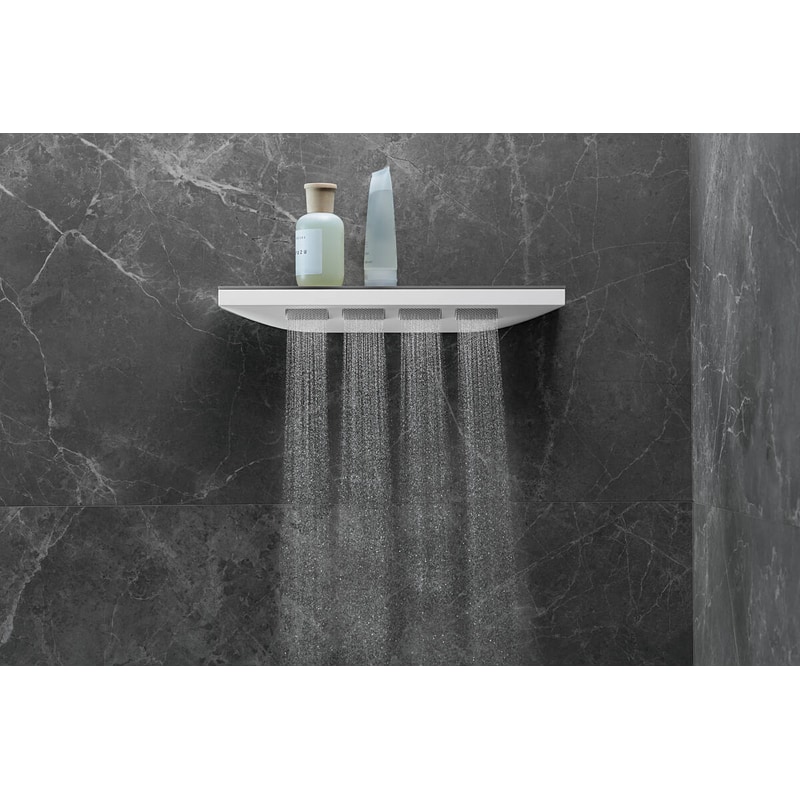
For a closer look at shape and operation alongside the finish, see why we like AXOR Starck and One, with examples of their controls and basin dimensions.
Our AXOR MyEdition finishes and cover plates guide shows how metal can be combined with materials such as timber and marble. For a simpler fitting, compare the finish choices on AXOR Uno basin taps.
The regret lives in the finish. Specifically, a finish picked for the showroom photograph rather than for the way it ages over ten years in a real bathroom. The same patterns come up again and again on Mumsnet, on Houzz UK threads, on MoneySavingExpert renovation forums. Matt black taps with worn cartridge edges at year three. Brushed brass with permanent water-spotting on the spout in hard-water postcodes. Electroplated chrome pitted where descaler was used, and waterfall spouts that look like a mineral exhibit by the second month in Essex.
None of that surprises anyone who specs brassware for a living. Almost without exception it comes down to three decisions made up front, and all three are easy to get right. Use PVD coating instead of electroplating on any non-chrome finish. Pick the finish tone for the water in your postcode rather than for the reference image. And avoid the spout styles that fail in hard water whatever finish you put on them. This guide walks the seven finishes that matter in 2026, what each one is good at, where each one falls down, and how to make the call for your own bathroom.
One framing rule first: brassware is the most-touched item in any bathroom. The cabinet handles get wiped twice a year; the basin tap gets touched five times a day. Whatever finish you pick, you're signing up for daily contact with it for at least a decade. So pick a finish that ages well over one that photographs well. That's a different decision from the one most retail copy pushes you towards.
02 · The shortlist
The seven finishes that matter in 2026 UK luxury bathrooms
Manufacturers publish dozens of finish names, but they boil down to seven visual families in UK luxury specs in 2026. The table below sets out where each one wins and where each one falls over, ahead of the detail sections. Treat it as a shortlist rather than a verdict. The right finish for your bathroom depends on your water hardness, your design direction, and how forgiving you need it to be day to day.
| Finish | Visual character | Hard-water tolerance | Best for |
|---|---|---|---|
| Polished chrome | Bright, reflective, cool | Excellent — limescale wipes off cleanly | Family bathrooms, hard-water postcodes, classic schemes |
| Brushed nickel | Matte, warm-grey, soft sheen | Very good (PVD); fair (electroplated) | Modern luxury, warm-neutral schemes, the chrome alternative |
| Brushed brass | Warm gold, textured, statement | Good (PVD only); poor (electroplated) | Warm-metallic schemes, period properties, principal suites |
| Matt black | Deep matte, graphic, contemporary | Fair — industry-standard lacquer / immersion-plated coating; limescale shows; softened water helps | Statement contemporary schemes, dark tile palettes |
| Polished nickel | Warm reflective, period-correct | Good | Period properties, traditional schemes, listed buildings |
| Aged brass / antique bronze | Mid-warm, deeper, lived-in | Variable — depends on PVD vs living finish | Country-property luxury, deep-toned colour schemes |
| Gold tone (true gold PVD) | Bright, warm, statement luxury | Good — PVD essential | Principal suites, statement schemes, designer-led specs |
Hard-water tolerance assumes Essex / South-East UK water (hard to very-hard band, 200–350 mg/L CaCO₃). Performance can shift noticeably in soft-water regions.
03 · Chrome
Chrome: electroplated vs PVD-coated, and why the difference matters
Chrome is the default. It's the finish nine out of ten UK bathroom taps have arrived in over the last forty years. It still owns the largest single share of the luxury brassware market in 2026, because it ages well, hides limescale better than anything else, wipes clean in seconds, and looks classic rather than dated. There's a reason the most expensive Hansgrohe, Axor and Crosswater collections still ship in chrome as the default option. It just works.
What most retail copy doesn't separate is that chrome covers two quite different processes. Standard electroplated chrome is the budget-to-mid-luxury approach: the brass body goes into an electroplating bath that deposits a chrome layer of about 0.25–0.5 microns. It looks excellent on day one and holds up well for the first five years. After that it can pit microscopically where descaler chemistry has been harsh, and the chrome layer can crack at high-flex points like the cartridge collar or the spout swivel, where the brass underneath moves under thermal cycling.
PVD-coated chrome is the same visible finish bonded by Physical Vapour Deposition rather than electroplating. The PVD layer is thinner (typically 1–3 microns of titanium-chromium-nitride compound), but it's bonded into the surface instead of sitting on top of it. You end up with a chrome finish several times more scratch-resistant, descaler-resistant and abrasion-resistant than the electroplated version, and one that holds its appearance for fifteen years rather than five-to-eight on the same body. PVD chrome typically carries a 15–30% premium over electroplated chrome in like-for-like collections.
For a UK family bathroom in a hard-water postcode (Braintree CM7, Chelmsford CM2, and the Colchester CO postcodes all sit in the hard band on Anglian Water's mapping), PVD chrome is the longer-term spec. Electroplated chrome is perfectly fine if the budget is needed elsewhere. On day one you can't see any difference between the two. At year ten you can.
04 · PVD
PVD explained: the modern luxury finish standard
PVD, or Physical Vapour Deposition, is the single most important development in bathroom brassware finishes in the last twenty years. It's the reason brushed brass, brushed nickel, matt black and gold tone are now serious long-term spec options rather than aesthetic choices that age out at year three. If you're spending more than £800 on a tap or shower set in any non-chrome finish in 2026, the question isn't whether to specify PVD. It's whether the manufacturer offers it at all on that range. If they don't, pick a different brand.
The process itself is straightforward. The brass tap body goes into a vacuum chamber. A target metal (titanium, zirconium, chromium or a compound) is vapourised by an electron beam or arc, and the vapour bonds to the brass surface at a molecular level under reactive gas. The resulting film is typically 1–3 microns thick, several times harder than the brass underneath, and chemically integrated into the surface instead of electroplated on top. The colour you see is the colour of that bonded film: brass-tone, nickel-tone, black or gold, controlled by varying the target metal and the reactive gas chemistry.
Why does this matter for a spec decision? On manufacturer testing data, PVD finishes are five to ten times more scratch-resistant than the electroplated equivalent. They shrug off chemical staining from descalers, they cope better with daily wipe-down cleaning, and they're far less prone to the colour-shift that hits electroplated brushed brass and matt black at year three-to-five. The PVD layer is also more UV-stable, which counts for little in a windowless bathroom but counts for a lot on an outdoor or skylight-lit install.
PVD warranty terms — read these before committing
The brassware-mechanism warranty (cartridge, body, internal seals) is one number. The finish warranty is a separate number, often a shorter one, and it's where most spec mistakes show up. So run three checks before you commit to a PVD spec at the £500+ price point.
- Length of finish warranty. Established luxury PVD ranges (Axor PVD across most ranges, JTP Vos PVD, Crosswater on selected PVD collections) carry 5–15 year finish warranties. Anything under five years on a £500+ tap is a red flag: either the PVD process is shorter-life or the manufacturer is hedging its bets.
- Exclusions for cleaning products. Most PVD warranties specifically exclude damage from abrasive cleaners, descalers used outside manufacturer guidance, and limescale-removal products containing strong acids. Read the exclusion list before you sign the spec off. If your cleaning cupboard already holds any of them, change the routine or pick a more forgiving finish.
- Domestic vs commercial coverage. Some PVD warranties cover domestic installs only and exclude high-frequency commercial use. If the bathroom sits in an Airbnb rental, a holiday let or a shared-living setup, check the cover applies before you pay the PVD premium.
So: PVD on a chrome tap is incremental insurance. PVD on any non-chrome finish is fundamental. It's the difference between a finish that lasts the life of the bathroom and one that needs replacing in year five. The price uplift sits inside a standard luxury budget rather than dictating it.
05 · Brushed brass
Brushed brass and aged brass: warmth, texture and the hard-water reality
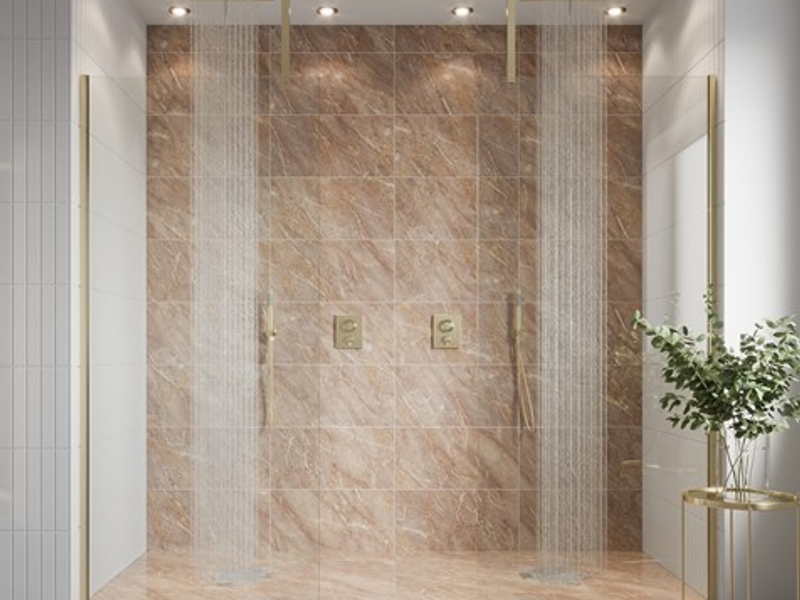
Brushed brass has carried more of the rising-trend conversation in UK bathroom design than any other warm metallic since 2023. Houzz UK's 2025 emerging-trends data showed pink-bathroom searches up 114% year-on-year, and the warm brassware finishes that sit alongside those palettes (brushed brass, aged brass, antique bronze) followed the same curve. The visual case is real. Brushed brass puts warmth into white, off-white and stone-tone schemes in a way polished chrome can't, and the brushed texture catches light differently to the cooler nickels.
The hard-water reality is just as real. Brushed brass shows mineral deposits more visibly than chrome on the spout face and around the cartridge, especially in the mid-warm tones where the deposit sits on the warm base like a paler shadow. In Essex hard-water postcodes (Anglian Water puts the CM and CO bands in the hard to very-hard range), an electroplated brushed brass tap will usually start water-spotting on the spout inside the first month. There are three ways to deal with that.
- Specify PVD-coated brushed brass. The PVD layer resists chemical staining from limescale and descaler residues, the brushed texture is integrated into the finish rather than added on top, and the spotting that does appear wipes off without leaving a halo. JTP Vos brushed brass PVD, Hansgrohe Axor brushed brass, and Crosswater PVD brushed brass collections all hit this spec.
- Install a softener treating the whole supply. A whole-house water softener removes the calcium and magnesium that drive limescale formation across every tap in the house. The investment is £1,200–£2,500 plus salt running cost, but it solves the problem comprehensively for any finish you specify.
- Accept a weekly limescale-care routine. A microfibre wipe-down with a mild PVD-safe cleaner once a week keeps the spout clear. It works, but it's a standing commitment: skip three weeks and the deposit gets much harder to shift without a descaler.
Aged brass and antique bronze are the deeper-toned cousins of brushed brass. They handle hard water a little more forgivingly, because the deeper base tone hides early-stage limescale better than the lighter brushed brass does. The same PVD-versus-electroplated rule still applies. The BC Designs Che brushed brass collection, and the Che321g floor-mounted bath shower mixer in particular, is one of the strongest options at the boutique end of the spec, with PVD coating on the visible elements.
One more variant worth knowing: living-finish aged brass and bronze. These are unlacquered brass finishes that develop their patina deliberately over the first five years, as handling oils and water exposure build the antique appearance the finish is named after. They're beautiful when they age well. But they're a world away from PVD aged brass: the patina develops unevenly in hard water, and how the room gets used changes what you end up with. If you want a guaranteed appearance through year ten, specify PVD. If you want the real antique effect and you'll accept a variable result, specify living-finish.
06 · Brushed nickel
Brushed nickel: the 2026 chrome alternative
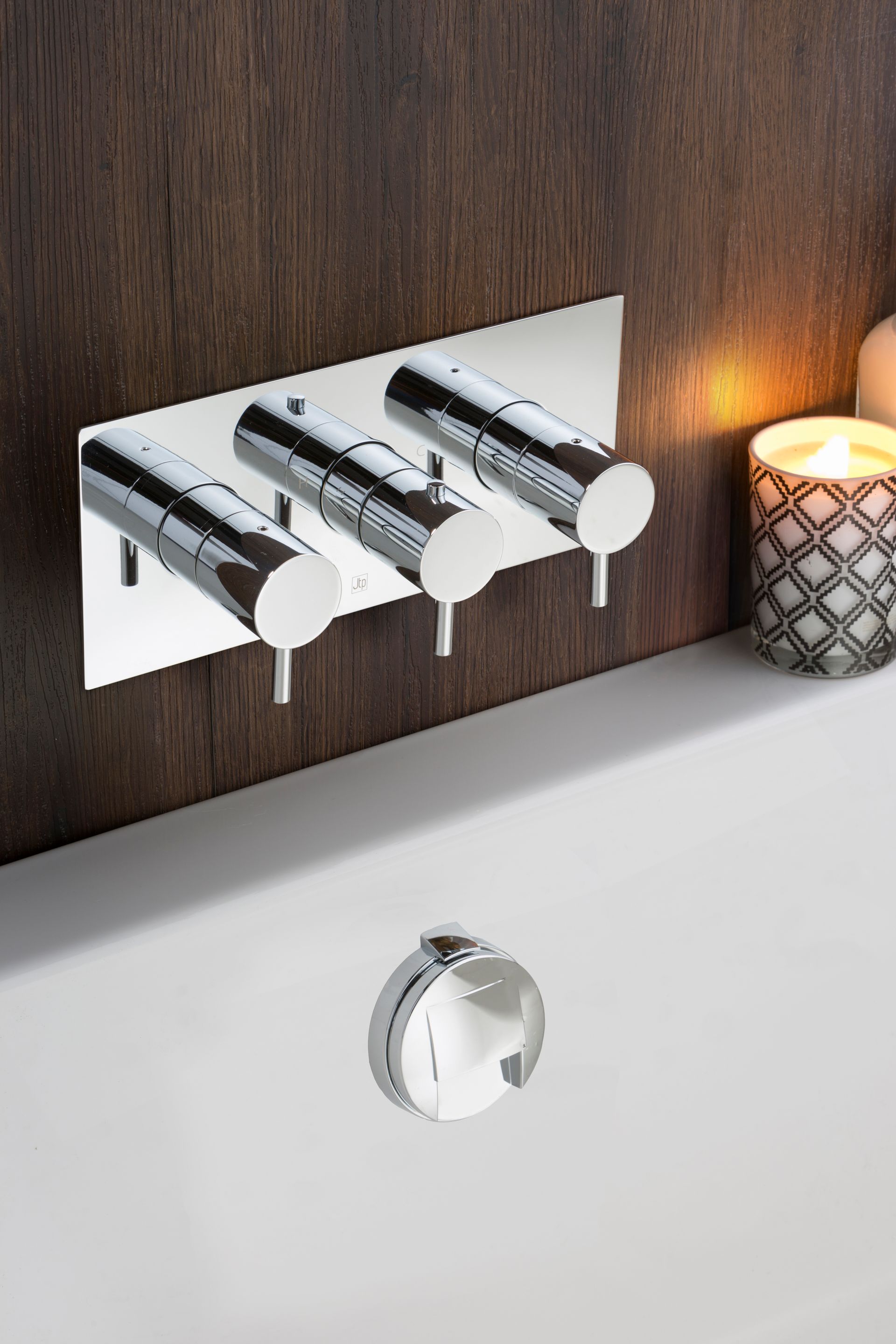
Brushed nickel is the finish overtaking chrome in 2026 luxury specs, and it's the one to understand if you're picking brassware this year. BC Designs design manager Keeley Sutcliffe put it neatly to kbbfocus in early 2026: brushed nickel gives you the neutrality of chrome without the coldness. That's the spec value in one line. It behaves like a warm-toned chrome rather than a coloured finish, and it sits happily against timber vanities, off-white tile palettes and stone-effect porcelain where polished chrome can feel too cold.
Visually, brushed nickel sits between polished chrome and brushed brass on the warmth axis. It has the matte texture of brushed brass with the neutral grey-warm tone of chrome, softened by a shade. In a palette built around limestone tones, oak vanities and warm-white walls, it's usually the right answer: chrome can feel clinical in that company, and brushed brass can shout.
Hard-water tolerance is very good in PVD and fair in electroplated. The brushed surface catches limescale more visibly than polished chrome but less visibly than brushed brass, because the warm-grey tone forgives mineral deposits better than the warmer brass tones. In Essex hard-water postcodes a PVD brushed nickel tap starts water-spotting at month two-to-three rather than month one (brushed brass) or month six-plus (polished chrome). A weekly wipe is enough, and the finish doesn't punish you for a missed week the way coated matt black does.
Where it sits in the brand stack: Crosswater Union and MPRO both ship brushed nickel as a standard finish option. Hansgrohe Axor carries it across the MyEdition and Starck collections, and Crosswater offers PVD brushed nickel on selected ranges at the upper-luxury end. Expect a price uplift over chrome of roughly 10–20% on the same collection without PVD, 25–40% with it.
Where it fits less well: high-contrast contemporary schemes built around matt black tile, dark stained timber or charcoal-tone palettes. Against a very dark background the warm-grey can come across as muddy, and matt black or polished chrome are the stronger calls. For anything in the warm-neutral, mid-tone, classic-contemporary band, brushed nickel is the 2026 default.
07 · Matt black
Matt black: the statement finish that scratches if you spec it wrong
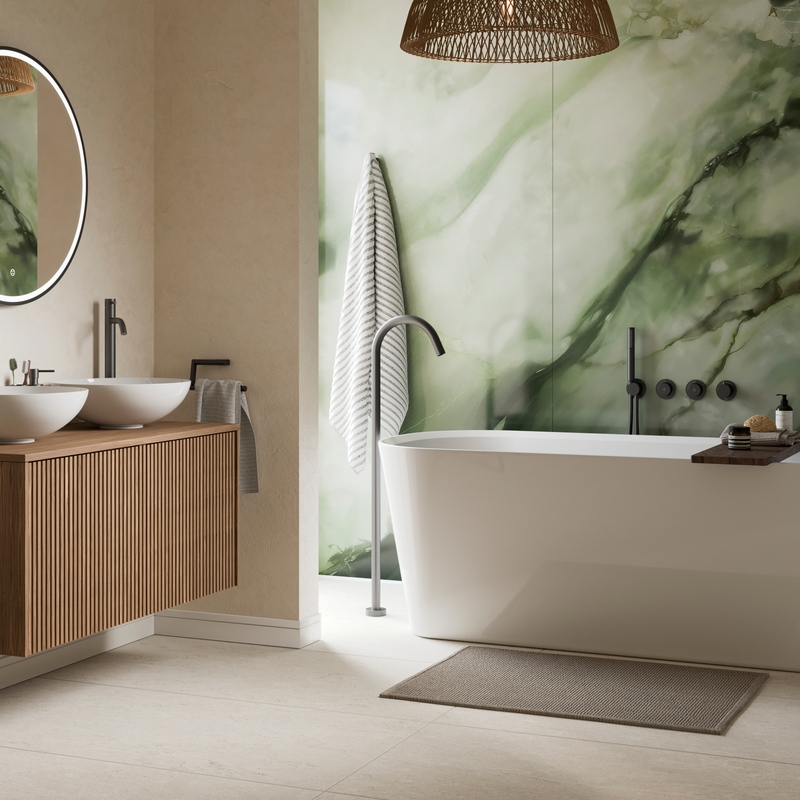
Matt black is the most polarising brassware finish on the market in 2026. Specified well, it's the strongest contemporary statement on the spec sheet. It looks deliberate rather than accidental, and it pairs hard with the dark-stone tile palettes (dark Marquina marble, basalt-effect porcelain, dark micro-cement) that have driven contemporary luxury since 2022. Treated properly it lasts a decade. Set up wrong, it shows limescale faster than anything else in this guide, and the high-touch points go soft by year five.
Something to know before you specify it: matt black, across every major brand Bowmans retails (Crosswater MPRO, Hansgrohe / Axor, JTP Vos), comes from lacquer or immersion-plated coating rather than PVD. A lot of marketing copy is sloppy about this. Read the manufacturers' own care-and-cleaning documentation and they all say the same thing.
- Crosswater MPRO matt black is, in Crosswater's own words, “an immersion-plated finish”: the brass is polished and a hard-wearing matte coating goes over the top. So it's a coating rather than PVD. (Source: Crosswater Bathrooms care guide.)
- Hansgrohe / Axor matt black comes from a special lacquer applied over the metal body in a multi-step process at the Hansgrohe production facility. PVD is reserved for the coloured finishes that start with chrome and add a vapour-deposited colour layer over the top: brushed bronze, brushed black, polished gold optic. Matt black isn't in that set. (Source: Hansgrohe PVD process explanation.)
- JTP Vos matt black is similarly a painted or lacquered finish. JTP's PVD on the Vos range applies to brushed brass, brushed bronze and brushed black. Brushed black PVD is a different SKU from the matt black painted finish, and it's the call to make if you want PVD durability on a dark colour. (Source: JTP Vos brushed-finish PVD ranges.)
This isn't an industry conspiracy. It's a manufacturing reality. PVD is a vacuum-chamber deposition process that works best on thin, even, lustrous coloured layers (gold tones, brushed bronze, brushed black with its directional sheen). A truly flat, dead-matte black is hard to produce through PVD without losing the matte quality, so most of the industry uses high-spec lacquers or immersion-plated coatings instead. Specify a top-tier brand, treat the finish properly, and you'll get 8–12 years out of it. That's short of a 15-year PVD lifetime and nowhere near the 24-month catastrophe some forum threads describe.
What that means in practice:
- Specify a top-tier UK luxury brand for the matt black finish (Crosswater MPRO, Hansgrohe, JTP Vos, BC Designs). Cheaper imports use thinner coatings that wear faster.
- Wipe the spout and high-touch points dry after every use. Matt black shows water spotting and limescale at every drip line; a daily microfibre wipe extends visible life dramatically.
- Use only manufacturer-approved cleaners. No abrasive pads, no descaler, no acidic limescale removers: they all strip the matte coating. Dish soap and warm water for routine cleaning, and the manufacturer's own product range for anything stronger.
- Soften your water if you can. Hard water and matt black are the worst combination of any finish in this guide. A whole-house softener pays back faster on a matt-black bathroom than any other finish.
- If you want true PVD durability on a dark colour, specify brushed black (JTP Vos brushed black is the standout in the Bowmans range). Brushed black is a PVD-coloured finish on a chrome base: longer lifetime, a slightly directional sheen rather than dead-flat, and it still lands as a dark statement in the scheme.
Hard-water tolerance on a top-tier matt black coating is fair rather than poor, as long as the care discipline above holds. The Mumsnet horror stories are almost always budget imports, specified without softened water and cleaned with descaler. Different category of product entirely.
Where matt black wins: contemporary statement bathrooms with dark tile palettes, deep-toned cabinetry and a designer-led colour story. It doesn't do quiet. It draws the eye, and you should treat it as the architectural moment in the room. If you want something softer in a contemporary scheme, brushed nickel or chrome are the stronger calls.
08 · Polished nickel and gold tone
Polished nickel and gold tone: period properties and statement schemes
Two finishes with narrower briefs, both of them strong inside those briefs. Polished nickel is period-correct for late-Victorian, Edwardian and Arts & Crafts properties: warmer than chrome, more reflective than brushed nickel, and visually closer to the silver-and-nickel-plated brassware those houses were fitted with in the first place. In a listed-building bathroom or a heritage principal suite, nothing else gets the period right in the same way. Hard-water tolerance is good. The polished surface wipes clean much like chrome, and the warm tone forgives mineral deposit slightly better.
Crosswater offers polished nickel on selected heritage collections, and Hansgrohe Axor produces it on the Carlton and Montreux ranges through their broader heritage line. The price uplift over chrome is typically 20–35%. On a period-property brief that premium buys visual coherence with the rest of the architecture. Chrome looks wrong in those rooms; polished nickel doesn't.
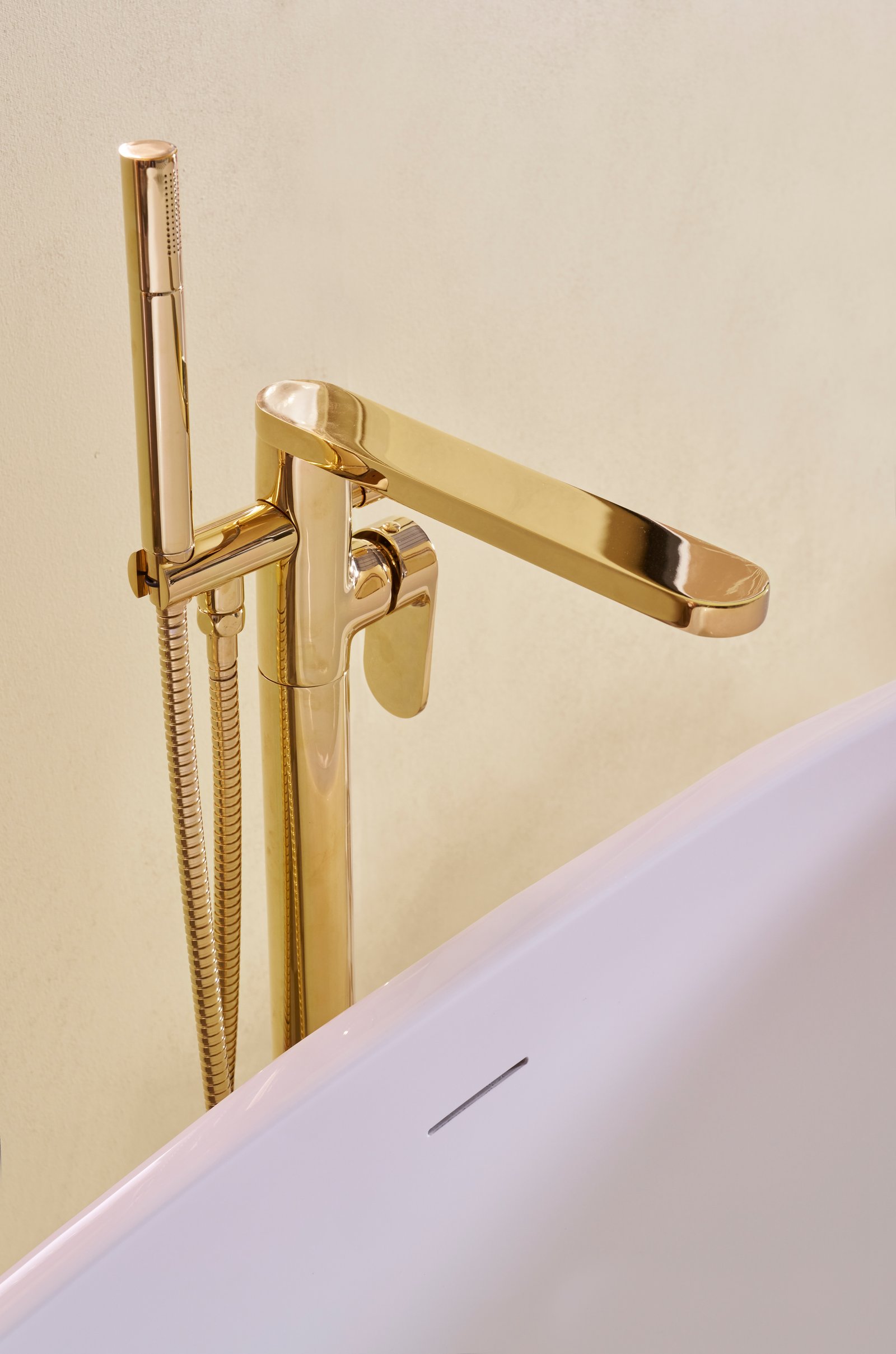
Gold tone sits at the opposite end of the brief spectrum: true gold-coloured PVD rather than the warmer brushed brass family. It's statement luxury, designer-led, and it works in two specific contexts. The first is a principal-suite bathroom with a deliberate jewellery-box aesthetic, dark-stone backgrounds and saturated colour. The second is a scheme built around one statement piece (a stone basin, a bookmatched marble feature wall, a hand-painted tile floor) where the brassware needs to lift the room without competing with it. Anywhere else, gold tone tips into overstatement.
One thing here is non-negotiable: gold tone is PVD-essential. Electroplated gold in bathroom brassware tarnishes visibly within twelve months of installation in hard water, and the colour shift is dramatic and permanent. Specifying gold tone without PVD is one of the worst single-finish errors you can make. PVD gold from Hansgrohe Axor or selected Crosswater statement collections holds its colour for 10–15 years in UK domestic use. The uplift is significant, at typically a 40–60% premium over chrome on the same collection, but the alternative is electroplated gold that tarnishes by year two. That isn't really an option.
09 · The hard-water reality
Hard-water reality: why waterfall taps fail in Essex postcodes
Anglian Water classifies most of Essex as hard to very-hard water: total hardness 200–350 mg/L as calcium carbonate, comfortably above the 150 mg/L threshold where mineral deposits start showing on bathroom fittings. The CM7, CM2, CM6, CM77 and CO postcodes we serve from the Braintree showroom all sit in that band. So hard water is a design constraint in those postcodes, and it belongs in the brassware spec rather than in a footnote. The most common forum complaint about luxury bathroom taps in Essex isn't about a brand at all. It's about a spout style.
Why waterfall spouts fail in hard water
A waterfall tap sends water across an open flat channel instead of through an enclosed aerator. You get a thin sheet of water flowing over the wide spout face, which is striking in a showroom photograph and distinctive in person. The mechanism that produces that effect is the same mechanism that fails in hard water. The flat channel is open to air between uses, so calcium and magnesium ions settle on the channel surface and dry as visible white scale. Within four-to-six weeks in a hard-water postcode you get permanent-looking scale lines that break the water sheet up on every use. By month three the spout looks dirty even when it's just been wiped.
The Mumsnet thread on waterfall taps in hard-water areas has been uniformly negative for years: a disaster, impossible to keep clean, the spout looks like a mineral exhibit, tried every descaler and it just keeps coming back. Those comments aren't from people who picked the wrong brand; they're from people who picked an open-channel waterfall spout, and the brand barely matters. The spout style is the failure point, not the brassware quality.
If you still want the waterfall look in a hard-water postcode, you have three options.
- Install a whole-house water softener. A softener treating the supply at the house entry point removes the calcium and magnesium that drive the deposits. Capital cost £1,200–£2,500 plus salt running cost (£80–£150 per year). Solves the problem comprehensively for any spout style.
- Pick a different spout shape with similar visual character. Cast spouts with a shaped flow profile (the Hansgrohe Axor MyEdition cast outlets, Crosswater Union shaped spouts) deliver visual presence without the open-channel limescale failure mode.
- Commit to a daily wipe-down. A microfibre wipe straight after each use, plus a weekly limescale-removal session, keeps the channel clear. It works. You're just signing up for it every day.
Other hard-water spec rules for Essex postcodes
Beyond spout choice, three more hard-water rules apply to any Essex luxury bathroom spec.
- Aerators with anti-limescale rubber inserts. Most luxury aerators (Hansgrohe AirPower, Axor neoperl) include flexible rubber outlets that flex limescale off as water flows. They limescale up far less than rigid metal aerators or open-channel waterfalls.
- Take care with matt finishes on horizontal high-deposit zones. Matt black on a horizontal valve plate is harder to clean than the same finish on a vertical spout, because deposits sit on a horizontal surface for longer. Wipe the plate dry after each use, and stick to manufacturer-approved cleaners (no descaler, no abrasives) to protect the coating.
- Specify thermostatic shower valves with descaling-friendly cartridges. The Crosswater MPRO thermostatic valves and Hansgrohe Ecostat valves both ship with cartridges designed for periodic descaling without disassembly, which is a meaningful long-term advantage in hard-water postcodes.
Specifying brassware for hard-water Essex follows a different curve to specifying it for a soft-water county. None of these rules are dramatic on their own. Together they change what the room looks like at year five-to-ten.
10 · The coordination rule
Coordinating finishes across one bathroom: the spec-coherence rule
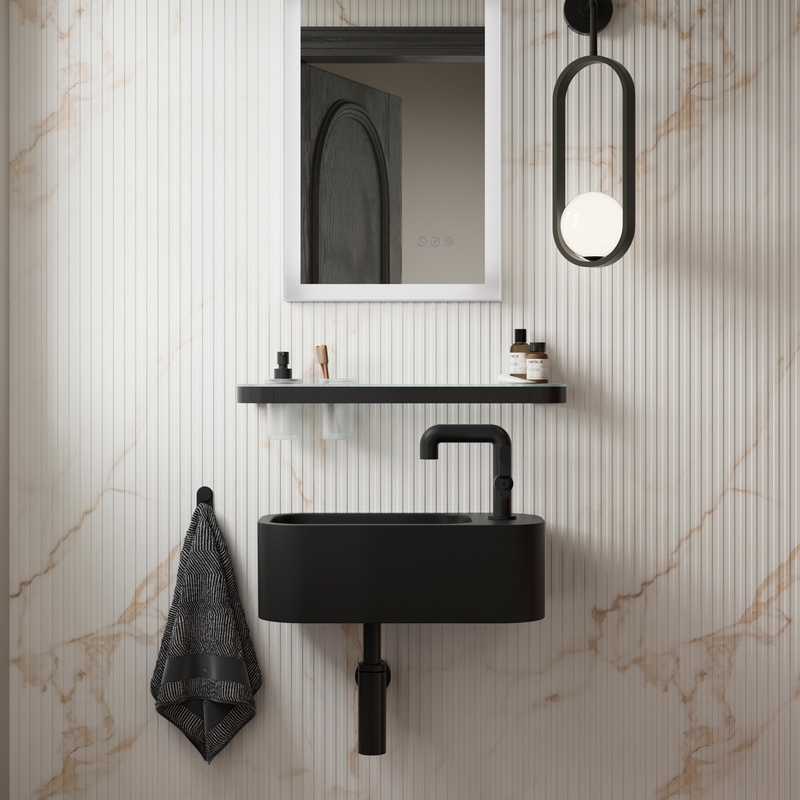
Once the basin tap finish is decided, two-thirds of the spec decisions for the rest of the bathroom follow from it. The biggest mistake in this category isn't the finish choice itself; it's the failure to carry that choice across the rest of the visible hardware. A brushed nickel basin tap next to a chrome bath waste looks unresolved. A matt black shower valve against a chrome thermostatic plate comes across as a cost cut. A brushed brass mixer with chrome shower brackets says the project ran out of budget at the spec stage.
The single-finish-family rule
Pick one finish family (chrome, brushed nickel, brushed brass, matt black) and carry it across all visible wet brassware in the bathroom. That means:
- The basin tap or basin mixer
- The bath filler or bath shower mixer
- The shower head, handset and shower valve cover plate
- The exposed waste plate at the basin and bath
- The overflow plate
- The thermostatic valve handle (if exposed)
- Any exposed pipework or trap covers
The waste plate is the item most often missed on that list. Most basin and bath wastes ship as chrome by default, but the matching brushed brass or matt black waste is there for an extra £30–£80 from the same manufacturer, and it's the difference between a coherent spec and a half-finished one. So ask your supplier for the matching waste before you sign the spec sheet off.
Where you can step a finish (and where you cannot)
Secondary hardware (towel rails, robe hooks, toilet roll holders, mirror frames, cabinet pulls) can step away from the primary brassware finish, as long as you do it deliberately. These are the pairings we'd trust:
- Brushed brass primary brassware with a matt black towel rail and accessories. It's a current designer favourite for warm-contemporary schemes.
- Polished chrome primary brassware with brushed nickel cabinet pulls and mirror frame, where the warm-cool tone shift adds depth without breaking coherence.
- Brushed nickel primary brassware with timber-finish handles and dark-bronze accessories, which works particularly well with oak vanities.
What doesn't work is a wet-versus-dry mismatch inside a single sightline: a brushed brass basin tap with a chrome basin waste plate is the classic example. The fix costs £30–£80; left unfixed, it's the single most-cited bathroom regret on UK forum write-ups.
Brassware sits inside a broader cost picture for any luxury bathroom build. Our luxury bathroom cost UK guide breaks down where the £600–£3,500 brassware band sits inside a £18,000–£35,000 luxury bathroom budget. Our luxury bathroom planning checklist covers the spec sequence that heads off the most common brassware-related delays: brassware ordered before strip-out, lead times for special finishes, the 6–12 week PVD finish window.
One last spec error sits outside finish choice: the monobloc-tap-on-gravity-system mistake. Most designer monobloc basin taps need pumped or mains-pressure water (typically 1.0 bar minimum) to deliver the flow rate the design assumes. A gravity-fed UK system, common in older properties with a cold-water tank in the loft, runs at 0.1–0.3 bar at the basin. You end up with a beautiful tap that trickles. The fitter finds out on installation day; the homeowner finds out at completion. Our is a bathroom designer worth it guide sets out the four trigger conditions for bringing a designer in, and this compatibility check is one of them. Catching it at design stage costs nothing. Catching it on install day costs £200–£500 for a positive-head pump or a last-minute spec change.
Frequently asked questions
Everything UK homeowners ask about bathroom brassware finishes, PVD, hard water and finish coordination in 2026.
What is next
Specifying brassware for your own bathroom?
We carry every finish in this guide across Hansgrohe, Axor, Crosswater, JTP and BC Designs at our showrooms in Braintree and Leigh-on-Sea, including the PVD ranges where the warranty terms justify the premium. The first appointment is included, takes about an hour, and works out which finish family suits your bathroom, your water hardness and the rest of your spec. We benchmark our brassware pricing against the major UK online retailers (Drench, Victorian Plumbing, the supplier-direct sites) on every brand we sell, so the design service sits alongside the product price, not on top of it.
Our showrooms sit in Braintree (Springwood Industrial Estate, CM7 2YN) and Leigh-on-Sea. You pay for the products you choose and nothing else: no design fee, no uplift on product to cover the drawings, no obligation at the end of it. Bring a tile sample, your cabinet finish and a photo of the room, and we'll work the brassware finish around them.
Companion guides: how much does a luxury bathroom cost in the UK in 2026? · is a bathroom designer worth it? · luxury bathroom planning checklist
Prefer to see these finishes in a built room? Brushed brass and bronze run through several completed rooms from our Colchester bathroom design service.