
Bowmans · Inspiration · Design
Bathroom layout mistakes that cost thousands to fix
Most bathroom regrets are spec mistakes — wrong tap, wrong tile, wrong grout colour. They cost a few hundred to put right, sometimes less. This list is different. They’re built into the layout itself, so you can’t undo them without lifting the floor or moving a wall, and they turn a £25,000 renovation into a £30,000 one, ruining the room every day until somebody fixes them.
00 · The category
Why layout mistakes are different from spec mistakes
A spec mistake is the tap, the tile, the grout colour, the vanity finish. Get it wrong and the worst case is a return-and-reorder, two weeks of delay, maybe £500. We covered the five most expensive of those in our companion piece on whether a bathroom designer is worth it: monobloc taps on gravity systems, waterfall taps in hard-water areas, textured vanities and limescale, the rest of it. Annoying, but recoverable.
A layout mistake is built into the room itself. The bath sits in the wrong place, or the soil-pipe is in the wrong wall, or the joists run the wrong way and the mirror reflects the wrong thing. You can’t return-and-reorder a layout. You have to rebuild the room.
That difference is why layout decisions deserve more attention at the planning stage than spec decisions ever do. Spec mistakes turn up post-install, in the snagging round. Layout mistakes turn up six months in, once you’ve lived with them long enough to notice that the door catches the vanity edge every single time, or that the mirror puts the toilet in view from the bath. By then the room is finished, and putting it right means structural work.
Most of the 10 mistakes below got caught at planning stage on every project we’ve designed in the last three years. That isn’t because we’re cleverer than fitters. It’s because layout problems are easier to spot with a tape measure and a 3D render than with a Pinterest board. Each entry below gives you the cost once the mistake reaches construction. Catching the same thing on paper costs nothing at all.
01 · Mistake one
Door swing into the vanity
This is the most common layout mistake we see, and the one homeowners discover on day one of using the room. The bathroom door opens inward and the leading edge clears the vanity by 15mm. Then you stand at the basin and the door clips your back. Or you put a pull handle on the front of a vanity drawer and the drawer won’t open with the door swung wide.
It happens because the floor plan is drawn with the vanity flush to the wall and the door arc shown as a faint dotted line. On screen the clearance looks generous; on site, with a 600mm-deep vanity instead of the 500mm shown, or with a Crosswater pull-out drawer that the catalogue spec lists at 470mm extension, the geometry stops working. On an architect-led extension this is exactly the gap between what the plans show and who actually designs the bathroom inside the shell.
Cost to fix once installed: rehanging the door to swing outward is £150–£300 if the corridor allows it. Replacing it with a sliding pocket door is £600–£1,200 plus making good. Cutting the vanity back by 100mm to clear the swing is rarely possible without rebuilding the unit, so budget £800–£2,000 for a bespoke replacement. Worst case, you take out the door wall and rebuild it to swing outward into a different room, at £1,500+.
What a designer catches: the door arc gets drawn full-radius on the layout rather than as a dotted line, and the vanity is sized off the drawer-extension dimension rather than the carcass. We work to a minimum 100mm clearance between the fully-extended drawer and the door at its tightest point. Below that we change the door swing on the plan, or swap in a vanity with a recessed handle, or lose 50mm of vanity depth. On paper it’s a 30-second decision. In plaster it’s a £1,000 one.
02 · Mistake two
WC too close to a wall (waste-line offset)
You can stand a WC pan as close to a side wall as you like, because there’s no Building Regulations minimum distance for domestic dwellings. The mistake here is two-fold, and the second half is the expensive one.
First, the ergonomic problem. Most close-coupled WCs want 200mm minimum from the centre of the pan to the nearest obstruction, or the room feels cramped. Approved Document M Volume 1 (in force October 2024) sets the accessibility benchmark at 200mm clear for M4(2) accessible & adaptable dwellings, and 250mm for M4(3) wheelchair-user. Below 150mm the elbow rotation you need to wipe is awkward. People notice. They mention it to guests.
Second, the structural problem. The soil-pipe centre-line is set by where the pan sits, and most close-coupled WCs need the soil connection 200–230mm from the finished wall. Plan the pan flush to the wall and the soil-pipe centre lands too close to the studs. There’s no clean route left for the waste, so the pipe ends up behind the cistern back-panel, the cistern won’t sit flush, and the whole assembly is offset by 30–50mm at the front. By the time the tiler finds it, the back-of-pan tile is cut, the access panel won’t sit flat, and the room looks subtly wrong forever.
Cost to fix once installed: repositioning the soil pipe is £400–£900 in plumbing rework if the floor is still up; £1,500–£3,000 if the floor has been tiled. Replacing the pan with a model that has a closer-coupled outlet is £200–£600. Adding a back-to-wall frame system to hide the offset is £400–£800.
What a designer catches: we plan to the soil-pipe centre rather than the wall, and we specify the pan model before the layout is fixed. The Catalano Zero, the Roca In-Wall and the Geberit Sigma all have different centre-line dimensions, so we draw the layout around the pan you’ve chosen. Never the other way round.
03 · Mistake three
Shower drainage falling the wrong way
The shower works on day one. Within a fortnight, water pools at the wall opposite the drain instead of running into it. The tiles look slightly warped, though they aren’t; the floor underneath them is. By six months the silicone at the base of the screen is permanently wet, the grout has gone dark, and the room smells faintly of drain.
Two things cause it. The first is a branch waste pipe without enough fall. BS EN 12056-2 sets the gradient for domestic shower wastes at 18mm per metre minimum (1:55) and 90mm per metre maximum (1:11). Below 18mm the water won’t shift solids, and above 90mm it runs away faster than they do. The second cause turns up more often. The floor itself doesn’t fall toward the drain, and for a wet-room linear drain the showering zone needs a fall of 1:50 to 1:80 right across the area. If the tray former or the screed isn’t set to that gradient, no amount of waste-pipe grade will rescue it.
Cost to fix once installed: lifting a tiled floor to re-screed and re-tank runs £1,500–£3,500 depending on size, with proper waterproofing to suit the membrane system in use. If only the tray needs replacing (most off-the-shelf trays come pre-formed with the correct fall) it’s £400–£900 plus retiling the perimeter. Outside warranty, you eat all of that.
What a designer catches: we calculate the branch pipe length and fall at planning stage and put it on the section drawing, so the plumber isn’t working it out on site. For wet rooms we name the tray former or pre-graded screed (Wedi, Schluter Kerdi-Line) and ask for photographed evidence of the gradient before tiling starts. Together those two items add 30 minutes of designer time. They head off a £2,500 problem.
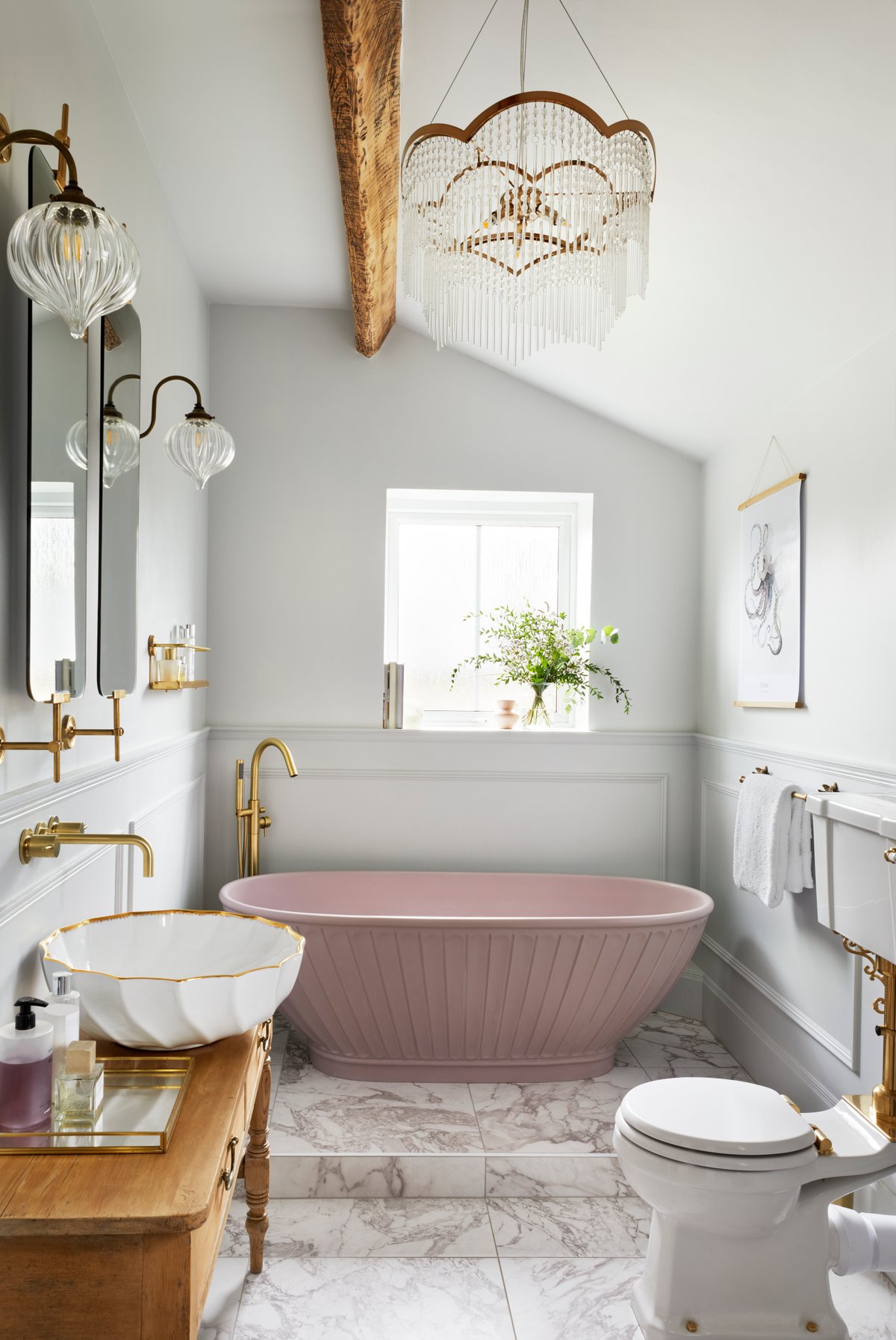
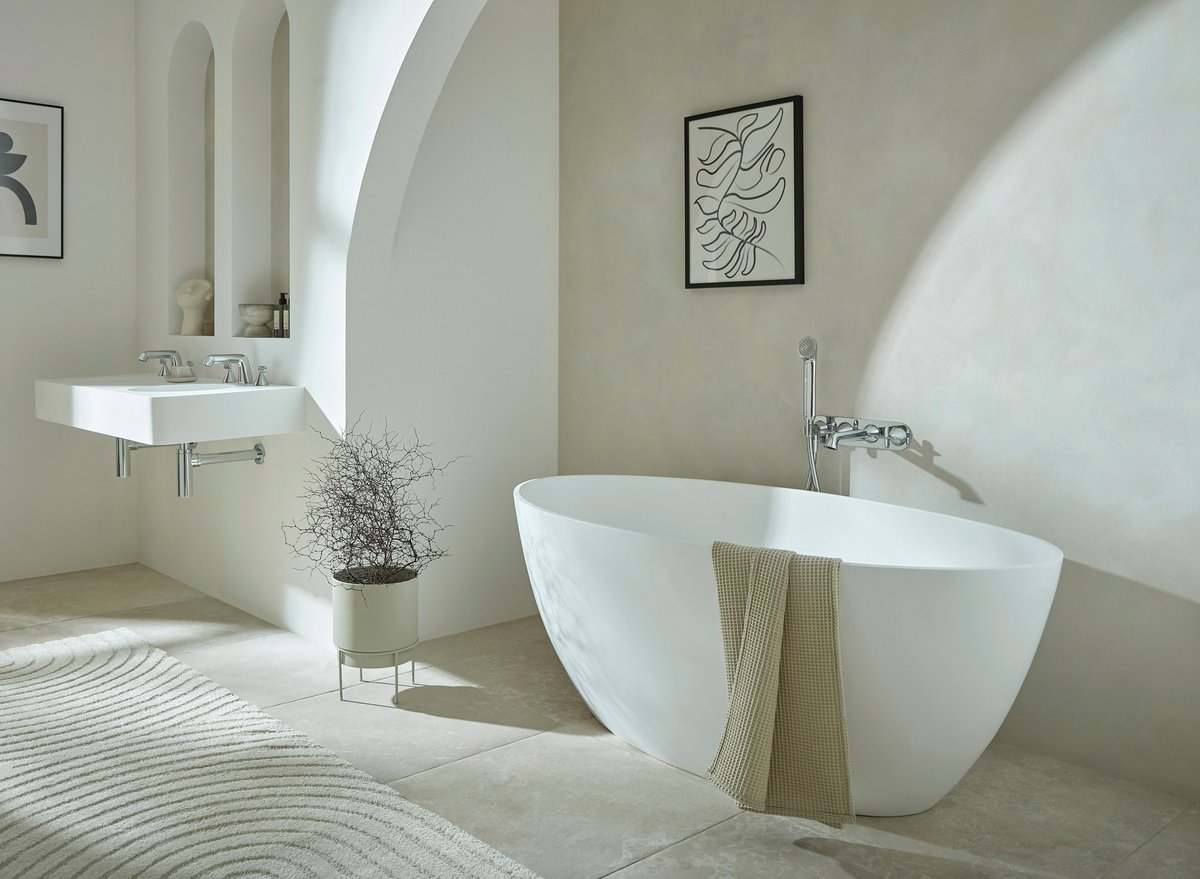
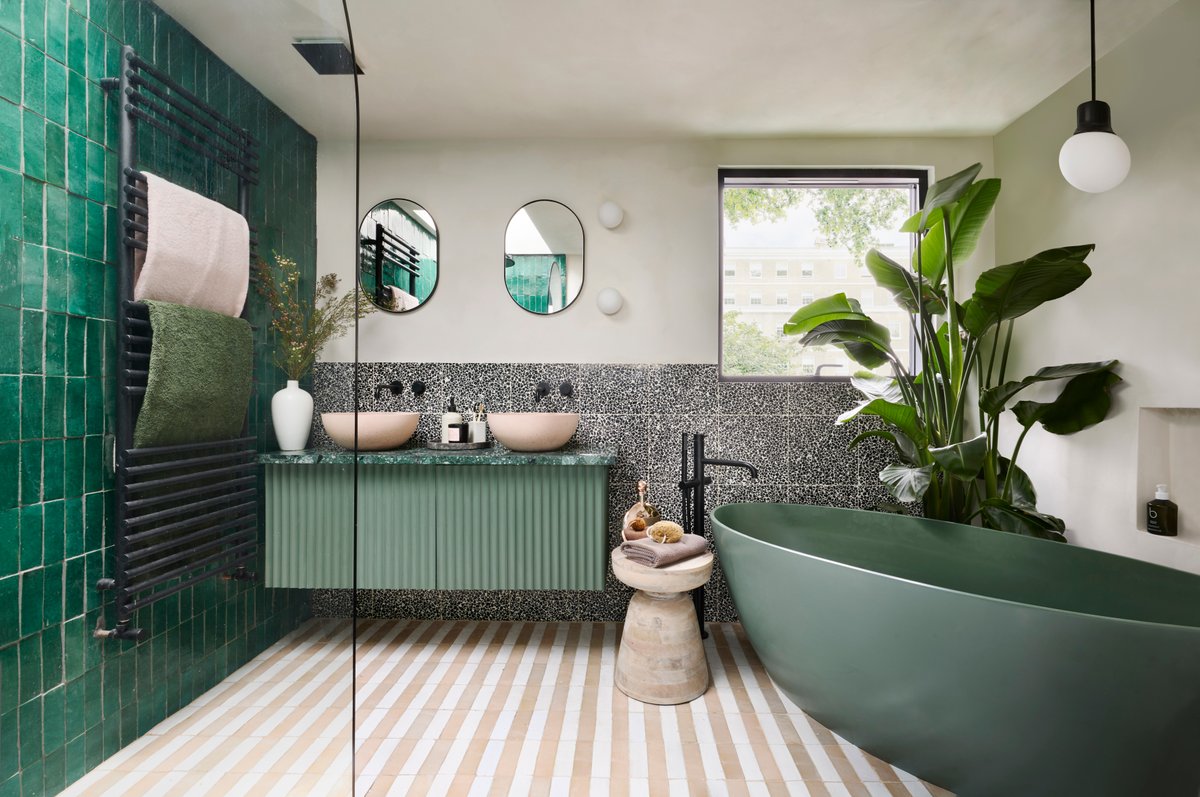
What considered layout looks like
04 · Mistake four
Joist orientation under a freestanding bath without reinforcement
This one belongs in the unrecoverable category, and it’s the second-most-expensive mistake on the list. A cast-iron freestanding bath weighs 100–180kg empty. Add 200 litres of water (200kg) and an adult bather (75–100kg) and you’re loading 350–450kg over a footprint smaller than a sofa. That loaded weight per square metre will usually exceed the design-load assumption for a domestic floor, especially in a period property.
Where the joists run perpendicular to the bath length, the load distributes across four to six joists. The floor handles it. Where the joists run parallel to the bath length, the bath load sits over one or two joists only. The floor flexes. You feel it when the bath is full. Six months in, the silicone at the base of the bath cracks because the bath has moved. A year in, you notice the wall tile at the bath end is hairline-cracked because the bath is rocking on the floor.
Period-property joists are usually undersized by modern standards anyway: 100×50mm at 400mm centres was standard for Victorian terraces, against current Building Regulations Approved Document A guidance, which assumes 175×47mm at 400mm for similar spans. So the two problems compound.
Cost to fix once installed: lifting the floor, sistering the joists or adding steel-flitch reinforcement, relaying the floor and refinishing it. That’s typically £1,200–£2,500 plus any re-tiling of the bath surround. If the wall tile has cracked, add £500–£1,500 to retile.
What a designer catches: we ask the joist-orientation question at the design stage, before the bath is chosen. Where the joists run parallel to the bath we have three moves. Rotate the bath 90° on the layout, swap cast-iron for acrylic or stone-resin (which cuts the dry weight by 60–70%), or write "joist reinforcement required" on the spec sheet so it gets priced into the build. The fitter then sees it on day one of strip-out rather than day one of bathing.
05 · Mistake five
Soil-stack relocation that wasn’t necessary
This is the most expensive layout mistake on the list in pure rework terms. The pattern goes like this. A homeowner falls in love with a layout that puts the WC on the opposite wall from the existing soil stack. The fitter quotes for relocating the stack, often £1,500–£3,000 in plumbing alone and more if the floor or a party wall is involved, and the cost goes into the build budget. Six months later, in a different conversation, a designer sketches an alternative where the WC stays within 1.5 metres of the existing stack and the room rearranges around it. Same usable bathroom. £2,000 cheaper.
This isn’t always avoidable. Sometimes the stack really is in the wrong place and relocating it is worth every penny. But about half the soil-stack moves we see in completed projects didn’t need to happen at all. The homeowner committed to a layout before asking whether the stack position was negotiable, and by the time the quote for moving it landed, it felt like a sunk cost.
Cost to fix once committed: you can’t, at least not easily. Soil stacks are large-diameter cast-iron or PVC pipes running vertically through several floors, and once they’ve moved they don’t move back cheaply. The problem isn’t that the mistake is unfixable. It’s that you spent £2,000+ on plumbing rework nobody needed.
What a designer catches: the planning conversation opens with "where’s the soil stack, and can we keep it there?" rather than "where do you want the WC?". On nine projects out of ten we can put the WC within the 1.5m soil-pipe limit, the maximum branch length for a domestic WC under a standard install, without compromising the layout. The 10% that really do need a relocation are much easier to spot once you’ve ruled the other 90% out.
“Half the soil-stack moves we see in completed projects didn’t need to happen.”
06 · Mistake six
Bath in front of an inward-opening window
A freestanding bath under a window is one of the most photographed bathroom moments there is. It’s also one of the easiest to get wrong, because the photograph never shows the part that fails: the window operating into the bath zone.
Three things go wrong here. The first is an inward-opening casement: every time you ventilate, the casement swings into the splash zone and clips the bath rim. The second is a sill sitting below the bath rim, which turns it into a hard headrest. Anyone over five foot eight will feel it. The third is a textured timber frame finish, which traps moisture and goes mouldy within two years above an active bath.
The fixes are straightforward. Outward-opening, top-hung, sliding sash and fixed-glass-with-vent-above all dodge the inward-swing problem. Sill height wants to be at least 200mm above the bath rim, ideally more, and you measure that from the rim rather than from finished floor. For the frame, pick a finish that handles humidity: uPVC, painted timber with marine-grade paint, aluminium, or powder-coated steel.
Cost to fix once installed: repositioning a window, swapping a casement for a sash, or rebuilding the reveal to raise the sill is the most expensive single-item fix in this whole article. Typically £2,500–£6,000 with structural lintel work, rendering and making good externally. If the frame finish is the only issue, repainting with marine-grade paint and adding active extraction is closer to £400–£800.
What a designer catches: windows go on the elevation drawing first, with the casement arc shown live. Bath placement is constrained to "no fitting within the casement arc plus 200mm". Where the existing window really does conflict and can’t be moved, we shift the bath or change the window before any spec is committed.
07 · Mistake seven
Towel rail blocking the radiator valve
A small mistake, but a daily one. The towel rail is fixed to the wall and the thermostatic valve (TRV) sits at the bottom of one upright. Something nearby sits close enough that you can’t turn the valve handle without contortion. Usually it’s the WC, sometimes a built-in basin run, sometimes a wall-mount tap.
It happens because the TRV body sticks out 80–110mm from the wall, and the valve handle needs another 60–80mm clearance to rotate. The catalogue diagram of a Bisque or DQ Heating towel rail shows the bare upright; the diagram doesn’t show the protruding valve. On a Pinterest mood board, the scale is wrong. On a 2D plan, the valve is invisible.
Cost to fix once installed: moving the towel rail 100mm sideways is typically £200–£450 in plumbing rework plus making good the original wall (filling, retiling if the original tile is mounted, repainting). Replacing the TRV with a low-profile or flat-fronted alternative is £80–£180 plus install. Living with it costs nothing, and most homeowners do exactly that.
What a designer catches: the towel-rail elevation carries the valve dimension as well as the rail itself. Adjacent fittings get checked on the elevation, then again on the plan. Five minutes of designer time saves £400 of plumbing rework.
08 · Mistake eight
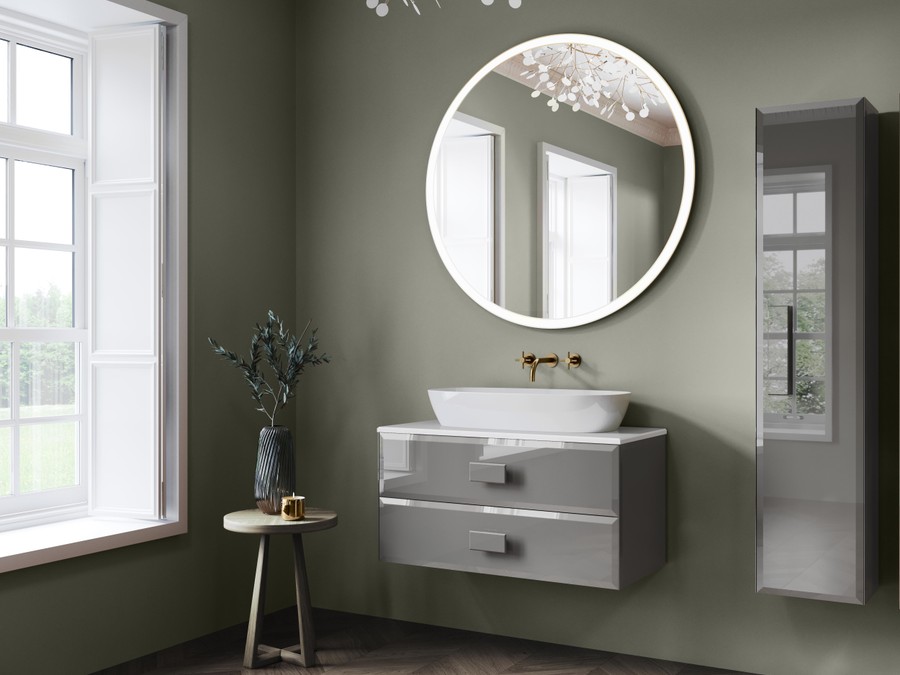
Mirror placement reflecting the WC
This isn’t a regulation. It’s an ergonomic and resale problem, and one of the most-cited bathroom regrets on UK home renovation forums. The mirror hangs above the basin, opposite the WC or at a 45-degree angle to it, and the reflection takes in the toilet from anywhere you stand in the room, doorway and bath included. Magazines never warn you about this, because the photographer crops the WC out of shot. You only notice in occupation.
The fix is not putting the mirror there in the first place. Go wider, so the reflection catches your face without the angle to the WC. Move the mirror to a different wall. Or, most commonly of all, shift the toilet by 200–400mm so the WC drops out of the reflection line.
Cost to fix once installed: repositioning a hung mirror is £50–£150 if you keep the same mirror, or up to £300 if it’s illuminated or hardwired. A recessed or LED-backlit mirror is £200–£600 to move, with retile. Moving the WC costs a lot more (see mistake two), typically £400–£1,500.
What a designer catches: we walk the 3D render from every standing point in the room, doorway included. If the WC turns up in any view, the mirror moves on screen rather than in plaster. That’s a check a 2D plan simply can’t give you.
09 · Mistake nine
Basin too close to the side wall (no elbow room)
The basin goes in with its centre 150mm from the side wall. On the plan that looked tight but workable. In use, washing your face needs a tilt, washing your hair in the basin is impossible, and in a child’s bathroom a smaller user takes a constant elbow knock from the wall.
Our working rule is 200mm minimum from the basin centre to the nearest obstruction, and 250mm or more for comfort. The catch is that "the nearest obstruction" includes a wall that’s plumb, a tile that adds 12mm to the original wall, a bath rim at the same height as the basin, or a tall vanity unit. Plans drawn to bare-wall dimensions don’t allow for finishes, so once the room is done your 200mm has quietly become 175mm.
Cost to fix once installed: repositioning a wall-hung basin is £200–£500 plus retile. A vanity-mounted basin is rarely movable without replacing the vanity, so £600–£1,500. Living with it costs nothing, and homeowners on Mumsnet describe putting up with cramped basins for ten years without ever solving it.
What a designer catches: we draw elevations to finished-wall dimensions rather than bare-wall. The 200mm clearance goes on the layout as a no-fitting zone. Where the room really is tight, a smaller basin (Catalano Zero 80, Roper Rhodes Note 530) keeps the clearance instead of cramming a 600mm basin into a 750mm slot.
10 · Mistake ten
Lighting position causing face shadow at the mirror
This is the single most-cited "wish we’d thought about" item on UK bathroom forums after underfloor heating. The mirror goes up, the only light above it is a ceiling downlight or one spot directly overhead, and you get shadow under the eyes, nose and chin every time you look at yourself. Useless for shaving. Worse for makeup.
Light from above casts shadow downward. Light from beside the face casts none. The fix is vertical wall-lights either side of the mirror at face height (around 1700mm finished-floor-level for an average user), or an integrated edge-lit LED mirror that throws diffused light forward onto the face, or both together. CIBSE LG7 (the lighting guide for healthcare and domestic environments) recommends 300 lux at the face for grooming tasks. Most single ceiling downlights deliver 150–200 lux at the face whatever position they’re in.
Cost to fix once installed: adding wall-lights post-completion means cutting tile, chasing cable, getting Part P notification under Approved Document P (since the bathroom is a special location requiring 30mA RCD protection per BS 7671:2018+A4:2026). Typically £400–£800 per pair of fittings plus the lights themselves. Replacing a non-lit mirror with a backlit version is £300–£700 if the spur is already in place; up to £900 if not.
What a designer catches: the lighting plan is a separate drawing from the layout, with mirror-light fittings shown at face height, switched on a dedicated circuit, and noted as "wall-mounted at 1700mm AFFL, IP44 minimum, dimmable warm-white". The fitter then wires for it on day one of first-fix, well before the tile goes on the wall.
“Light from above casts shadow downward. Light from beside the face casts no shadow.”
11 · The pattern
The pattern beneath every layout mistake
Read the 10 mistakes back to back and the same shape shows up in every entry. Each one is invisible on a 2D plan, and only becomes visible once the room is built. Catching any of them at planning stage costs nothing. Fixing them afterwards costs money. And every one of them shows up on a 3D render walked from every standing point in the room, before a single product is committed.
That’s no coincidence. Layout mistakes survive because 2D plans are flat: they don’t show door arcs in motion, valve protrusions, mirror reflection geometry, joist orientation, sill heights against bath rims, or shadow direction at face height. Pinterest is worse than a plan, because Pinterest is camera-cropped. The angle the photograph leaves out is exactly the angle you’ll live with for the next ten years.
The one skill that prevents every entry on this list is being able to walk the room before it’s built. A 3D render drawn from accurate room measurements gives you that, and it’s the bit most fitter-only routes leave out. A good fitter knows how to plumb, tile and finish. What they usually won’t do is sit with you for two hours walking the render, checking sight-lines, swing arcs and valve clearances. That’s designer work — and it’s the work that earns the fee.
If you’re weighing the cost of getting it right against the cost of fixing it later, our breakdown of UK luxury bathroom cost in 2026 puts the planning-stage spend in context. As a rough rule, every £1,000 you spend on careful planning will usually save you £2,000–£4,000 in rework, and almost all of that saving sits in the layout-mistake category above.
None of the regulations above stop layout mistakes on their own; they set the floor, and the layout work happens on top of it. Every entry above sits inside compliance, so the rooms still pass building control. They’re just rooms you’d rather not be in. Working through a designer’s 14-step planning checklist before anything goes on order is the cheapest way to keep the rest of this article hypothetical.
Frequently asked questions
Everything UK homeowners ask about bathroom layout mistakes and rework costs.
What’s next
Plan it once, build it once
Every mistake on this list is preventable in the first design appointment. The 3D render walks the room before products go on order, the elevation drawings catch valve protrusions and door swings before the fitter starts, and the joist and soil-pipe questions get asked before the layout is committed. None of that is expensive. It’s an hour or two of designer time, spent at the stage where changes cost nothing.
Our design service runs from the Braintree and Leigh-on-Sea showrooms. Because we benchmark our product pricing against the major online retailers, you don’t pay a premium to get the layout work done. The kit costs roughly what it costs online, and the design, the spec sheet, the elevations and the 3D render all come alongside it. If you want to talk your room through before anything is ordered, you’re welcome to book in.