
Bowmans · Inspiration · Design
Kylie Jenner’s Marble Shower: How Much Pattern Is Enough?
By Jonathon Barclay · · 9 min read
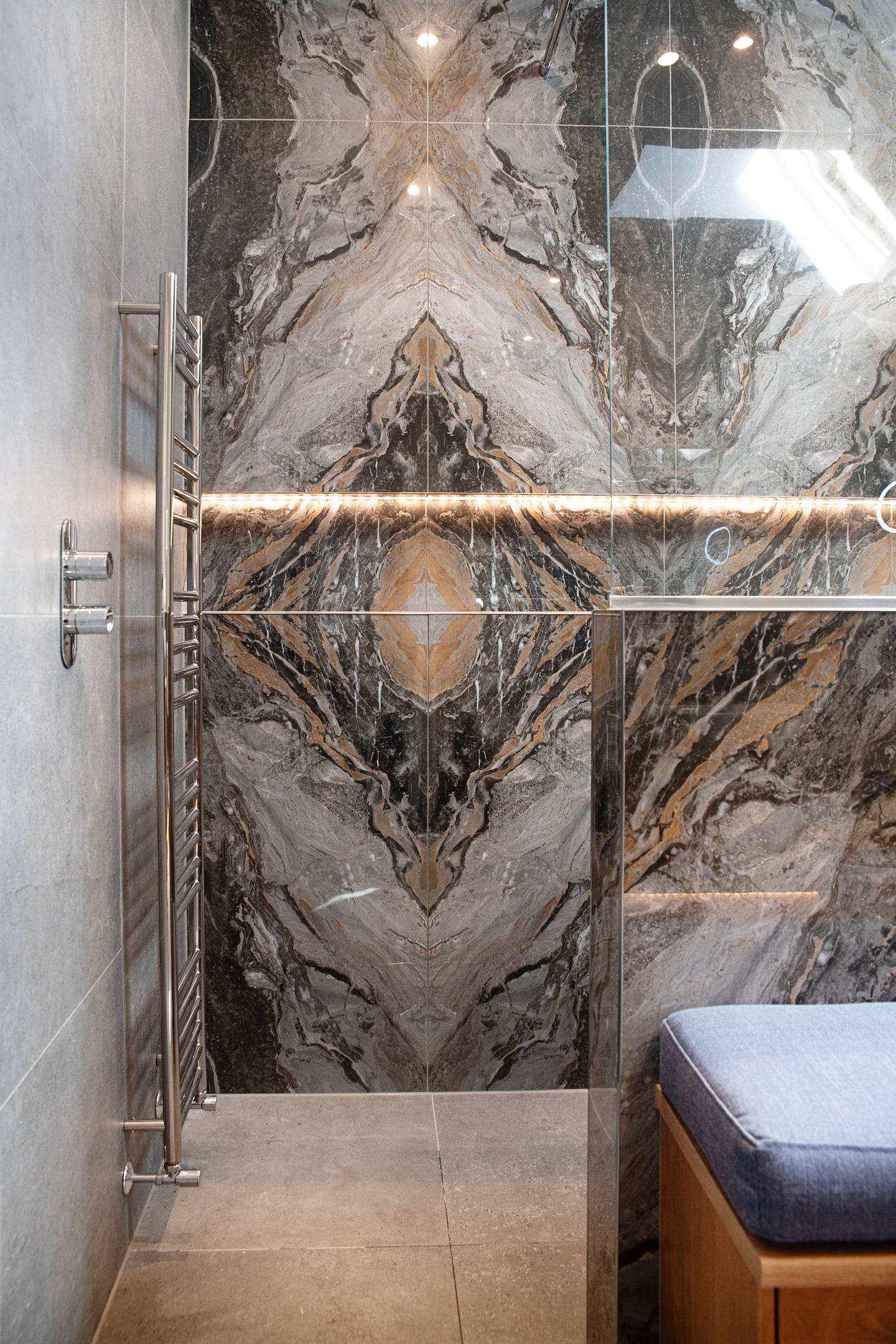
If you like the bold marble look in Kylie Jenner’s shower, decide where the pattern will stop before choosing anything else for the room.
Strong veining needs space around it. Cover every shower wall and the stone becomes the main feature of the bathroom. Use it on one wall or the bench and you still get the colour and movement without asking every other surface to compete.
We’d usually start with one feature surface. We’d only carry dramatic stone around the whole shower once we’d seen the actual slabs at wall scale and knew exactly where the joints, corners and fittings would sit.
Quick Navigation
What has actually been reported about Kylie Jenner’s shower?
In January 2026, Livingetc reported an Instagram glimpse of Kylie Jenner’s renovation showing a walk-in shower with a built-in bench. The publication identified the stone as Calacatta Viola.
That identification comes from the article rather than a verified supplier specification, and the image is only a glimpse of the shower rather than a complete room reveal. You can see the original photograph in Livingetc’s report on Kylie Jenner’s marble shower.
The useful idea to take from it isn’t a particular celebrity room or an assumed product. It’s the decision to let heavily patterned stone control the shower design.
How much patterned stone should you use?
For most bathrooms, we’d put the strongest pattern on one carefully chosen surface. That might be the wall you see as you enter, the wall behind the shower controls or the built-in bench.
Covering the whole shower can work, but it needs much more planning. Veins that look attractive on individual slabs can become restless once they meet at several corners. A smaller accent is easier to control, although it won’t have the same impact from across the room.
| Approach | What works well | What you need to accept |
|---|---|---|
| All shower walls | Makes the shower the clear focus and allows the veining to run around the enclosure | Every slab, joint and corner becomes noticeable. The rest of the room needs to be restrained |
| One wall or bench | Gives you a substantial area of pattern without surrounding you with it | The stopping point must look deliberate, especially where stone meets the quieter surface |
| Small accent | Introduces the colour and veining in a niche, splashback or selected panel | You see less of the slab pattern, and a heavily figured stone may lose some of its effect when cut into a small area |
Our recommendation
Start with one feature wall or the bench unless the shower is large enough, and the chosen slabs coherent enough, to justify wrapping the pattern around every wall. Full coverage shouldn’t be the default simply because the material is expensive.
Choose the slabs before you approve the layout
A small marble sample can help you judge the background colour and finish, but it can’t show you how the room will look. The important information sits across the full slab: where the darkest veins run, how much quieter space surrounds them and whether the next slab looks related to the first.
Not every slab will match. Even pieces sold under the same stone name can have different proportions of colour and veining. So we’d want to see clear images of the actual slabs being proposed, laid out at a scale that relates to the shower walls.
That needs to happen before the final cutting plan is agreed. Otherwise, the fabricator may have to make sensible cutting decisions without knowing which parts of the pattern you wanted to keep prominent.
Decide where the cuts will fall
The strongest part of the pattern shouldn’t disappear behind a shower control, get divided by a niche or finish awkwardly at the edge of a screen.
Mark the main fittings on the slab layout before cutting. That includes the shower head, controls, outlets, bench and any recessed storage. You can then decide whether a vein should pass behind a fitting, sit beside it or be kept away from that area entirely.
This matters even more on a feature wall because there’s nowhere else for the eye to go. A poorly placed joint on a quiet tile may pass unnoticed. Across bold marble, it can interrupt the part of the pattern you chose the slab for.
Agree the corners and joints
Don’t leave the corner treatment until the stone arrives on site. Decide whether the pattern should continue around a return, stop cleanly at the corner or change to another surface.
The same applies to the bench. If the seat, front and wall behind it are all being covered, the cuts need to make sense together. Simply using the same material on each surface doesn’t guarantee that the finished arrangement will look considered.
Ask the fabricator and fitter to agree the slab allocation, joints, corners, niche details and fitting positions as part of one plan. The drawing and slab images should tell the same story before anything is cut.
Keep the other surfaces quieter
Once you’ve chosen strongly veined stone, the surrounding finishes should support it rather than introduce a second pattern.
We’d take the quieter colours directly from the selected slab. That might mean using its background tone for the remaining walls, or picking up a softer colour from within the veining for the vanity or painted surfaces. The decision should come from the actual material, not from a general rule about what supposedly works with marble.
Be careful with patterned floors, fluted furniture and heavily figured timber in the same room. Any one of those could work, but using all of them alongside a dramatic shower makes it harder to see what the design is meant to be about.
Brassware needs the same restraint. Choose the finish after viewing it against the slab, because a metal that suits the stone name in theory may look quite different beside the particular piece you’re buying.
The aim isn’t to make everything plain. It’s to give the marble enough visual space that you can appreciate the pattern rather than having to pick it out from several competing finishes.
Natural marble or marble-effect porcelain?
Choose natural marble if you value the variation of the stone enough to accept its care requirements. Choose porcelain if you want a similar design direction with a surface that may better suit the way you intend to use and maintain the shower.
Natural marble shouldn’t be specified from appearance alone. Ca’ Pietra’s natural-stone care guidance advises using suitable pH-neutral products because acidic and abrasive cleaners can damage natural stone. That’s general care advice for the material, not a report on the celebrity shower.
If your normal cleaning routine relies on stronger bathroom products, discuss that before ordering the stone. It’s better to change the material than to spend years worrying about every bottle used in the shower.
Porcelain can give you more control over the printed pattern and removes some of the decisions associated with selecting individual natural slabs. But don’t treat every marble-effect porcelain as interchangeable or describe it as maintenance-free. Ask the supplier to confirm that the exact product, finish and format are suitable for the intended shower surface, then follow its cleaning instructions.
Our guide to marble bathroom costs, advantages and alternatives explains the wider choice between marble, porcelain and engineered surfaces.
Don’t approve a natural marble shower on colour alone. Make sure you’re comfortable with the cleaning guidance and the variation between slabs before the cutting plan is signed off.
Treat the bench as part of the whole shower
A built-in bench can give the patterned material another useful surface, but it affects more than the appearance.
Its position has to work with the shower controls and outlets. The top, front and adjoining walls also need to be detailed together so the joints and edges don’t look like separate decisions.
Waterproofing, drainage, access and the bench construction should be agreed with your fitter as part of the complete shower specification. This isn’t a detail to add after the wall material has been ordered.
You also need to decide whether the bench continues the main pattern or provides a stopping point. Carrying the same stone across it can look strong if the cuts relate properly. Using a quieter material can help if the wall already has enough movement.
If you’re still deciding how the shower itself should be constructed, our wet room versus walk-in shower guide explains the practical difference between the two.
What we would take from the design
We wouldn’t try to copy the room from a partial photograph. We’d take the useful principle, which is that one confidently chosen material can do most of the visual work.
For a client who wants a dramatic shower but doesn’t want the whole bathroom covered in pattern, we’d begin with the main shower wall or bench. We’d then choose the adjacent colours from the actual slab and keep the other surfaces quieter.
For full stone coverage, we’d want the slab images, wall elevations and cutting plan considered together. Without that work, adding more marble can simply create more awkward joints and more places for unrelated veins to meet.
Bring the image that caught your attention, along with any thoughts about natural stone care and how much pattern you’re comfortable living with, to a showroom appointment. The team at Braintree or Leigh-on-Sea can help you develop it into a complete design and supply specification, whether Bowmans is designing the whole bathroom or supplying products for your own fitter.