
Marble Bathrooms: The Cost, the Trade-Offs and the Alternatives
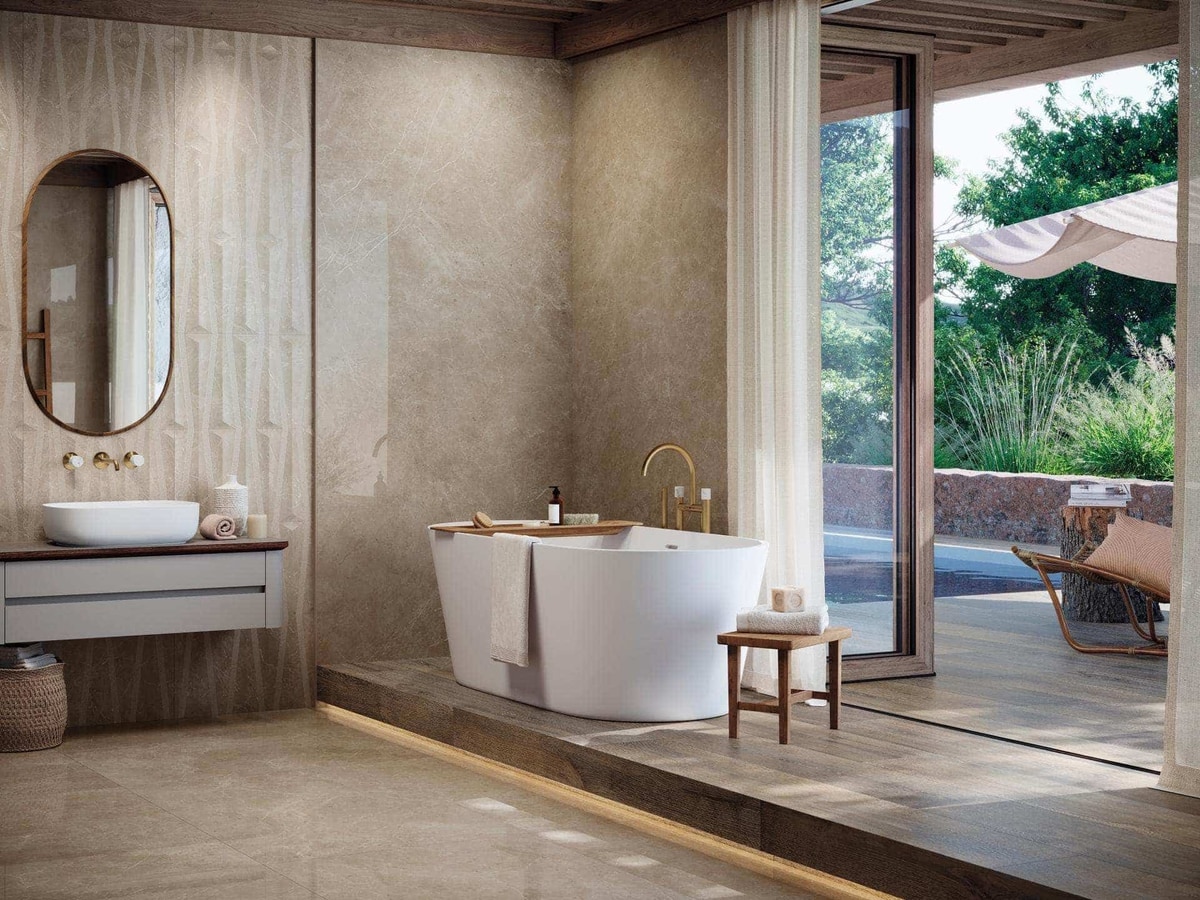
A marble bathroom starts with the tile price, and marble tile runs roughly £92 to £330 per m², supply only, at Ca’ Pietra UK retail prices checked August 2026. Marble slabs work differently. They’re quoted per slab, on enquiry, never per m², because every slab is its own piece of stone. Marble-effect porcelain and engineered stone cost less to own, because they never need sealing and acid doesn’t etch them.
Most marble cost guides put a price in the headline and then never give you one, so you scroll two thousand words and get “it depends”. This guide does the opposite. Every figure below is either published by a named supplier or flagged as our own estimate, so you can see where each one came from.
You get real tile prices first, then the reason slab pricing works differently, then a straight comparison of marble, marble-effect porcelain and engineered stone. Last comes the maintenance cost almost nobody prices in.
We supply all three at Bowmans, Ca’ Pietra marble, Porcelanosa porcelain and Cosentino surfaces, so there’s nothing in this guide trying to push you towards any one of them.
Quick Navigation
What a Marble Bathroom Costs
Marble tile costs roughly £92 to £330 per m², supply only, and those are Ca’ Pietra retail prices checked in August 2026. What moves you up that range is format more than stone quality: a plain honed brick tile sits at the bottom, a hand-cut mosaic at the top.
| Ca’ Pietra marble tile | Format | From, per m² |
|---|---|---|
| Long Island Marble Honed Brick | Brick tile | £92 |
| Folio Marble Honed | Tile | £132 |
| Versailles Marble Creme Honed | Tile | £144 |
| Zen Marble Grand Basket Weave | Mosaic | £295.97 |
| East Java Hummingbird Marble Temple Mosaic | Mosaic | £330.24 |
Ca’ Pietra UK retail, supply only, checked August 2026.
Our bathroom tiling cost guide puts natural marble tile at £60 to £100 per m² at entry level, with mid-range at £100 to £200. High-end runs £200 to £500 and above, and those bands still hold, with the Ca’ Pietra list sitting neatly inside them.
Tile pricing is published and comparable, and slab pricing isn’t, which isn’t evasion so much as how the trade works. A slab is a specific piece of a specific block, so two slabs of the same stone can differ widely in price once veining, size and yield are taken into account. Ca’ Pietra price every marble slab on enquiry, and Porcelanosa do the same for XTONE. So anyone quoting a confident per-square-metre figure for a slab, before seeing it, is guessing.
Marble tile is a material choice, and a marble slab is a commissioned piece, priced per slab, on the stone, after you’ve seen it. They’re different purchases. Treat the slab as its own budget line, sitting on top of the tile budget instead of inside it.
Book-matching is the other cost people miss. Two slabs are cut from one block and opened like pages, so the veining mirrors, and the pair costs roughly what two standard slabs cost. What you’re paying for is the cut sequence rather than extra material, so the premium is really labour. On our own projects, installation typically runs 30 to 60% above a non-matched wall, which usually puts the total premium between £600 and £1,800. That’s our figure, not a published one. Our bathroom tiles buyer’s guide covers book-matching in full.
Veining and scale are almost impossible to judge from a photo, which is why both Bowmans showrooms hold Ca’ Pietra stone alongside Cosentino surfaces. Bring your plans to Braintree or Leigh-on-Sea and handle the samples under real light.
Marble, Porcelain or Engineered Stone?
You buy marble for the veining, and you buy porcelain or engineered stone for the maintenance. That’s the whole trade-off, and the table below is where it shows.
| Attribute | Natural marble | Marble-effect porcelain | Engineered stone |
|---|---|---|---|
| Needs sealing | Yes | No | No |
| Etched by acid | Yes | No | No |
| Published wet slip figure | Rarely | Common on tile ranges | Check the finish |
| Hardness | Mohs 3 to 5 | Rated to EN 101, not comparable | Mohs 7 for Dekton |
| Where it is specified | Walls, floors, vanities, showers | Walls, floors, worktops, basins, trays | Worktops indoors, Dekton also outdoors |
| How it is priced | Tile per m², slab on enquiry | Slab on enquiry | Per slab, on enquiry |
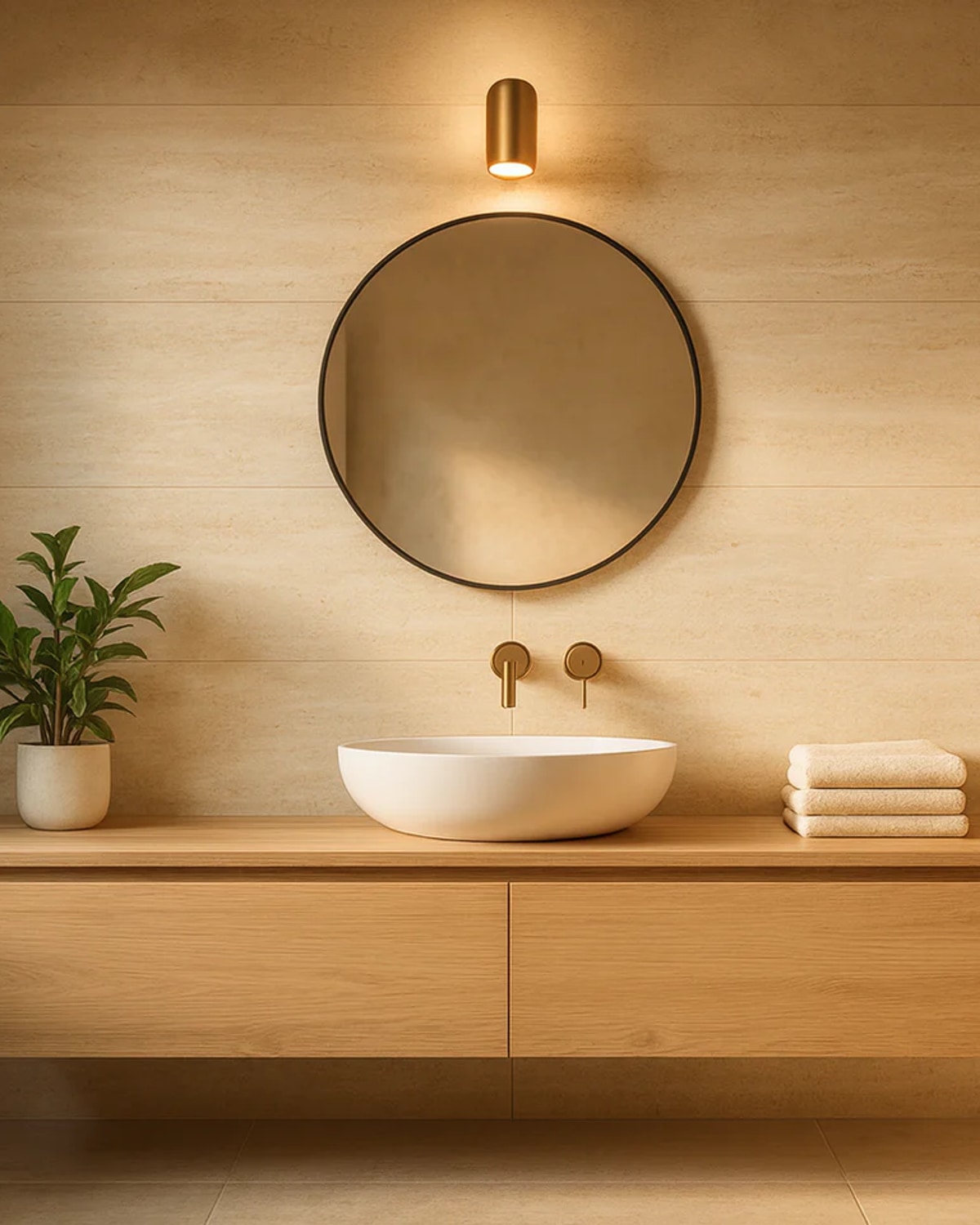
Ca’ Pietra marble is the real stone, and its main mineral is calcite, which sits at Mohs 3. Marble itself runs roughly 3 to 5. By worktop standards, that’s a soft surface.
Porcelanosa XTONE is a large-format porcelain slab, made by pressing natural mineral raw materials, decorating them digitally, then firing them at high temperature. Slabs come in 160 × 320 cm and 160 × 160 cm, in thicknesses of 3.5, 6, 10, 12 and 20 mm, as published in August 2026. Thin gauges suit wall cladding and furniture, ten millimetres is used for flooring with a non-slip finish, and twelve and 20 mm are the worktop gauges. Applications include bathtubs, shower trays and washbasins.
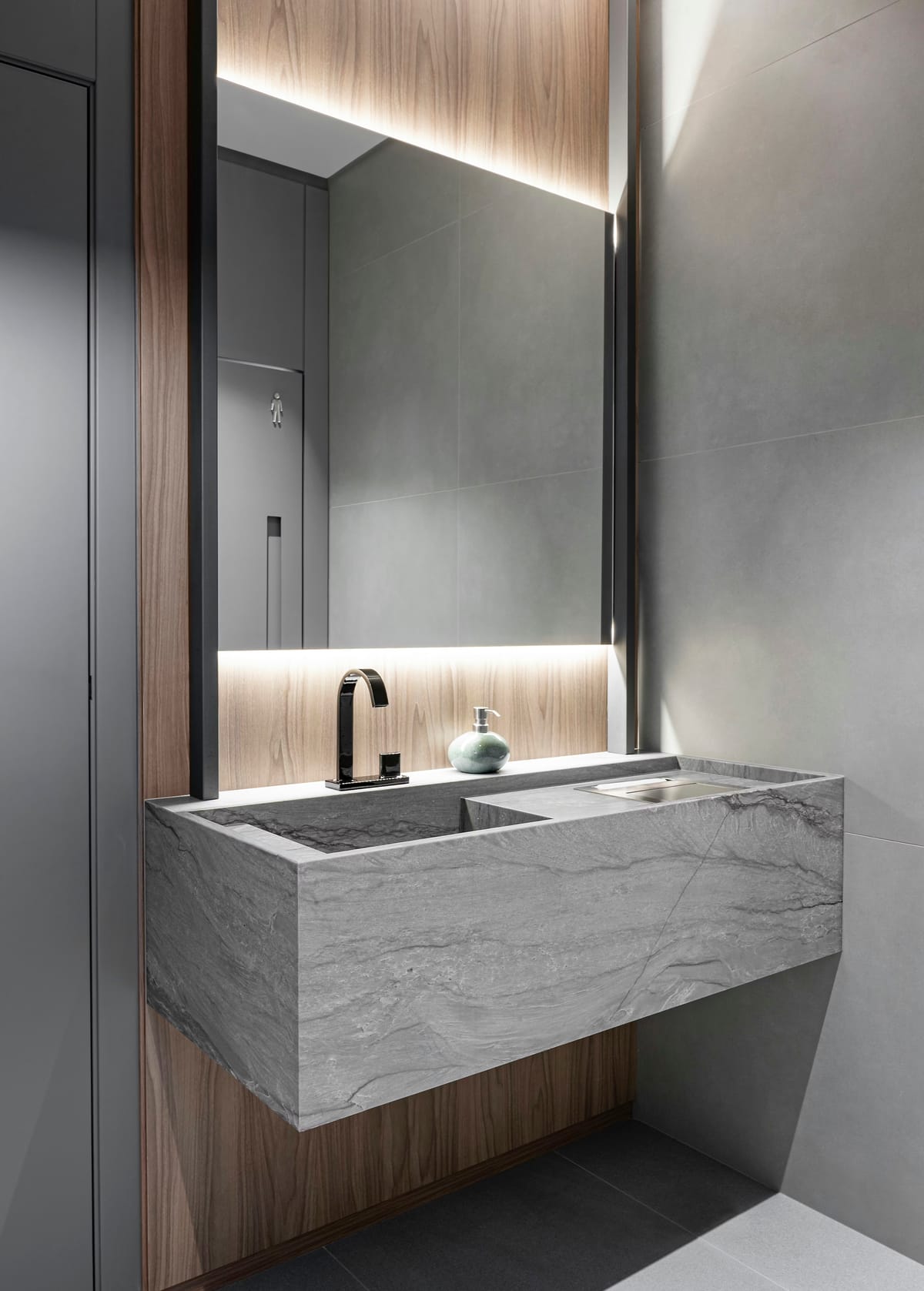
Cosentino makes two different things. Silestone is engineered quartz, with mineral fillers bound in polymer resin, and it’s non-porous, so it never needs sealing. Cosentino specify it for indoor use only, because prolonged UV can affect colour. Dekton is an ultracompact surface, made by sintering mineral particles under high pressure and heat, with water absorption of 0.03% under ASTM C373M and no sealing ever. Cosentino publish Mohs 7, the same as quartz, and state that it resists abrasion better than granite or porcelain. It’s UV stable and frost resistant too, so it gets specified indoors and out.
Verdict: which one wins where
Marble wins where you want the actual stone and the household will change how it cleans. Porcelain wins on floors and in family showers, because you can ask for a published wet slip figure, and engineered stone wins on worktops and vanity tops, where perfume, cleaner and toothpaste get spilled. Plenty of good bathrooms use two of the three.
Bowmans designs and supplies across all three ranges, which in practice means specifying marble where it earns its place and porcelain where the room won’t be babied. Our bathroom design service starts with how the room gets used, then picks the material to match.
What Marble Forgives and What It Won't
Marble is forgiving on a wall and unforgiving underfoot, so height is the simplest way to think about it. The higher up the room it sits, the easier it is to live with.
Marble won't forgive
- Limescale remover, in any form
- A polished floor in a family bathroom
- Cleaner or perfume left sitting on a vanity
- A shower that never fully dries
- A household that won't change its cleaning products
- Routine use of deep-clean products
Marble copes with
- Walls, including full-height feature walls
- Shower niches and recesses
- The panel behind a freestanding bath
- Vanity tops used with care
- Shower walls in a honed finish
- A low-traffic ensuite floor
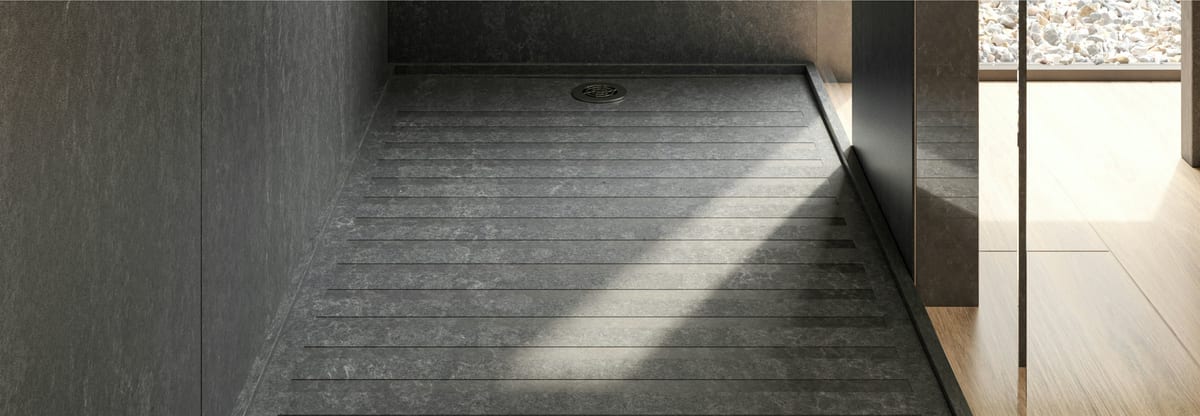
Marble does work in a shower. Ca’ Pietra list their marble tiles and slabs as suitable for bathroom, shower and wet room use, with two conditions attached: internal use only, and sealing.
Four things go wrong when it’s done badly. Acidic cleaning products dull the surface. Water marking makes it look patchy, because marble darkens where water sits, and a shower that never fully dries never evens out. Sealer breaks down first where the water hits hardest, and grout and soap residue show badly on light marble with white grout.
All four are manageable. Choose a honed finish, seal it properly, ventilate the room well and use a pH-neutral cleaner and nothing else. If the household won’t commit to that cleaner, specify porcelain instead.
Sealing, Etching and Hard Water
Sealing marble doesn’t stop it etching, and that single misunderstanding causes more marble regret than price ever does. They’re two separate problems, and only one of them has a sealer-shaped answer.
Marble is calcium carbonate, so acids attack it directly: lemon juice, vinegar, limescale remover and plenty of supermarket bathroom sprays all dull the surface where they land. The Natural Stone Institute puts it plainly. Products containing lemon, vinegar or other acids may dull or etch calcareous stones.
An etch isn’t a stain. It’s damage to the stone itself, so no amount of cleaning will lift it and only re-honing or re-polishing takes it out.
A stone sealer is an impregnator: it sits in the pores and slows absorption, which helps against staining, but it does nothing to stop acid reacting with the surface. The Natural Stone Institute describes these products as impregnators which do not actually seal the stone. They also note that sealing makes the stone more stain resistant but never stain proof.
Reseal intervals are where the internet and the manufacturer disagree, and most UK retailers say 6 to 12 months. Lithofin technical data for MN Stain-Stop says around a year for heavily used surfaces such as kitchen worktops, and every three to five years for bathrooms and lighter-use areas. Work to the manufacturer figure.
Three things shorten that interval. Hard water comes first, because limescale removers are acidic and strip the treatment straight off. Deep-cleaning products come second, and Ca’ Pietra state directly that tiles will need resealing after a deep clean product is used. Third is a honed finish, which is more open and takes more sealer.
Test it rather than diarise it. Put a few drops of water on the stone, leave them ten minutes, and if the stone darkens underneath it’s time to reseal.
Hard water is the real villain in Essex, because this is a hard-water region and every widely sold limescale remover is acidic enough to etch marble on contact. Someone who buys marble and keeps reaching for their usual bathroom spray will damage it within months. So a water softener belongs in the conversation alongside a marble spec, and that isn’t an upsell.
Sealer darkens the stone. Impregnating sealers darken and slightly enrich most marble, so if you sign off a dry sample and then see the sealed floor, you may think the wrong stone arrived. Ask to see a sealed sample before you order.
Marble also changes over time. Over the years it picks up small etch marks, it softens where it’s touched most, and the surface stops looking factory-new. Plenty of people prefer it that way, but be clear about what’s happening: that’s wear, and it isn’t a finish the stone was designed to develop. If you want a surface that still looks new in ten years, marble is the wrong choice.
Is Marble Slippery?
Wet is the only figure that matters, and wet figures fall hard: take Ca’ Pietra Tribeca Blanco porcelain in a satin finish, which tests PTV 60 dry and PTV 20 wet. Same tile, same day, one splash of water.
UK slip risk is measured with the pendulum test, and the result is a Pendulum Test Value, or PTV. The method now sits in BS EN 16165:2021, Annex C, which replaced the withdrawn BS 7976 series in February 2022.
HSE publishes exactly three bands: PTV 0 to 24 is high slip potential, PTV 25 to 35 is moderate, and PTV 36 and above is low. So Tribeca Blanco is comfortably low risk dry, and high risk wet.
Now the awkward part. Most marble carries no published slip figure at all, and none of the Ca’ Pietra marble product pages publish one. So a buyer who assumes stone comes with the same spec sheet as porcelain is in for a surprise.
Honed marble is usually safer underfoot than polished, because it has more surface texture and texture generates grip when wet. HSE ties slip resistance to surface microroughness, and classes floors below Rz 10 micrometres as high slip potential when wet. But usually safer isn’t a rating, and honed marble isn’t slip-resistant by default.
Our position is simple: we don’t specify polished marble on a bathroom floor. On a wall, behind a bath or in a niche, no slip question arises. On a floor, go honed or textured, ask for the wet pendulum figure before ordering, and if nobody can produce one, treat that floor as untested. R-ratings are a separate scale, and the bathroom tiles buyer’s guide explains them in full.
No Building Regulation in England sets a slip standard for a domestic bathroom floor. Approved Document K covers falling, collision and impact, Approved Document M covers access to and use of buildings, and Approved Document T, published in 2024, covers non-domestic toilet accommodation. The pendulum thresholds come from HSE workplace guidance, and we apply them at home because they’re the only credible yardstick, never because anyone requires it.
Will Your Floor Take It?
A 20 mm marble floor weighs in the region of 50 to 55 kg per m², before adhesive and screed, and that figure is a working estimate rather than a datasheet number. Across a 6 m² bathroom, that’s over 300 kg of extra permanent weight.
On a solid ground floor this is a non-issue, but on a suspended timber floor it deserves attention before any stone is ordered. Older houses especially.
The concern is deflection, not collapse. Timber floors flex and stone doesn’t, so the flex cracks grout first and then tiles. The usual answer is stiffening joists or overboarding, and both are far cheaper before the tiles go down.
No Building Regulation requires approval to lay a stone floor in an existing bathroom, because replacing a floor finish isn’t building work. So this is a buildability question and not a compliance one. Bowmans can flag when a scheme looks floor-load-heavy, but the structural check itself is a job for a builder or a structural engineer.
Underfloor heating adds one more requirement: natural stone over underfloor heating needs a decoupling membrane and a controlled heat-up cycle. Skip either and the floor cracks.
Two codes of practice are worth knowing. BS 5385-1:2018 covers internal wall tiling and includes natural stone tiles, but it excludes units over 12 mm nominal thickness, so it doesn’t cover marble slabs. BS 5385-3:2024 covers natural stone and terrazzo floors, and published on 31 May 2024, it absorbed the content of BS 5385-5:2009. So if a contractor quotes BS 5385-5, they’re working from a superseded document. Neither code is law. They’re what a competent installer works to.
The Mistakes That Cost the Most
Good marble still goes wrong when a detail gets skipped, and these three faults come up again and again.
1. Cleaning marble with limescale remover
Every widely sold limescale remover is acidic. It etches marble on contact rather than over time, and in a hard-water area the temptation is constant, because scale marks show on everything else. Sealer won’t save the stone here, so buy a pH-neutral stone cleaner on day one and put the old bottle out of the bathroom.
2. Assuming the sealer stops etching
This is the most common marble misconception in the UK. A sealer is an impregnator, so it slows absorption and resists stains, but acid damage is a different mechanism entirely: acid reacts with the calcium carbonate at the surface. The Natural Stone Institute is explicit that sealing makes stone more stain resistant but never stain proof. Etching needs re-honing to remove.
3. The wrong adhesive under light marble
Slow-set adhesive draws moisture and salts up through pale stone, and the result is permanent patchy staining that shows up weeks after handover. Ca’ Pietra instruct storage in a dry area to prevent efflorescence, and also specify a rapid or semi-rapid set adhesive. That’s entirely a fitting decision. Agree it with your tiler in writing before the boxes are opened.
Frequently Asked Questions
Common questions about marble bathroom cost and care
Still got a marble question this guide hasn’t answered? Bring it to a showroom and put it to a designer with the samples in front of you.
Seeing Marble in Person
Marble photographs better than it lives, and lives better than it photographs, and which of those you get depends on the room and the household. Bowmans designs and supplies across marble, porcelain and engineered stone, so the recommendation follows the room rather than the stock list. Design is included in the service, and the products you choose are the only thing you pay for.