
Bowmans · Inspiration · Design
UK bathroom regulations 2026: what every homeowner needs to know
Most homeowners only meet UK bathroom regulations when something has already gone wrong on site. They aren't buried and they aren't impossible: they're written down, free to read, and unforgiving when ignored. Five Approved Documents and one British Standard cover almost everything that matters in a domestic bathroom in 2026, and if the room has been designed properly the spec sheet honours all of them by default. This is the plain-English version, and you can read it in twenty minutes.
01 · The map
What regulations apply to a UK bathroom in 2026?
A UK domestic bathroom is governed by five Approved Documents under the Building Regulations (England), plus one British Standard for electrical work. Some only bite when you're doing certain types of work; others apply to every refurb. None of them are optional once they're triggered.
The five Approved Documents are F (ventilation, including the bathroom extract-fan rate), G (sanitation, hot water safety and water efficiency) and L (conservation of fuel and power, the related energy-efficiency targets). The other two are M (access to and use of buildings) and P (electrical safety in dwellings). A sixth, T (toilet accommodation), gets cited often enough to be worth naming, but it covers new non-domestic buildings only. The British Standard is BS 7671:2018+A4:2026, the IET Wiring Regulations, 18th Edition. Every one of them is published and maintained on gov.uk; BS 7671 comes from the IET and BSI.
Approved Document T is on that list for completeness, but it does not apply to dwellings: it covers new non-domestic buildings only (offices, schools, retail). Most of the 2024 commentary about Document T has nothing to do with home renovations. You can ignore it on any residential bathroom project.
On top of the building regulations sits a separate piece of law, the Water Supply (Water Fittings) Regulations 1999, and it governs every fitting connected to the mains water supply. You normally show compliance through WRAS Approval (Water Regulations Approval Scheme) or the equivalent NSF REG4 certification. And if your home is listed or sits in a conservation area, you'll need listed building consent, and possibly planning permission, alongside building regulations approval.
A designer-led showroom should put a spec sheet in front of you that meets all of these rules without you ever opening them. If you're ordering products yourself and briefing a fitter, the responsibility shifts to you and the trades on site. The next eight sections cover each rule in plain English.
UK bathroom rules at a glance
| Document | What it covers | In force |
|---|---|---|
| Approved Doc G | 125 L/p/d water and 48°C bath fill (new dwellings and changes of use); unvented cylinders over 15 L | 1 Oct 2024 |
| Approved Doc F | Extract: 15 L/s intermittent or 8 L/s continuous high rate (new or added bathrooms) | Current |
| Approved Doc L | Energy-efficiency targets (heating, lighting, fabric) | 2021 + 2023 |
| Approved Doc M | Accessibility — M4(1), M4(2), M4(3) standards | 2015 + 2024 |
| Approved Doc P | New circuits, and most special-location work, notifiable | 2013 (current) |
| BS 7671+A4 | Zones 0/1/2, IP ratings, 30mA RCD on every bathroom circuit | 15 Apr 2026 |
| WSR 1999 | WRAS / NSF REG4 approval for all water fittings | CoP Jan 2025 |
| Approved Doc T | Non-domestic only — does NOT apply to dwellings | 1 Oct 2024 |
Sources: gov.uk Approved Documents; IET BS 7671:2018+A4:2026 (Amendment 3 remains a valid alternative until it's withdrawn on 15 October 2026); legislation.gov.uk SI 1999/1148; WRAS Approvals.
"The rules aren't buried. They're written down, free to read, and unforgiving when ignored."
02 · Water and hot water
Approved Document G — water, hot water and the 48°C rule
Approved Document G covers sanitation, hot water safety and water efficiency, and the current edition is the 2015 publication incorporating the 2024 amendments, in force from 1 October 2024. Three of its sections matter for bathrooms, although G2 and the 48 degree rule apply only to new homes and homes formed by a change of use.
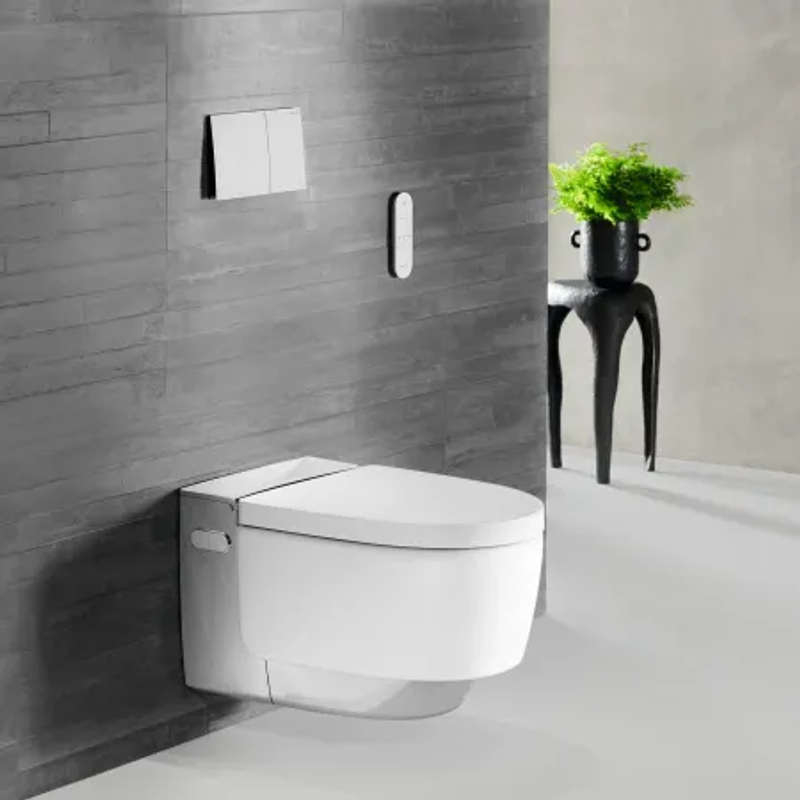
Section G2: water efficiency. The mandatory standard is 125 litres per person per day for new dwellings, with an optional tighter standard of 110 L/p/d that some local authorities adopt in water-stressed areas. The figure comes out of the government's water efficiency calculator, which assigns flow rates to the WC, basin tap, bath, shower, kitchen tap, washing machine and dishwasher. Refurbishments don't always need the calculation done, but the spirit still applies. Spec a 6/4 dual-flush WC like the Geberit Sigma 70, a 6 L/min flow-restricted basin tap and a 9 L/min thermostatic shower, and you'll sit comfortably under either ceiling.
Section G3: hot water safety. Two rules dominate here. First, every unvented hot-water storage system over 15 litres has to be installed by a competent person registered with a recognised body, usually a G3-qualified installer working under the Building Regulations or a Competent Person Scheme. Self-installation of an unvented cylinder is not legal in a dwelling. Second, in a new dwelling or one formed by a change of use, bath fill must be limited to a maximum outlet temperature of 48 degrees Celsius, and Approved Document G's route is an in-line blending valve or other temperature control device on the hot supply to the bath. That's a scald-prevention rule, and it doesn't apply to adding or replacing a bath in an existing home.
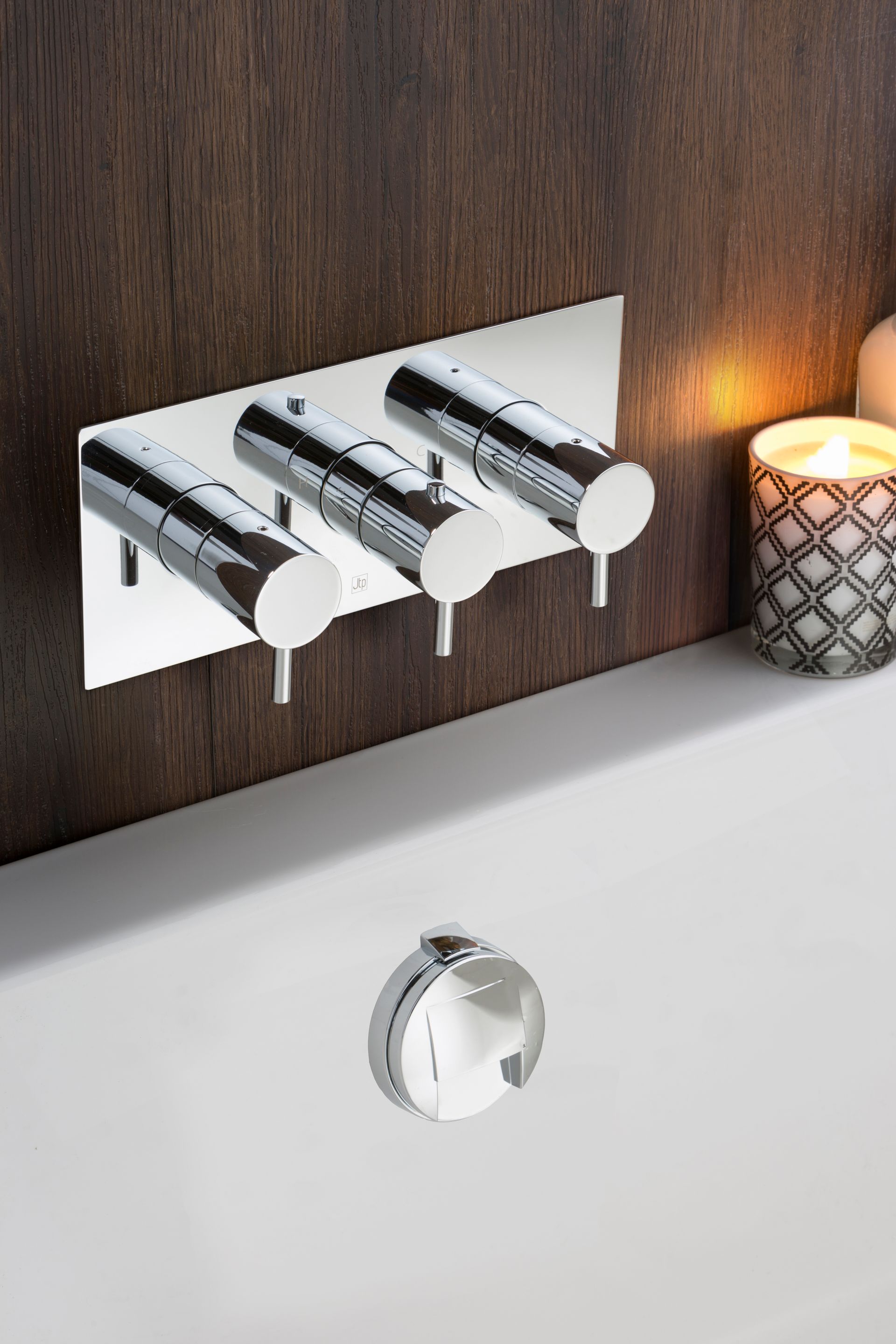
The 48 degree rule limits the hot supply, not the filler itself: in a new home or one formed by a change of use, a bath filler without an integral thermostatic valve needs a blending valve or other device on the hot supply to hold it to 48 degrees Celsius. The rule isn't new, either; the 2024 amendments only updated Approved Document G's references for Part T. In an existing home, a thermostatic filler or blending valve is our recommendation rather than a legal requirement. Crosswater, Hansgrohe, Axor, JTP and Roper Rhodes all sell TMV2-compliant bath fillers as standard now. If you're buying a separate floor-mount or wall-mount bath filler from a single-tap supplier, check the data sheet says TMV2, or have a separate TMV fitted on the hot supply.
Section G4: sanitary conveniences. This one covers the 6/4 dual-flush WC standard for new installations, plus rules on access for cleaning, ventilation and drainage. The detail rarely catches refurbs out. You'd have to go out of your way and spec a single-flush 9-litre cistern to fail it.
For how spec choices on cisterns, smart WCs and water-efficient brassware stack up at design stage, our UK luxury bathroom cost guide walks the line items at three price tiers.
Source: gov.uk Approved Document G (Sanitation, hot water safety and water efficiency), 2015 edition incorporating 2024 amendments.
03 · Ventilation and energy
Approved Documents F & L — extract ventilation and energy efficiency
Two separate Approved Documents cover ventilation and energy in a bathroom refurbishment. Approved Document F (Ventilation) sets the extract rate a new or added bathroom has to meet. Approved Document L (Conservation of fuel and power) has a much wider energy remit than bathrooms alone, but its rules on heating elements, lighting and building fabric still apply to every refurbishment.
Extract ventilation. In England, a new or added bathroom needs a means of extract ventilation venting to outside; if you're refurbishing a bathroom that had no ventilation system, you don't have to add one unless the work would make the building less compliant than before. The two common routes are an intermittent extract fan rated at 15 litres per second, with a 15-minute overrun where the room has no openable window, or a continuous extract system with a high rate of at least 8 litres per second. The fan has to vent through an external wall, soffit or roof. Never into the loft, never into another room. Those figures come from Approved Document F (Ventilation); Approved Document L covers the separate energy-efficiency targets below.
In a windowless internal bathroom (common in 1980s and 1990s built-ins, and in most modern apartments) the fan is usually wired to the lighting circuit and runs on a 15-minute overrun timer. The fan and its circuit fall under the wiring regulations too, even though the job they're doing is ventilation. The two rules read together.
In a new or added bathroom, an opening window doesn't replace mechanical extract under Approved Document F: its window route is for sanitary accommodation, meaning a room with a WC but no bath or shower. Even where the guidance doesn't require a fan, as in a refurbished bathroom that had no ventilation, we'd still specify one. Relying on the homeowner to remember to open a window is not a serious mould-prevention strategy.
Energy-efficient heating and lighting. Heated towel rails, electric underfloor heating and lighting all count toward the dwelling's primary-energy and fabric-energy targets. For a single-bathroom refurb the practical implications are small. Spec LED lighting (the only sensible choice anyway), put the underfloor heating on a thermostatically controlled zone, and don't leave bathroom-only circuits unzoned on a single-zone heating system. Warmup electric mat systems, and wet underfloor heating zoned through a thermostat, both meet the energy criteria.
The Future Homes Standard, expected through 2025–26, will tighten these criteria further, mainly by phasing out fossil-fuel heating in new builds. For existing-property bathroom refurbs, the impact lands mostly on hot-water source decisions (heat-pump water cylinders rather than gas combi expansions). Ask your installer whether any related work, like extending a hot-water cylinder or moving boiler flues, falls inside the new Standard's scope at the time you start.
Sources: gov.uk Approved Documents L and F. Future Homes Standard timetable: gov.uk consultation responses 2024–25.
04 · Accessibility
Approved Document M — accessibility and adaptable bathrooms
Approved Document M Volume 1 (Access to and use of dwellings) covers accessibility for new dwellings and major renovations, and the 2015 edition incorporating the 2016 amendments is current. It defines three optional standards that local plans can choose to adopt. Most existing-property refurbishments sit at the M4(1) baseline; the higher standards only bite where local planning policy requires them, or where the homeowner is futureproofing.
M4(1): visitable dwellings. This is the default. It asks that a wheelchair user could get into the home, reach a WC at entrance level and get into the principal rooms. For a bathroom refurb in an existing home M4(1) almost never imposes new constraints, because most rooms already meet it.
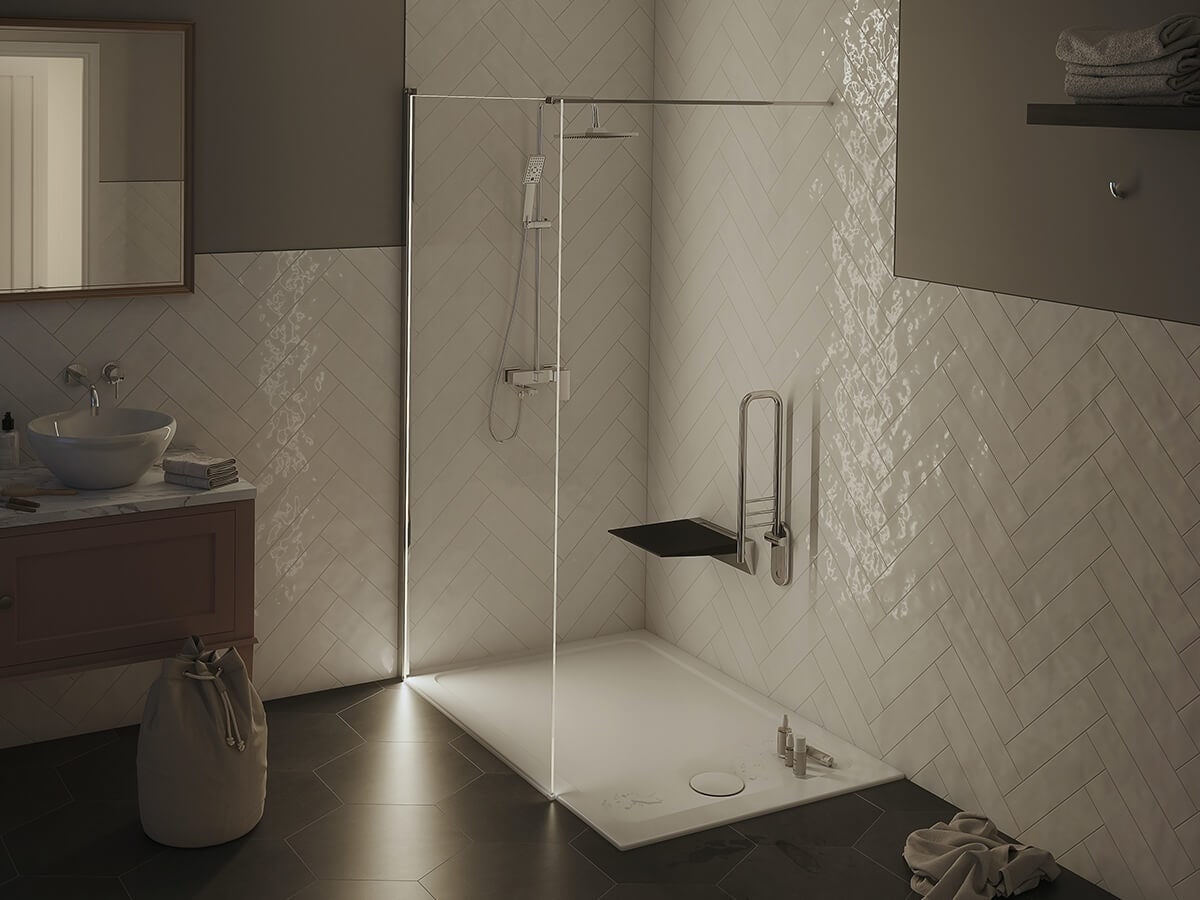
M4(2): accessible and adaptable dwellings. Optional, and adopted by some local plans for new builds. It wants walls capable of supporting future grab rails at 1.5 kilonewtons per square metre. In practice that means solid blockwork or reinforced studwork behind any wall where a grab rail might later be retrofitted: typically beside the WC, the shower and the bath. You also need reasonable circulation space, level thresholds and lever taps. The bathroom doesn't have to be designed as though a wheelchair user lives there today; it has to be capable of adaptation later without a major rebuild.
M4(3): wheelchair-user dwellings. Optional, and adopted by very few local plans. This one is designed for a wheelchair user from day one, so the dimensions are specific. A level-access shower of at least 1200 by 1200 millimetres, a 1500 by 1500 millimetre clear turning circle in the bathroom, and 750 millimetres of clear floor space in front of the WC. Basins go at 770 to 850 millimetres above finished floor level, with knee space below so a wheelchair user can roll under. Lever or sensor taps, a slip-resistant floor and drainage falls compatible with level-access showering.
For most luxury bathroom refurbishments in Essex your project sits at M4(1), and you won't need to engineer for grab-rail loading or wheelchair turning. M4(2) becomes worth a thought in two situations: aging-in-place futureproofing (a couple in their late fifties planning to stay put) and resale strategy in larger homes, where an M4(2)-spec ensuite sells to a wider pool of buyers. M4(3) is rare in private bathroom design unless the brief asks for it. If it does, the dimensions above are non-negotiable.
If you're converting a downstairs WC into a shower room, or moving from a separate bathroom-and-WC layout to a single accessible bathroom, call the local building control officer before design work starts. They'll tell you which M4 level your authority is applying at the moment.
Source: gov.uk Approved Document M Volume 1, 2015 edition incorporating 2016 amendments.
"Every new circuit is notifiable. So is almost anything else you do inside the zone around a bath or shower."
05 · Electrical work
Approved Document P — Part P electrical notification
Approved Document P (Electrical safety, dwellings) is the government guidance on the Building Regulations rules that make a new circuit notifiable, along with most work inside the "special location" around a bath or shower. You comply either by using a registered competent person or by notifying the local building control body before you start. The 2013 edition is current. A bathroom counts as a special location because of the combination of water and earth-bonded fittings, and the consequences of bad work are higher than in a kitchen or a living room. There are limited exemptions, like a genuine like-for-like replacement of an accessory on an existing circuit, so check your specific job with a registered electrician rather than assuming either way.
You've got three routes to comply. They're all legal, and they play out very differently in practice.
Route one: a registered competent person self-certifies. Most bathroom electrical work goes through here. The electrician has to be registered with an authorised Competent Person Scheme, such as NICEIC or NAPIT. Once the work's finished they issue a Building Regulations Compliance Certificate, and their scheme sends it to building control automatically without you doing anything. They also issue an Electrical Installation Certificate (EIC) or Minor Works Certificate (MEIWC) under BS 7671. You get a copy of both. Hang on to them. Your conveyancing solicitor will ask for them when you sell the house.
Route two: use a registered third-party certifier. A third-party certifier inspects and certifies work carried out by an electrician who isn't scheme-registered themselves. Homeowners use it less often than route one, but it's a legitimate compliance path and worth knowing about if your electrician suggests it.
Route three: notify building control directly before starting. If your electrician is competent but not scheme-registered, or if you're doing some of the work yourself when you shouldn't be, building control has to be notified before any work begins, fees paid and an inspection scheduled. This route costs more (typical local authority notification fees £200–£400 for a single bathroom) and it's more disruptive. Most homeowners just hire a Part P-registered electrician.
Notification is triggered by any new circuit, and by any addition or alteration to an existing circuit inside the special location around a bath or shower. It's also triggered by an electric shower, electric underfloor heating or extract fan where that involves a new or altered circuit. Outside the special location, minor additions to an existing circuit are often not notifiable. But almost every luxury bathroom refurb triggers Part P somewhere, because there's rarely a refurb that doesn't add or alter at least one circuit inside the zoned area.
Failing to comply is a criminal offence under the Building Regulations. The fine is rarely the consequence; the conveyancing problem is. Sell within ten years of the work without a compliance certificate and the buyer's solicitor will want either retrospective certification (an inspection costing £150–£400 plus any remedial work) or an indemnity insurance policy (£100–£300, single-property only). The cheapest path is always to use a registered electrician on the day.
On our design and supply projects we don't carry out electrical work: your own fitter and electrician are welcome, or we can introduce an approved fitter. More on working with your own fitter or an approved fitter is on our installation page.
Source: gov.uk Approved Document P (Electrical safety, dwellings), 2013 edition, current.
06 · The wiring rules
BS 7671:2018+A4:2026 — bathroom zones, IP ratings and 30mA RCDs
BS 7671:2018+A4:2026 is the British Standard that governs every piece of electrical installation work in the UK. It's still the 18th Edition; there's no 19th Edition. Amendment 4 was published on 15 April 2026 and has applied ever since. The previous version, Amendment 3:2024, stays a valid alternative until it's withdrawn on 15 October 2026, a six-month transition during which installers may work to either. For bathrooms the standard defines three zones, the minimum IP rating of fittings in each zone, and the residual current device protection every bathroom circuit must carry.
Read the three rules together. The zones tell you where a fitting is, the IP rating tells you how watertight it has to be, and the RCD tells you how the circuit shuts itself off if water gets in anyway.
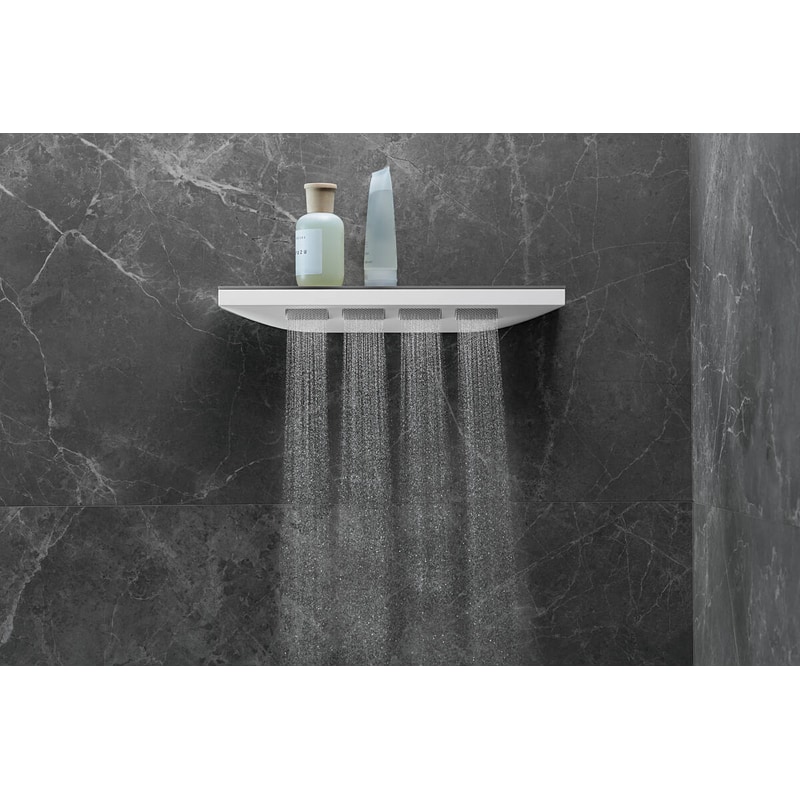
Zone 0: inside the bath tub or shower tray. Fittings here must be IPX7 minimum (protected against full immersion) and must run at SELV, Separated Extra-Low Voltage, at no more than 12 volts. In practice that limits you to specific products: the inset spotlights inside a steam-shower roof, or the touch-control panel inside a smart WC seat. Mainstream bathroom fittings rarely sit in Zone 0.
Zone 1: directly above the bath or shower, up to 2.25 metres above the floor. IPX4 minimum, meaning protected against splashing. This is where downlights over the shower live, where shaver lights might sit above a basin inside the splash zone, and where overhead rainfall shower heads sit. IPX4 is easy to find. Almost every reputable bathroom-rated downlight from HIB, Sensio, Saxby and similar UK suppliers carries it. Watch out for older "general living room" downlights that don't.
Zone 2: 0.6 metres horizontal beyond Zone 1, and up to 2.25 metres vertical. IPX4 minimum again. This is where most thermostatic shower controls, basin lights and accent wall lights end up. Mains switches are not allowed in Zone 2; only SELV-supplied switches can go there. Otherwise they go outside it, or they're the pull-cord type, because no exposed metal switch belongs in a wet zone.
The old Zone 3: REMOVED. Older guidance still circulating online refers to Zone 3 (anywhere outside Zone 2) with reduced IP requirements. That zone came out of BS 7671 in an earlier amendment. It doesn't exist in the current standard. Treat anywhere more than 0.6 metres horizontally beyond a bath or shower tray as outside the regulated zones; a shower without a tray has no Zone 2, and its Zone 1 reaches 1.2 metres from the fixed shower outlet. The room itself is still a "special location" though, and the 30mA RCD rule still applies to every circuit in it.
30mA RCD protection: every bathroom circuit, no exceptions. BS 7671:2018+A4:2026 requires every circuit supplying a bathroom or shower room to be protected by a 30 milliamp residual current device. That covers lighting, heating, sockets (rare in bathrooms; ordinary 230V sockets must be at least 2.5 metres horizontally from the Zone 1 boundary), towel rails, extract fans, electric showers and underfloor heating. There is no exemption for low-load circuits. The RCD is what saves a life on the day the zone IP ratings fail under real conditions.
There are two practical implications most homeowners miss. First, if your house has an older consumer unit (pre-2008), a bathroom refurb may trigger a consumer-unit upgrade, because the existing board can't accept dual-RCD protection under the new rules. That's an extra £400–£900 on top of the bathroom budget. Second, any bathroom that adds an electric underfloor heating zone will almost always trigger consumer-unit work, because UFH is a load that wants its own RCBO protected circuit. Ask your electrician about both at quoting stage.
Source: IET BS 7671:2018+A4:2026, published 15 April 2026. Amendment 3:2024 remains a valid alternative standard until it's withdrawn on 15 October 2026.
07 · Water fittings
WRAS and the Water Supply (Water Fittings) Regulations 1999
The Water Supply (Water Fittings) Regulations 1999 (Statutory Instrument 1999/1148) govern every fitting installed on a UK mains water supply. They aren't part of the Building Regulations. They're separate statute, enforced by your water company and ultimately by the Secretary of State, and the current Code of Practice was updated in January 2025. The principle is simple enough: every tap, fitting, valve, cistern and connection on the mains side has to prevent backflow and be approved as fit for purpose.
WRAS Approval: the standard compliance route. The Water Regulations Approval Scheme is the recognised UK certification that a fitting complies with the regulations, and every reputable UK bathroom brand certifies its UK-market products through it by default. Crosswater, Hansgrohe, Axor, JTP, Roper Rhodes and the rest of the brands we work with all carry WRAS approval on their UK ranges. NSF REG4 is an equivalent scheme, and either one is acceptable.
The risk is grey-market product. Order a designer-looking tap from a third-party European site and you may find it has no UK WRAS approval, which means your water company can technically require its removal at your expense. The same product bought through a UK retailer almost always carries WRAS approval, because the retailer can't legally stock non-compliant fittings.
Backflow prevention. Domestic bath and basin taps in UK premises must provide a Type AUK2 air gap. In plain terms, the spout sits above the spillover level of the bath or basin, with at least the prescribed vertical distance, so contaminated bath water can't siphon back into the cold supply. A floor-mounted bath filler with the spout below the rim of the bath would breach that rule. The standard fix is an in-line check valve, or a redesign so the tap meets AUK2 by geometry. Most off-the-shelf bath taps from the brands above comply by default.
Notifiable installations. Some installations have to be notified to the water company before work starts, including most unvented hot-water systems, water softeners and fittings on a private supply. A wetroom installation that involves new mains connections will normally trigger it. The Water Fittings Regulations run alongside Building Regulations notification rather than replacing it, so some projects need both notifications, sent to different authorities.
For homeowners the practical rule is simple. Buy your brassware, sanitaryware and shower controls through a UK retailer, check the data sheet says WRAS or NSF REG4 approved, and you're inside the rules. If your installer flags a fitting without approval, swap it before the install rather than after.
Sources: legislation.gov.uk SI 1999/1148; WRAS Approvals (wrasapprovals.co.uk); Water Regulations Advisory Scheme Code of Practice 2025.
08 · Heritage and planning
Listed buildings, conservation areas and when planning is needed
For most domestic bathroom refurbishments you won't need planning permission, because the work falls under permitted development. There are two big exceptions: listed buildings and conservation areas. Either one can turn a routine bathroom refurb into a regulated alteration, and getting it wrong can mean enforcement action and forced reinstatement at the owner's expense.
Listed buildings. If your home is on the National Heritage List for England (Grade II, II* or I), every alteration affecting its historic character needs Listed Building Consent. On bathroom refurbs the triggers are moving internal walls, replacing original sanitaryware (more sensitive in II* and I-listed properties) and changing window positions. Also soil pipes through external elevations, original tiles or panelling removed, and plumbing routes altered through historic floor structure. Routine like-for-like replacement of modern fittings in an already modernised bathroom rarely needs consent. Structural alteration of the room itself almost always does.
Listed Building Consent is separate from Building Regulations approval. A project can need both, and they're processed by different teams inside the same local authority. Your first call is the conservation officer, and you want that call at design stage rather than on site. Work without consent on a listed building is a criminal offence.
Conservation areas. Around 10,000 conservation areas across England restrict external alterations within their boundaries: boiler flues, external soil-stack runs, rooflights serving bathrooms, and anything visible from the street. The constraints are usually milder than for listed buildings, but they can still block a new high-level rooflight to ventilate a windowless bathroom, or an external waste run that would otherwise be the cheapest plumbing option. Article 4 directions in some conservation areas strip permitted development rights for further specific alterations.
Permitted development. For un-listed houses outside conservation areas, most internal bathroom refurbs are permitted development and need no planning application. Loft conversions and extensions that include a new bathroom may need planning, depending on size and position, but those are project-level questions rather than bathroom-specific ones. Once the drawings are approved a separate question follows: who actually designs the bathroom itself, because the planning set rarely covers tap centres or tile set-out.
Here's the honest summary for Essex homeowners. Most of our Braintree, Chelmsford, Colchester and Maldon catchment is unlisted post-war or 1960s–80s housing, so listed building consent rarely comes up. Where it does, in Coggeshall, Dedham, Earls Colne, parts of Halstead and Saffron Walden, the conservation officer is the gatekeeper, and our designers know to engage them early. If you're planning a luxury refurb in a listed property, we'll flag the consent route at the first design appointment, long before the spec sheet is drawn.
Sources: gov.uk Listed Buildings; Historic England conservation area guidance; Town and Country Planning (General Permitted Development) (England) Order 2015 as amended.
09 · Building control
Building control sign-off for a bathroom refurb
Building control is the local authority function that signs off completed work as compliant with the Building Regulations. Most homeowners think of it as a new-build thing. That's simply wrong. Plenty of bathroom refurbishments need at least partial sign-off, and how that sign-off happens depends on which trades are involved and which Competent Person Schemes they belong to.
What triggers building control involvement on a bathroom refurb.
- New electrical work in the bathroom (Approved Document P): sign-off via the electrician's CPS scheme, or by direct notification.
- An unvented hot-water cylinder over 15 litres installed or replaced (Approved Document G3): sign-off via a G3-qualified installer, or direct notification.
- A new window or rooflight added to the bathroom: full Building Regulations approval.
- Structural alterations (moving internal walls, joist alterations under a freestanding bath, a wetroom that needs the floor lowering): full Building Regulations approval.
- Conversion of a non-bathroom space into a bathroom (loft conversion, garage conversion, downstairs WC enlargement): full Building Regulations approval.
What usually does NOT trigger building control involvement. A genuinely like-for-like cosmetic refurbishment normally falls outside the regulations: same WC position, same bath, same basin, no new circuits, no relocated waste runs, no new windows, no structural changes. In practice that's rare on luxury refurbs, because the design improvement that justifies the spend nearly always involves at least one position change.
There are two routes to sign-off. A "full plans" application goes to building control before work starts, with drawings and specifications, and the work is inspected at intervals during construction. A "building notice" is shorter: you notify building control 48 hours before starting and they inspect during and after. For most bathroom refurbs the building notice is the practical route, with the extra certifications coming from the trades' Competent Person Schemes. The local authority issues a Completion Certificate when it's satisfied. Keep that with your conveyancing pack.
Approved Inspectors. The alternative to local-authority building control is a private-sector Approved Inspector, who fulfils exactly the same statutory function. Costs are similar; the service can be more responsive. Both routes produce a final certificate with the same legal weight.
Here's where Bowmans fits. We aren't a building control inspector and we don't certify work; that's the local authority's job, or the Approved Inspector's. What we do at design stage is work out which Approved Documents your specific project triggers, brief the relevant trades on what each has to certify, and make sure the spec sheet contains nothing that would fail certification. If you use an approved fitter we introduce, the certification sits with them and their electrician, not with us. If you're using your own fitter and electrician, we make sure they know which schemes to certify under and which paperwork to produce.
The single biggest cause of failed building control sign-off we've seen on luxury bathrooms is uncoordinated trades: nobody taking ownership of the certification. Agreeing the design, the spec and who certifies what before the trades start helps solve that.
Sources: gov.uk Building Control; Local Authority Building Control (LABC); Construction Industry Council Approved Inspectors Register.
"A spec sheet that meets the regulations isn't extra value. It's the floor."
Read next
Cluster · design
Is a bathroom designer worth it? An honest answer
When a designer earns the fee, including how one keeps your spec inside Approved Documents G, L, M, P and BS 7671 from day one.
Cluster · cost
How much does a luxury bathroom cost in the UK in 2026?
£15k, £25k and £40k spec breakdowns, including the cost impact of consumer-unit replacement and thermostatic bath fillers.
Frequently asked questions
Plain-English answers to the regulatory questions UK homeowners ask before a luxury bathroom refurbishment.
What's next
Want a designer to keep your spec inside the rules?
Most homeowners don't want to read five Approved Documents to refurbish one bathroom. A designer-led showroom is meant to do that work for you. It puts a spec sheet in front of you that meets G2, G3, L, F, M, P and BS 7671 by default, with WRAS-approved brassware throughout, so the only thing left to choose is what looks right. Worth pairing this with our bathroom layout mistakes guide. Regulations set the legal floor — layout work happens on top of compliance, and most expensive bathroom regrets are layout, not regulatory.
At Bowmans the design service comes alongside our standard online-comparable product pricing, and there's no margin uplift to fund the regulatory belt-and-braces. The first appointment is at our Braintree or Leigh-on-Sea showroom. Bring a rough plan and photos of the room, and we'll walk through what your specific project triggers under each document.