
Bowmans · Inspiration · Design
Luxury bathroom storage design: vanities, niches, mirror cabinets and concealed solutions
Storage is the line on a bathroom spec sheet that gets revisited last and regretted first. The conversation defaults to brassware and tile, because that’s where the showroom photographs are. So the vanity, the mirror cabinet, the niche, the concealed-cistern duct, the towel run and the in-cabinet electrics get bolted on at the end. By then the layout is locked and the budget is bruised. Twelve months later, "beautiful, but where do I keep anything?" is how most UK homeowners describe the result. A luxury bathroom that earns its budget gets the storage right at the same time as the layout: same drawing, same regulations as everything else in the room.
01 · The pattern
Why storage gets under-specified
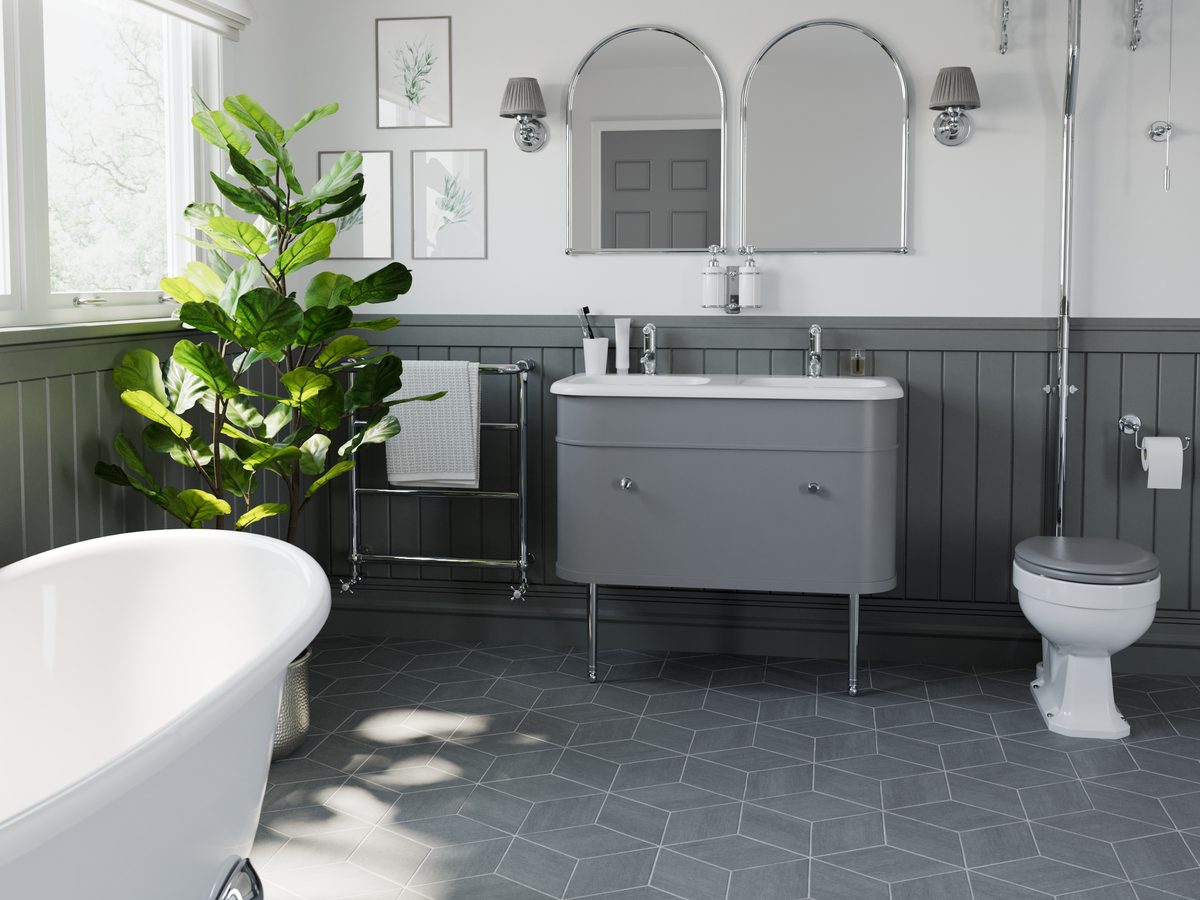
Most UK luxury bathroom installs in 2026 still under-spec storage, and the reason is predictable. The showroom conversation gravitates to the visible hero pieces. Brassware, the freestanding bath, the tile, the basin shape: these are the items a homeowner has been pinning to a Pinterest board for six months, and the items the showroom has on display. Storage turns up two-thirds of the way through the conversation as a category ("and what about a vanity?") rather than as a brief in its own right. By then the layout is provisional and the budget is allocated. So the storage decisions get made under time pressure instead of from first principles.
The result is the storage shortfall most UK homeowners describe twelve months into a finished bathroom. There’s nowhere to put the bottles in the shower without them sitting on the tray edge. There’s nowhere to hide the everyday clutter on the vanity. The mirror is a flat panel instead of a cabinet, because the cabinet got value-engineered out late in the process. The towel run is a single rail when the household has four people. The concealed cistern went in without a service void, so the duct has no shelf above it. Each decision was defensible on the day. Together they add up to a beautiful room that doesn’t hold the household’s things.
The fix is to design storage at the same time as the layout, on the same drawing, against the same regulations as the brassware. Vanity placement, mirror-cabinet versus separate mirror, niche position and depth, concealed-cistern duct construction, towel and laundry storage, in-cabinet electrics: all of it has to land before the plasterer arrives. Because the cabling, the tanking, the noggin pattern in the studwork and the wall fixings for floating units all have to be planned in. That’s the clearest example of why a designer earns the fee at this tier. We’ve covered the wider trigger conditions in our honest guide on whether a bathroom designer is worth it, and the broader sequence of pre-design decisions in our 14-step luxury bathroom planning checklist. Storage is step nine on that checklist for a reason. It sits after the regulatory, structural and waterproofing checks but before the decorative spec, because the storage decisions constrain everything decorative that follows.
Houzz UK’s 2025 Bathroom Trends Study found that 28% of UK homeowners hire a designer and 89% hire professionals for bathroom renovation. The group that brings a designer in at brief stage, rather than after the layout is set, is much smaller. Storage is the category that most rewards early involvement. By the time the decorative spec is being chosen, the storage decisions have already been made by default. A drawing-stage storage brief identifies what needs to be stored (cosmetics, towels, cleaning supplies, laundry, medications, decorative pieces, devices), where in the room it lives, what circuit serves it, and how the access works. None of that fits on a Pinterest board.
02 · The hero
Built-in vs floating vanity — the core decision
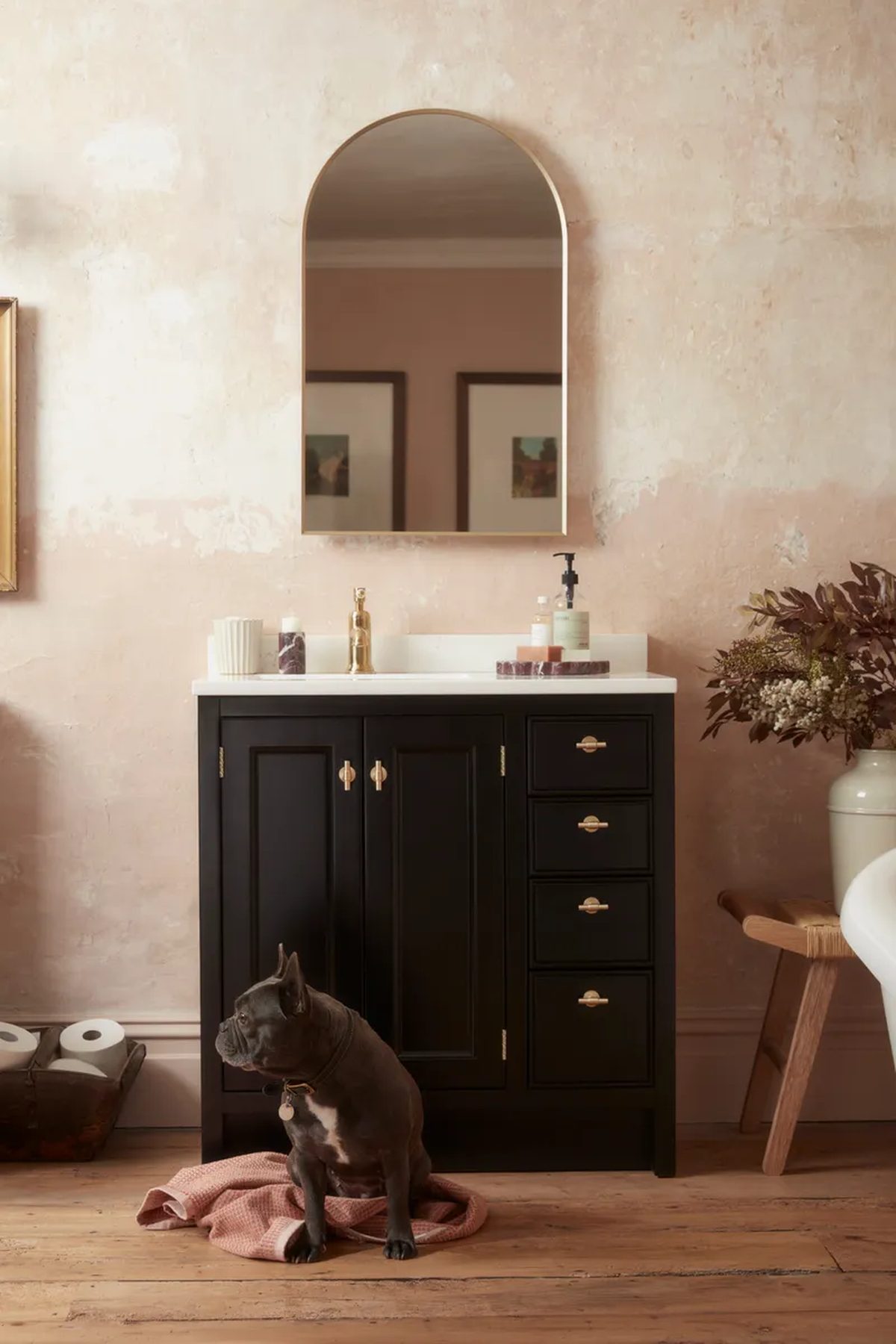
The vanity is the largest single piece of storage in most bathrooms, and it drives the rest of the scheme. The first decision is built-in versus floating. It’s a functional call before it’s an aesthetic one. Floating vanities sit on wall brackets with a clear gap below the unit; built-in vanities sit on the floor with a plinth or kickboard. Both can be specified to luxury standard. Both fail, differently, if you pick the wrong one for the room.
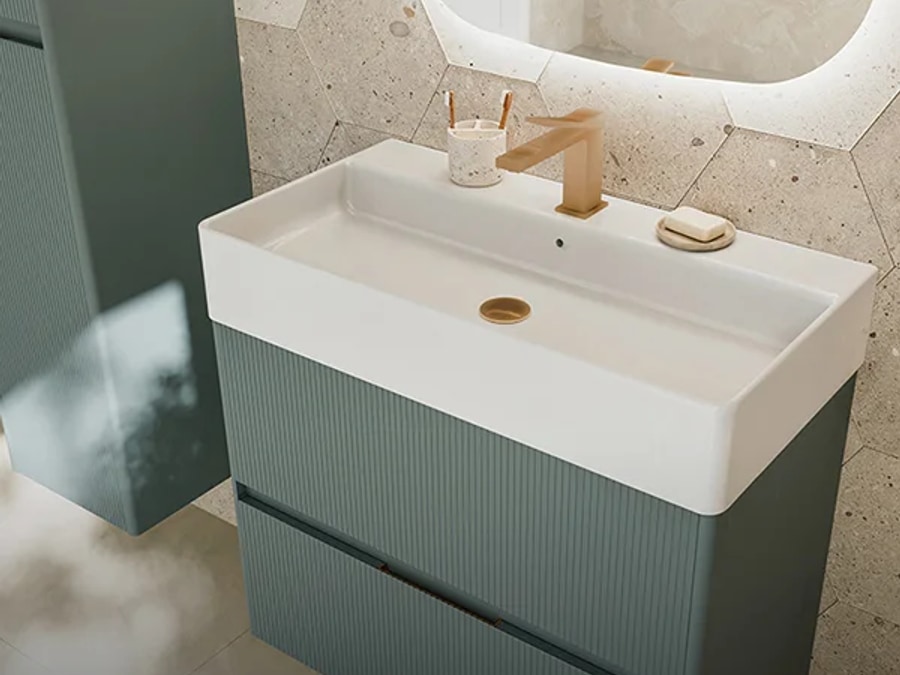
Floating vanities suit modern schemes, smaller bathrooms, and any layout where you want the floor to run unbroken across the room. That’s the visual trick that makes a small bathroom feel larger, because the eye takes in the full floor area instead of a chopped-off section behind a kickboard. They also let you mop or vacuum under the unit, which family bathrooms benefit from. The constraint is structural. A floating vanity needs a wall capable of taking the bracket load, typically 60 to 80 kilograms once you add the basin, the contents and the cantilever moment. A standard timber stud wall is fine if the studs are doubled or noggined for the bracket fixings, but that noggin pattern has to be planned in before the plasterboard goes on. Adding a floating vanity to a finished room means stripping plasterboard or accepting visible bracket plates. Neither fits a luxury brief. The wall surface also has to be flat and level enough to take the bracket without packing, so older properties with bowed walls need a packed-out-and-skimmed substrate first.
Built-in vanities suit period properties, family bathrooms with heavier daily use, and any scheme where you want a continuous countertop in bookmatched stone. They also win where storage capacity beats visual lightness. Sitting on the floor with a plinth detail buys you three things. More internal volume, because you get the height of the plinth back as drawer space. More rigid construction, because the unit is supported along the whole floor edge instead of cantilevered off brackets. And a wider basin range, including stone-resin countertops and integrated-basin options that don’t work as well on a floating unit. The trade-off is the plinth itself. It either matches the kickboard detail of the rest of the room or it feels like an afterthought, and it’s one more joint to keep clean.
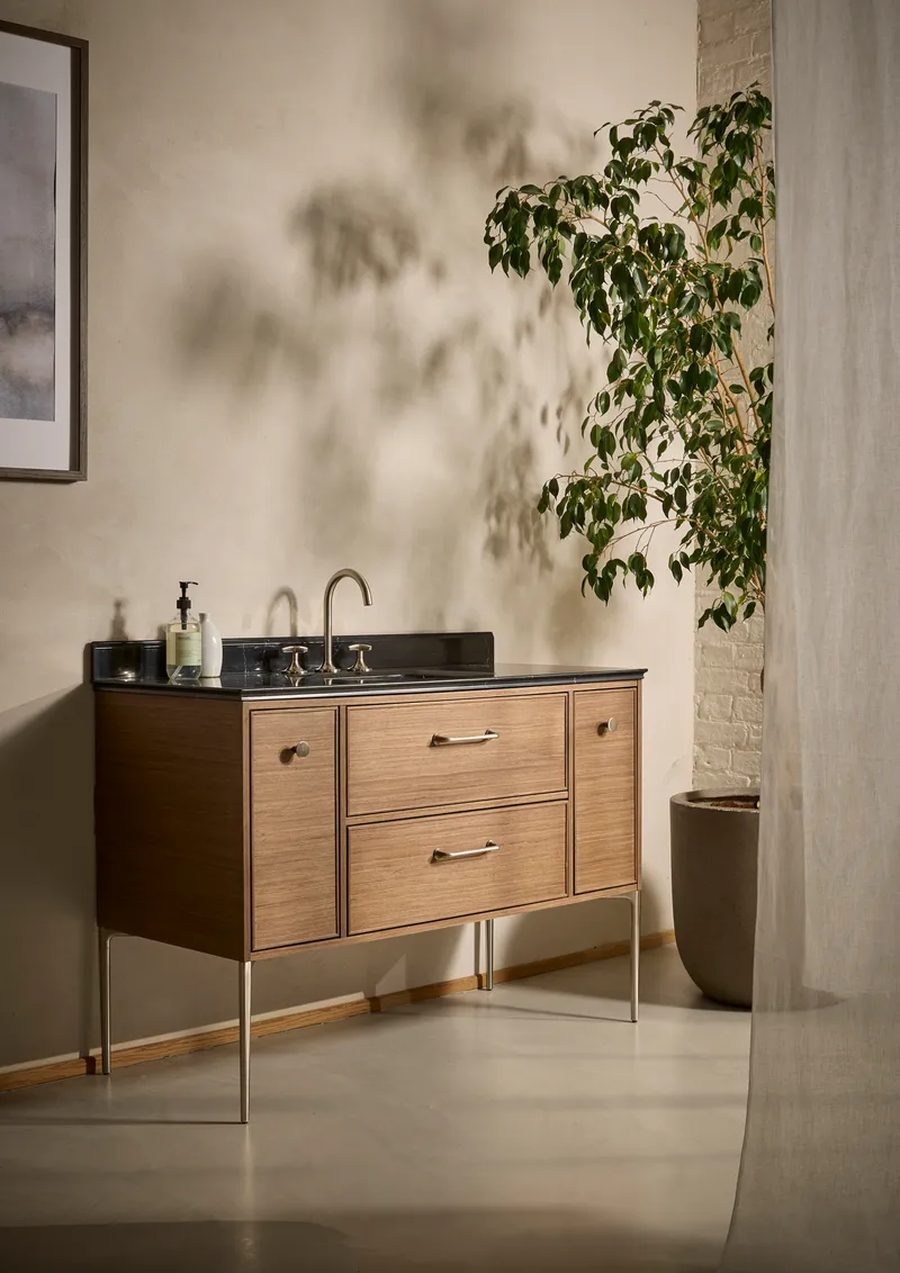
Drawer mechanism matters more than people think, on either type. The marker of a luxury vanity is a soft-close drawer on full-extension runners, taking a full load (5 to 15 kilograms depending on size) without bowing or jamming. Cheap vanity drawers run on partial-extension slides, plastic or stamped metal. Loaded daily for two years, they sag, and the drawer starts dragging on the carcass. A premium vanity uses Blum or Hettich runners with cushioned soft-close and 35-kilogram capacity per drawer. Ask the fitter which the unit uses. The difference is invisible on install day and obvious eighteen months in. The Ambiance Bain range of French-built furniture sits at the upper end of the UK luxury market: full-extension Blum runners, lacquered or veneered carcass options, bespoke widths to the millimetre. That’s the build quality a £25,000-plus bathroom is paying for.
Width and basin choice are the other core decisions. A single-basin vanity at 600 to 900 millimetres suits an ensuite or a small bathroom. Go to a 1,200 or 1,500 millimetre vanity with one wide countertop and you can run either one basin or two, which suits a family bathroom or a principal ensuite. Twin basins come from couples who use the room at the same time in the morning. They need the vanity wide enough to space the basins at 800 to 900 millimetres centre-to-centre, or the taps and waste pipes clash. The Catalano sanitaryware range includes integrated and inset basin options sized for these widths. It’s the brand we most often pair with a designer-led floating or built-in vanity on a luxury scheme.
"Storage decisions get made by default the moment the plasterer arrives. The drawing has to be on the wall before then."
03 · Above the basin
Mirror cabinets vs separate mirror plus storage
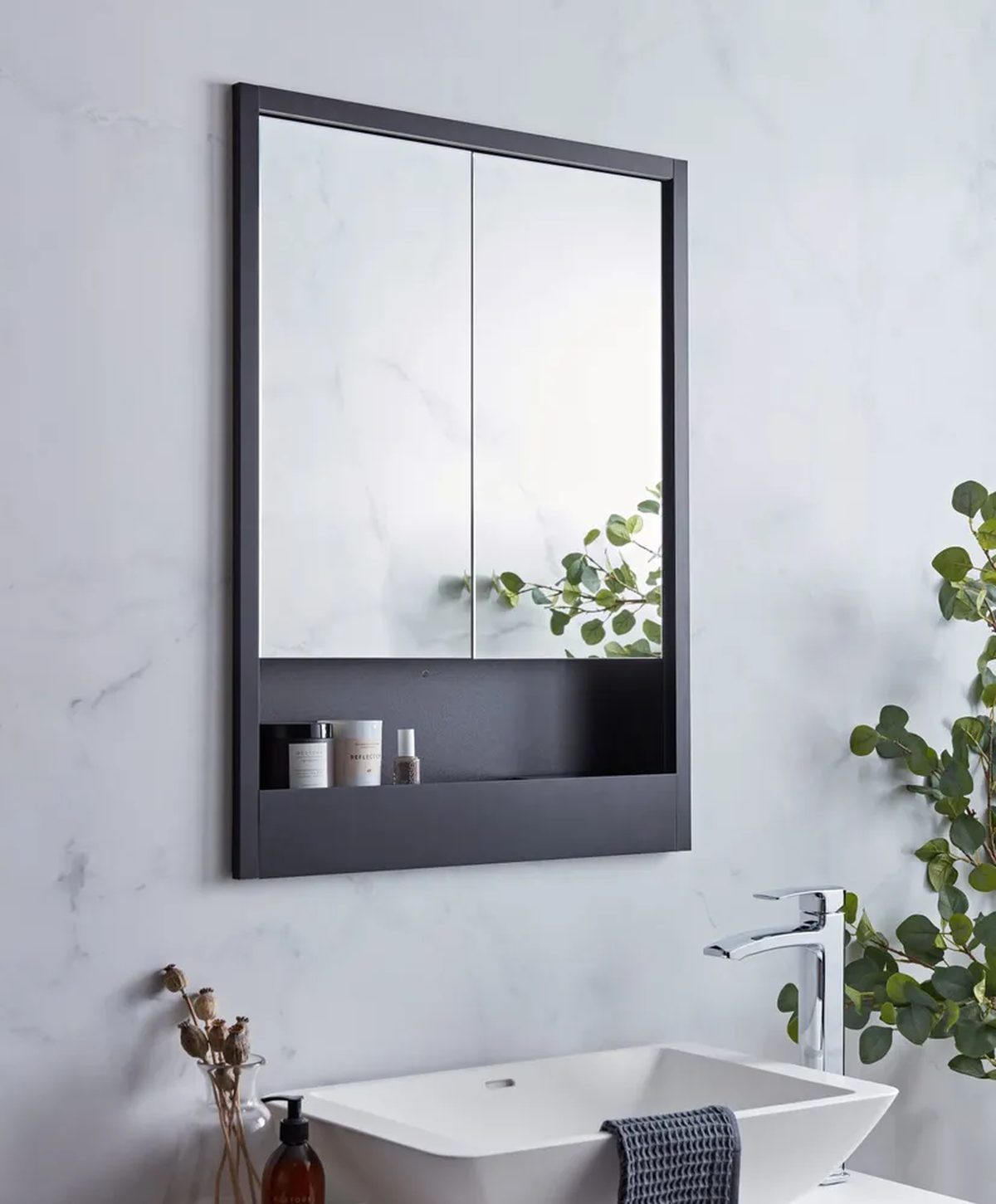
The space above the basin is the second big storage decision. You’re choosing between an integrated mirror cabinet (mirror, internal shelves, lighting, demister and shaver socket in one unit) and a separate mirror plus a tall storage column elsewhere in the room. Both of them work. They just suit different briefs.
The mirror cabinet is the workhorse of mid-to-upper luxury bathrooms, because it solves three problems at once. It puts the day-to-day items (toothbrushes, prescriptions, shaving kit, cosmetics) at hand height behind a closing door, so the visible vanity stays clear. It puts task lighting at the right height for the face, without a separate fitting cluttering the wall. And on the higher-spec models it adds more. A demister pad so the mirror doesn’t fog during a shower, a sensor switch for touchless on/off, an internal shaver socket on a 230V/115V isolating supply, and adjustable colour temperature on the LED edge light. The trade-off is depth. A quality mirror cabinet sits 130 to 180 millimetres proud of the wall once installed, which can crowd a small bathroom.
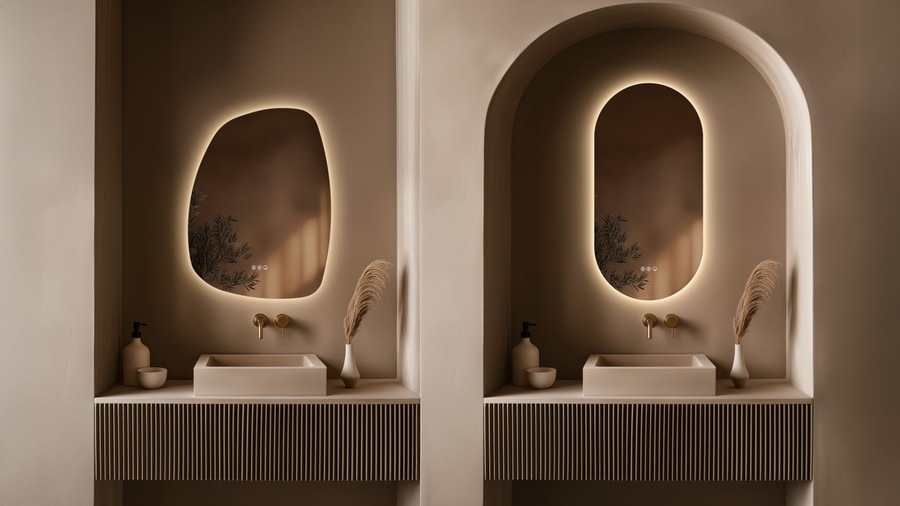
The HIB range is the backlit mirror cabinet brand we specify most, and the one we carry. It covers the Bellus, Alba, Cassini, Solas and Genesis families: various widths, IP44 ratings (suitable for Zone 2), built-in demister pads, sensor switches, and adjustable colour temperature on the higher-spec models. Pricing sits at £400 to £1,200 depending on width and feature level. That’s roughly the same order as a backlit non-storage mirror plus a budget storage column, so the cabinet earns its place on cost-per-feature.
The separate-mirror-plus-column approach suits period schemes and very tight spaces, where the cabinet depth eats too much room. It also suits any brief where the mirror needs to read as a flat decorative panel rather than a piece of cabinetry. A traditional Burlington-style mirror with a moulded frame works editorially, but it holds nothing. So the storage moves to a tall vanity-side column at 1,800 to 2,000 millimetres, which can take towels, cleaning supplies, the medicine cabinet contents and decorative pieces in one coherent unit. That column has to be on the layout drawing before any plumbing is run, because it constrains where pipes can rise on the wall behind it.
Mirror-cabinet placement matters for the lighting plan as much as the storage plan. If the cabinet falls within Zone 2, 0.6 metres beyond the bath or shower’s Zone 1, the integrated lighting must be IPX4 minimum, and like every bathroom circuit it needs 30mA RCD protection per BS 7671:2018+A4:2026. The cabinet’s internal shaver socket must also be IP-rated and isolating-transformer protected. Most are, but check the spec sheet. For a fuller picture of how the cabinet fits the bathroom lighting layers, see our luxury bathroom lighting design guide. At the vanity, the task layer is usually the cabinet doing double duty: storage and primary face-light.
04 · Wet-zone storage
Niches — wet-zone storage that earns its place
The recessed shower or bath niche is the storage move that most lifts a wet zone. It’s a tiled-in shelf set into the wall, sized for shampoo bottles and razors, that stops the products living on the shower-tray edge or wedged on the brassware. It’s also the storage move most often built badly. Three things have to be right: the dimensions, the placement and the tanking. Get any one of them wrong and the niche is either useless or a future leak point. We go through all three, plus how the tiles line up, in our shower niche guide.
Start with depth. Internally, 90 to 120 millimetres is the sweet spot. Deep enough for a shampoo bottle on its long edge, shallow enough to fit between standard 100-millimetre studwork and the tile thickness without breaking through to the next room. Width depends on use. Allow 300 to 450 millimetres for a single product cluster, or 600 to 1,200 millimetres for a long horizontal recess that holds the whole household’s products at one height. Height matters more than people expect. The niche bottom edge should sit 1,000 to 1,200 millimetres above the shower tray, which puts the contents at comfortable hand height for an average adult. Lower than 900 millimetres and you’re bending awkwardly to reach it. Higher than 1,400 millimetres and the shorter people in the house can’t reach at all. Twin niches at different heights work well for mixed-height households, and they look intentional rather than makeshift.
Placement against the showering position matters too. The niche should sit on a wall you face or reach naturally, usually the side wall opposite the showerhead. Never the back wall behind a fixed showerhead: the soap just runs into it. On a walk-in shower with a glass screen, the niche shows from outside and becomes a feature. On a wet room, it reads as part of the architecture. We’ve covered the wider trade-off between the two in our wet room vs walk-in shower guide. The niche question sits inside that decision, because how you build the niche depends on what the wall behind it supports.
The tanking is where most niches fail. The niche cuts a hole in the studwork, and that hole has to be fully waterproofed before any tile goes on. Typically that means lining the back, sides and base with waterproof tanking board (Schlüter Kerdi-Board, wedi or equivalent), sealing every joint and internal corner with the sealing products made for that system, then sealing it to the surrounding wet-zone tanking. Skip it and you’ve bought one of the most expensive forgotten details in a wet zone. A leaking niche shows up as damp staining on the ceiling below. Usually twelve to eighteen months in. The rework means stripping out the tile, the niche lining and the leaking studwork, then re-plastering the room underneath. No Building Regulation in England specifically requires tanking; it’s best practice, with codes of practice including BS 5385 giving guidance rather than law. The principle is simple. Any wet-zone construction must be waterproof, drainable and durable for the design life of the room.
For wider context on bathroom waterproofing (what tanking involves, the products that work, where the regulations sit), see our guide on what bathroom tanking is. The niche is the smallest-format version of the same principles that govern the whole wet zone.
05 · Behind the WC
The concealed cistern — back-of-WC storage
A wall-hung WC on a concealed-cistern frame is now the default specification on a designer-led luxury bathroom. It does three things a close-coupled WC can’t. It clears the floor under the pan for cleaning, it lifts the visual line off the floor so the room feels larger, and it creates a natural service void behind the wall that becomes useful storage. The cistern frame itself sits 820 millimetres tall and 200 millimetres deep behind the pan. Add a 200-millimetre service void around it and you get a tiled or panelled duct above and beside the cistern, containing the plumbing and giving you a horizontal shelf at a convenient height.
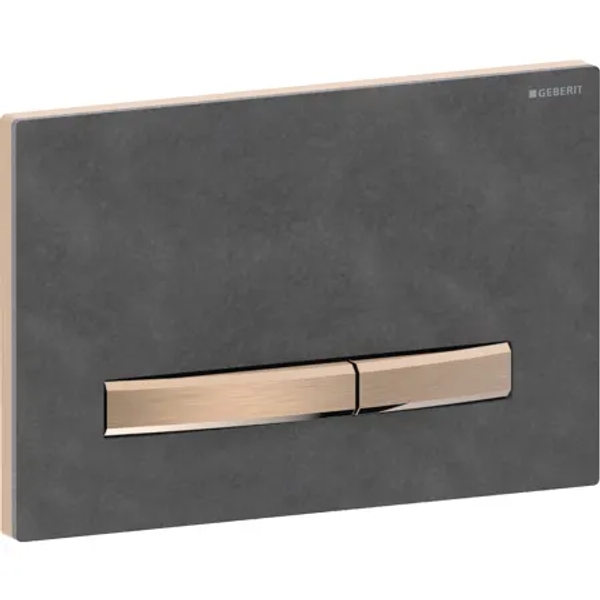
The Geberit Duofix range is the most widely specified concealed-cistern frame in the UK luxury showroom market. It comes in standard 820mm or low-height 720mm versions, with flush-plate options including the Sigma series in chrome, brushed brass and matt black. The frame supports the WC pan to a typical 400-kilogram static load, well above any realistic user weight. The cistern itself uses a dual-flush mechanism at 6/3 litres or 4.5/3 litres, which meets Approved Document G water-efficiency targets (125 litres per person per day, or 110 litres per person per day for the optional tighter standard). Geberit AquaClean is the integrated bidet-WC option where the brief includes washlet functionality.
The maintenance access panel is the detail most often forgotten, and the most expensive to forget. The Water Supply (Water Fittings) Regulations 1999 and the cistern manufacturer’s own installation guidance both require the cistern to stay accessible for maintenance. The flush mechanism, the inlet valve and the dual-flush actuator all need reaching if something faults. In practice the flush plate is the access panel: take the plate off and you reach the cistern internals through a service opening. So the plate has to be one of the manufacturer’s own designs, because most third-party plates don’t fit the access opening. It has to come off without specialist tools. And the surrounding tiling has to let it come off without cracking a tile. Tile-edge profiles around the flush plate get planned at the tiling stage. An over-tight tile cut around the plate is the most common cause of cracked tiles during a later flush-mechanism repair.
The duct above the cistern, typically at 1,000 to 1,100 millimetres above floor level, is where the storage payoff sits. Build it 200 to 250 millimetres deep and the duct top becomes a useful shelf for towels, decorative pieces, or a recessed niche with integrated lighting. The same regulatory framework as the shower niche applies. Any niche construction must be waterproofed if it sits in a wet zone, and any integrated electrics (LED strip, sensor light) must comply with BS 7671:2018+A4:2026 zoning rules. The duct itself is a tile-on-tanked-plywood detail with a fully sealed back face to the cistern void.
One detail to flag: bidet outlets. If the brief includes a separate bidet next to the WC, rather than an integrated washlet WC like the Geberit AquaClean, the bidet plumbing rises through the same wall as the cistern. Which means the plumbing run has to be coordinated with the duct construction, and the duct construction with the storage detail above. All of it has to be on the drawing before the plumber starts first-fix. The fitter can’t make this up on the day.
06 · Family use
Towel and laundry storage in family bathrooms
The family bathroom has a different storage brief from the principal ensuite. Multiple users, multiple towel sizes, daily laundry volume, and everything has to be reachable by a child as well as an adult. The vanity, mirror cabinet and niches cover the cosmetics and the products. Towels and laundry are the third leg of the stool, and the one most often hand-waved at brief stage.
Towel storage breaks into three categories. There’s the heated rail for drying after use, the folded-towel storage for clean towels in rotation (a linen cupboard, in effect), and the hand-towel storage, which is smaller, basin-side and changed more often. A single 600x1,200 millimetre rail in chrome or brushed-finish steel takes four to six bath towels, and it runs off the central heating circuit or an electric element. If more than two people use the room regularly, add a second rail or a vertical ladder rail at 500x1,800 millimetres. The rail position belongs on the layout drawing, because the plumbing run (or the electrical spur, on an electric-element rail) has to be there at first-fix.
Folded-towel storage is where the brief opens up. A family bathroom needs volume: eight to twelve folded bath towels in active rotation, plus hand towels and face cloths. The vanity carcass typically holds two or three towels in one drawer, so the rest has to live somewhere else. Three approaches work here. A tall storage column at 1,800 to 2,000 millimetres beside the vanity holds eight to twelve folded towels across three or four shelves. A built-in alcove with shelf inserts, usually set into the wall above the cistern duct or in a redundant corner, holds the same volume more architecturally. Or you integrate a laundry-hamper-and-shelf combination into the vanity itself, with a drawer-front pull-out at the base and drawers above, which does both jobs at once on a unit wide enough to take it.
Laundry matters more in the family bathroom than in the ensuite, because the volume is daily rather than weekly. A pull-out hamper integrated into the vanity is the cleanest design solution: typically a 400-millimetre-wide drawer with a removable fabric liner. A freestanding hamper in the corner is the fallback. The integrated version has to be on the drawing, because the carcass has to accommodate the hamper height (600 to 700 millimetres internal) and the door-front detail has to match the rest of the vanity. The freestanding version is more flexible, but it eats floor area a small bathroom can’t spare.
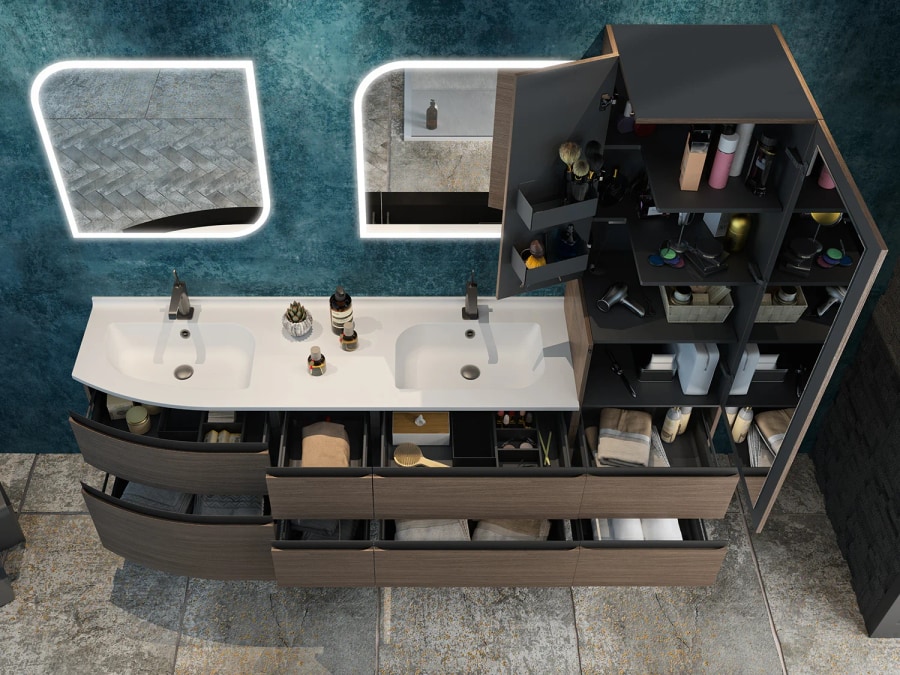
The Roper Rhodes furniture range includes pull-out laundry baskets and tall storage columns sized for UK bathrooms, in finishes that match a luxury vanity scheme without going to bespoke joinery prices. On a family bathroom the integrated hamper earns its place. On a couples-only ensuite, the freestanding alternative is fine. We've collected the wider ensuite decisions, master and guest, in our ensuite bathroom ideas guide.
07 · Regulations
BS 7671:2018+A4:2026 — in-cabinet electrics
Any storage piece with integrated electrics falls under the same regulatory framework as the rest of the bathroom wiring. That covers the mirror cabinet with its LED edge light, the internal shaver socket, the demister pad, the sensor switch, an under-vanity LED strip, an integrated cove light. The governing standard is BS 7671:2018+A4:2026, the IET Wiring Regulations, 18th Edition, sitting underneath Approved Document P (Electrical safety, dwellings, 2013 edition). Amendment 4 took effect on 15 April 2026, and Amendment 3 stays valid until it’s withdrawn on 15 October 2026. One point still trips people up: Zone 3 has been removed. There are three zones now, Zone 0, Zone 1 and Zone 2, and plenty of older UK guidance still writes as though Zone 3 is one of them. It isn’t one of them.
The zones are defined by proximity to water:
- Zone 0: inside the bath or shower tray. IPX7 minimum, SELV 12V maximum. Almost nothing in a luxury bathroom storage scheme belongs here.
- Zone 1: directly above the bath or shower tray, up to 2.25 metres above finished floor level. IPX4 minimum, 30mA RCD on the circuit. Storage in this zone is rare but not impossible, a recessed shower niche with an integrated LED strip being the obvious case.
- Zone 2: extending 0.6 metres horizontally beyond Zone 1 around a bath or shower tray; there is no separate zone around a basin. IPX4 minimum. Storage with integrated electrics can sit here when the basin is near the bath or shower: the mirror cabinet above the basin, the sensor switch on the vanity, the demister pad, the internal shaver socket.
Beyond Zone 2 you can use standard fittings, but the whole bathroom circuit still needs 30mA RCD protection. That part is non-negotiable. BS 7671:2018+A4:2026 makes RCD protection mandatory on every circuit serving a bathroom, storage-integrated circuits included, with no opt-out. A modern consumer unit with RCBOs meets it: one combined MCB and RCD per circuit. An older split-load unit may need rewiring, which is a survey item your electrician should pick up on the first visit.
That has two practical implications for storage. First, every storage piece with integrated electrics needs an IP rating matched to its zone. The mirror cabinet, the LED strip, the demister pad: confirm each one on the spec sheet before you order anything. Reputable bathroom-specialist brands publish IP ratings on every product page. HIB, Roper Rhodes and Origins Living all do. If the spec sheet doesn’t list a rating, the fitting probably isn’t IPX4 and probably isn’t for a bathroom at all. Second, the cabling for storage electrics has to be on the layout drawing before plaster, because retrofitting a sensor switch or an internal shaver socket means surface trunking or hacking plaster off. Both fail the luxury bar.
For the wider compliance picture covering Approved Documents G (water and sanitation), L (energy), M (accessibility), P (electrical) and T (toilet accommodation), plus BS 7671:2018+A4:2026, see our UK bathroom regulations 2026 guide.
08 · Investment
Storage budget — what £1,500 to £8,000 buys
Storage on a designer-led luxury bathroom sits realistically between £1,500 and £8,000 all-in: the vanity, the mirror cabinet, niche detailing, towel and laundry storage, the in-cabinet electrics, fittings and product before installation labour. That’s a meaningful share of a £25,000 to £40,000 luxury bathroom budget. It’s also one of the highest-impact lines on the spec sheet, because the storage decisions show on every single day you use the room. Roughly, the breakdown:
- Vanity unit, designer-led floating or built-in with soft-close drawers, full-extension Blum or Hettich runners, lacquered or veneered finish. Single basin: £700 to £2,200. Double basin or 1,500-millimetre+ widths: £1,500 to £3,500.
- Mirror cabinet with integrated LED, demister pad, sensor switch, internal shaver socket, IPX4-rated for Zone 2: £400 to £1,200. Or a separate backlit mirror plus a tall storage column: £600 to £1,500 combined.
- Niches (per niche), tanking, lining and tile finish: £150 to £400 in materials, plus tiler labour at typically £200 to £400 per niche on top of the base tiling. Bigger horizontal niches sit at the upper end.
- Concealed-cistern frame plus duct construction. A Geberit Duofix frame at £200 to £450, plus duct plywood, tanking and tile to match the room scheme: £500 to £1,200 all-in.
- Towel storage, heated towel rail at £150 to £600, tall storage column at £300 to £900: £450 to £1,500 combined.
- Laundry storage, whether an integrated pull-out hamper inside the vanity or a freestanding bespoke piece: £100 to £600.
- In-cabinet electrics, meaning cabling, internal shaver socket, RCD spur and sensor-switch wiring (electrician parts and labour): £200 to £500 on top of the storage product cost.
On top of the product cost, expect the carpenter or fitter to charge £500 to £1,200 to install a mid-to-upper-spec storage scheme. That covers bracket-mounting the floating vanity, levelling it on a wall that may not be perfectly true, fitting the mirror cabinet, building the cistern duct, and coordinating with the tiler and electrician on niche detailing and cabling. Bespoke joinery pushes the total well above £8,000: full-wall fitted storage, custom-recessed shadow-gap niches, integrated laundry baskets to a non-standard width. It’s a different supply chain, built to drawing rather than ordered from a catalogue.
Storage is the line homeowners most often try to economise on. It’s also the line that produces the most-cited regret afterwards. Save £400 by taking a basic mirror panel instead of a mirror cabinet and you look at the day’s clutter for the next ten years. Save £200 by dropping the shower niche and you get shampoo bottles on the tray edge for the design life of the room. Storage is one of the few places where a marginal £500 buys a visible upgrade. For the broader question of where the money should go across the whole room, read our guide on what a luxury bathroom actually costs in the UK.
Bowmans benchmarks product pricing on the storage furniture we supply against the major UK online retailers, the same as we do on sanitaryware and brassware. The design service that draws the storage scheme onto the layout drawing is included. There’s no separate fee for it, and no margin uplift on the storage product to fund it. Work with us through a full bathroom design appointment and the storage plan goes onto the same drawing as the layout. The spec sheet lists every piece with its IP rating and its Building Regulations zone compliance. And the fitter gets the package as a build-ready document.
Frequently asked questions
The questions UK homeowners ask before signing off a luxury bathroom storage plan.
What’s next
Want a storage plan on your own bathroom?
Storage is one of the few areas of a bathroom where designed-up-front and added-after produce visibly different rooms. Without a drawing, the cabling, tanking and structural decisions all get made by default. If you’re planning a luxury bathroom and want the storage on the layout drawing from the start, the design appointment is where that happens. Our product pricing on the furniture and storage we supply benchmarks against the major online retailers, so the design work comes alongside the kit rather than on top of it.
That first appointment happens at our Braintree showroom on the Springwood Industrial Estate, or at our Leigh-on-Sea showroom. Bring your measurements, some photos, and any reference images for the look you’re after. We’ll walk through how the storage scheme sits in your specific room, and what the fitter, electrician and tiler will need on the documentation.