Bowmans · Inspiration · Design

Is a bathroom designer worth it? An honest answer from a luxury showroom

By Jonathon Barclay, Founder 17 min read

"A designer seems overkill — but I'm worried about expensive mistakes if I don't use one." A version of that question lands in our showroom inbox almost weekly, and we see it on Mumsnet most months. The honest answer is more interesting than "yes" or "no" — and most articles on this topic dodge it. We're not going to.

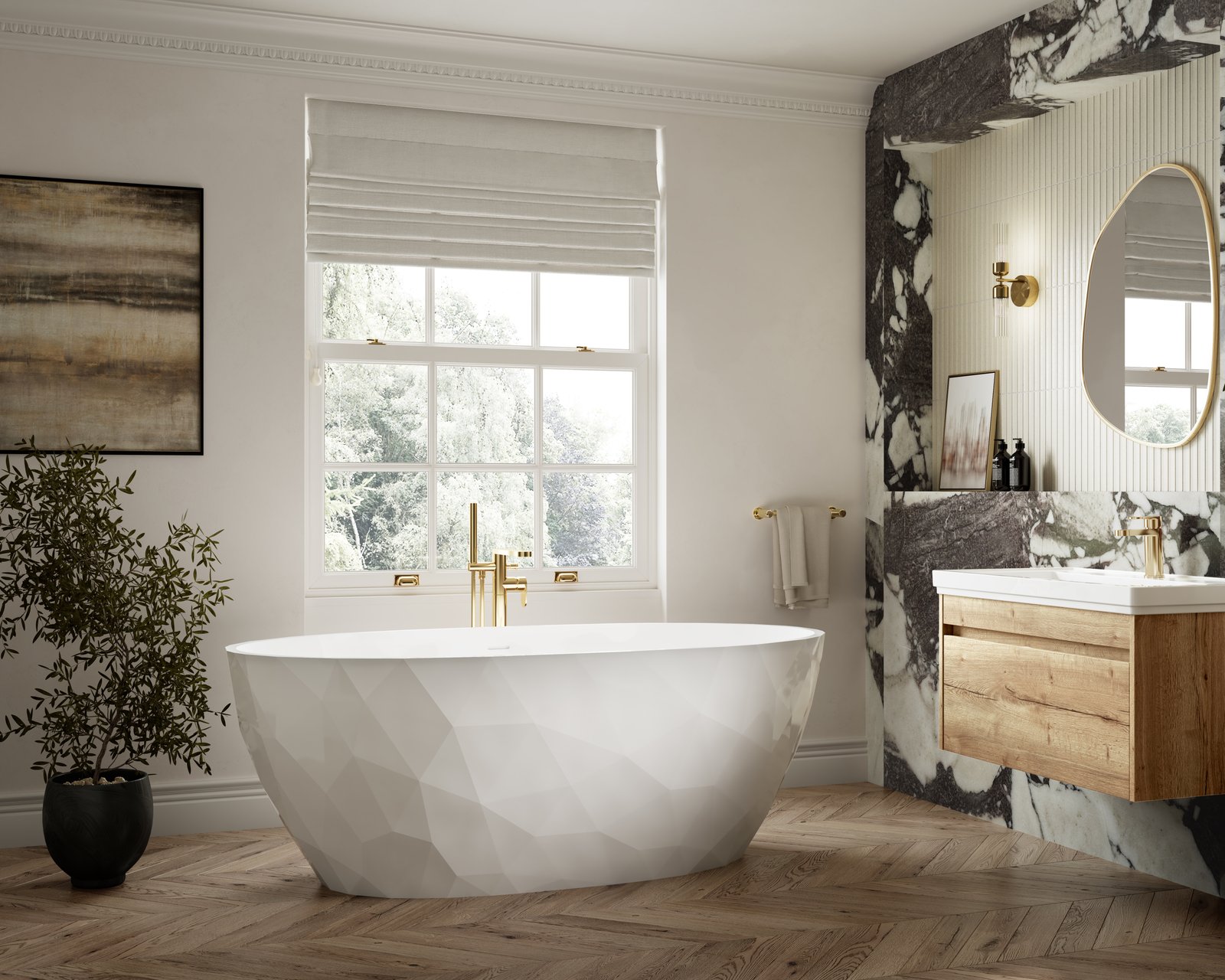
Designer-led luxury bathroom scheme — BC Designs Aurelius faceted freestanding bath, dramatic veined marble feature wall, walnut floating vanity with white basin, oak herringbone parquet floor, gold floor-mount bath filler, period sash window with linen blind — the kind of material specification a designer assembles before a single product is ordered
Faceted freestanding bath, veined marble, walnut joinery, gold tap, herringbone parquet — material coordination assembled in advance, not on site.

01 · The role

What does a bathroom designer actually do?

A bathroom designer produces four real outputs: a measured layout drawing, a full product specification sheet, a walkable 3D render, and a single point of accountability for whether all those products work together. Everything else they do is in service of those four things.

The layout drawing is the floor plan with every fitting placed to scale, including soil-pipe positions, joist runs, window reveals and door swings. The specification sheet is the line-by-line list of products — brassware codes, sanitaryware model numbers, tile SKUs, light fittings, electrical accessories, even the silicone colour. We typically produce a 60–120 line spec for a standard luxury bathroom; the longer the list, the fewer the surprises on site. The 3D render lets you walk through the room before a single tile is ordered, which catches the "I didn't realise the towel rail would block the radiator valve" problems that Pinterest mood boards never reveal.

Single-point-of-accountability is the bit most readers underestimate. When the brassware, the cistern, the tap aerator, and the water pressure are all signed off by the same person, there's no finger-pointing if something doesn't work on install day. Buy your shower head from one website, your valve from another, and your tray from a third — and when the assembled kit dribbles or leaks, every supplier blames the others. A designer-led showroom is responsible for compatibility, not just aesthetics; you call one number, not three.

What a bathroom designer usually doesn't do for free: site management, weekly progress visits, snagging visits, or warranty admin after handover. Those are typically charged separately at luxury showrooms, even when the design itself is included in the product price. We'll come back to that under "free design" below.

If you want a fuller breakdown of what's included end-to-end, we've written it up under our bathroom design service.

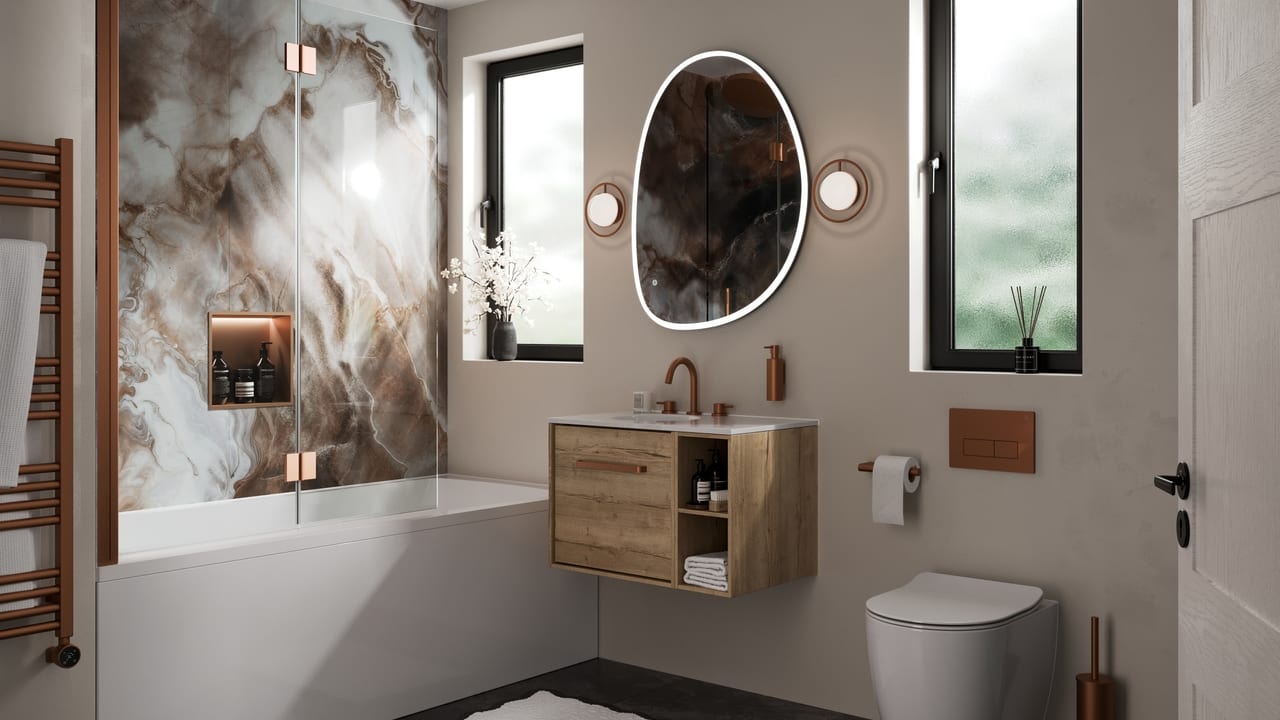
Coordinated Crosswater scheme — bronze marble shower wall, walnut floating vanity, bronze brassware throughout, oval backlit mirror in the same finish — every element specified to match before any product is ordered
Designer coordination at the finish-level — marble, walnut joinery, bronze brassware and matching mirror all signed off as a single specification.
"Most articles on this topic say always use a designer. We disagree."

02 · Cost

How much does a bathroom designer cost in the UK?

There are three pricing models in the UK market. Fee-based independent designers charge £500–£3,000 for a design-only package, then leave you to buy products separately. Margin-funded showroom designers — the most common model — don't charge a design fee because list prices sit a touch above online retailers; the design is paid for through product mark-up. Online-priced designer-led showrooms — much rarer — match the major online retailer prices on products and treat the design service as an added value the business absorbs. Bowman sits in the third category, which is why "is a designer worth it" needs a different answer here than it does at a typical luxury showroom.

Fee-based independent designers are best if you want product-agnostic advice — they'll specify across any supplier with no incentive to push particular brands. The downside is you pay twice: once for the design, again for the products at retail (or near-retail) margins from a separate supplier. Independent designers also rarely take responsibility for the build phase, so you become the project manager between the designer, the supplier and the fitter. Homeowners on UK property forums describe this fragmented model as failure-prone — items that won't work together, lead-time clashes, finger-pointing on install day.

Margin-funded showroom designers are the default model across most UK designer-led showrooms. The showroom doesn't charge a separate design fee because the cost is folded into product margin. That model produces excellent design — but it does mean the products you buy carry a built-in design subsidy, so list prices typically sit somewhere between RRP and online retailer pricing. The right way to test it: ask any showroom what their pricing looks like compared to Drench, Victorian Plumbing, or the supplier-direct sites. If the answer is vague, the design isn't really free.

Online-priced designer-led showrooms — much rarer — match the major online retailer prices and absorb the design service as added value the business carries. Bowman is one. That changes the maths of "is a designer worth it" entirely: you're not paying a design premium and getting design value back; you're paying online prices and getting the design service alongside.

2026 UK luxury bathroom project bands

Tier Investment What's typical
Entry designer-led £10,000 – £18,000 Mid-spec brassware (Crosswater MPRO), single freestanding bath, porcelain tile
Standard luxury £18,000 – £35,000 Hansgrohe Axor or Crosswater Union brassware, large-format porcelain or natural stone, freestanding bath + walk-in shower, bespoke vanity, UFH
Bespoke principal suite £35,000 – £60,000+ Catalano sanitaryware paired with Hansgrohe Axor brassware, book-matched Ca’ Pietra stone slabs, smart WCs (Geberit AquaClean), integrated lighting and audio

Source: kbbreview Bathroom Designer of the Year category structure (£30k+ category cap), industry-standard 2026 supplier pricing

The kbbreview Bathroom Designer of the Year award has a dedicated category for projects over £30,000 — which gives you the trade press's working definition of where "luxury" actually starts in 2026. We've broken the cost question down further in our UK luxury bathroom cost guide, including line-by-line breakdowns for £15k, £25k and £40k+ specifications.

For comparison: the Houzz UK 2025 Bathroom Trends Study reports a median primary-bathroom spend of around $15,000 (USD), so most UK bathroom renovations sit below the bottom of the luxury band. If your spend is under £8,000, you almost certainly don't need a designer — you need a good fitter. If you're at or above £18,000, the case for a designer gets considerably stronger.

Three schemes across the tiers

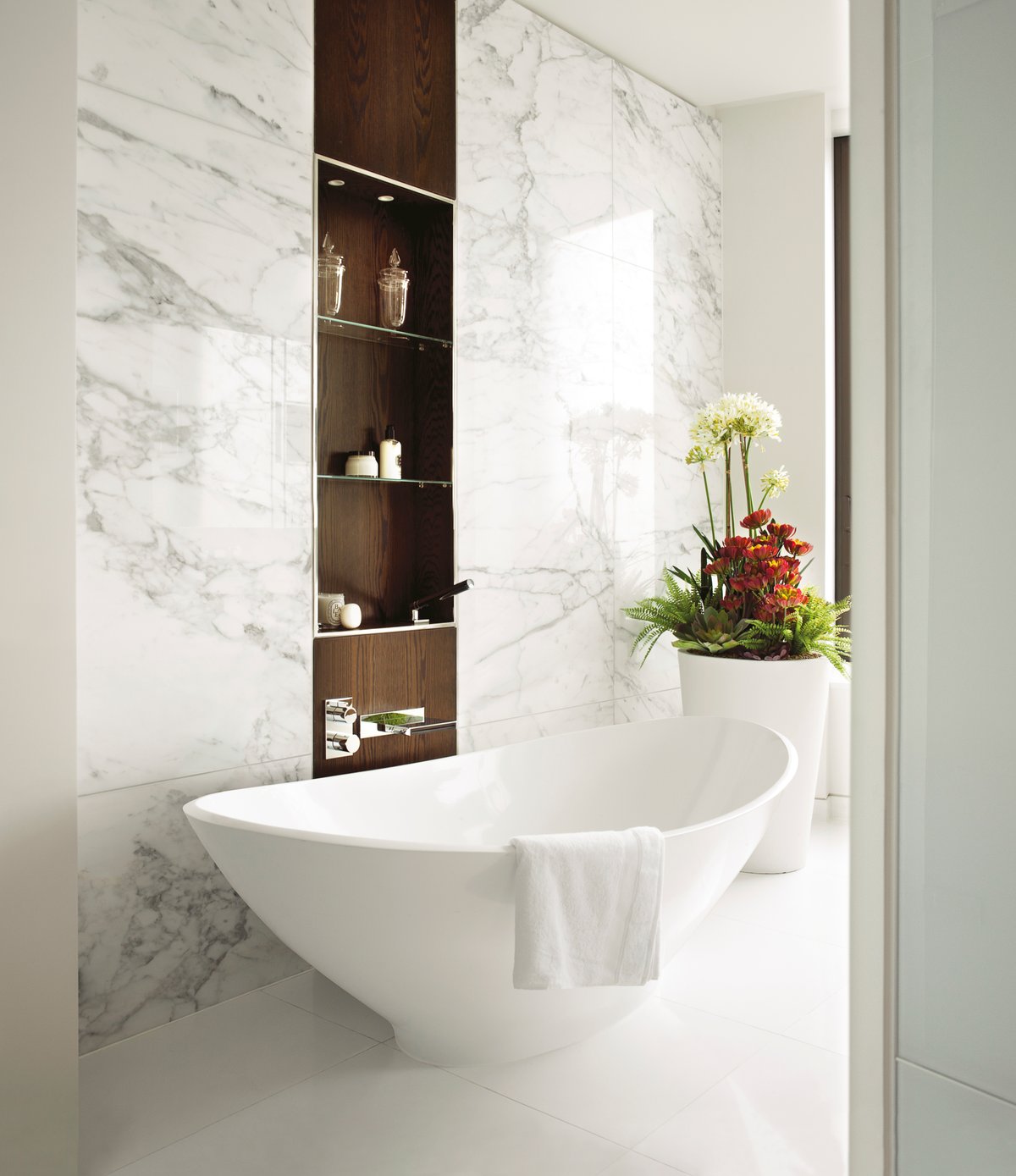
Compact luxury bathroom scheme — Calacatta marble feature wall, dark walnut storage niche, BC Designs Aurelius freestanding bath, chrome wall-mounted basin mixer
Entry designer-led — compact luxury
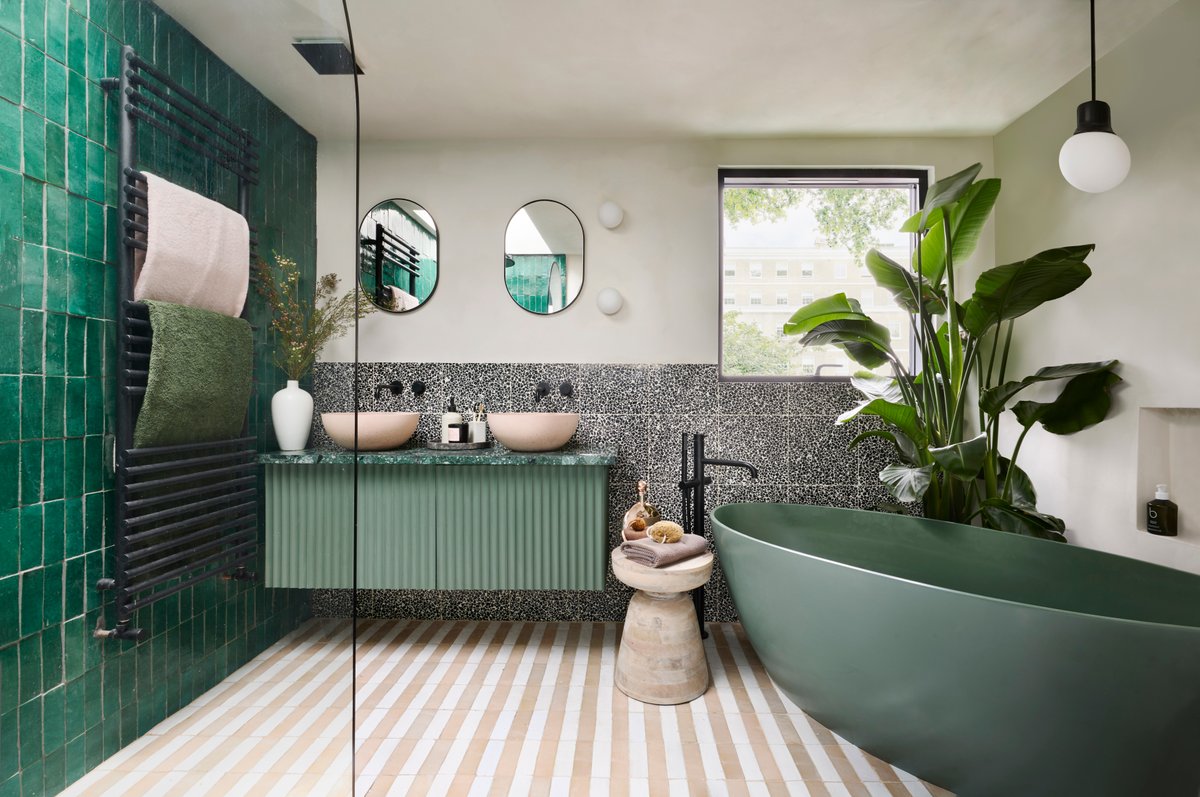
Standard luxury bathroom scheme — green-panelled ribbed vanity, painted green BC Designs freestanding bath, emerald metro feature wall, terrazzo splash zone, matte black brassware, twin oval mirrors
Standard luxury — statement scheme
Bespoke principal suite scheme — Catalano premium sanitaryware, large-format stone walls, freestanding bath, integrated lighting, signature designer joinery
Bespoke principal suite

28%

UK homeowners hire a designer

89%

Hire a professional of some kind

£30k+

Where 'luxury' actually starts

Houzz UK 2025 Bathroom Trends Study · kbbreview 2026

03 · The honest version

How free is "free" bathroom design, really?

At most UK designer-led showrooms, "free design" is funded by product mark-up — the design service costs the showroom money to run, and the cost is recovered through the prices you pay for the products. That isn't dishonest; it's the industry-standard model. But it does mean "free" sits in air-quotes — you're paying for the design through the prices, not through a separate invoice.

Bowman is a deliberate exception. We benchmark our product pricing against the major online retailers — Drench, Victorian Plumbing, the supplier-direct sites — and don't recover the design cost through margin. The design is treated as added value to the business, not a paid acquisition cost folded into list prices. The framing we use with our clients is straightforward: you can buy your bathroom from any online retailer at roughly the same price as us; the difference is everything that comes alongside the products — the design, the spec checking, the spatial verification, the curated kit, a single number to call when something goes wrong on install day.

That changes who the service is for. Margin-funded showrooms have to qualify clients hard — designer time is the cost, products buy it back. We're more relaxed about the qualification because we're not subsidising the design through your basket. Even so, if you're shopping designers as a commodity and plan to source elsewhere, we'd rather you went to an independent fee-based designer — they're set up for that, we aren't.

✓ Included in 'free'

  • Initial showroom appointment (60–90 min)
  • Site visit and measure (in most cases)
  • CAD floor plan and elevations
  • 3D render
  • Full specification sheet
  • Supplier sourcing across the brand list
  • Project programming (lead times, sequencing)

✗ Usually charged separately

  • Weekly site management visits during install
  • Trade coordination if you're using your own fitter
  • Snagging visits after handover
  • Bespoke joinery design outside standard range
  • Variations after sign-off (each round costs designer time)

A standard luxury bathroom design takes 8–15 hours of designer time from first appointment to final spec. That's a real cost to the business — a cost we don't claw back through product mark-up, which is why we'd rather have one serious appointment than three speculative ones. There's no contractual obligation to buy from the showroom that designed your bathroom; equally, if you take the design, walk away, and source the same brands from a discounter, expect that to end the relationship.

If you're considering whether our free design service is right for you, the honest test is: are you 70%+ likely to buy products from us if the design works? If yes, book the appointment. If you're shopping designers as a commodity and plan to source elsewhere, an independent fee-based designer will give you better-aligned incentives.

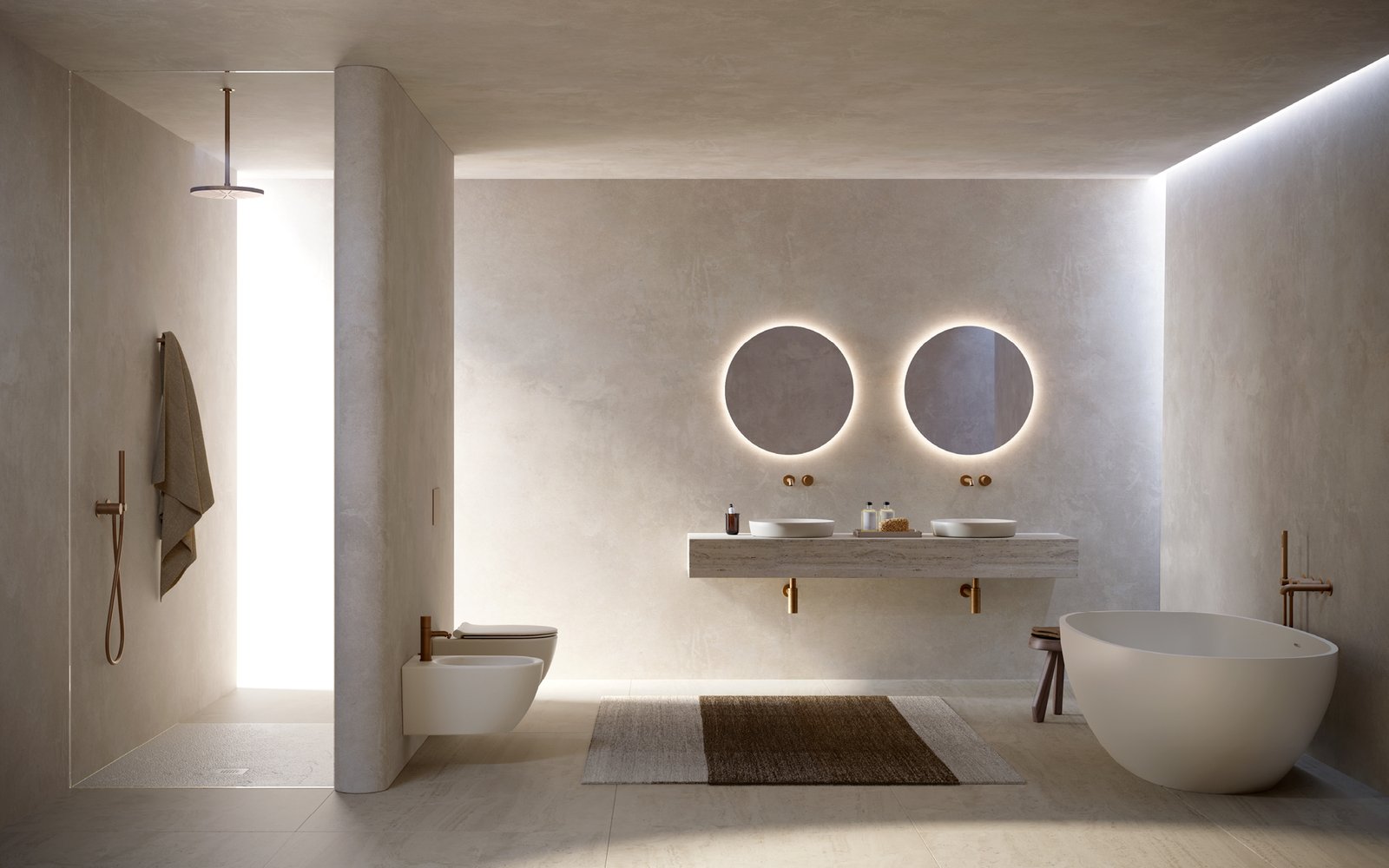
Travertine-plaster luxury bathroom scheme — Catalano Lino sanitaryware, double basin on a stone vanity, brushed brass brassware, walk-in shower with overhead rainfall, ceramic freestanding bath, integrated cove lighting — the kind of materials and finish coordination a designer assembles before any product is ordered
Catalano Lino in a brushed-brass-and-travertine scheme — the sort of finish coordination decided in the showroom appointment, before a single product goes on order.

04 · Roles

Bathroom designer vs bathroom fitter — what's the difference?

A bathroom fitter installs the products listed on a specification sheet. A bathroom designer writes the specification sheet. They're not the same job, and most of the disasters we get asked to fix are projects where one person was asked to do both.

A good fitter knows how to plumb, tile, wire (within Part P limits) and finish a bathroom to a high standard. What a fitter usually doesn't do — and shouldn't be expected to do — is select brassware compatible with your home's water system, ensure the cistern model fits the recess depth before you knock through, calculate whether the freestanding bath weight requires joist reinforcement, or check that the tile range you've picked has matching cove and corner trims in the same dye lot. Those are designer jobs, and a fitter who tries to do them on the fly often gets at least one wrong.

Who decides what?

The job Designer Fitter
Choosing brassware compatible with water system
Verifying cistern depth fits the recess
Calculating joist load for freestanding bath
Plumbing the products
Tiling and finishing
Part P-compliant electrics
Accountability if the products don't fit ✓ in integrated model

The integrated designer-installer-products model — one team accountable for the whole stack — is what designer-led showrooms typically offer. The fragmented model is what most homeowners end up with by accident: spec the products themselves from Pinterest, hire a fitter on price, hope it all works on day one. The fragmented model is the most common cause of preventable failure on UK home renovation forums — items that don't fit together, lead-time clashes, and one trade blaming another.

When fitter-only is genuinely fine: like-for-like swaps where every product replaces an existing fitting in the same position, you've already chosen everything (or you're using the showroom's online configurator without a designer), and you're confident about what you want. Standard rectangular family bathroom, mid-spec products, no plumbing relocation — a competent fitter on day rate will deliver a perfectly good result.

When fitter-only goes wrong: anything involving moving the WC stack, relocating the bath, adding a wetroom, or speccing brassware on a gravity-fed water system. We've seen brand-new £180 monobloc taps installed against a cylinder system with 0.5 bar pressure, dribbling cold water at full open. That's a designer-prevented mistake, not a fitter-prevented one.

For projects where we handle both — design and supply, with a vetted installer network — the workflow is described on our installation page.

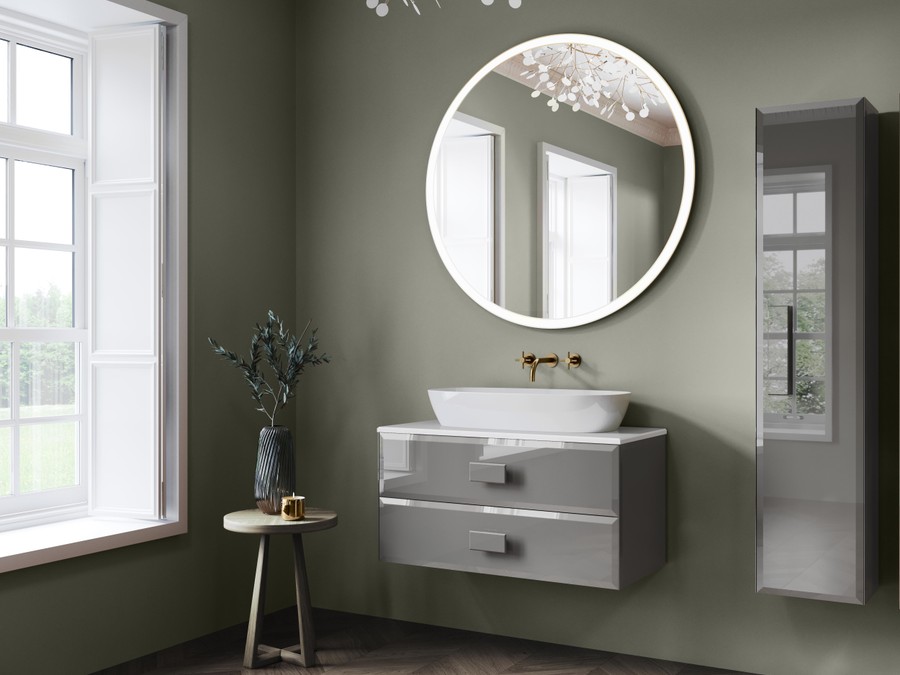
Designer-led layout — olive-green walls, oversized round backlit mirror, grey gloss vanity with vessel basin, brushed brass wall-mount tap, parquet floor — the designer's call on mirror size, tap reach and finish coordination
Designer · sets the layout
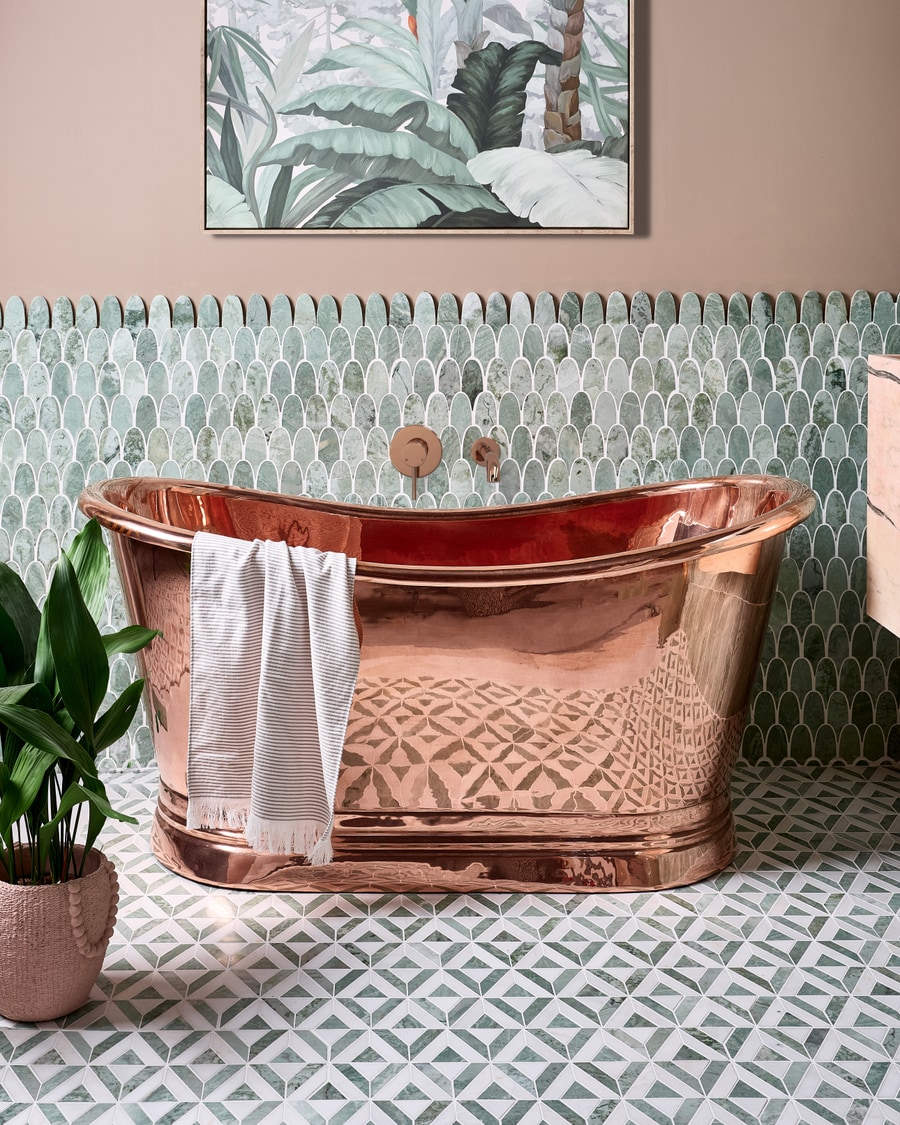
Ca' Pietra East Java marble mosaic detail — installed to the designer's specification, every grout line and edge profile signed off in advance
Fitter · executes the spec
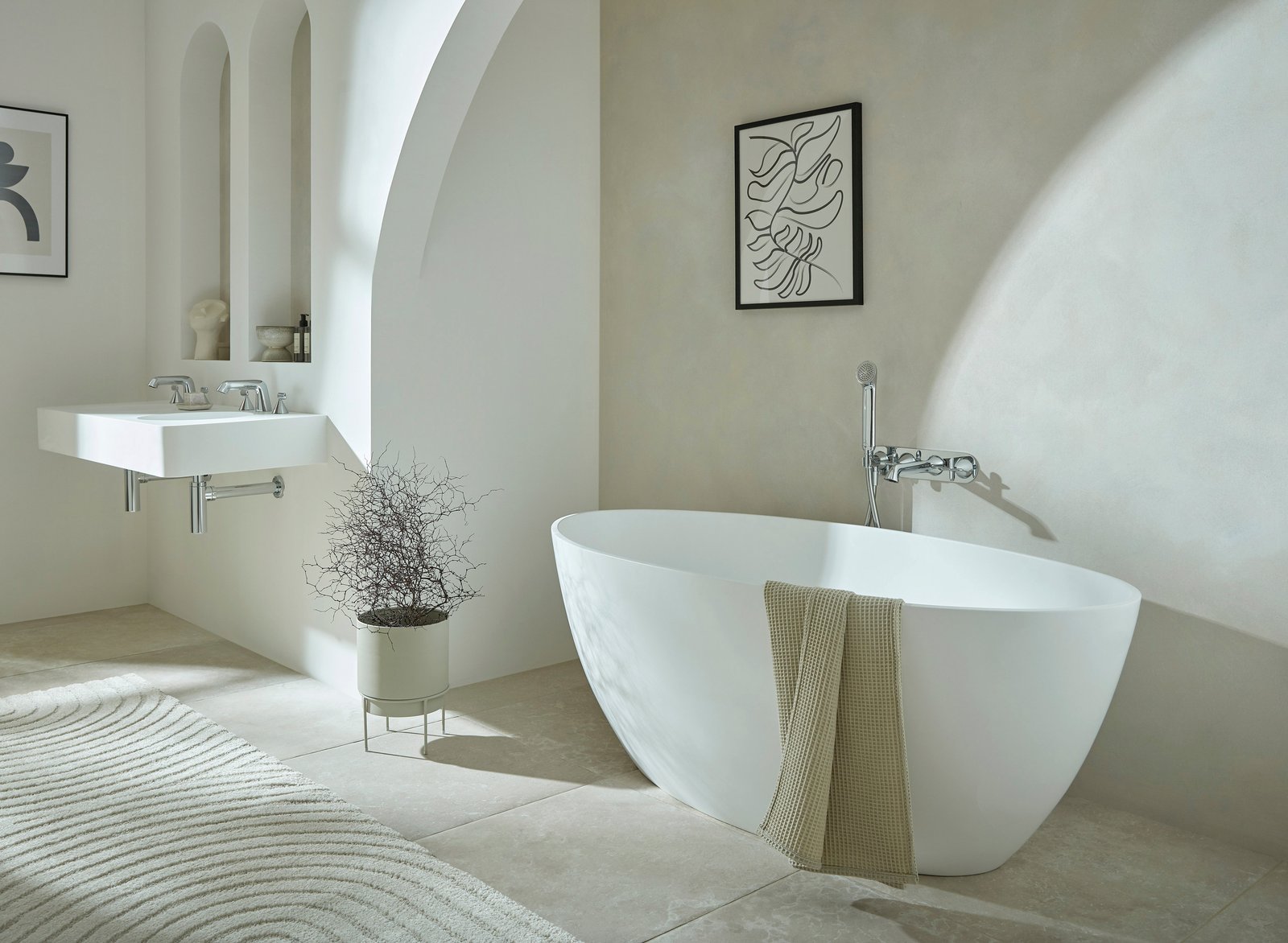
Minimal luxury bathroom scheme — BC Designs egg-shape double-ended freestanding bath, plaster walls with arched alcove framing twin mirrors and a wall-hung basin, polished chrome wall-mount bath filler with handheld shower, large-format limestone floor — restrained material coordination across a coherent palette

Egg-shape freestanding bath, plaster archway, restrained palette — luxury isn't a single product, it's a coherent specification. That coherence is what a designer assembles.

05 · The honest no

When a bathroom designer is NOT worth it

There are at least three scenarios where hiring a designer is genuinely overkill, and you'd be better off keeping the money in your project budget.

Scenario one

Standard rectangular bathroom, like-for-like swap, sub-£8,000 spend

If your existing layout works, you're replacing the bath where the bath was, the WC where the WC was, and the basin where the basin was — and you're spending under £8,000 — a designer is overkill. Pinterest plus a competent fitter (or a showroom's online configurator) will deliver the result. The design service is genuine value when the brief is complex; on a same-position swap with mid-spec products, there isn't enough complexity for a designer to earn their keep. Skip the design appointment, brief the fitter directly, save the time.

Scenario two

You've already done the work

Some homeowners arrive at our showroom with a finished mood board, exact products chosen, layout decided, dimensions verified — they want a supplier, not a designer. That's fine. We'll quote on the products and bow out of the design conversation. You simply won't need the design half of what we do.

Scenario three

Tight budget, no margin for mistakes

If your budget is genuinely tight — under £8,000 for a standard family bathroom — the maths can still work for a fitter-only route. Hire the most experienced fitter you can afford (one who has done at least 50 bathrooms, ideally with a portfolio), use them as informal advisor, and accept that one or two minor regrets is the price of that route. The budget objection at a designer-led showroom is usually about appointment time, not the cost of the service itself — worth checking what's included before you rule one out.

The case where small does NOT mean skip-the-designer: ensuites under 4 square metres, awkward roof slopes, narrow run-throughs, or period-property quirks. Small-and-complex is exactly where a designer earns the fee. A 3 sqm ensuite with a sloping ceiling and a soil pipe in the wrong place is harder to design well than a 9 sqm rectangular family bathroom. Don't confuse "small" with "simple".

The Houzz UK 2025 Bathroom Trends Study reports that 28% of UK homeowners hire a designer for bathroom renovations — meaning 72% don't. Of those who hire a professional of any kind (89% of respondents), most are hiring fitters and plumbers, not designers. The numbers themselves say a designer isn't always necessary. If your project is small, simple, and standard, you're in the majority — skip the designer, get a good fitter, save the money.

"Don't confuse small with simple. Small-and-complex is where a designer earns the fee."

06 · The unrecoverables

The five most expensive bathroom design mistakes

Most bathroom regrets are recoverable for under £500. The five below are the ones that aren't, and they're the reason readers end up on Mumsnet at midnight searching for fixes.

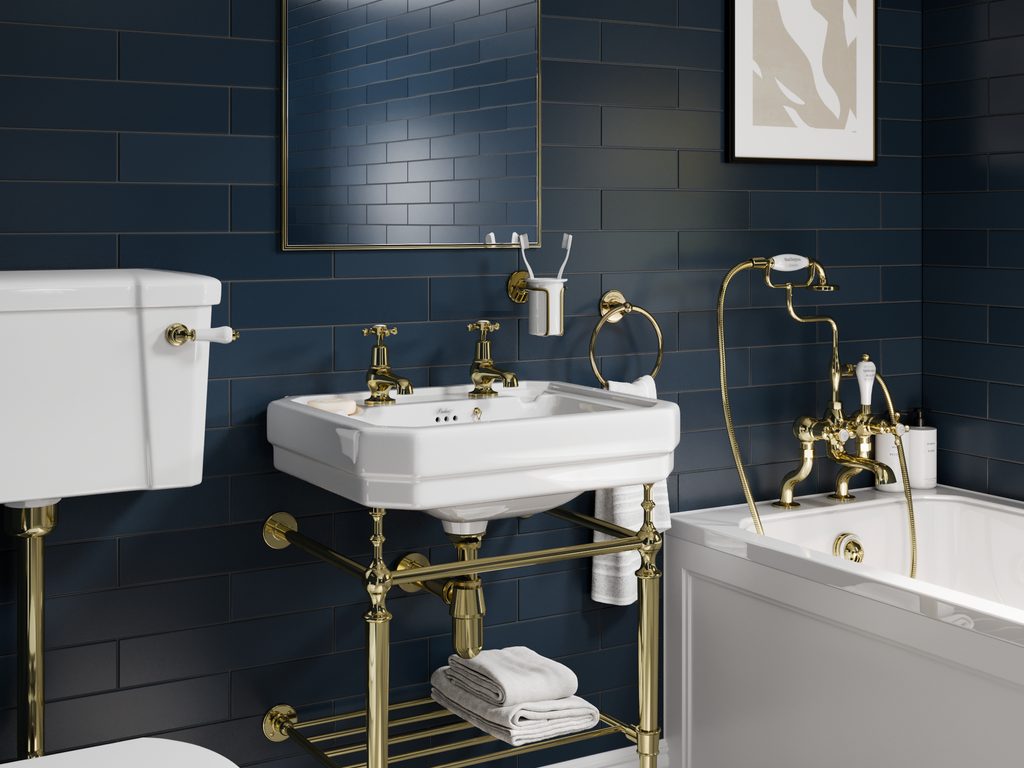
Burlington Cameo Collection traditional scheme — navy metro-tile wall, polished brass console basin with twin pillar taps, gold-trim mirror, brass framed bath shower mixer — every brass element matched as a coordinated set
Finish-level coordination — navy metro tile, polished brass, console basin, mirror frame, bath mixer. Every brass element settled at the design stage; visible if any one of them is wrong.
01

Monobloc taps on a gravity-fed system

Monobloc taps need 1.0 bar dynamic pressure minimum, often more for premium models. Houses with cold from a loft tank and hot from a vented cylinder usually deliver 0.3–0.5 bar at upstairs taps. The tap dribbles, the homeowner blames the brand, and the £180 install gets ripped out (£250 rework) or a pressure pump gets retrofitted (£600–£900 rework).

A designer asks "what's your water system?" in the first 10 minutes.

02

Waterfall taps in a hard-water area

Waterfall taps in hard-water areas are a recurring complaint on UK homeowner forums — the wide flat-channel outlet scales heavily and visibly, and within six months the chrome looks frosted.

A designer steers you to a closed-spout pillar tap, a PVD-finish brand (JTP Vos, Crosswater MPRO), or specifies a softener.

03

Textured vanity finishes plus limescale

Textured oak-effect or fluted laminate vanities in hard-water areas trap limescale in the grain — a recurring forum complaint. Within twelve months the vanity looks tired.

A designer steers you to a smooth-finish vanity, or pairs the textured finish with a softened water supply, or moves the texture above splash height.

04

Black grout in showers (in hard-water areas)

Black grout looks magazine-perfect on day one. By month six, hard-water residue leaves visible white limescale lines that are worse than the original grime would have been on grey grout.

A designer specifies mid-grey or sand-tone grout that masks limescale rather than highlighting it. Or recommends a softener on the cold supply to the wet zone.

05

Forgotten concealed-cistern access seal

A recurring £400-rework story on UK home renovation forums. Concealed-cistern WCs (Geberit, Roca In-Wall, Grohe Rapid SL) need a vapour seal between the access panel and the surrounding tile/vanity. Without it, condensation migrates into the cabinet over 12–18 months. The cabinet rear panel goes mouldy. Strip, seal, refinish — typically £300–£500.

A designer specifies the seal on the spec sheet; the fitter installs it on day one.

The honest line: most bathroom mistakes are recoverable for under £200, often under £50. The five above are the unrecoverable ones, the ones that drive readers to forums in the first place. They're also the ones a designer would catch in the first appointment — because each is a known-failure-mode pattern, and pattern recognition is the bit that hours of designer experience actually buys you.

If you're at the point where these mistakes feel real — they sit on the spec sheet, they're avoidable for the cost of one appointment — talk to a bathroom designer before the first product goes on order.

07 · The decision

When to hire a bathroom designer — the four trigger conditions

We use four trigger conditions to tell clients honestly whether a designer is worth it. If your project ticks two or more, the designer earns the fee. If it ticks one or zero, save the money.

Trigger one

Your layout has a problem

Soil-stack relocation, joist running wrong way under a freestanding bath, window in the shower zone, awkward door swing. Soil-stack relocation alone is £1,500–£3,000 in plumbing rework.

Trigger two

You're spending £15,000+

15–20 product lines, 6–14 week lead times. The cost of one mis-spec (wrong waste size, wrong tap-hole spacing, wrong cistern depth) is high, and time-to-reorder pushes the project over.

Trigger three

You live in a period property

Victorian terrace, 1930s semi, listed building. Non-standard joists, single-skin walls, cast-iron soil stacks, floors that move under a 200kg cast-iron freestanding bath.

Trigger four

You can't picture it from a 2D plan

Most homeowners can't, fully. The 3D render closes the gap between 2D imagination and reality before products are ordered — it prevents the "I didn't realise" regret.

The one-line check: if any two of the four apply, a designer is worth it for your project. If only one applies, it's a closer call — weigh it against your budget. If none apply, you don't need one.

If two or more triggers apply and you're in our service area, we cover Braintree, Chelmsford, Colchester and Maldon as standard from our Braintree showroom, and travel further for projects that warrant it.

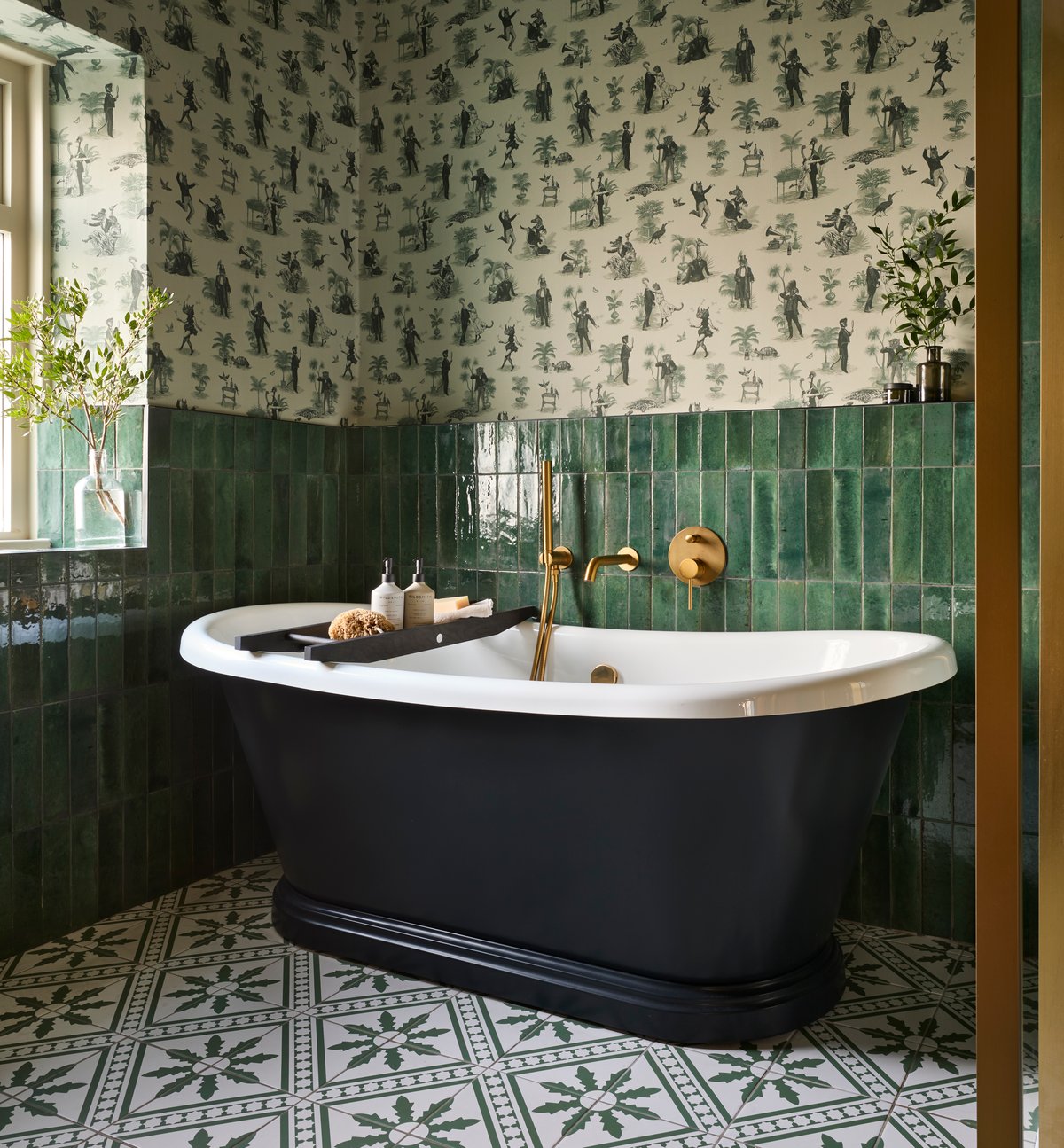
Period-property luxury scheme — BC Designs painted black slipper boat bath, emerald green metro tile dado, toile-de-Jouy wallpaper above, heritage encaustic tile floor, brushed brass wall-mount bath filler — non-standard period detailing requiring designer coordination
Period-property luxury — toile-de-Jouy wallpaper, encaustic tile floor, slipper boat bath, brushed brass throughout. Period detailing is exactly the kind of brief where two of the four triggers apply at once.

Frequently asked questions

Everything UK homeowners ask before booking a bathroom designer.

Realistically, between £0 and £3,000 on a typical luxury bathroom project, depending on what they catch. The biggest single saving is avoiding a soil-stack relocation that wasn't actually necessary — that alone saves £1,500–£3,000 in plumbing rework. A designer also typically prevents one or two product mis-specs (wrong size, wrong hole-spacing, wrong pressure rating) that would otherwise cost a return-and-reorder cycle of £200–£800. We don't make 'save 30%' claims because they wouldn't be true; the saving is on errors prevented, not list price discounted.
Yes more often than for a family bathroom, because ensuites are usually small and complex — the worst combination. Awkward roof slopes, narrow door positions, soil pipes in the wrong place, and a floor area where every centimetre counts. The Houzz UK 2025 Bathroom Trends Study reports 25% of respondents enlarged their primary shower by more than 50% during renovation; in an ensuite, that decision interacts with the door swing and the basin position in ways a 2D Pinterest board can't predict. Worth it for ensuites under 5 square metres almost without exception.
A fitter alone is fine for like-for-like swaps in a standard rectangular bathroom, where you've already chosen products and you're confident about the result. Designer plus fitter is the right call when your project ticks any two of the four triggers: layout problem, £15,000+ budget, period property, or a 3D-visual requirement. The integrated designer-and-installer model (one team accountable end-to-end) prevents the most common failure mode: products that don't work together because nobody owned the spec.
Most are — they fund the free design service through product margin, so list prices sit a touch above online retailers. We don't operate that way. Bowman benchmarks product pricing against the major UK online retailers (Drench, Victorian Plumbing, the supplier direct sites) so you don't pay a premium to use a designer-led showroom. The free design service, technical compatibility checks, spatial verification, and curated specification are added value on top of like-for-like pricing — not a hidden cost. Always ask a showroom directly: "How does your pricing compare to online retailers?" If they hesitate, the design isn't really free.
Free design typically excludes site management visits during install (£60–£100 per visit), ongoing trade coordination if you're using your own fitter (often charged hourly), snagging visits after handover (£150–£300), bespoke joinery design outside the standard range, and revision rounds after sign-off (each costs designer time). The CAD plans, 3D render, spec sheet, supplier sourcing and project programming are genuinely included; the post-design execution support is usually charged. Ask before you sign anything.
First appointment to a draft 3D render is typically 1–2 weeks. Full specification, sign-off and quote: 3–6 weeks from first appointment, depending on revision rounds. Order-to-install timeline: a further 6–12 weeks, dominated by product lead times — European vanities and bespoke stone slabs take 6–10 weeks, brassware in special finishes (PVD bronze, brushed nickel) takes 8–14 weeks. Order before strip-out is the operative rule. Total project from first appointment to handover: 12–20 weeks for standard luxury, longer for bespoke.
If you've paid an independent fee-based designer for design only, yes — the design is yours, and a good independent designer will price for that explicitly. If you've used a free showroom design service, almost never — the design is funded by the assumption you'll buy products through that showroom, and most showrooms won't release the spec sheet to a third-party supplier. Ask upfront if you think you might want to source elsewhere. Honest answer: if you don't intend to buy from the showroom, pay for an independent design instead.
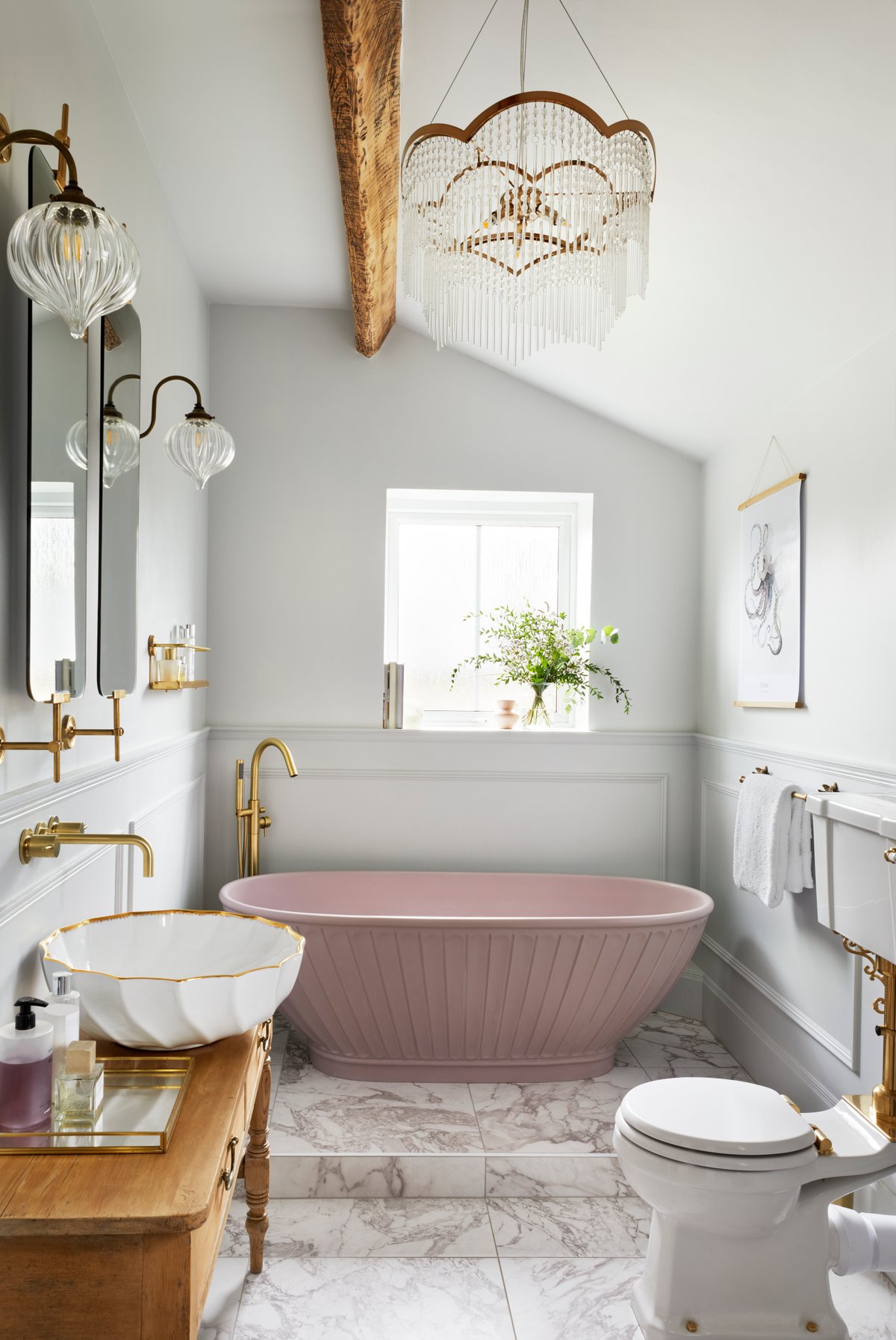
Period bathroom scheme — BC Designs blush-pink fluted slipper bath, exposed timber ceiling beam, period sash window with sill flowers, gold-finish wall-mount bath filler, marble floor tiles, crystal chandelier, gold-trim wall-light scones — coherent designer-assembled luxury
Pink fluted slipper bath, exposed beam, gold throughout, crystal chandelier — the sort of coherence easier to commit to in person than from a screen.

What's next

Worth booking a designer?

If your project ticks any of the four trigger conditions — a layout problem, £15,000+ spend, a period property, or a room you can't picture from a 2D plan — getting a designer involved earns its keep. And because we benchmark our product pricing against the major online retailers, you don't pay a premium for the design service to be there; the kit costs roughly what it costs online, and the design, the spec checking, the spatial verification and the fitter-ready documentation come alongside it.

We run our design service at the Braintree and Leigh-on-Sea showrooms. There's no separate fee, and there's no margin uplift on products to fund it — which is why we ask clients to be seriously planning a project before we allocate designer time. If that fits, you're welcome to book in.

Visit Our Showrooms Free brochures Price estimator