
Bowmans · Inspiration · Design
Smart bathroom technology in 2026: what is actually worth it?
Smart bathroom technology in 2026 isn’t a novelty category any more. It’s a meaningful spend line on most luxury projects, and a confused one. Showroom floors carry voice-controlled lighting, app-driven underfloor heating, digital showers with user presets, integrated audio, smart WCs, in-mirror displays. Some of it pays for itself every day. Some of it is a £2,000 way to do something a £200 product already did. So the filter we use is simple: which features would you use, which ones do the regulations make practical, and which ones fail in year three with no easy repair path. This is the 2026 review, written from a luxury showroom that specifies the kit on real projects.
01 · The category
What counts as ‘smart’ bathroom technology in 2026?
The retail label has drifted. In 2020 a smart bathroom meant a Geberit AquaClean WC and maybe a Bluetooth speaker in the ceiling. In 2026 it gets applied to anything with a chip in it: backlit LED mirrors with a touch sensor, digital shower valves with a slim wall controller, motion-sensor lighting, app-driven underfloor heating, voice-activated extract fans, in-mirror displays, integrated audio. And a growing number of products that solve no problem the buyer has.
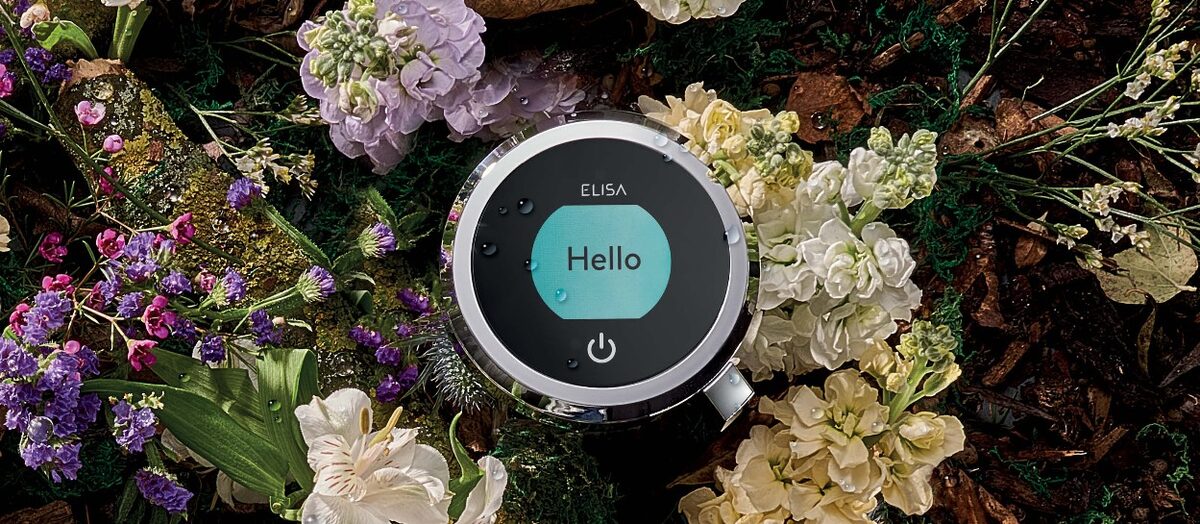
The definition we use on the showroom floor is simple. Smart bathroom technology is any product or system that changes how you interact with the room daily, rather than any product that happens to contain an electronic component. A backlit LED mirror with a demist pad is electronic, but it isn’t smart in the daily-use sense. An Elisa Intuition digital shower with three named user presets and an app start-from-cold is. The distinction matters, because the price gap between the two categories runs into thousands of pounds and the marketing language treats them identically.
The categories that carry the smart label honestly in 2026:
- Smart WCs. Integrated bidet wash, warmed seat, deodoriser, self-cleaning: Geberit AquaClean Mera, Sela and Tuma, with a tier of mid-range integrated-wash units below that. International alternatives like Toto Washlet exist, but we don’t retail them.
- Digital shower controls. An electronic valve unit in a service void, a slim wall controller (often with app or voice control), user-preset memory and start-from-cold timing. Elisa Intuition covers voice and touch; Aqualisa runs Smart Q, Optic Q and Quartz Touch. Crosswater and Hansgrohe make excellent thermostatic showers, but neither currently retails a true digital-control line.
- Voice-activated room control. Lighting scenes, the extract fan, audio playback and the underfloor heating thermostat, all running through Alexa, Google Home or Apple HomeKit with smart switches and dimmable circuits underneath.
- App-controlled underfloor heating thermostats. Warmup 6iE, Warmup 4iE, Heatmiser neoStat, for geo-fencing, learned scheduling and energy-use logging.
- Humidity-triggered extract fans. An integrated humidistat runs the fan only when the room is steamy enough to need it, which keeps the energy use down.
- Smart mirrors and in-mirror displays. A touch interface, sometimes a small embedded display, occasionally Bluetooth audio. HIB ranges are the mainstream luxury tier.
- Bathroom audio and AV. Ceiling speakers, in-mirror TVs, waterproof TVs, with ProofVision covering the AV layer.
The rest of this guide works through each category in turn. It names the brands we specify, gives the 2026 cost band, and answers the only question that matters. Is it worth the spend on your project, or is it a £2,000 way to do something cheaper kit already does?
02 · The headline upgrade
Smart WCs: is a Geberit AquaClean worth it?
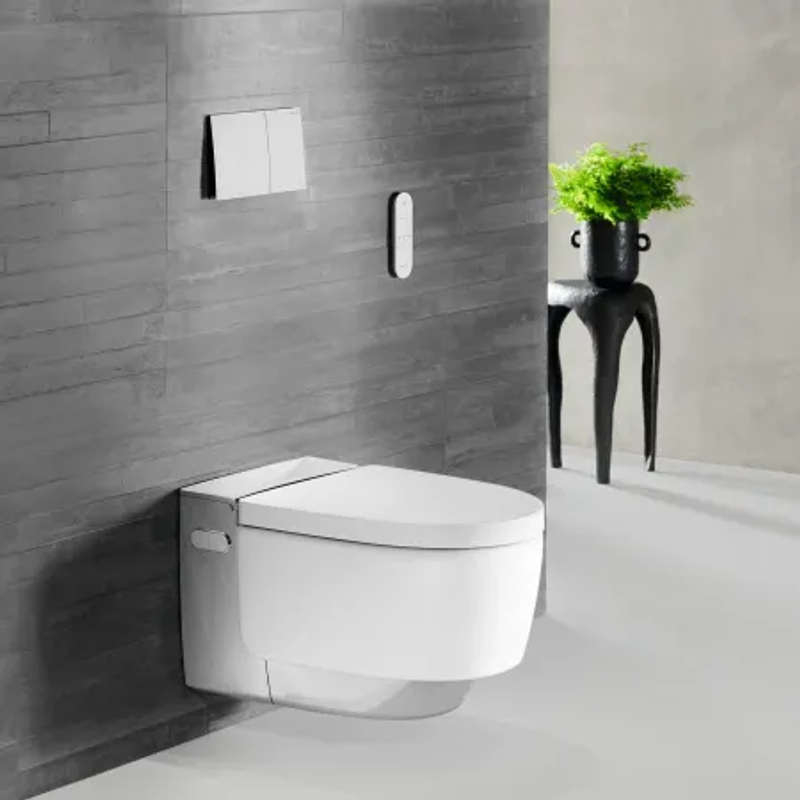
The smart WC is the category most owners describe as the bathroom feature they wouldn’t give up. The Geberit AquaClean range (Mera, Sela and Tuma) puts a bidet wash, warmed seat, deodoriser, self-cleaning function and lid sensor into one ceramic unit. It changes the daily routine in a way a paper-only WC never does. Owners who buy one almost always specify the same range again when the next bathroom comes round. The ones who go for a cheaper non-AquaClean alternative are the ones who most often regret the saving.
What you’re paying for in a Geberit AquaClean unit is Swiss engineering on the parts of a WC most likely to fail invisibly: the ceramic, the cistern mechanism, the wash arm, the seat heater. Geberit has been making concealed-cistern systems since the 1960s, and the AquaClean range applies that same discipline to the smart layer. A 2026 AquaClean Mera unit price sits at £5,400–£6,500 list before install. The Sela opens the range at £2,800–£3,800. Below that, the mid-range integrated-wash units we stock are a real upgrade on a manual WC at £1,200–£2,200 unit price. They just don’t have the AquaClean engineering depth behind them.
The install reality nobody mentions in the brochure
The AquaClean spec needs three things at first-fix that a manual WC doesn’t: a fused-spur 230V supply within 1m of the cistern, a separate cold-water feed, and an accessible service void for the electronic control unit. On a refurbishment that scope is usually fine, because the bathroom is back to substrate anyway. On a tight retrofit, meaning you’re replacing a single WC without redoing the room, the electrical first-fix and the cold-feed routing can add £400–£800 of work.
That fused spur is notifiable under Approved Document P. Either a Part-P registered electrician carries it out and self-certifies, or the work gets notified to Building Control before it starts. The 30 mA RCD protection requirement under BS 7671:2018+A4:2026 applies. Source: gov.uk Approved Document P.
When a smart WC earns the spend
The AquaClean upgrade reliably justifies its price on three project profiles:
- A principal en-suite at the £30,000+ tier. The proportional uplift is small (£5,500 on a £35,000 build is 15%) and the daily-use benefit is the largest of any single product on the spec.
- A guest WC or downstairs cloakroom positioned as a feature. The visual difference between a manual WC and an AquaClean unit is immediate, and on a coordinated luxury cloakroom it’s the spec piece guests notice.
- An accessibility-adapted bathroom under Approved Document M4(3). The integrated bidet wash preserves independence in a way paid-care alternatives don’t match.
Outside those three profiles, the AquaClean is a luxury preference rather than a functional upgrade. Specify one of our mid-range integrated-wash units at the lower price point and put the saved £3,000–£4,000 into brassware or tile instead.
03 · The shower control
Digital showers: Elisa Intuition, Aqualisa — what they really do
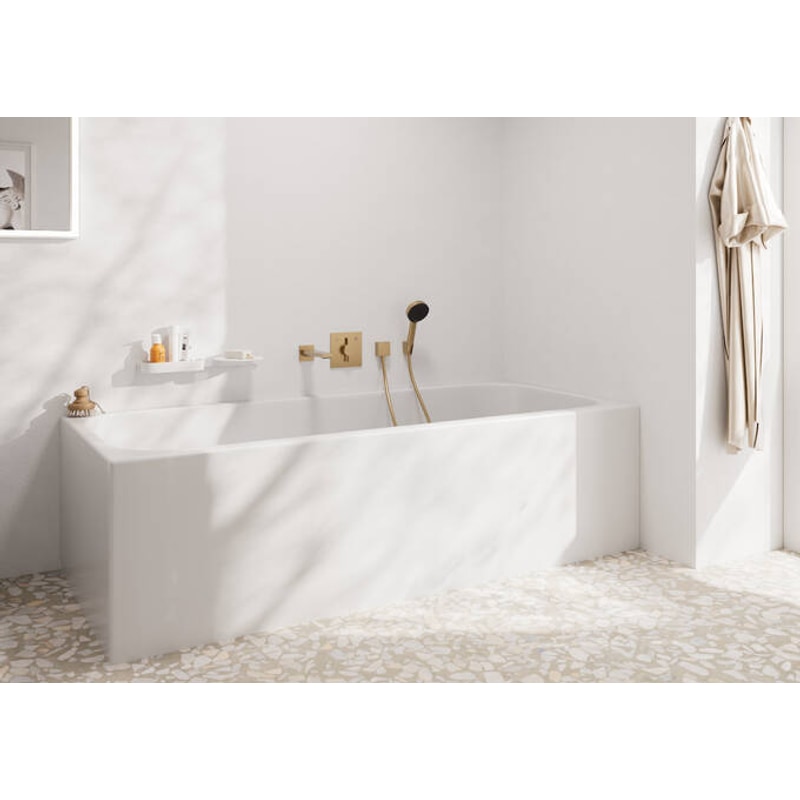
A digital shower replaces the manual mixer-and-thermostatic-valve assembly with two parts. There’s an electronic control unit hidden in a service void or airing cupboard, and a slim wall-mounted controller on the shower wall, sometimes paired with an app or a voice assistant. Behind the wall the plumbing is the same as a thermostatic shower. It’s the user-facing layer that’s electronic. The two digital shower specialists we stock in 2026 are Elisa and Aqualisa. The Elisa Intuition system adds voice and touch-screen control on top of the digital unit; the Aqualisa Smart Q, Optic Q and Quartz Touch ranges cover the £900–£2,200 unit-price band before install. Elisa Intuition itself runs £1,400–£2,500 unit price. Add £200–£400 of install above a standard thermostatic shower spec. Crosswater and Hansgrohe both make excellent thermostatic showers, but neither retails a true digital-control line in 2026. Their RainSelect and Crometta thermostatic ranges are the right call when you want consistent temperature without the digital layer. They just aren’t in the same product category as Elisa or Aqualisa.
What the digital layer gives you above a £300 thermostatic mixer:
- User-preset memory. Three to six named profiles: press a button and the shower runs at your stored temperature and flow, with nothing to re-adjust. On a family bathroom shared by four people this is the daily-use feature that matters most.
- Start-from-cold timing. The controller starts the shower before you step in, runs for 20–40 seconds while the cylinder primes, then tells you when it’s up to temperature. On a long pipe run from cylinder to shower, which is most UK houses and especially en-suites at the far end of the first floor, that saves 30–60 seconds of cold water down the drain every shower.
- Visual cleanness. The slim wall controller takes up less tile real-estate than a chrome valve plate and a separate diverter. On a tile-led luxury scheme this matters; on a normal bathroom it’s a nice-to-have.
- App control. Most digital ranges pair to a phone app for preset programming and (on premium models) flow logging. This is the one owners use hard for the first month, then rarely touch again. The wall controller does the daily work.
When a digital shower earns its place
Signals it’s the right call:
- Multi-user household. Different family members, different preferred temperatures and flows. Preset memory is the headline feature.
- Long cylinder-to-shower pipe run. Start-from-cold saves real water and time on a daily basis.
- Tile-led visual scheme where the brassware is meant to recede. The slim wall controller is the cleanest visual option short of a fully concealed valve.
If none of those apply, the £900–£2,500 unit-price gap above a quality thermostatic mixer buys you a feature you won’t use often. Specify a Crosswater MPRO or Hansgrohe Crometta thermostatic spec at the lower band, then put the saved spend into a better shower head, a bigger glass screen, or a proper rainfall ceiling-mount. The head is the part of the system you feel. The control valve, once it’s consistent, is invisible.
04 · The voice layer
Voice control: what works in a steamy bathroom and what does not
Voice control in a 2026 bathroom is more practical than the 2020 generation made it look. A ceiling-mounted speaker sitting outside the immediate steam zone (Zone 2 or beyond per BS 7671:2018+A4:2026) typically achieves 90–95% recognition accuracy on common commands, even mid-shower. The hardware has caught up. What hasn’t moved is the regulatory boundary on what the voice is allowed to control.
What voice control reliably handles in a bathroom:
- Lighting scenes. ‘Bath time’ calls a 2700K warm dim setting on the LED ceiling layer plus the mirror lights at 30%; ‘Morning’ calls a 4000K bright wash. On smart switches and dimmable circuits, this is the use case voice control pays back on every day.
- Extract fan control. Manual override or scheduled shutdown. Useful when the bathroom is steamy but the humidistat hasn’t triggered.
- Underfloor heating thermostat. ‘Set bathroom to 22 degrees’. Pairs cleanly with a smart UFH thermostat (Warmup 6iE).
- Audio playback. Music, podcasts, radio. Ceiling speaker outside the immediate shower zone, paired to your existing voice assistant.
- Smart mirrors with voice input. Time, weather, news headlines: the ambient-display use case.
What voice control does not reliably handle, and should not:
- Voice-controlled water flow. Voice-triggered shower start, voice-triggered bath fill. Both are technically possible with smart valves, but they turn the install into notifiable electrical work with safety interlocks that most retrofits don’t include: anti-scald, water-detection cut-off, manual override. A hot-water valve triggered by misheard speech in a steamy room is a boundary almost no UK install should cross. Approved Document G’s 48°C maximum bath-fill mixing requirement applies regardless of how the valve is operated.
- Locked door control. Smart locks on bathroom doors fail closed surprisingly often, and the trapped-occupant call-out that follows is the most-cited regret on smart-home forums.
- Mirror display content selection. Voice works for display ON/OFF but content selection (TV channel, video) reliably fails on bathroom-noise-floor speech recognition. Use the touch interface or app.
So the practical line is this: voice control is the convenience layer for everything around the water. The water itself stays mechanical. That’s the right boundary in 2026, and we’d expect it to hold until the safety-interlock standards catch up.
05 · The mirror question
Smart mirrors vs backlit LED: where the spend stops paying back
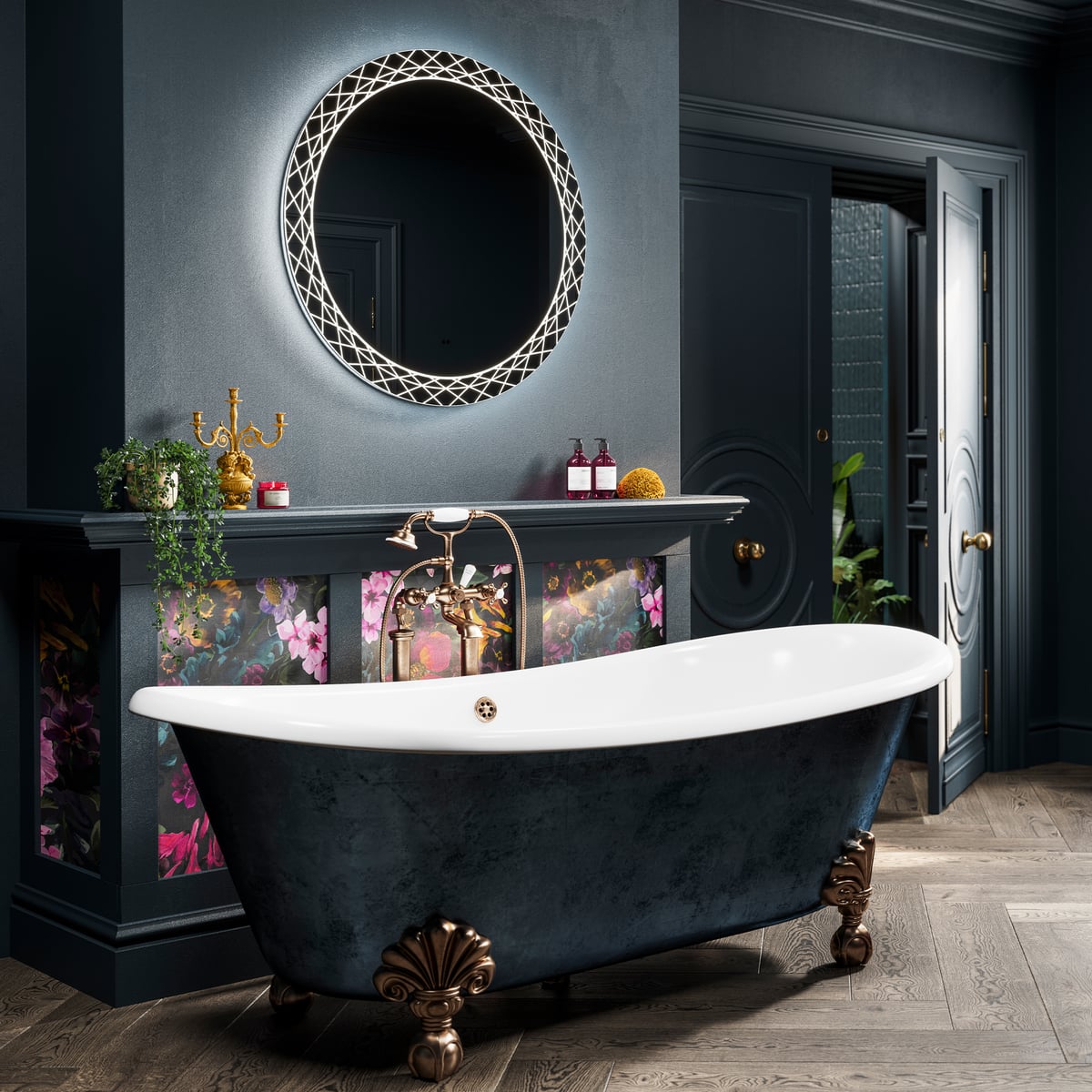
Backlit LED mirrors with a demist pad are the right answer on most luxury UK bathroom briefs. A HIB Bellus, HIB Globe or HIB Atrium runs £350–£900 unit price. For that you get 2700–3000K warm-white wash light around the face, IP44-rated for Zone 2 install per BS 7671:2018+A4:2026, motion-sensor or touch on/off, and a demister pad that keeps the centre of the mirror clear after a shower. Five years on the floor, the part that fails most often is the touch sensor, and in most cases that’s a low-cost replacement.
A ‘smart mirror’ layers on a touch interface, sometimes a small embedded display behind a one-way silver film, occasionally a Bluetooth speaker, and on premium models ambient sensors and voice integration. Price jumps to £1,200–£2,800 unit. The smart layer does add real features for the first 18 months or so, then starts ageing in the wrong direction. The display panel goes first: back-condensation reaches the electronics, the heating element struggles, the touch interface stops responding cleanly. Replacing the smart layer costs what a new mirror costs.
When a true smart mirror earns its place
Where it does make sense:
- A coordinated wellness brief in a principal suite. The touch interface or in-mirror display has to be part of the daily routine: ambient health metrics, a music-and-lighting scene controller, a dressing-room-style information display. You specify it because the rest of the room asks for it.
- A high-end commercial install (boutique hotel, spa). Where the smart layer is a guest-experience feature and the replacement cycle is faster than domestic.
Outside those two cases, specify a backlit LED. The HIB Bellus, the HIB Globe and the Roper Rhodes Refine all sit at the right price-and-spec point for a luxury domestic bathroom. We go through the whole layered-lighting approach in our luxury bathroom lighting design guide.
06 · The unsexy winner
App-controlled underfloor heating: the most cost-effective smart upgrade
The Warmup 6iE smart thermostat is, by some distance, the smart bathroom upgrade with the best return on spend in 2026. Unit price £180–£280 against £40–£90 for a standard programmable thermostat. Swapping it is a 30-minute job for an electrician, and it doesn’t disturb the floor or the heating mat underneath. You gain app control, geo-fencing so the bathroom warms as you arrive home, and learned scheduling that works out when you use the room and adjusts the warm-up window. You also get energy-use logging, so you can see what the bathroom UFH costs to run.
The energy saving is real and predictable. A geo-fenced, learned schedule will usually cut UFH run-time by 15–25% on a UK bathroom run a few hours a day, which pays the thermostat upgrade back in 3–5 years on energy alone. If the house already has a wider smart-home setup (HVAC, hot water, towel-rail timing) the integration value goes up again.
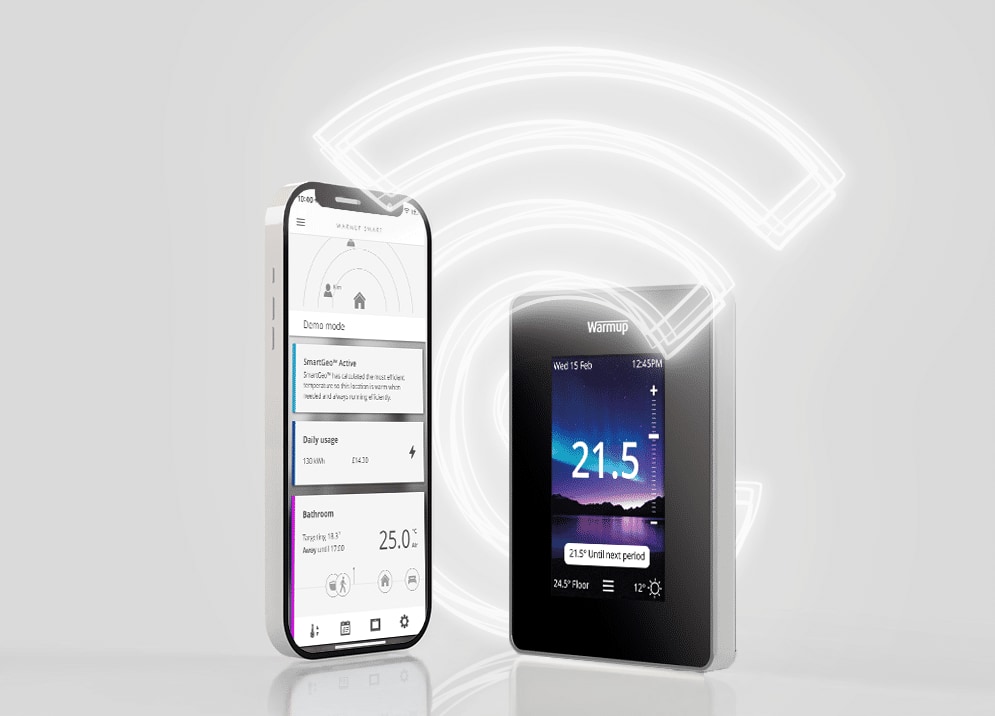
The retrofit case is unusually clean. You can swap a standard floor thermostat for a Warmup 6iE without touching the heating mat, the screed, or the tiled floor. The wiring is identical: live, neutral, earth, plus a floor-temperature sensor wire that runs back through the existing conduit to the wall position. On almost every UK bathroom built in the last 15 years, that wiring is already there. Our bathroom underfloor heating wet vs electric guide covers the rest of the UFH picture.
The notifiable-work rule under Approved Document P applies if the existing thermostat is being replaced as part of a wider electrical refurbishment. A like-for-like swap on an existing circuit isn’t a new circuit in itself, so the Part-P notification scope sits with the wider work rather than the swap. Source: gov.uk Approved Document P.
07 · The boring upgrade that matters most
Humidity-triggered extract fans: the boring upgrade that prevents the most expensive failures
A humidity-sensing extract fan with an integrated humidistat replaces the standard intermittent extract that runs off the light switch. It reads room humidity, runs only when the bathroom is steamy enough to need it, holds the right flow rate until the moisture level drops, then switches itself off. Energy use goes down. Mould and condensation risk goes down with it. So do tile-grout and silicone failures, which are the most expensive long-term bathroom failure mode on the UK forums. Unit price £120–£250 against £40–£80 for a standard extract.
The Approved Document F target is 15 L/s intermittent or 8 L/s continuous for bathroom extract. Continuous low-level extract with a humidistat boost is the spec we put on most luxury bathrooms now: the room dehumidifies gently all the time, with a high-flow boost for the post-shower window. A wet room or a visually-led principal suite with a high steam load (rainfall ceiling shower, body jets) will want the boost mode; a small ensuite usually won’t.
The retrofit cost is mostly the fan unit and the labour. Cabling already runs from the light switch to the existing fan position; the smart extract uses the same cabling with a different terminal arrangement. The notifiable-work rule under Approved Document P applies if the circuit is added or modified. Replacing the fan like-for-like doesn’t trigger it. The 30 mA RCD requirement under BS 7671:2018+A4:2026 applies either way.
This one is on the ‘worth it’ list for a simple reason: the alternative is tile-grout failures and ceiling-back mould in year three to five, which run £800–£2,500 to put right on a luxury bathroom. The £100 differential is the cheapest insurance on the spec.
08 · The audio layer
Bathroom audio and AV: where it works, where it disappoints
Bathroom audio falls into two categories that retail copy tends to conflate. The first is ceiling speakers wired into a whole-home audio system: cabled to a central amp, paired with a whole-home audio source (Sonos, BluOS, Apple HomeKit), sitting outside the immediate steam zone. That’s the spec that lasts. Driver corrosion is minimal, because the speaker sits in the ceiling cavity rather than the steam plume. Sound quality holds up against a standalone Bluetooth speaker. Cost is £400–£1,200 per room, added to a whole-home audio install that already exists.
The second category is in-mirror or in-tile Bluetooth speakers retrofitted into a bathroom with no whole-home spine. These are the ones most owners get tired of. They pair and unpair every shower, the audio is compressed Bluetooth, and the driver corrodes faster because the unit sits inside the mirror frame in the steam plume. Replacing it means replacing the whole mirror or tile. We don’t recommend them on luxury schemes.
The third category is the in-mirror or wall-mounted waterproof TV. ProofVision is the brand we specify most often: UK-engineered, waterproof to IP66, wall-mountable inside Zone 2 with the right install, and available in model lines that sit behind a one-way mirror finish. Unit cost £1,500–£4,500 for a 22–32-inch panel. The use case is real on a principal en-suite where the bath is the focus and the TV is part of the ritual. On a quick-shower family bathroom it’s decoration.
The most-cited audio regret on UK forum threads is retrofitting a Bluetooth speaker into an existing bathroom because ‘it would be nice’, then replacing it within four years when the driver fails. So pick a side. Either commit to the whole-home spine while the build is open, or skip the audio layer and use a portable speaker you can replace on its own when it dies.
09 · The regulatory beats
UK regulations every smart bathroom build must clear
Smart bathroom kit increases the number of notifiable electrical decisions on a project. Five regulatory beats matter on any 2026 install. Asking about them is also one of the strongest signals you can give an installer that you expect the work done properly.
BS 7671:2018+A4:2026 — bathroom electrical zones
The current edition of the IET Wiring Regulations is BS 7671:2018+A4:2026, the 18th Edition. Amendment 4 was published on 15 April 2026 and has applied since then, and Amendment 3 stays a valid alternative standard until it’s withdrawn on 15 October 2026. There is no 19th Edition. Here are the bathroom zones for any smart kit you add:
- Zone 0: inside the bath or shower itself. IPX7 minimum, with SELV (separated extra-low voltage) limited to 12V.
- Zone 1: from the floor of the shower up to 2.25m above floor level. IPX4 minimum.
- Zone 2: the 0.6m band horizontally beyond Zone 1. IPX4 minimum again.
- Zone 3 has been removed in current editions, so any older guidance that references it is out of date.
- 30mA RCD protection is mandatory on every bathroom circuit. Smart WC fused spurs, digital shower control units, smart UFH thermostats, smart extract fans, ceiling speakers, mirror power, the lot.
Smart mirrors with integrated electronics typically need IP44 minimum. A wall-mounted ProofVision TV installed in Zone 2 needs to be IP66 unit-rated. Put voice-assistant ceiling speakers outside Zone 2 wherever you can: the further from the steam plume, the longer the unit lives. Source: IET BS 7671.
Approved Document P — notifiable work
A new circuit, and most alteration work inside the special location around a bath or shower, is notifiable under Approved Document P, though there are limited exemptions. Compliance runs through one of three routes: a Part-P registered competent-person electrician self-certifying the work (via NICEIC, NAPIT, ELECSA or STROMA), a registered third-party certifier, or notification to Building Control before work starts. The smart-kit additions that fall inside that scope:
- Fused spur for a Geberit AquaClean WC.
- Dedicated supply for an Elisa Intuition or Aqualisa Smart Q digital-shower electronic valve unit.
- New circuits for ceiling speakers, smart mirrors with electronics, in-mirror displays.
- New circuits for smart UFH thermostats (existing-circuit replacement is not notifiable in itself, but most smart UFH retrofits go alongside other electrical work).
There is a shortcut, which is running smart kit off an existing socket without notification. It fails the building-control sign-off when you sell, it invalidates most household insurance for any water-related claim, and in extreme cases it voids the manufacturer warranty on the smart unit itself. A Part-P registered electrician on a smart-bathroom install costs £200–£500 above a non-Part-P quote. That’s the cheapest insurance on the project. Source: gov.uk Approved Document P.
Approved Document G — water and sanitation
Approved Document G (sanitation, hot water safety, water efficiency) is the 2015 edition incorporating the 2024 amendments, in force from 1 October 2024. Two beats matter for smart bathroom kit:
- Bath-fill mixing has to cap the maximum outlet temperature at 48°C. That holds however the valve is operated, so a digital shower or a smart bath-fill sits under the same 48°C ceiling as a manual mixer.
- Water efficiency target of 125 L per person per day for new dwellings, with 110 L/p/d as the optional tighter standard. High-flow rainfall heads on a digital shower can put pressure on that calculation if the rest of the spec isn’t flow-restricted.
Source: gov.uk Approved Document G. For everything else on the regulatory side, see our UK bathroom regulations 2026 guide.
Approved Document F — ventilation
Bathroom extract sits under Approved Document F, cross-referenced with the Approved Document L energy targets. The figure is 15 L/s intermittent or 8 L/s continuous. Smart humidity-triggered extract fans clear that comfortably. A like-for-like retrofit doesn’t need building-control notification, but a new dedicated extract circuit does.
WRAS approval — smart valves and water handling
Any electronic valve handling drinking water (digital shower units, smart bath-fill, AquaClean WC connections) must be WRAS Approved (or NSF REG4) under the Water Supply (Water Fittings) Regulations 1999, code-of-practice updated January 2025. The reputable brands carry WRAS approval as standard: Geberit, Crosswater, Hansgrohe. Budget direct-from-manufacturer kits sometimes don’t, so check the approval before you specify. Source: WRAS Approvals.
10 · The summary
The worth-it matrix: what to spec, what to skip, what to ask
So here’s the summary on every smart bathroom feature in 2026: the brand we specify, the cost band it adds to a standard build, and the verdict for a typical luxury UK bathroom project.
| Feature | Brand we specify | Added cost | Verdict |
|---|---|---|---|
| Smart UFH thermostat | Warmup 6iE | +£160–£280 | Worth it. Best ROI on the list. Retrofit-friendly. |
| Humidity extract fan | Spec-driven, integrated humidistat | +£80–£170 | Worth it. Prevents tile-grout and mould failures. |
| Backlit LED mirror | HIB Bellus / Globe / Atrium | +£350–£900 | Worth it. Replaces the standalone smart mirror at a fraction of cost. |
| Voice-controlled lighting scenes | Smart switches on dimmable LED circuits | +£200–£500 | Worth it if a voice assistant is already in the home. |
| Smart WC (mid-range) | Bowman-stocked integrated-wash units | +£1,200–£2,200 | Worth it for the integrated wash function. |
| Smart WC (headline) | Geberit AquaClean Mera / Sela | +£2,800–£6,500 | Worth it on principal en-suites and accessibility-led builds. |
| Digital shower control | Elisa Intuition / Aqualisa Smart Q | +£900–£2,500 | Worth it on multi-user households or long pipe runs. |
| Whole-home ceiling audio | Wired Sonos / BluOS spine | +£400–£1,200/room | Worth it only if the house already has the spine. |
| Waterproof TV | ProofVision (UK) | +£1,500–£4,500 | Selective. Right on principal en-suites with bath-led ritual; wrong on family bathrooms. |
| Standalone smart mirror | (skip) | +£1,200–£2,800 | Skip. Backlit LED gives you 90% of the benefit at a third of the price. |
| Voice-controlled water | (skip) | +£800–£3,000 | Skip. Regulatory and safety boundary not yet bridged. |
| Retrofit Bluetooth speaker | (skip) | +£200–£600 | Skip. Driver corrosion in 3–4 years; a portable speaker is more honest. |
Cost ranges reflect our 2026 supplier pricing on a standard luxury UK bathroom build. Final spec depends on site and circuit conditions, and the install premium varies with retrofit complexity.
Five questions to ask before you specify smart kit
- What’s the daily-use routine you’re optimising for? Smart kit pays back when it removes a daily friction, and it doesn’t pay back at all sitting unused.
- Is there already a voice assistant or smart-home spine in the rest of the house? Bathroom smart kit integrates with what’s already there, and standalone bathroom kit ages faster.
- Is the install scope a refurbishment back to substrate, or a tight retrofit? Smart kit on a refurbishment is straightforward; on a tight retrofit the first-fix electrical can double the install cost.
- Is the electrician Part-P registered, and have they done bathroom smart kit before? Smart kit exposes install-quality differences fast: a wrongly-zoned ceiling speaker, a smart valve unit buried where nobody can service it.
- What’s the warranty position and the replacement-cycle expectation on each smart unit? The headline kit (Geberit AquaClean) carries a long warranty and real engineering depth. The budget tier doesn’t. Specify accordingly.
That last question matters more than the other four combined. Smart bathroom kit is the part of the spec where engineering depth and warranty position separate the categories. We coordinate all of it on every project that comes through the showroom. Layout, smart kit, install scope, regulatory sign-off and supplier choice go into one specification, signed off before the first product is ordered. The wider planning sequence sits in our luxury bathroom planning checklist.
Frequently asked questions
Everything UK homeowners ask about smart bathroom technology in 2026.
What is next
Specifying smart bathroom kit on your project?
We coordinate the smart layer the same way we coordinate everything else: layout, brassware, sanitaryware, lighting, electrical zones and service voids, signed off as one specification before the first product is ordered. The first showroom appointment takes about an hour. It works out which smart features earn their place on your project and which are decoration, and design is included, so you only pay for the products you choose. We benchmark our product pricing against the major UK online retailers (Drench, Victorian Plumbing, the supplier-direct sites) on every brand we sell, including Geberit, Crosswater and Hansgrohe. So the smart-kit spend goes on the kit rather than a margin uplift to fund design.
Our design service runs out of two showrooms: Braintree (Springwood Industrial Estate, CM7 2YN) and Leigh-on-Sea. You pay no design fee, there’s no margin uplift on products to fund the design, and nothing obliges you to buy at the end of it. Use your own fitter or use ours; either way works for us.
Companion guides: is a bathroom designer worth it? · how much a luxury bathroom costs in the UK in 2026 · UK bathroom regulations 2026 · luxury bathroom planning checklist