
Bowmans · Inspiration · Design
Bathroom mirrors and mirror lighting: a UK 2026 buyer's guide
Most UK bathrooms get the wrong mirror. Too small for the wall, too low over the basin, lit at 4000K so the face in it looks tired by 8am. No demist pad, so it fogs the moment the shower runs. And an IP rating that doesn’t legally allow it where it’s been hung. The mirror is the one product in the room that gets used every day at close range, by everyone in the house. On a luxury bathroom it has to be specified properly: the regulations, the colour temperature, the shape, the height, and where it sits relative to everything else on the wall. Get that right and the room looks designed. Get it wrong and no amount of brassware or stone rescues what people see in their own face.
01 · The case
Why the mirror matters more than people think
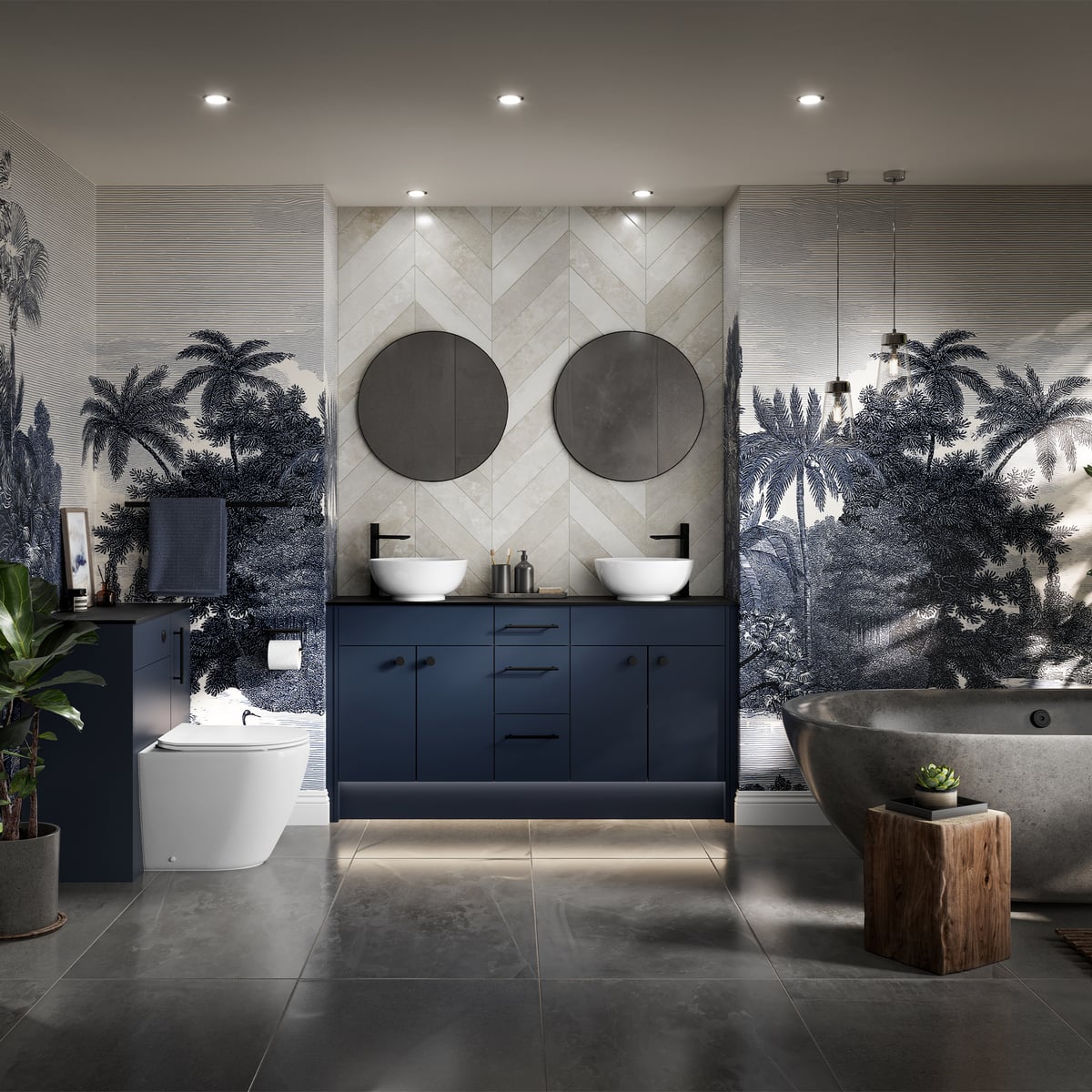
The mirror is the one product in a bathroom that touches the user every single day at the closest possible range. The bath might get used twice a week. The shower runs for ten minutes a day. But the mirror is in someone’s face twice a day at minimum, often four or five times, for ten minutes or more each visit. It’s the product the household sees itself in, and it’s the product where light, ergonomics and regulations all meet. That’s why it goes wrong in so many UK installs.
Most off-the-shelf bathroom mirrors fail one of three tests. They fail the lighting test by running at 4000K cool white, which turns skin tones greenish or grey and quietly tells the user they look tired however much sleep they had. They fail the regulatory test by being a non-IP-rated fitting hung in Zone 2, which is unlawful under BS 7671:2018+A4:2026 and a shock-and-fire risk in a wet room. Or they fail the ergonomic test: wrong height, wrong width, or the wrong reflective relationship to the rest of the room. That last one mirrors the WC back into the space every time the door opens.
A luxury bathroom mirror is a piece of specification rather than decoration. It has a colour temperature, a CRI, an IP rating, a depth, a width, a position, a wiring requirement, and a relationship to the layout drawing for the rest of the room. Getting all of that right is what separates a £150 mirror that looks fine in a brochure from a £600 mirror that quietly carries the room. The price gap is real, but it’s small against the rest of a luxury bathroom budget. Pound for pound it’s one of the highest visible-impact lines on the spec sheet. Nobody sells you a mirror this way at a high-street showroom, though, which is why high-street mirrors at high-street prices look the way they do.
This guide walks through every decision that goes into specifying a bathroom mirror in 2026. That means the LED anatomy, the regulations, the cabinet-versus-flush call, the demist and sensor features that pay their way, the shape and positioning, the face-shadow trap, and the realistic price band at each level. We sit on the design side of this every day. Most of the post-completion regrets we hear trace back to a mirror chosen by default rather than by design.
02 · The product
Backlit LED mirror anatomy: what you are actually buying
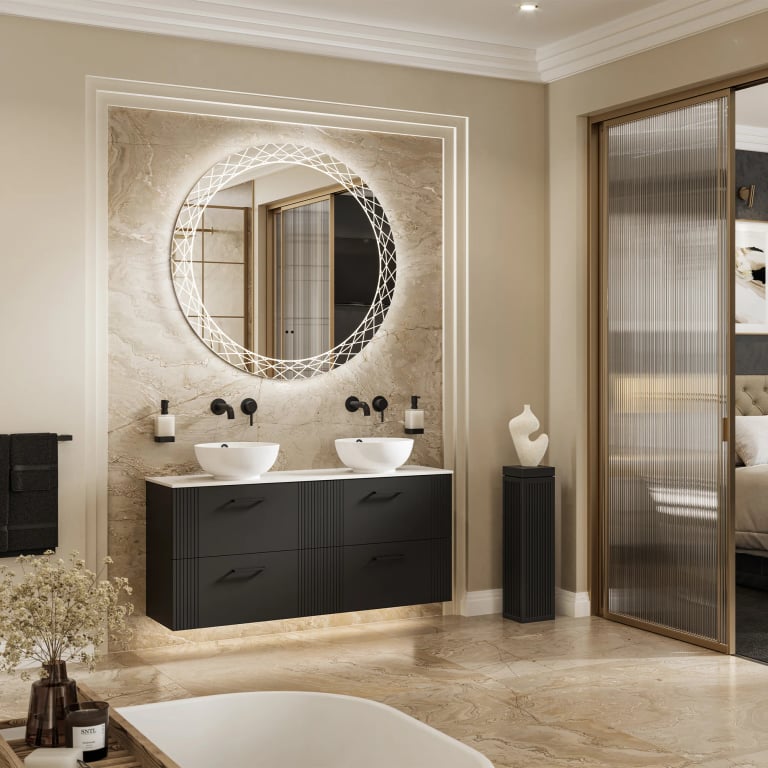
A modern backlit bathroom mirror is six things layered into one product. The silvered glass itself, an LED light source, a frosted or sandblasted border that diffuses the LED, a power driver, a demister pad on the back, and a control system: touch sensor, motion sensor or remote. Know what each layer does and the spec sheet stops being impenetrable.
The LED source is the layer where the colour temperature lives. Most quality mirrors run at 2700K to 3000K warm-white as standard, and the higher-spec models add adjustable colour temperature across 2700K, 4000K and 6500K on a touch control. Adjustable models cost around £80 to £150 more than fixed-temperature equivalents. They pay for themselves on a master ensuite where one user applies makeup at 4000K and the other prefers warm-white shaving at 2700K. On a guest ensuite or family bathroom, fixed 2700K is fine and arguably better: one less control to mis-set.
The frosted border is the layer that turns a hard LED point source into soft diffuse light. Cheap mirrors have a thin diffuser that lets the LED dots show through as a string of pixels around the edge. Quality mirrors have a deeper diffuser that produces a continuous wash. The HIB Bellus, Alba and Cassini ranges all use a refined diffuser that looks like a clean glow rather than a strip of LEDs. That’s one of the spec differences you can only judge in a showroom, never from product photography.
The driver is the small electronic unit that converts mains 230V AC down to the 12V or 24V DC the LEDs need. On most quality mirrors it’s integrated behind the mirror itself, so the wall feed is standard 230V. On others the driver sits remote in a separate housing. That’s fine if the housing has somewhere ventilated to live, but it adds an installation step. Driver quality decides flicker, dimming compatibility and lifespan. Cheap drivers fail at the 5-to-7-year mark, and that’s the single most common reason a budget LED mirror needs replacing.
The demister pad is a thin heating element bonded to the rear of the glass, and it warms the mirror surface above the room dew point. It typically draws 30 to 60 watts and switches automatically with the mirror lights. Whether it’s worth specifying comes up again in section five. On a luxury build, almost always yes. The control system is the layer the user touches, and there are three. A capacitive touch sensor on the mirror surface looks cleanest, but it needs a dry finger. A motion sensor on the underside means you never touch it, though passing pets and opening doors can set it off. A remote wall switch is the most reliable and the least elegant. Touch sensors are the modern default. Motion sensors come into their own on a master ensuite, where a 3am visit means no fumbling for switches.
HIB is the British mirror specialist Bowman carries across most luxury bathroom installs. The HIB range covers the Bellus and Alba families (slim-edge backlit), the Cassini round mirrors, the Genesis and Solas mirror cabinets, and the smaller Veles and 100 sizes for compact rooms. They all run at 2700K to 3000K and they’re all IP44 rated for Zone 2, with demister pads standard on the higher-spec models. Pricing across the HIB ranges sits between £350 and £1,500, depending on size and feature level. That’s the band where bathroom mirrors stop looking like commodity products and start looking like specified ones.
"A bathroom mirror at 4000K doesn’t just look cold. It tells the user every morning that they look tired, and the fix is the easiest line on the whole spec sheet."
03 · The regulations
IP44, Zone 2 and BS 7671:2018+A4:2026
UK bathroom electrical work is governed by BS 7671:2018+A4:2026 (the IET Wiring Regulations, 18th Edition). Amendment 4 has applied since it was published on 15 April 2026. Amendment 3 stays valid as an alternative standard until it’s withdrawn on 15 October 2026, so installers have a transition window in which either amendment can be worked to. In England, Approved Document P (Electrical safety, dwellings, 2013 edition) gives Building Regulations guidance alongside the wiring standard. It matters for mirrors because the bathroom has only three zones: Zone 0, Zone 1 and Zone 2 (Zone 3 was removed in an earlier amendment). So anything you read referencing Zone 3 is out of date.
A mirror’s electrical zone depends on its position relative to the bath or shower; a washbasin does not automatically put it in Zone 2. Ask your electrician to establish the zone before choosing an illuminated mirror. In Zone 2, the water-protection requirement is normally IPX4, or IPX5 where water jets are likely. An IP44 rating meets the IPX4 water-protection level, but the product must also be suitable for its location and installed to the manufacturer’s instructions.
Outside Zone 2 the IP requirement falls to whatever the room standard is. The wider regulation doesn’t relax, though. Under BS 7671, 30mA RCD protection is mandatory on every circuit serving a bathroom, including any circuit feeding a mirror, with no opt-out. Modern consumer units with RCBOs (combined MCB plus RCD per circuit) meet this; older split-load units may need rewiring before a new mirror circuit can be added. Ask your electrician to confirm the consumer unit position on the first survey, before any of the mirror choices get locked in.
What that means in practice: confirm the mirror IP rating on the spec sheet before the order is placed, and draw the wall-feed position on the layout before the plasterer arrives. Add a mirror to an unprepared wall later and you’re into surface-mounted wiring, or chasing a wet plaster wall. Both fail the brief on a luxury bathroom. We cover the wider regulatory picture in our UK bathroom regulations 2026 guide: Approved Documents G, L, M, P, T plus BS 7671 in plain English.
04 · The decision
Mirror cabinet or flush mirror?
If you want storage recessed into the wall, our HiB Vanquish cabinet guide covers the tallboy and wider formats, lighting, charging and trim choices.
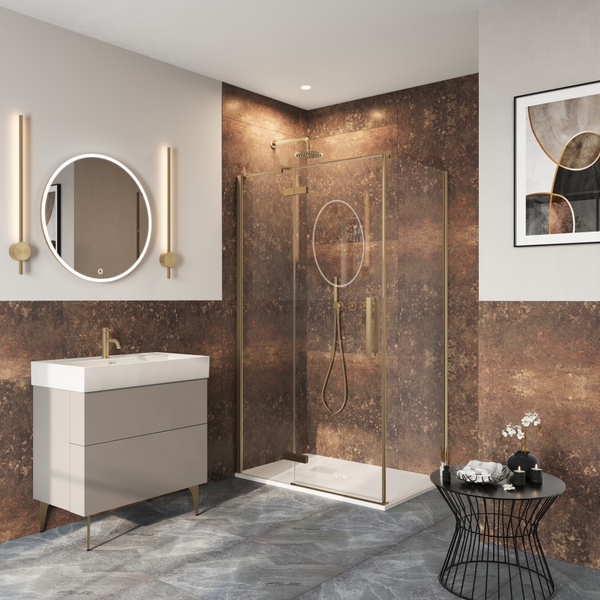
Once you’ve settled on a backlit mirror, the next big call is whether you want a mirror cabinet or a flush mirror. A mirror cabinet is a backlit mirror that doubles as concealed storage; a flush mirror leaves the storage to be handled elsewhere. Both work. They just suit different rooms and different storage strategies.
A mirror cabinet pays its way when storage is tight elsewhere in the bathroom. The cabinet sits behind the mirror surface and hides the daily-use clutter that otherwise crowds the vanity counter: electric toothbrushes, razors, prescription medicines, aftershave, small toiletries. On modern luxury cabinets like the HIB Genesis and Solas ranges, the doors are mirror-finish on both sides, so the whole thing looks like one mirror with no storage tell. Internal LED strips light the contents when the door opens. Soft-close hinges replace the slam of cheaper fittings, and shaver sockets sit inside on the upper shelf.
The trade-off on a cabinet is depth. Surface-mounted cabinets stand 130 to 160mm proud of the wall. A recessed (concealed-fix) cabinet sits flush only when the wall stud takes the depth, typically a 100 to 130mm minimum void. Recessing gets decided at design stage, before plasterboard goes on. Added later, it’s a major rework involving stud reframing. On a stud wall that’s straightforward to plan; on solid masonry it usually rules recessing out altogether. Surface-mounted is the fall-back, and it looks fine when the cabinet has slim edges and good detailing.
A flush mirror is the answer when storage is handled elsewhere: a vanity with proper drawers, a tall storage tower, or a separate dressing area. The wall then benefits from a calmer plane. The mirror sits flat (effectively a few millimetres thick), the wall-feed cable comes through the centre or top, and the rhythm of the wall stays uninterrupted. Flush mirrors also let you go larger. A 1200 by 800mm full-vanity mirror, or a 1500 by 900mm landscape across a double basin, comes across as a single architectural feature in a way no mirror cabinet at the same size can.
The tie-breaker is storage. If your vanity has fewer than three drawers and the bathroom has nowhere else to put things, specify a mirror cabinet. If the vanity has proper drawers and the room has a tall unit, the flush mirror wins. We see more flush mirrors on master ensuites and more cabinets on family and guest bathrooms, simply because the storage demand differs by room type.
05 · The features
Demist pads, motion sensors and the smart features worth paying for
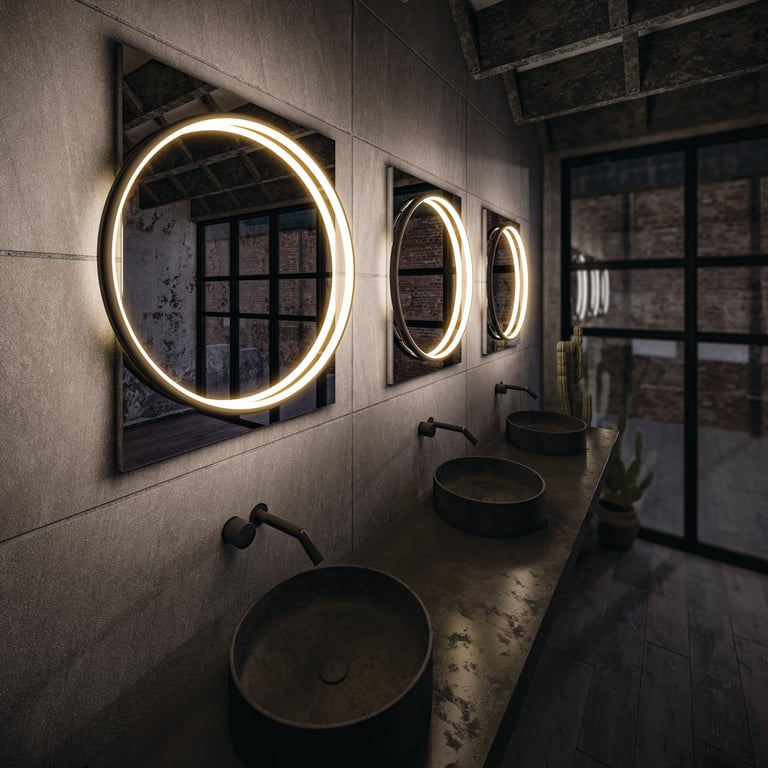
Modern backlit mirrors come with a feature menu that runs from genuinely useful to pure gimmick. Three earn their place on a luxury install: demist pads, motion-sensor activation, and adjustable colour temperature. Bluetooth speakers and built-in clocks are mostly gimmicks. The speakers sound thin, the clocks date the look, and both add cost for very little daily benefit.
The demist pad is the single feature with the highest daily payoff. It warms the mirror surface above the room dew point, so the glass doesn’t fog when the shower runs. On a quality backlit mirror it adds £40 to £80 to the unit cost and switches automatically with the lights. Without a pad, the post-shower mirror takes 5 to 10 minutes to clear in a standard family bathroom, and that’s exactly the moment you most need it. Every HIB Bellus, Alba, Cassini, Genesis and Solas in the higher-spec sizes includes a demister as standard. Cheaper mirrors leave it off, and that’s one of the spec differences separating a £150 mirror from a £500 mirror.
The motion sensor comes into its own on a master ensuite, where one or both users get up at 3am and would rather not fumble for a switch with one eye open. It mounts on the underside of the mirror and triggers the lights at low brightness when it detects movement nearby. Some models step up to full brightness with a hand-wave. Touch sensors look cleaner for everyday use, but they want a dry finger and a known location, and both of those fail at 3am in the dark. Motion-sensor mirrors run roughly £50 to £100 more than touch-only equivalents. Worth it on the room you use most.
The adjustable colour temperature control is the third feature worth specifying, particularly on a couples vanity where one user wants 2700K warm-white shaving light and the other wants 4000K daylight for makeup. The control sits on the mirror surface or on a remote, and it switches between presets. Adjustable models cost £80 to £150 more than fixed-temperature equivalents. One caveat. 4000K and 6500K are useful for specific tasks, but they make the room look like a clinic if you leave them as the default, so somebody has to remember to switch back. On a guest ensuite or family bathroom we’d usually specify fixed 2700K and skip the variable altogether.
Some features look good on the spec sheet and earn their cost less often. Built-in Bluetooth speakers: audio quality is poor, and most bathrooms already have a phone or smart speaker doing the job better. Built-in clocks: gimmicky, and they date quickly. USB-C charging on the mirror itself: rarely used in practice, because charging happens at a vanity drawer or wall socket. Colour-changing RGB LED edges: showroom novelty rather than luxury. When budget is tight, drop these first and keep the demister, the motion sensor and the colour-temperature control.
06 · The shape
Shape choice: round, arch, rectangle and irregular
Mirror shape is the editorial decision in the spec list, and the one most clients want to start with. Rectangle, round, arch and irregular: the four common formats each suit different rooms, different vanities and different design intents. The choice should follow the room rather than lead it.
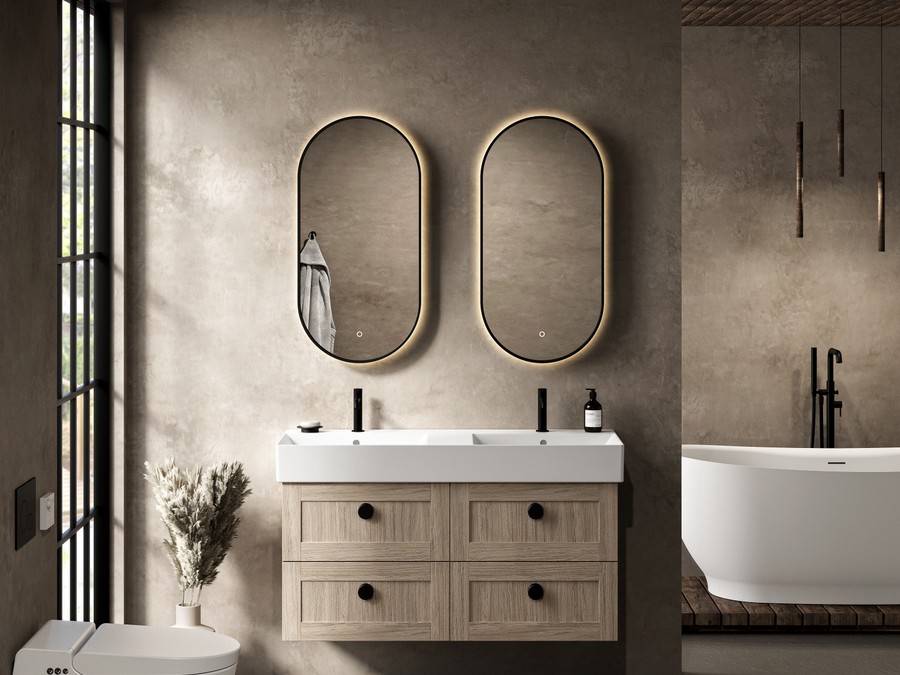
The rectangle is the workhorse, and the format that gives the most reflective surface for a given wall area. Landscape rectangles work over double-basin vanities; portrait rectangles work over a single basin where the wall has the height to carry it. Slim-edge rectangles in the HIB Bellus and Alba families look architectural rather than utilitarian, and the format is the easiest to live with daily, because nothing gets cropped at awkward angles. If you can’t decide on a shape, the rectangle is rarely wrong.
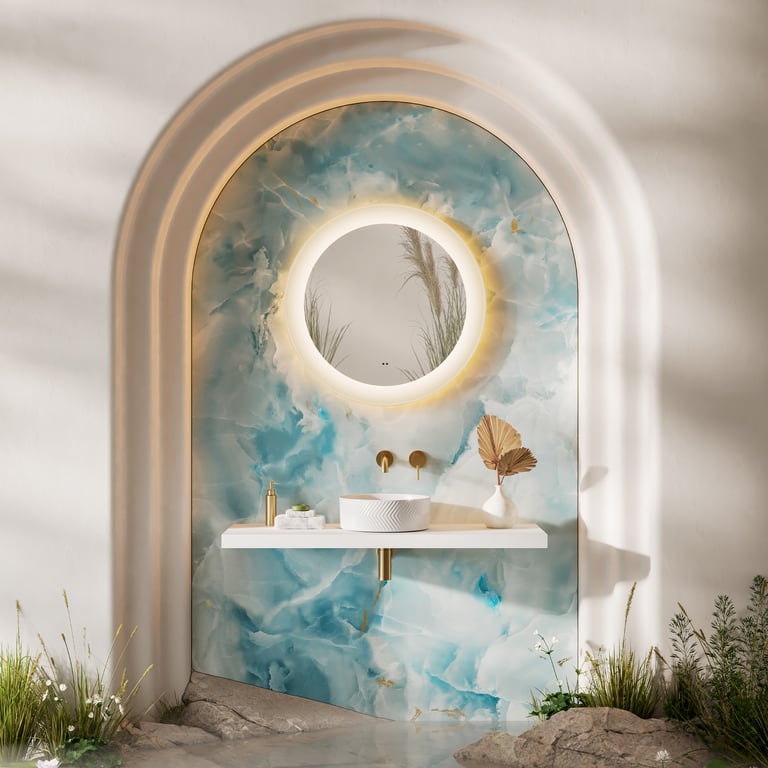
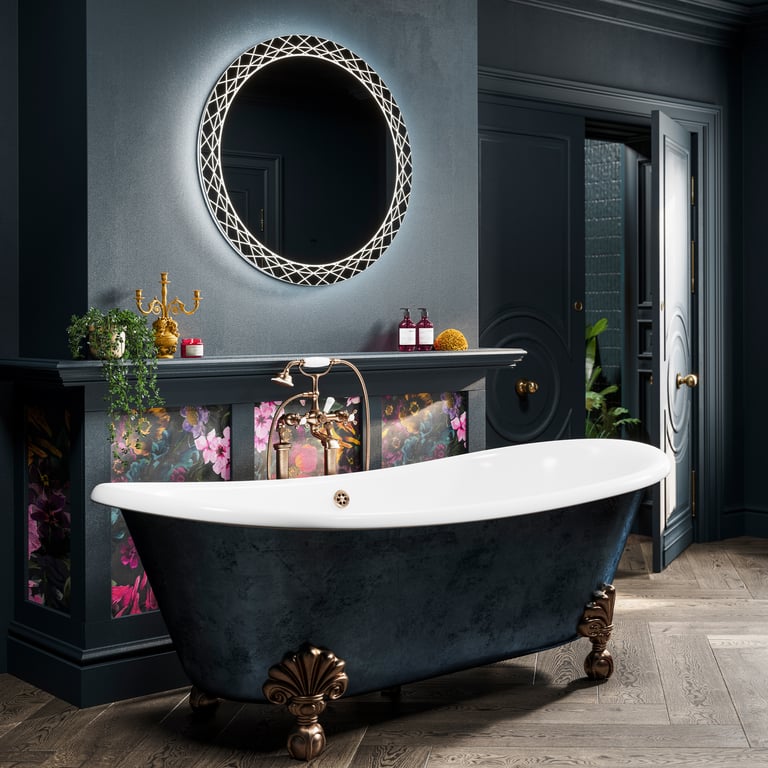
The round mirror has been the dominant editorial trend in UK luxury bathrooms since around 2022 and it feels softer and more decorative than a rectangle. The round form pairs particularly well with rectilinear vanities and stone-clad walls, because the contrast in geometry creates visual interest. The HIB Cassini round backlit family covers diameters from 600 to 800mm with the same edge-LED, IP44 and demister spec as the rectangular ranges. Round mirrors do lose reflective surface area against a rectangle of the same wall footprint. A 700mm round gives less reflective height than a 700mm-tall rectangle of any width, so check where the head reflection lands at standing position before you commit. On a small ensuite, a round can look undersized.
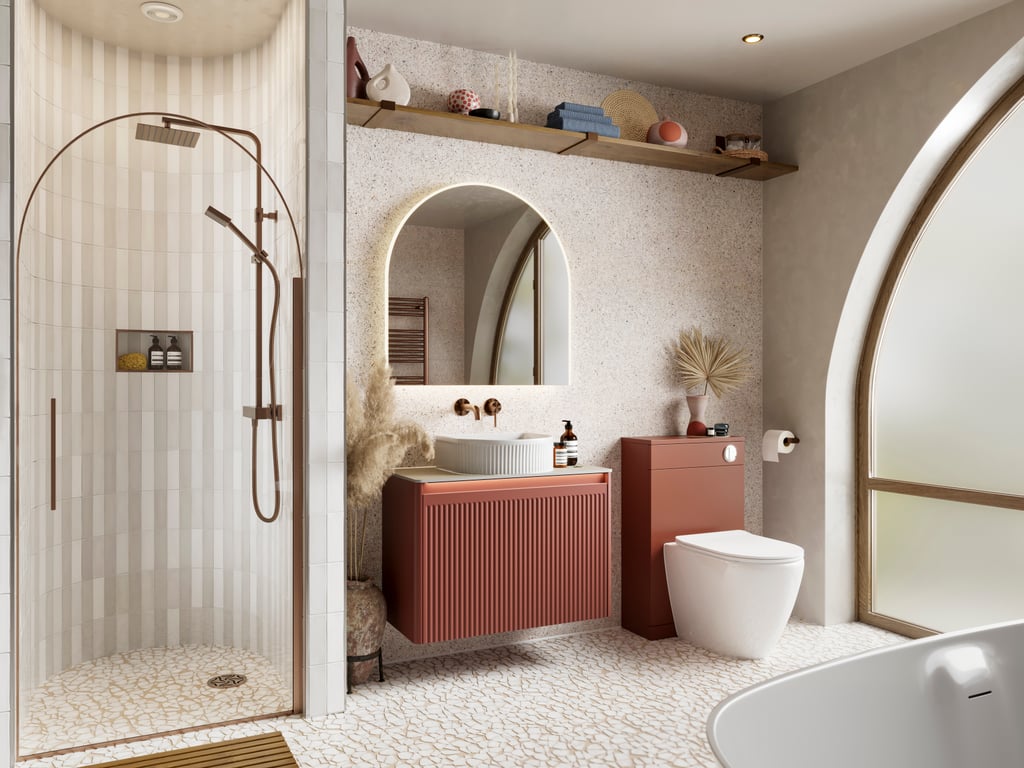
The arch mirror has overtaken the round in editorial coverage through 2025 and 2026: an arched top with straight sides, sometimes called a window-arch or chapel-arch profile. It feels soft the way a round does, but it keeps most of the height and reflective area of a rectangle. It sits especially well in traditional or transitional schemes, whether that’s a Burlington-style heritage suite or a period-property install, where a round can look too modern and a rectangle too plain. The arch usually comes either as a backlit edge-LED format or as flat plain glass in a metal frame, and both work at different price points.
The irregular shape (pebble, organic curve, asymmetric profile) is the editorial flourish for design-led ensuites where the mirror is treated as the room’s art statement. It looks bold and contemporary. It also dates faster than the other shapes, since the irregular trend cycle runs about five years, and it works best when the vanity, brassware and tile all stay calm enough to let the mirror carry the visual weight. Irregular mirrors usually come plain rather than backlit, because LED tooling is harder to apply to a non-standard edge. So a separate task light at the vanity has to do that work. We specify irregular shapes occasionally on master ensuites where the brief calls for a single statement piece, and almost never on family bathrooms.
A couple of secondary considerations apply across all shapes. Mirror frame: a brushed brass, matt black or chrome frame around a plain mirror comes across as decorative rather than functional, and it should match the brassware finish in the rest of the room. Mirror size: most mirrors get the shape right and the size wrong, usually too small, when the mirror should be at least the width of the basin and ideally wider. A 600mm mirror over an 800mm basin looks like a postage stamp and quietly undersells everything below it. Mirror set: a triple-mirror cabinet (centre door plus two side doors) is a useful format on a wider double-basin vanity, giving you storage and a wider reflective surface in one product.
07 · The position
Positioning rules: height, basin and WC relationships
Where the mirror sits on the wall matters as much as which mirror it is. Three rules govern the position: the height above the basin, the width relationship to the basin, and the reflective relationship to the rest of the room.
The height rule: the bottom edge of the mirror should sit roughly 200mm above the highest point of the tap or spout. High enough to clear the tap visually, low enough that the mirror centre falls at average eye height, which is broadly 1550 to 1650mm above finished floor level for a single-user vanity. Too low and the mirror reflects the basin rather than the face. Too high and the head reflection cuts off at uncomfortable points. Most off-the-shelf basin-and-mirror combinations end up too low, because the vanity height gets taken off the spec sheet without anyone checking the tap. So measure the tap and spout in place before you fix the mirror height.
The width rule: the mirror should be at least as wide as the basin and ideally wider, up to the full width of the vanity. A 600mm mirror over an 800mm basin looks undersized and undersells the vanity beneath it. A mirror that runs the full vanity width becomes one architectural feature rather than two products fighting for the same wall. That matters most on a double-basin install, where a single landscape mirror replaces twin smaller ones. Twin mirrors on a double vanity work too, as long as each basin has its own task light and the symmetry is deliberate. The worst result is a single mirror centred on the vanity midpoint that misses both basin centres.
The WC reflective relationship is the rule most often missed and most often regretted. A mirror directly opposite the WC throws it back into the rest of the room every time the door opens or the angle of approach changes. That’s the visual a luxury bathroom is specifically designed to avoid, and the fix is layout-led rather than mirror-led: put the WC on a wall that doesn’t directly face the primary mirror. If the room geometry forces the WC opposite the vanity, use a mirror cabinet with closeable doors, so the visible mirror surface can be put away when the room is shared. A smaller mirror centred above the vanity works too, in place of a wall-spanning one. Mirror placement belongs on the layout drawing alongside the sanitaryware positions, drawn in at design stage rather than at second-fix. We cover the broader layout-mistake set in our guide to bathroom layout mistakes that cost thousands to fix.
Two more rules sit behind those. Window adjacency: a mirror near a window picks up natural light bouncing off the glass, which is a bonus, but it also reflects the window itself when the user stands at the basin. Set the mirror at least 200mm clear of the window edge to avoid that overlap. Door swing: a mirror behind a door swing reflects the door opening, which can look busy in a small bathroom. Where you can, put the mirror on the wall the door doesn’t swing toward.
08 · The shadow
Why your face looks shadowed and how to fix it
The single most common complaint we hear about UK bathroom mirrors has nothing to do with the mirror itself. It’s the racoon-eye effect: deep shadow under the eyes, across the nose and on the chin, which is what makes high-street bathroom mirrors look so unflattering. The cause is almost never the mirror. It’s the ceiling downlight directly above where the user stands. Light falls vertically down the face, and shadows land wherever the bone structure projects forward.
There are two fixes, and both have to be designed in. First, set the ambient downlight grid out from the front of the vanity rather than centred on the room, with the nearest spot 600 to 800mm in front of the vanity wall. Light then reaches the face from a slight downward-and-forward angle instead of straight above. Second, add a dedicated task layer at the mirror itself: a backlit LED edge, or two flanking sconces at eye height, throwing diffuse light forward onto the face from the mirror plane. Together they remove the downward shadow source and light the face from in front.
That’s the reason backlit mirrors exist as a category. A backlit edge produces forward-facing diffuse light at the same height as the face, which is the lighting condition makeup artists, photographers and dressing-table designers have used for a century. The frosted border softens the LED into a wash and the colour temperature at 2700K to 3000K matches skin tones. What you get back is a face that looks rested rather than tired, however the user happens to feel. The Hollywood-mirror dressing-room version uses a row of bare bulbs around the perimeter to do the same job; the modern bathroom version uses a continuous LED edge.
The flanking-sconces alternative is more traditional, and it gives the cleanest face-light when it’s done right. Two wall lights at roughly 1.6m above finished floor (eye height for an average adult), one on each side of the mirror. Both suitable for their electrical zone and exposure to water, with lamps at 2700K to 3000K and CRI 90 or above. The classic dressing-room sconce setup feels period-appropriate in heritage schemes; the backlit mirror feels modern and integrated. Pick one or the other. Mixing them looks overdone.
Layered lighting is the broader topic sitting over all of this, and we cover the four-layer scheme (ambient, task, accent and decorative) in our luxury bathroom lighting design guide. The mirror sits in the task layer. Specifying it correctly is necessary but nowhere near sufficient on its own. The surrounding lighting has to support it, or the face still looks wrong behind a perfect mirror.
09 · Investment
What it costs: realistic 2026 mirror budget
A quality backlit bathroom mirror in 2026 sits between £400 and £1,500, depending on size, format, feature spec, and whether it’s a flush mirror or a mirror cabinet. Below £400, the spec drops under the IP44, demist and CRI 90 thresholds that separate a luxury mirror from a commodity one. Above £1,500 you’re paying for triple-mirror cabinet sets, integrated audio, or imported European specialty pieces. The realistic luxury band sits in the middle.
- Entry luxury (£400 to £700): backlit flush mirror, 600 to 800mm wide, fixed 2700K colour temperature, IP44 rated, integrated demister pad, touch-sensor activation. The HIB Bellus 60 to 80, Alba 60 to 80, and the Cassini 600mm round all sit in this band. It’s where most single-bathroom luxury installs end up.
- Standard luxury (£700 to £1,000): larger backlit flush mirror, 1000 to 1200mm wide, or a compact mirror cabinet with backlit edges. Adjustable colour temperature (2700K, 4000K, 6500K), motion sensor, demister, IP44, plus internal cabinet lighting and a shaver socket if you go for the cabinet. The HIB Genesis and Solas mirror cabinet ranges sit here, as do the larger Bellus and Alba flush mirrors. This is the everyday choice for a master ensuite.
- High luxury (£1,000 to £1,500): large mirror cabinet (1200 to 1500mm with twin or triple doors), backlit edges, internal LED strips, demister, motion sensor, soft-close hinges, integrated charging, premium finish. The Solas triple-door cabinet range and the larger Genesis sizes sit here. Specify this for a principal-suite master vanity where the mirror is the daily-use centrepiece.
- Beyond £1,500: specialty European imports, integrated audio-visual, bespoke shapes, large-format custom mirrors. Worth specifying only when the brief really calls for that feature set, because otherwise the marginal return drops away fast against the standard luxury band.
On top of the mirror itself, the cabling and electrician's labour for a properly-prepared mirror feed runs £120 to £300 within a wider bathroom rewire, with electrical certification and Part P notification where required. A standalone mirror swap on existing cabling is closer to £80 to £150 for fitting only. Recessing a mirror cabinet into a stud wall adds £200 to £400 for the stud reframing and plasterboard rework.
Bowman benchmarks product pricing on the mirrors and mirror cabinets we supply against the major UK online retailers, the same as we do on sanitaryware and brassware. The design service that picks the right mirror for the right room comes alongside the kit rather than on top of it. There’s no margin uplift on the mirror line to fund the design appointment. That’s why the mirror choice can stay a careful spec decision instead of a compromise to keep the sales conversation moving. We cover the broader question of where to spend in our guide on what a luxury bathroom actually costs in the UK.
10 · The decision
How to choose the right mirror for your bathroom
The mirror decision sits inside the broader bathroom-design decision and is best made alongside the vanity, the brassware and the lighting plan rather than as an afterthought at second-fix. The questions to answer in order:
- What’s the room type? A master ensuite gets the highest spec mirror, because the same two people use it most often. Family bathrooms get a hard-wearing mid-spec mirror cabinet, because storage is the priority. Guest ensuites get a smaller flush mirror because daily use is light, and cloakrooms just need the simplest backlit mirror that fits the wall.
- How is storage handled? If the vanity has fewer than three drawers and the bathroom has no tall storage tower, specify a mirror cabinet. If storage is plentiful elsewhere, specify a flush mirror.
- What size suits the wall? Measure the wall, the basin width, and the available wall height between the tap and the ceiling. The mirror should be at least as wide as the basin, ideally wider, with the bottom edge 200mm above the highest tap point. Pick the largest mirror that sits comfortably within those measurements.
- What shape suits the scheme? Rectangle is the workhorse. Round works against rectilinear vanities and stone walls, arch against traditional and transitional schemes, irregular where the brief wants a bold contemporary statement. Match the shape to the scheme rather than to the trend.
- What features earn their place? Always: IP44, demister, 2700K to 3000K colour temperature, CRI 90 or above. On a master ensuite: motion sensor, adjustable colour temperature. Skip the Bluetooth speakers, the RGB LEDs, the built-in clocks and the USB charging on the mirror itself.
- Where does it sit on the wall? 200mm above the tap, centred on the basin or vanity midpoint. Never directly opposite the WC, and at least 200mm clear of any window edge. Draw it on the same drawing as the wall feed and the surrounding lighting plan, before the plasterer arrives.
Most of these decisions interact. The shape you choose changes the size that fits, the cabinet-versus-flush call changes the wall depth you need, the feature list changes the price band, and the position changes the wall-feed cabling. Work through the questions in that order (room type, storage, size, shape, features, position) and you get a coherent spec rather than a run of compromises. Work in the wrong order, falling in love with a shape before checking whether it suits the room, and that’s how mirrors end up retrofitted at the wrong height with the wrong cabling.
Some projects carry complexity: a period property, a small ensuite, an unusual layout, a recessed cabinet on a stud wall, or simply a brief that needs the mirror to look like a designed element rather than a default product. That’s one of the rooms where a designer earns the fee. We cover when a designer makes sense in our honest guide on whether a bathroom designer is worth it, and the wider sequence of pre-design decisions in our 14-step luxury bathroom planning checklist. And for the ensuite case in particular, our ensuite bathroom ideas guide shows thirteen of them built.
Frequently asked questions
The questions UK homeowners ask before signing off the mirror line on a luxury bathroom spec sheet.
What's next
Want the right mirror specified for your own bathroom?
The mirror is the small line on the spec sheet that does the most for how the room feels day to day. Get the IP rating, the colour temperature, the shape, the size and the position right at design stage and you have a mirror that quietly carries the room instead of one that quietly undermines it. We carry the full HIB range across both showrooms, and we benchmark the pricing against the major UK online retailers. So the design service that picks the right mirror for your room comes alongside the product price rather than on top of it.
We’ll take the first appointment at our Braintree showroom on the Springwood Industrial Estate, or at our Leigh-on-Sea showroom if that’s closer. You can put the colour temperatures side by side, judge the diffuser quality in person rather than from product photography, and take the measurements home with you. Bring your bathroom dimensions, photos of the wall plane, and any reference images for the look you have in mind.