
Best Tiles for Small Bathrooms UK Design Guide 2026
Large-format, light-toned porcelain tiles laid in a simple grid or vertical stack with matching grout will usually make a small bathroom feel bigger, calmer and more premium. The most successful small UK bathrooms prioritise fewer grout lines, visual continuity, controlled contrast, one feature surface only and proportion over pattern.
Small bathrooms feel cramped when there is too much visual interruption — not necessarily when tiles are too large.
In the UK, many ensuites measure under 2.5m². In rooms of this scale, proportion and visual continuity matter more than decorative complexity.
This guide covers tile size, colour, layout, grout strategy and the most common mistakes to avoid when tiling compact bathrooms.
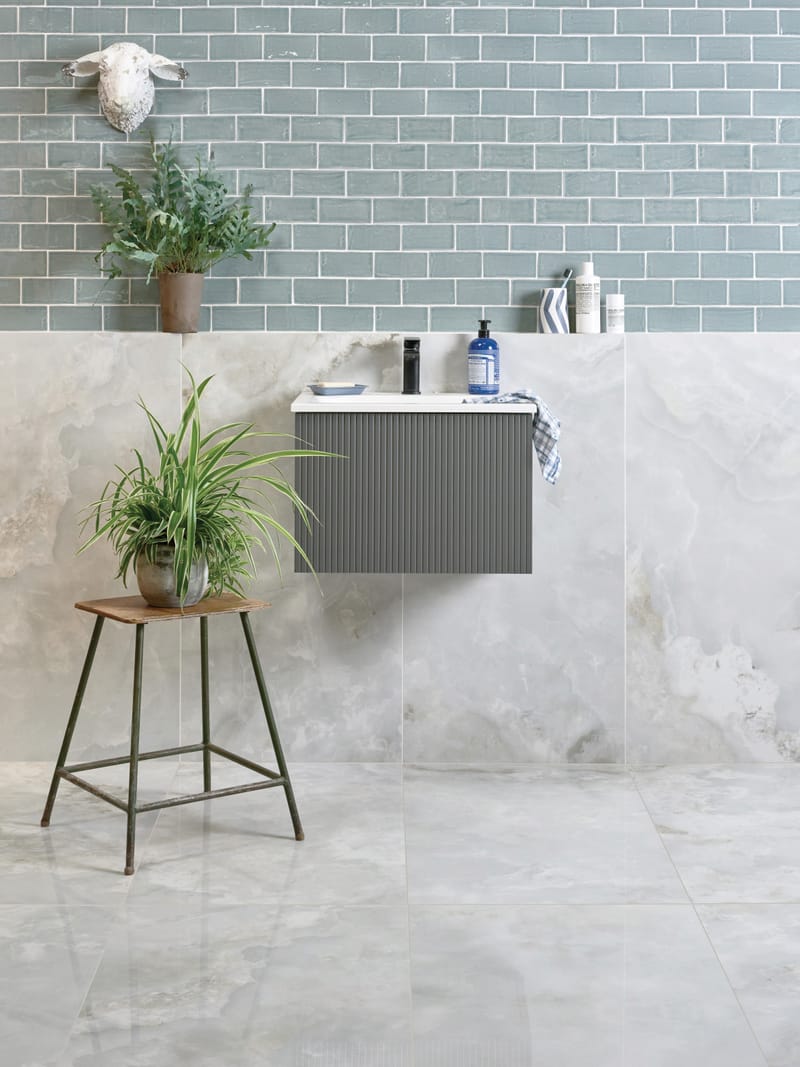
Quick Navigation
Does Tile Size Matter?
Yes. Tile size directly influences how spacious a room feels. In most UK ensuites and compact bathrooms, larger tiles (600×600mm or 600×1200mm) create a more seamless surface and reduce visual clutter.
Large Tiles in Small Bathrooms
Advantages
- ✓ Fewer grout joints
- ✓ Cleaner sightlines
- ✓ More contemporary feel
- ✓ Often lower labour time than intricate patterns
Considerations
- ● Walls must be flat
- ● Extremely narrow rooms may create awkward edge cuts
Small Tiles: Strategic Use
Small tiles are not inherently wrong — but they must be used intentionally. Small-format tiles work best when:
- ✓ Restricted to one feature wall
- ✓ Installed vertically to add height
- ✓ Paired with subtle, matching grout
Avoid covering every surface in small tiles unless the design intentionally embraces texture.
Designer’s rule: The fewer grout lines your eye sees, the larger the space feels.
Large vs Small Tiles: Practical Comparison
| Factor | Large Tiles | Small Tiles |
|---|---|---|
| Visual Clutter | Low | Higher |
| Grout Lines | Fewer | More |
| Installation Speed | Often faster | Slower |
| Best Use | Walls & floors | Feature areas |
| Risk in Small Rooms | Edge cuts | Visual busyness |
| Cost Impact | Often neutral or slightly lower labour | Higher labour due to more grout lines |
| Maintenance | Easier to clean (less grout) | More grout maintenance |
| Perceived Ceiling Height | Neutral | Can feel busier if overused |
Best Floor Tiles for Small Bathrooms
Floor tiles influence how wide a space feels. The right format and layout can visually stretch a compact room.
Recommended Approaches
- ✓ Large-format porcelain in straight grid
- ✓ Diagonal grid in square rooms to subtly widen perception
- ✓ Subtle stone-effect finishes with minimal pattern
Avoid busy encaustic patterns unless the room proportions are balanced.
In UK wetrooms, always check slip ratings. For bathroom floors, R9 or R10 slip resistance is typically recommended depending on usage and water exposure.
For layout comparisons, see Bathroom tile layout ideas.
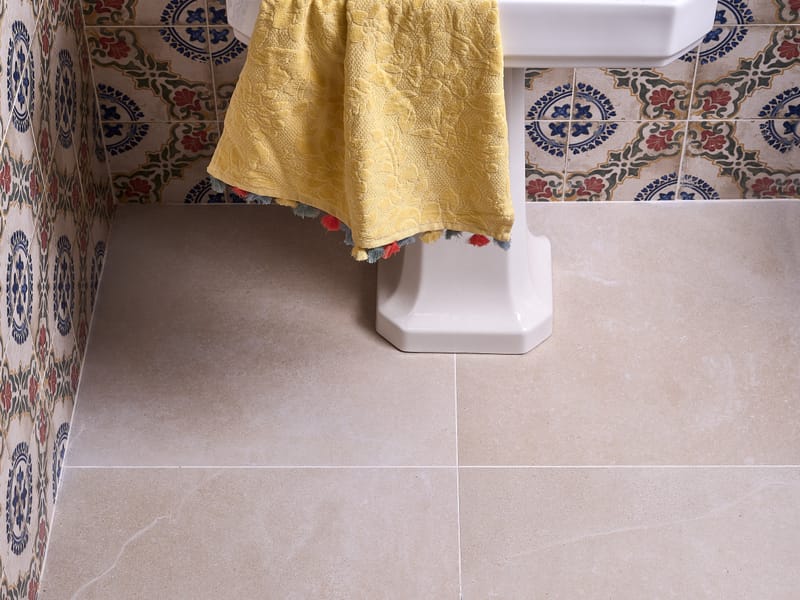
Best Wall Tiles for Small Bathrooms
Wall layout has the strongest impact on perceived height. How tiles are oriented matters as much as their size.
Vertical Stack Layouts
Vertical stacking draws the eye upward and increases perceived ceiling height. This is one of the most effective techniques for compact bathrooms.
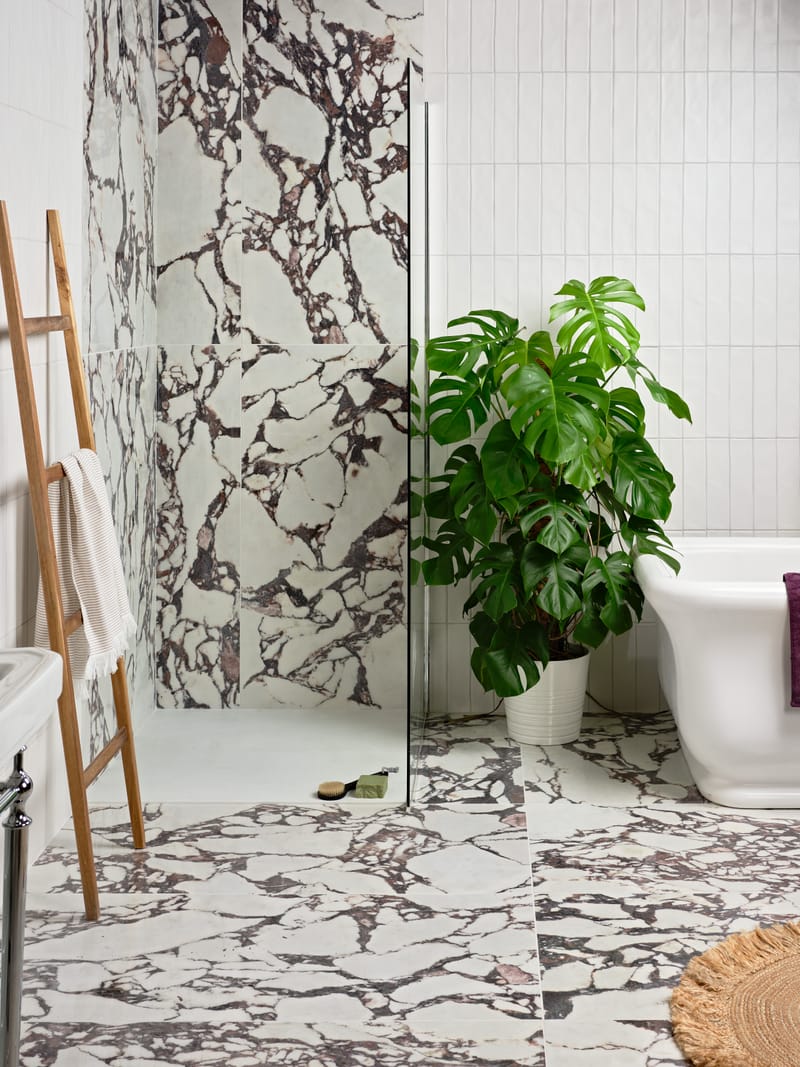
Full-Height Tiling
Full-height tiling often feels more cohesive and less visually segmented in compact bathrooms. It eliminates the horizontal break where tile meets paint, which can visually compress the space.
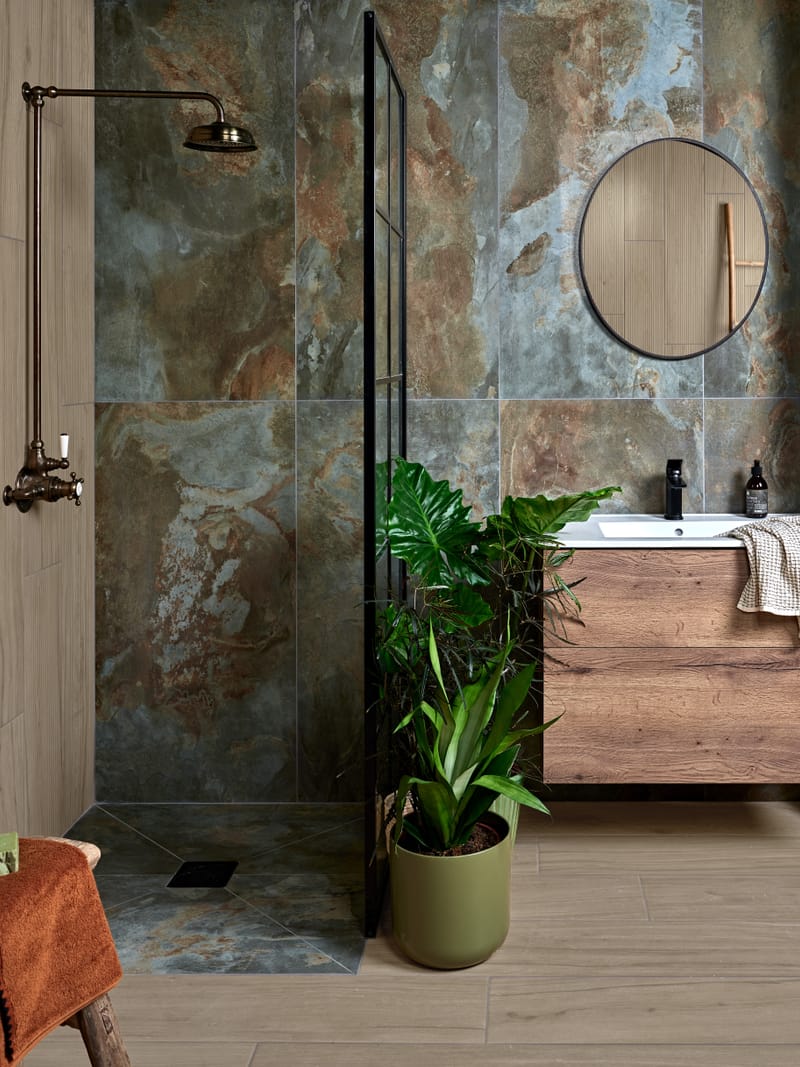
Horizontal layouts can widen narrow rooms visually, but in very small bathrooms they sometimes emphasise limited wall height. Use horizontal stacking carefully in low-ceiling spaces.
Using Herringbone in Small Bathrooms
Herringbone can work in compact spaces when:
- ✓ Limited to one surface
- ✓ Installed with matching grout
- ✓ Balanced with calmer surrounding tiles
For pattern comparison, see Herringbone vs chevron tiles.
What Colour Tiles Make a Small Bathroom Look Bigger?
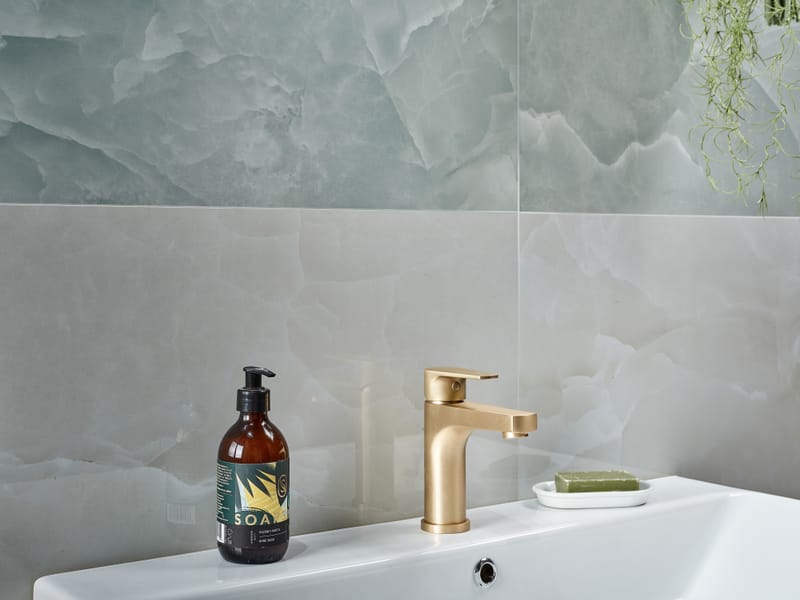
Colour affects light reflection and perceived scale. Lighter shades bounce more light around compact spaces.
Recommended Palette
Tone-on-tone schemes — where wall and floor tiles sit within the same colour family — tend to elongate visual flow and make compact bathrooms feel more unified.
Quick rule: Keep tonal contrast subtle to maintain flow. Sharp colour contrast between floors and walls can visually shorten compact rooms.
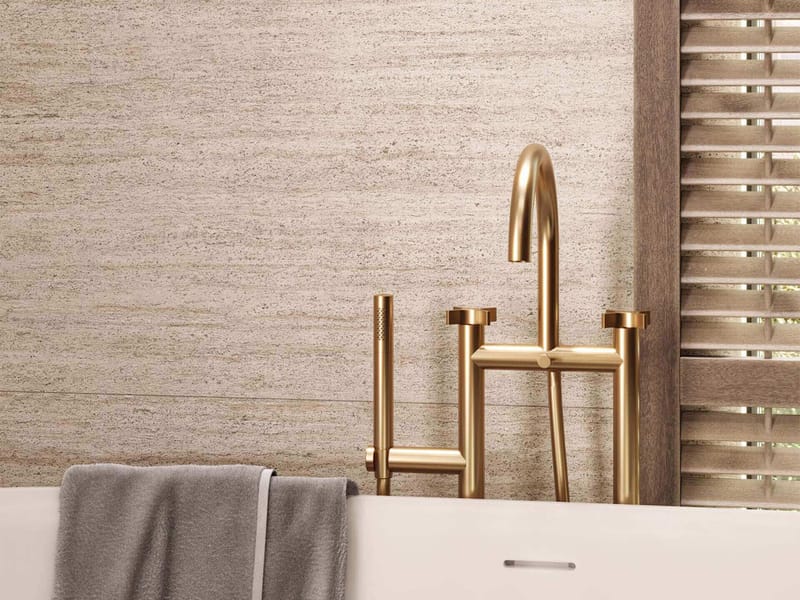
Gloss vs Matte Tiles in Small Bathrooms
Gloss Wall Tiles
- ✓ Reflect light
- ✓ Improve brightness in darker rooms
- ✓ Enhance openness perception
Matte Floor Tiles
- ✓ Provide slip resistance
- ✓ Hide water spotting better
- ✓ Offer softer visual texture
A gloss wall + matte floor combination often works best in compact spaces — maximising light reflection where it matters most while maintaining grip underfoot.
Grout Strategy for Small Bathrooms
Does Grout Colour Matter?
Yes — dramatically. Grout colour affects how visible each tile joint is, which directly impacts the perceived busyness of a room.
Matching Grout
- ✓ Blends tiles together
- ✓ Minimises grid visibility
- ✓ Makes walls feel less busy
Contrasting Grout
- ● Highlights pattern
- ● Adds visual rhythm
- ● Can shrink perceived scale
In most small bathrooms, matching grout creates a calmer environment and should be the default choice.
Common Small Bathroom Tiling Mistakes
Avoid
- × Using multiple strong patterns
- × High-contrast grout in compact spaces
- × Tiny mosaics across every surface
- × Dark heavy floors paired with bright upper walls
- × Complicated layouts in irregular rooms
- × Too many material transitions (tile to paint to panel to tile)
- × Dark ceilings without strong lighting to compensate
Follow Instead
- ✓ One feature surface maximum
- ✓ Matching grout as default
- ✓ Large-format tiles for most surfaces
- ✓ Tone-on-tone floor and wall palette
- ✓ Minimal material transitions
- ✓ Full-height tiling for cohesion
- ✓ Simple grid or vertical stack layout
Core principle: Simplicity scales better than complexity in small spaces. Each visual break compresses the room.
Cost Considerations (UK Context)
Tile selection influences both labour and waste. In small UK bathrooms, patterned layouts such as herringbone or diagonal grids can increase labour costs by 20–40% compared to a simple straight grid.
Waste percentages also rise in compact rooms due to tighter cuts — typically 10–15% for straight grids and up to 20%+ for patterned layouts.
Large Tiles
- ✓ May reduce labour time
- ● Require flatter surfaces
Complex Layouts
- ● Increase labour time
- ● Increase waste percentage
- ● Raise overall installation cost
For detailed breakdowns, see: Bathroom tiling cost guide UK • Tile waste percentage guide
When to Break the Rules
Design is not rigid. There are scenarios where darker tones or patterned tiles can work beautifully in small bathrooms — particularly when strong lighting, symmetry and proportion are controlled carefully.
If the architecture is clean and the layout balanced, a bold decorative tile used selectively can anchor the space without shrinking it visually.
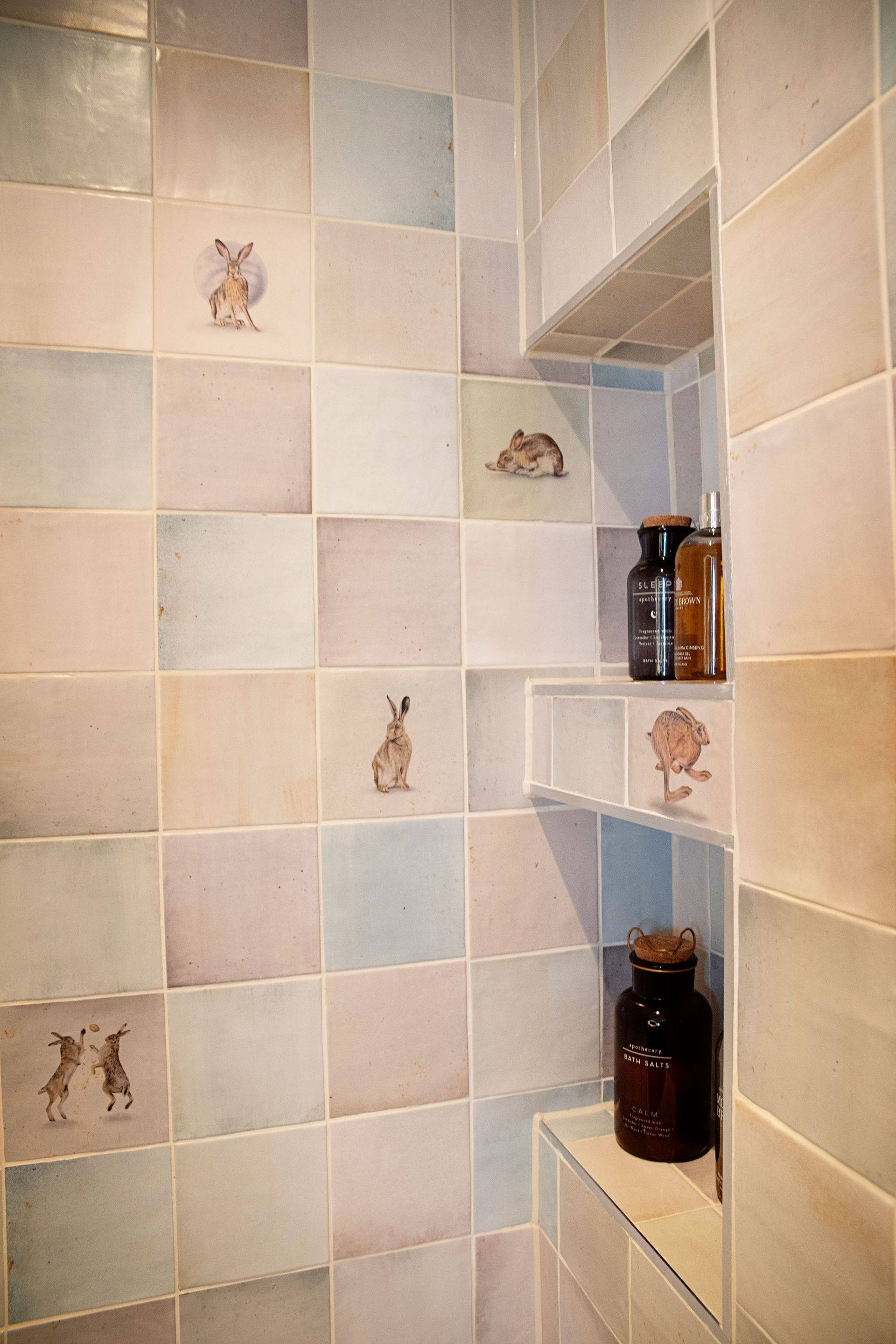
In our Coggeshall CO6 country cottage bathroom, Ca' Pietra Wiltshire Hares feature tiles were used within shower niches as a decorative accent, proving that pattern and character can work in compact spaces when applied with restraint.
Decision Framework
| Bathroom Type | Recommended Tile Strategy |
|---|---|
| Small Ensuite | Large-format + matching grout |
| Narrow Room | Vertical stack walls |
| Square Box Room | Diagonal floor grid |
| Low Ceiling | Vertical wall layout |
| Compact Wetroom | Calm grid floor + one feature wall |
Related Guides You May Find Useful
Tile Layout Ideas Guide
Complete UK guide to 10 bathroom tile layout patterns with waste, cost and spatial impact.
Herringbone vs Chevron Tiles
Compare herringbone and chevron patterns: tile shape, visual line, waste and cost.
Herringbone Tiles Guide
Detailed herringbone installation guide covering orientation, tile size and waste calculations.
Bathroom Tiling Cost Guide
UK pricing breakdown for bathroom tiling by layout type, tile size and labour.
Tile Quantities & Waste Guide
How to calculate exact tile quantities and waste allowances for every layout type.
What Is Bathroom Tanking?
Essential waterproofing knowledge for any tiled bathroom or wetroom.
Frequently Asked Questions
Common questions about choosing tiles for small bathrooms
Have a question we haven’t covered? Get in touch — we’re happy to help.
Planning a Renovation?
Small bathrooms reward proportion, restraint and consistency. The right tile size, layout and grout strategy can significantly influence how spacious and refined the room feels.
Our design consultations explore these decisions in detail — tailored to your space.